Find us at booth #83, join us for a harbor side happy hour, or catch Gorish’s talk.

Sept, 16-18 > Learn more

%20(1).avif)
Mamta Tainwala

February 3, 2026
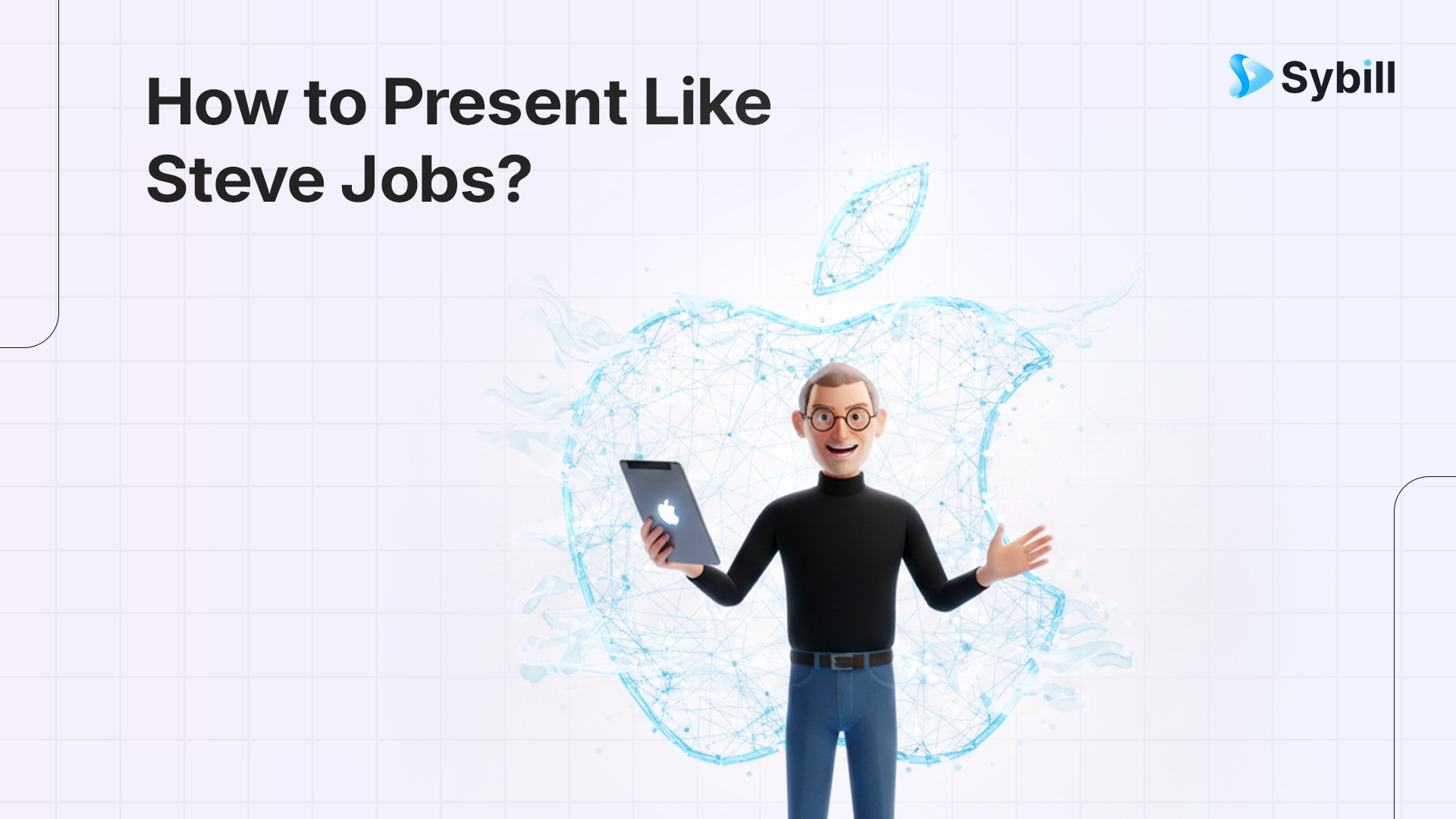
Steve Jobs didn't just launch products; he created moments people remembered for years. His 2007 iPhone presentation wasn't a feature dump. It was a masterclass in building anticipation, simplifying complexity, and making people feel something. For sales reps drowning in feature-heavy slides and prospects checking their phones mid-demo, Jobs' techniques offer a lifeline: the rule of three, strategic pauses, storytelling that connects emotionally, and demos that wow instead of confuse. This guide breaks down 11 actionable presentation techniques from Jobs' iconic launches and shows you exactly how to adapt them for virtual sales calls, discovery meetings, and product demos. You'll learn how to structure presentations that hold attention, handle objections like a pro, and close with CTAs that actually work.
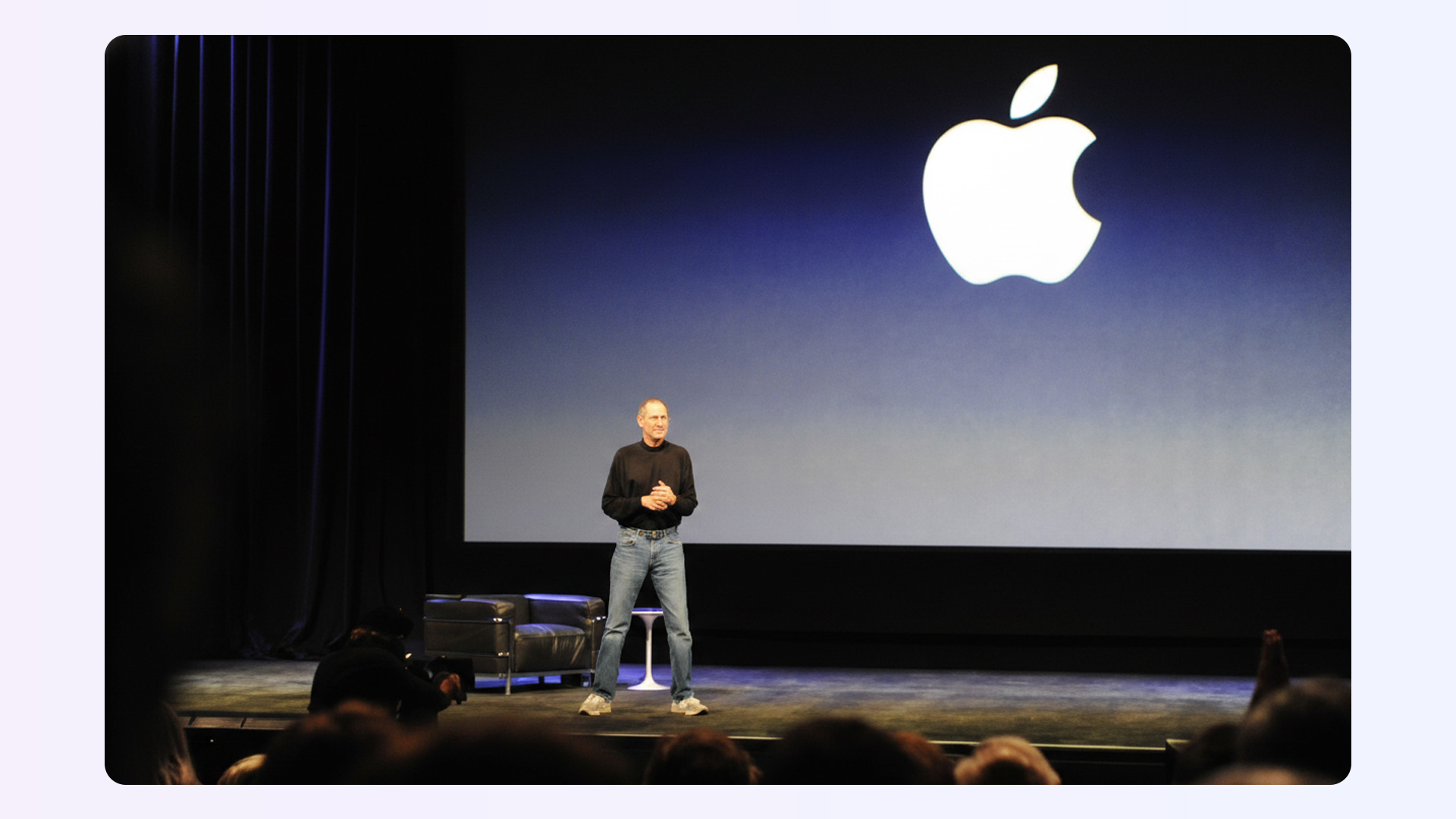
January 9, 2007. Steve Jobs walked onto the Macworld stage wearing his signature black turtleneck and jeans. He paused. The crowd waited. Sixty seconds of deliberate, uncomfortable silence before he said the words that would become legendary: "This is a day I've been looking forward to for two and a half years."
That pause wasn't accidental. It was strategic theater.
Most sales reps do the opposite. They fill every millisecond of airtime with words, terrified that silence means disengagement. They barrel through slide decks at highway speed, praying their prospect doesn't zone out or worse, open Slack in another tab.
Steve Jobs understood something most sales reps miss: great presentations aren't about conveying information. They're about creating an experience so compelling that people want to pay attention. He wasn't just selling devices. He was selling a feeling, a vision, a story that people wanted to be part of.
The good news? You don't need a billion-dollar product launch budget to present like Steve Jobs. You just need to understand the specific techniques he used and how to adapt them for virtual sales calls, product demos, and discovery meetings.
Jobs wasn't working with inherent advantages. The first iPhone had no App Store, couldn't record video, and didn't have 3G. He had to make people see the future instead of fixating on current limitations. Sound familiar? Every sales rep faces skeptical prospects who focus on what's missing rather than what's possible.
Here's what Jobs figured out that most sales presentations miss:
People don't buy features. They buy the feeling of transformation. Jobs never listed specs. He painted pictures of how life would improve. When he introduced the iPhone, he didn't say "3.5-inch multi-touch display with 480x320 resolution." He said, "You can actually see the web on your phone."
Attention is earned in the first 30 seconds. Jobs' openings were legendary because he understood that modern audiences decide whether to tune in or tune out almost instantly. Your prospects make the same call within moments of your demo starting.
Simplicity beats comprehensiveness. The 2007 iPhone presentation was about 80 minutes long. Jobs spent most of that time on just three things: the iPod, the phone, and the internet communicator. Most sales reps try to cram 47 features into 30 minutes.
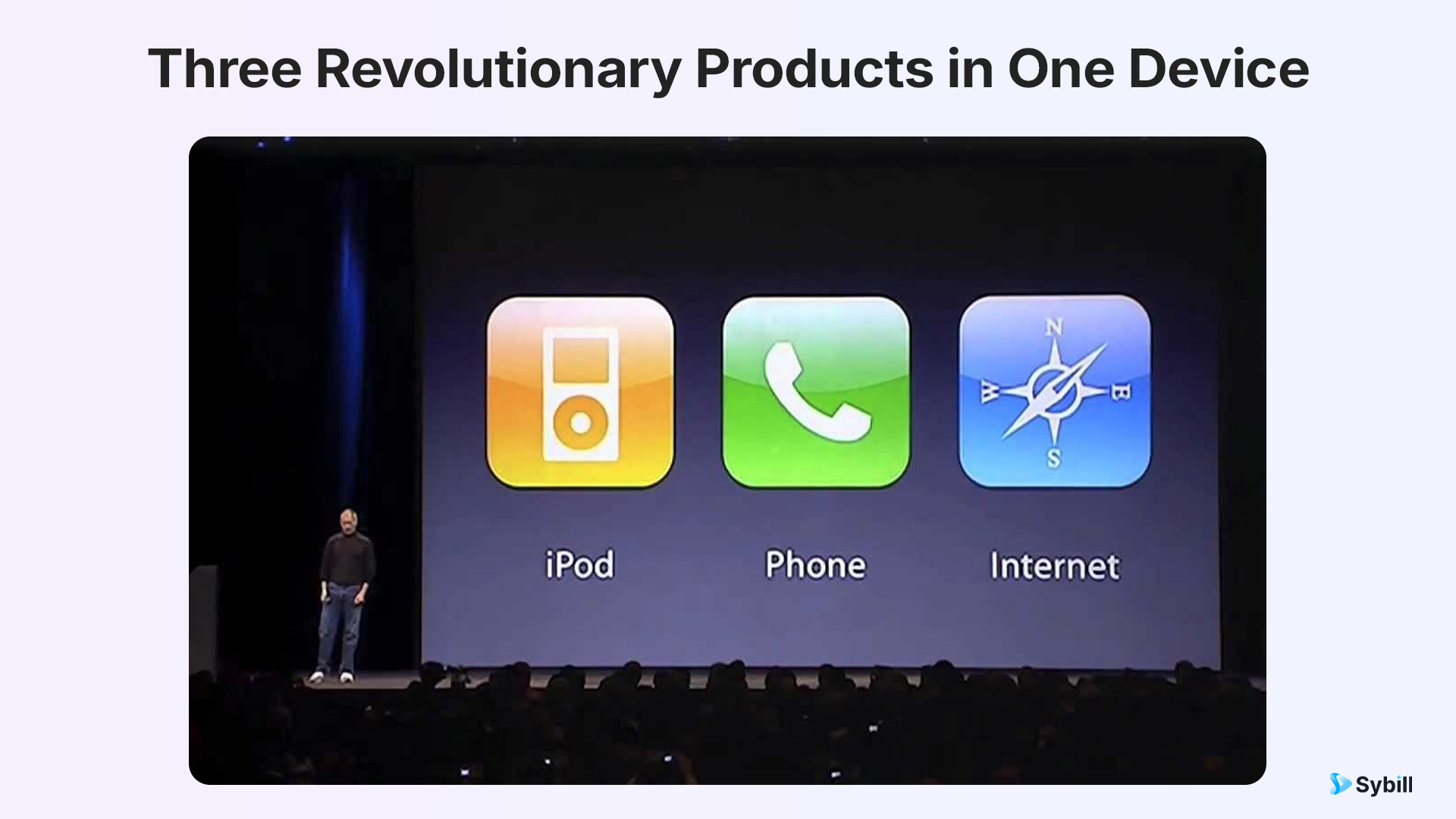
"Today, we're introducing three revolutionary products," Jobs announced in 2007. "The first one is a widescreen iPod with touch controls. The second is a revolutionary mobile phone. And the third is a breakthrough internet communications device."
The crowd went wild. Then Jobs delivered the punchline: "An iPod, a phone, an internet communicator... These are not three separate devices. This is one device. And we are calling it iPhone."
Why it worked: The human brain struggles to process more than three or four items simultaneously. Jobs knew this. He structured every presentation around three main points.
How to use it in sales calls:
Stop leading with your entire feature set. Your prospects don't need to know everything your product does. They need to know the three things that will solve their biggest problems.
For example, if you're demoing Sybill's conversation intelligence platform to a sales manager, don't showcase every feature. Focus on three outcomes:
The tactical move: When building your demo deck, create three section headers. If you can't fit a feature under one of those three headers, cut it or save it for the follow-up call.
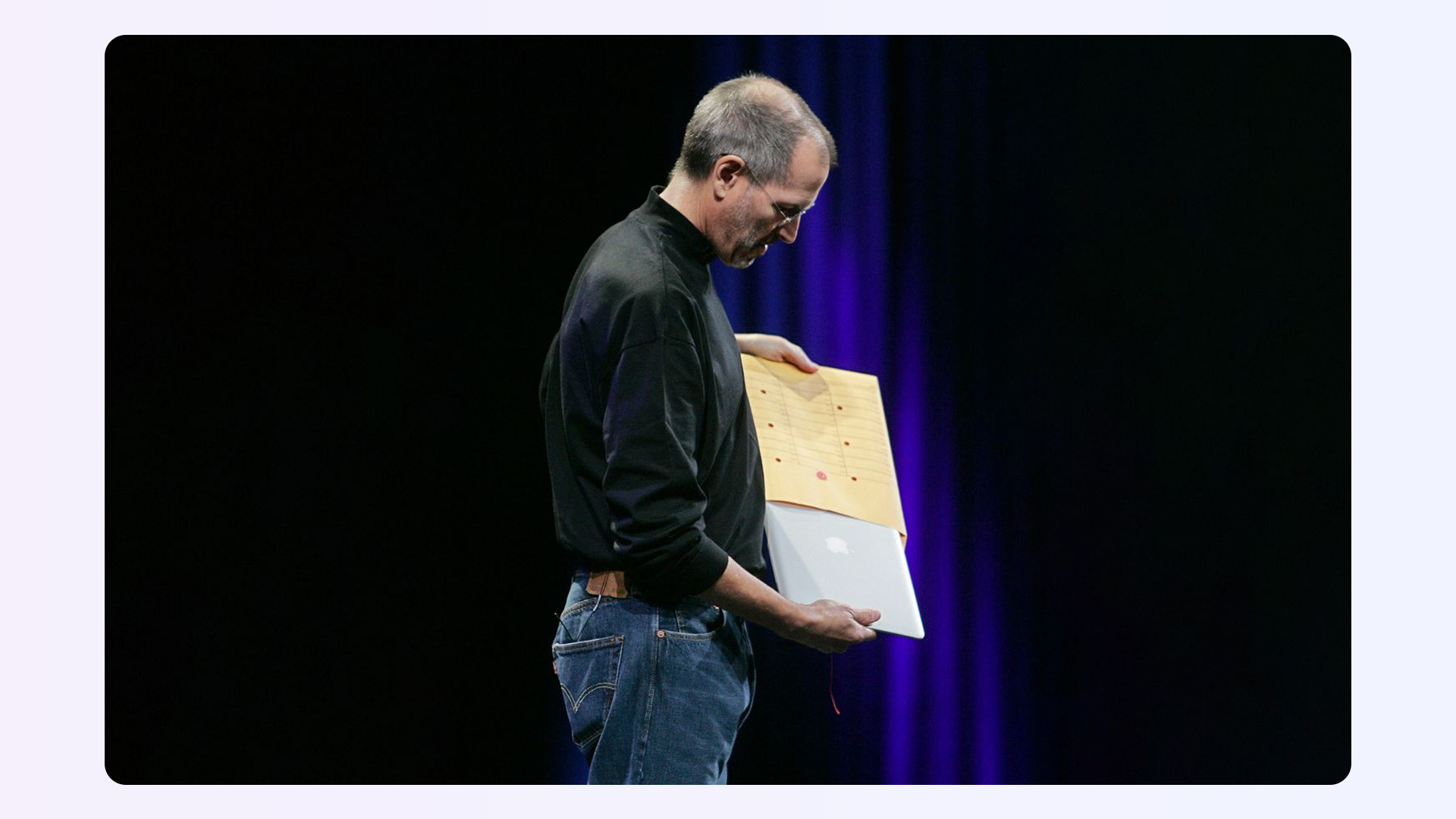
Jobs never opened with product specifications. He opened with the problem.
Before unveiling the MacBook Air in 2008, he talked about how laptops had gotten bulky and heavy. He pulled out a manila envelope and asked, "What would the world's thinnest notebook look like?" Then he pulled the MacBook Air out of the envelope.
Why it worked: Starting with the problem creates immediate relevance. Your brain perks up when someone describes your exact frustration.
How to use it in sales calls:
Open by articulating the prospect's pain in vivid detail. Make them nod before you show them anything.
Bad opening: "Thanks for joining today. I'm excited to show you our platform's capabilities."
Good opening: "You mentioned your team is spending 3-4 hours per week updating Salesforce, and you're not seeing enough pipeline activity to justify that time investment. That disconnect between doing admin work instead of actually selling is exactly what we're going to solve today. Sound right?"
The tactical move: Write out your prospect's three biggest pain points from discovery notes verbatim. Use their exact language in your opening. This is where tools that automatically capture conversation insights become invaluable.
Jobs deployed pauses like a weapon throughout his talks. After building up the iPhone reveal, he paused. Let the anticipation build. Made people want to hear what came next.
Most sales reps fill every gap with "um," "uh," "so basically," or nervous rambling.
Why it worked: Pauses create space for important information to land. They signal, "What I just said matters; take a second to absorb it."
How to use it in sales calls:
After you make a major point, stop talking. Count to three in your head.
Example:
The pauses gave your prospect time to imagine a world without manual data entry.
The tactical move: Mark your demo script with [PAUSE] reminders after key points. Practice pausing for 2-3 seconds when you transition between major sections.
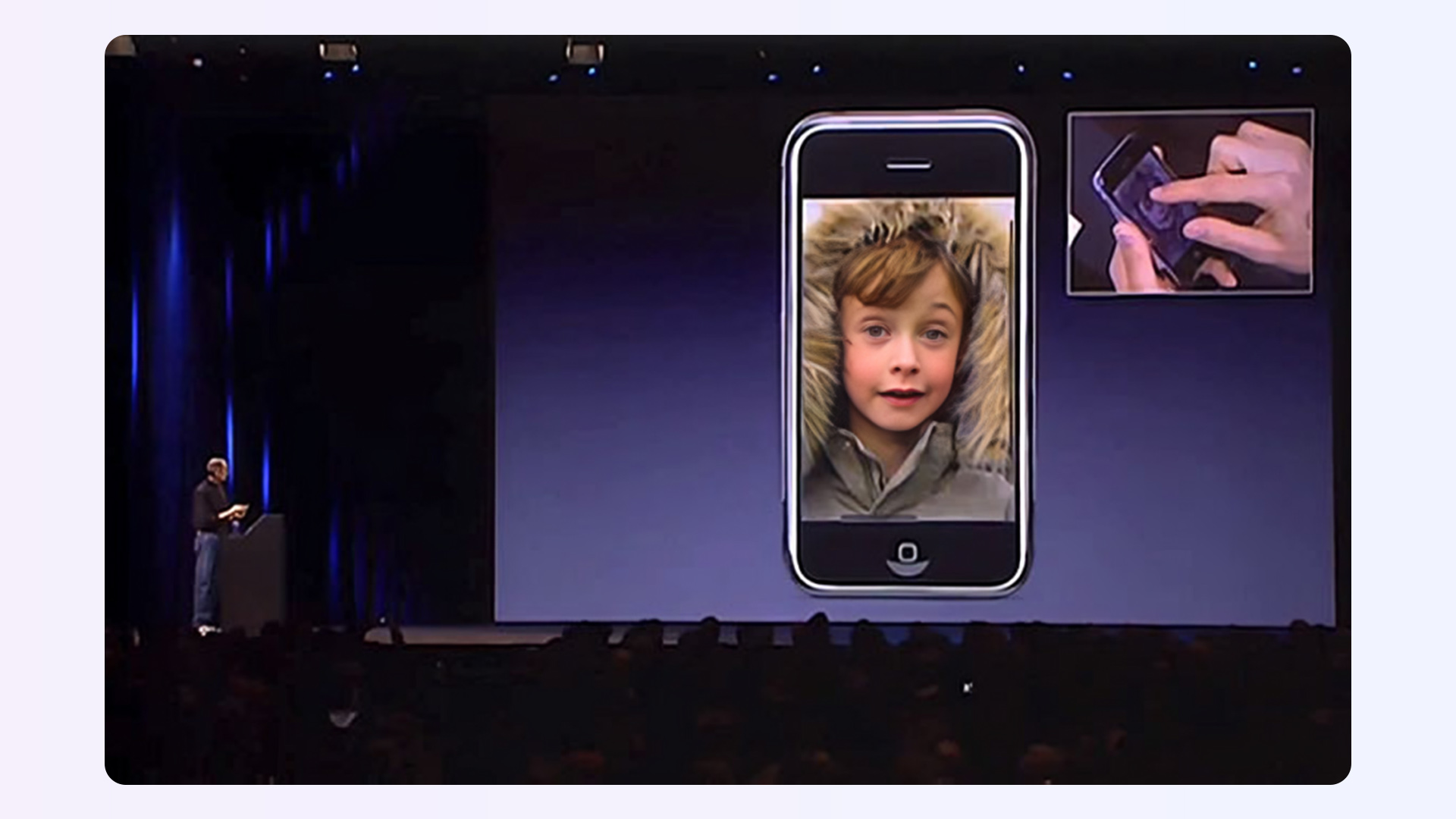
Jobs never just listed what a product did. He showed what it enabled.
When introducing pinch-to-zoom on the iPhone, he didn't explain the technical implementation. He pulled up a photo of the Golden Gate Bridge and zoomed in on a single car. The crowd gasped.
Why it worked: Features are abstract. Outcomes are tangible. Nobody cares about multi-touch gestures. They care about seeing photos clearly.
How to use it in sales calls:
Stop explaining how features work. Show what prospects can do with those features.
Bad demo: "This is our AI coaching feature. It analyzes call transcripts using natural language processing and sentiment analysis..."
Good demo: "Here's a call your rep Sarah did yesterday. Sybill flagged the exact moment where the prospect got confused. See that? Sarah started diving into technical specs, and the prospect's engagement dropped. Now here's the coaching suggestion: 'When prospects ask about implementation, start with timeline and team impact before technical details.' Sarah can apply that to her very next call."
The tactical move: For every feature in your demo, ask yourself: "What does the prospect experience with this?" Demo that experience. Most sales presentation training focuses on polish, but the real unlock is shifting from feature explanation to outcome demonstration.
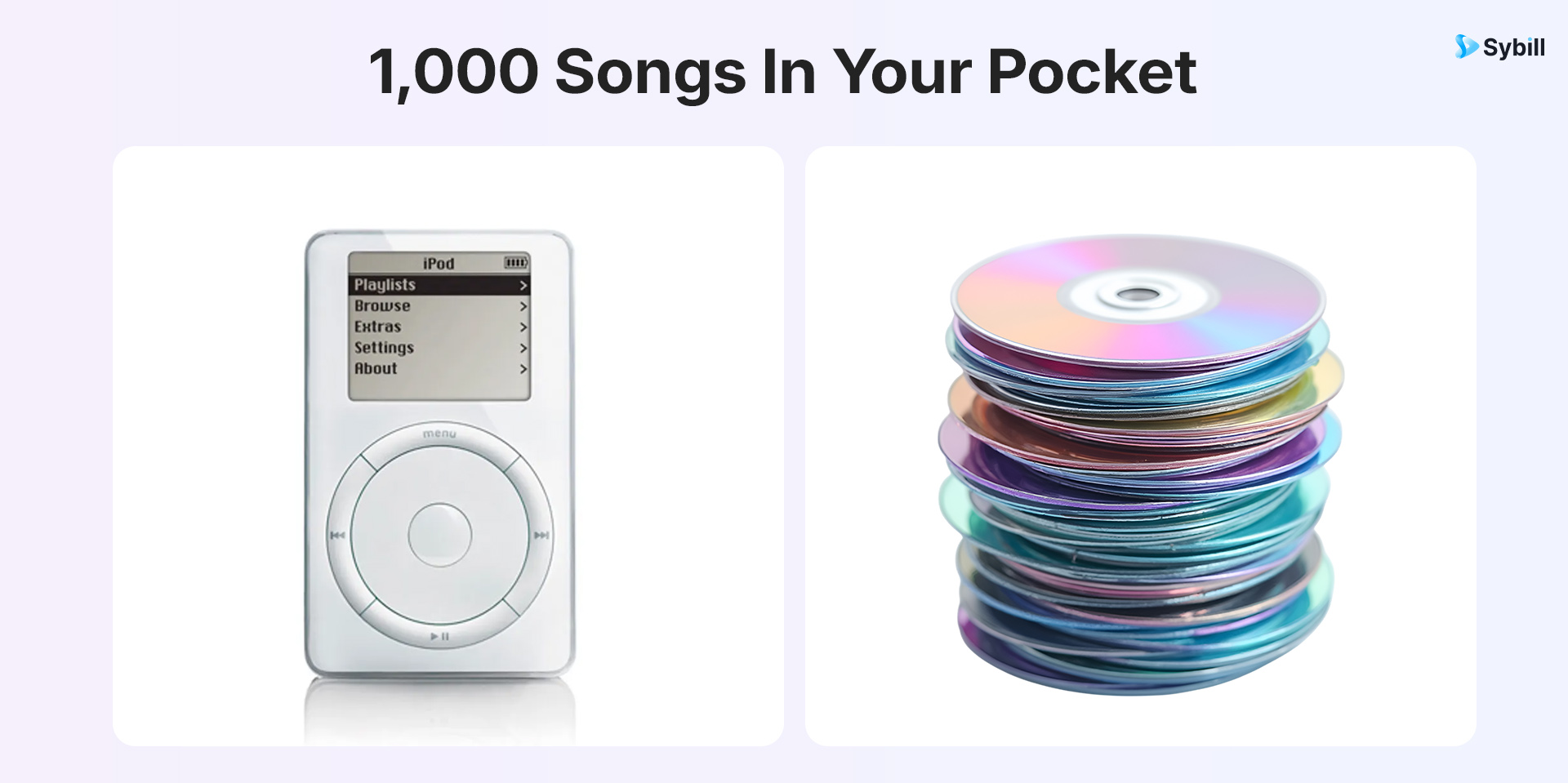
Jobs loved making abstract concepts concrete through specific numbers and unexpected comparisons.
"A thousand songs in your pocket" sold more iPods than any technical spec about storage capacity.
When introducing the iPhone's battery life, he didn't say "8 hours of talk time." He said, "That's enough to talk from San Francisco to New York and back again."
Why it worked: Specific numbers are memorable. Unexpected comparisons create anchors.
How to use it in sales calls:
Replace vague benefits with specific, surprising numbers.
Vague: "Our platform saves your team a lot of time."
Specific: "Sales reps using Sybill spend 90% less time on CRM updates. That's about 3 hours per week back. For a team of 20 reps, that's 60 hours per week. That's more than a full-time employee's worth of selling time you just got back."
Another example for call recording accuracy:
"Sybill captures 99% of what's said, even with accents and background noise. Compare that to taking manual notes where reps typically miss 60-70% of important details while trying to talk and type simultaneously."
The tactical move: For your top value propositions, find the specific numbers. Then create unexpected comparisons. "That's like adding two full-time SDRs to your team" lands harder than "significant productivity improvement."
Jobs was a master storyteller. Before introducing the iPhone, he told the story of carrying three devices (an iPod, a phone, and a Blackberry) and how absurd that felt. The audience connected because they'd lived that frustration.
Why it worked: Stories activate different parts of the brain than facts. When you hear a story, you mentally simulate the experience. Stories create emotional resonance. Specs create cognitive burden.
How to use it in sales calls:
Weave customer stories throughout your demo. Not testimonials. Actual narratives with tension and resolution.
Spec-based: "Our conversation intelligence platform transcribes calls and generates summaries."
Story-based: "Last month, a sales director at a Series B SaaS company told me her team was doing 200+ discovery calls per month, but she had no idea which reps were actually uncovering pain. She tried listening to recordings and gave up after the third 45-minute call. Then she started using Sybill. First thing she discovered? Her top performer was asking follow-up questions at 3x the rate of everyone else. Within two weeks, she'd turned that into a coaching moment for the whole team. Pipeline quality is up 40%."
The tactical move: Collect 3-5 customer stories that map to your three core value propositions. Sales coaching programs that actually work focus on this narrative skill because it separates reps who inform from reps who persuade.
Every Jobs presentation had a jaw-dropping reveal. The iPhone presentation's "three devices" fake-out. The MacBook Air emerging from a manila envelope. The "one more thing" tradition.
Why it worked: Unexpected moments trigger dopamine release. Your brain perks up when patterns break. Surprises create memories.
How to use it in sales calls:
Build one unexpected reveal into your demo. Something that makes prospects think, "Wait, it can do that?"
Example structure:
The tactical move: Identify one capability that prospects typically underestimate. Save it for the middle of your demo. Tools like Sybill's AI coaching create this effect when prospects discover the AI identified patterns they'd never have spotted manually.
Get started for free with Sybill and start analyzing your presentation delivery, identifying where prospects engage and disengage, and getting AI-powered coaching to refine your demo skills.
Jobs had a gift for making technical innovations accessible through everyday analogies.
He didn't explain multi-touch technology. He said, "You use your fingers. We've invented a technology called multi-touch, which works like magic."
Why it worked: Analogies connect the unknown to the known. Technical jargon creates exclusion. Analogies create inclusion.
How to use it in sales calls:
Every technical capability needs an everyday analogy.
Technical: "Our natural language processing engine performs sentiment analysis on conversational patterns to identify buyer intent signals."
Analogy: "Think of it like a fitness tracker for your sales calls. Just like a Fitbit shows you when your heart rate spikes during a workout, Sybill shows you when prospect engagement spikes during your pitch."
Another example for automated CRM updates:
"You know how your iPhone automatically uploads photos to iCloud? Same idea. Sybill listens to your calls and updates Salesforce automatically."
The tactical move: For each technical feature, write down an analogy to something your prospects already use. The best analogies make people say, "Oh! So it's basically like [the thing they understand]."
Jobs anticipated questions and addressed them preemptively. When introducing the iPhone's on-screen keyboard, he acknowledged: "You're probably thinking, 'How do I type on a glass screen?' Well, we've solved it. And you're going to love it."
Why it worked: Addressing objections head-on signals confidence. Ignoring objections makes them grow in the prospect's mind.
How to use it in sales calls:
Identify the top 3-5 objections you hear most often. Weave your responses into the demo before prospects ask.
Common objection: "This seems complicated to implement."
Preemptive handling: "I know what you're thinking. This sounds like a huge lift to get set up. Here's the reality: You connect your calendar and CRM, we automatically start capturing calls, and you're seeing insights within 24 hours. No IT involvement needed."
Common objection: "We already use [competitor]."
Preemptive handling: "A lot of teams come to us from Gong or Chorus. They liked the call recording but were drowning in manual work: tagging moments, writing summaries, still updating CRM separately. What they tell us is Sybill removes that entire layer of admin."
The tactical move: Keep a doc of every objection from your last 20 calls. Build your top 3-5 into your demo script as "I know you're probably thinking..." moments.
Jobs' slides were legendary for their minimalism. Often just an image. Sometimes a single word. Never bullet points drowning in text.
Why it worked: Cluttered slides split attention. Your audience reads the text instead of listening to you.
How to use it in sales calls:
Your demo slides should have 90% less text.
Bad slide: Title plus 6-7 bullet points with 15-20 words each.
Good slide: Clean visual of a before/after split screen showing messy notes versus clean Sybill dashboard.
The tactical move: For each slide, ask: "Could I communicate this with just an image or a single sentence?" If yes, cut everything else. When doing product demonstrations, less is genuinely more.
Jobs never ended presentations with "So, uh, any questions?" He closed with momentum.
"iPhone will be available June 29th. We can't wait for you to get your hands on it."
Clear date. Clear action. Clear next step.
How to use it in sales calls:
End every demo with a specific next step and timeline.
Weak close: "So that's Sybill. What do you think? Any questions?"
Strong close: "Based on what you've shared (your team spending 15+ hours per week on CRM updates and no visibility into why deals slip) it sounds like Sybill solves exactly what you're dealing with. Here's what I recommend: Let's get you set up on a two-week trial starting Monday. You'll see the time savings immediately, and we'll check in next Thursday to review the insights. Sound good?"
The tactical move: Write your ideal close ahead of the call. Include pain point summary, recommended action, timeline, and next touchpoint. Top sales coaches will tell you that confident closes convert at 2-3x the rate of wishy-washy endings.
Opening (2 minutes):
Body (15-20 minutes):
Close (2 minutes):
Total: 20-25 minutes. Three core messages. One unexpected insight. Zero confusion about next steps.
This structure works for discovery calls, product demos, or executive presentations.
Jobs gave maybe 20-30 major presentations over his career. Each was meticulously rehearsed for months. You're doing 10-20 demos per week. You need to improve in real-time.
Conversation intelligence platforms can now show you what Jobs had teams analyzing manually:
When prospects tune out: AI tracks engagement signals and shows you exact moments where attention drops.
Your verbal tics: See your talk time, filler word counts, and question-asking patterns quantified. Data beats guesswork.
What resonates: Which customer stories land? Which analogies create "aha" moments? AI identifies patterns across dozens of calls.
How to improve faster: AI coaching gives you specific feedback after every call: "You spoke for 8 minutes straight in the demo section. Try breaking that into 2-minute chunks with check-in questions."
You learn to pause strategically when data shows "prospects who pause 3+ times during demos have 25% higher close rates."
You learn which stories work when you measure "customer story about Series B SaaS company drives 3x more questions than generic use case."
Get started for free with Sybill and start getting the presentation feedback Steve Jobs had teams of coaches providing, automatically after every call.
1. Death by bullet points
You've got slides with 7-10 bullet points, and you're reading them verbatim. Jobs would throw your laptop across the room. Every bullet point makes your audience read instead of listen.
2. Feature vomiting
"Here's the call list, you can filter by rep, this shows talk time ratios, here you can tag moments, this exports to CSV, we also have Salesforce sync..." Stop. Jobs showcased three things per presentation. You're trying to showcase 30 things in 20 minutes.
3. Apologizing for your product
"This part's a little clunky..." "The UI isn't the prettiest..." Jobs never apologized. Your hedging tells prospects to doubt you.
4. Ignoring engagement signals
You're bulldozing through your script even though your prospect said "mm-hmm" three times (the universal signal for "I'm not listening"). Pause. Check in. Ask questions.
5. Weak openings
"Thanks for joining. Let me share my screen... can you see this? So, a little about our company. We were founded in 2019..." Nobody cares about your company history. They care about their problems.
6. No clear next step
"Let me know if you have questions or want to chat more." Jobs ended with "Available June 29th." You should end with "Let's get you set up on a trial starting Monday."
These are all fixable with practice and feedback from tools like Sybill.
Jobs wasn't trying to convince people to buy. He was trying to make people feel inevitable.
He didn't say, "You should buy this." He made you feel like the future had arrived and you were either going to be part of it or get left behind.
When you're trying to convince, you're pushing. You're arguing. You're overcoming objections.
When you're creating inevitability, you're painting a picture of where the world is going. You're showing prospects they're already feeling the pain of the old way.
Jobs didn't convince people touchscreen phones were better than BlackBerry keyboards. He made people hold a BlackBerry and feel ridiculous about those tiny plastic keys.
Stop selling your product. Start making the current way of doing things feel absurd.
If you're demoing conversation intelligence, show them what they're currently doing: letting 60% of call insights evaporate, spending hours on manual CRM updates, having zero visibility into why deals die. Make the status quo feel painful.
Then show them the new way as the obvious evolution.
"Of course your calls should automatically update your CRM. Why would you manually type information that was already recorded? This isn't a feature. It's just how sales should work in 2026."
Pre-Demo:
During Demo:
Post-Demo:
You just learned 11 presentation techniques from one of history's greatest presenters. You've got a framework, a checklist, and specific tactics.
Here's what matters: What will you change in your next demo?
Not all 11 things. Pick one. Maybe it's scripting your opening around pain. Maybe it's cutting your slides to visual simplicity. Maybe it's building in strategic pauses.
Do that one thing deliberately in your next three demos. Notice what changes. Then add another technique.
Steve Jobs didn't become a legendary presenter overnight. He refined his craft presentation after presentation, year after year.
You've got the playbook. Now go do the reps.
Get started for free with Sybill and start applying these techniques with AI-powered feedback on every call you run.
Jobs' product launches ran 60-90 minutes, but those were theatrical events at conferences. Your sales demos should be 20-25 minutes maximum. The key principle isn't length; it's focus. Jobs covered 3-5 major points in 90 minutes. You should cover three core outcomes in 20 minutes. If you're regularly running 45+ minutes, you're overwhelming prospects with information they won't retain. The demos that close deals leave prospects wanting more, not exhausted. If they need deeper dives on specific capabilities, use follow-up calls. Learn how to structure effective sales calls that respect your prospect's time while delivering maximum value.
Your product isn't too complex. Your approach is too comprehensive. Jobs introduced the iPhone (three products in one: iPod, phone, internet communicator) by focusing on just those three concepts. Your product probably has 50+ features. That doesn't mean you present 50 features. Figure out which three outcomes matter most to this specific prospect based on their pain points. The complexity stays in your product; the simplicity comes from your curation. A sales presentation isn't a user manual. It's a strategic case for why someone should care. If you must cover additional capabilities, save them for a second demo or technical validation call. First demo: make them want it. Second demo: prove it can do everything. This is critical in most sales training programs focused on enterprise selling.
Three approaches: First, record every demo and watch 10-15 minutes weekly. You'll spot verbal tics, pacing issues, and engagement gaps. Second, use conversation intelligence platforms that automatically track talk time, filler words, question frequency, and prospect engagement signals. This gives you quantifiable data across dozens of calls. Third, ask peers for hyper-specific feedback: "Was my opening story clear?" or "Did I pause enough after big points?" Don't ask "How was my demo?" Ask about specific techniques you're improving. The combination of self-review, data analysis, and targeted peer feedback creates a faster improvement loop than most reps build. Most top sales coaches will tell you that self-awareness through recording review is the single highest-leverage activity for improving presentation skills.