
Find us at booth #83, join us for a harbor side happy hour, or catch Gorish’s talk.

Sept, 16-18 > Learn more

%20(1).avif)
Mamta Tainwala

September 15, 2026
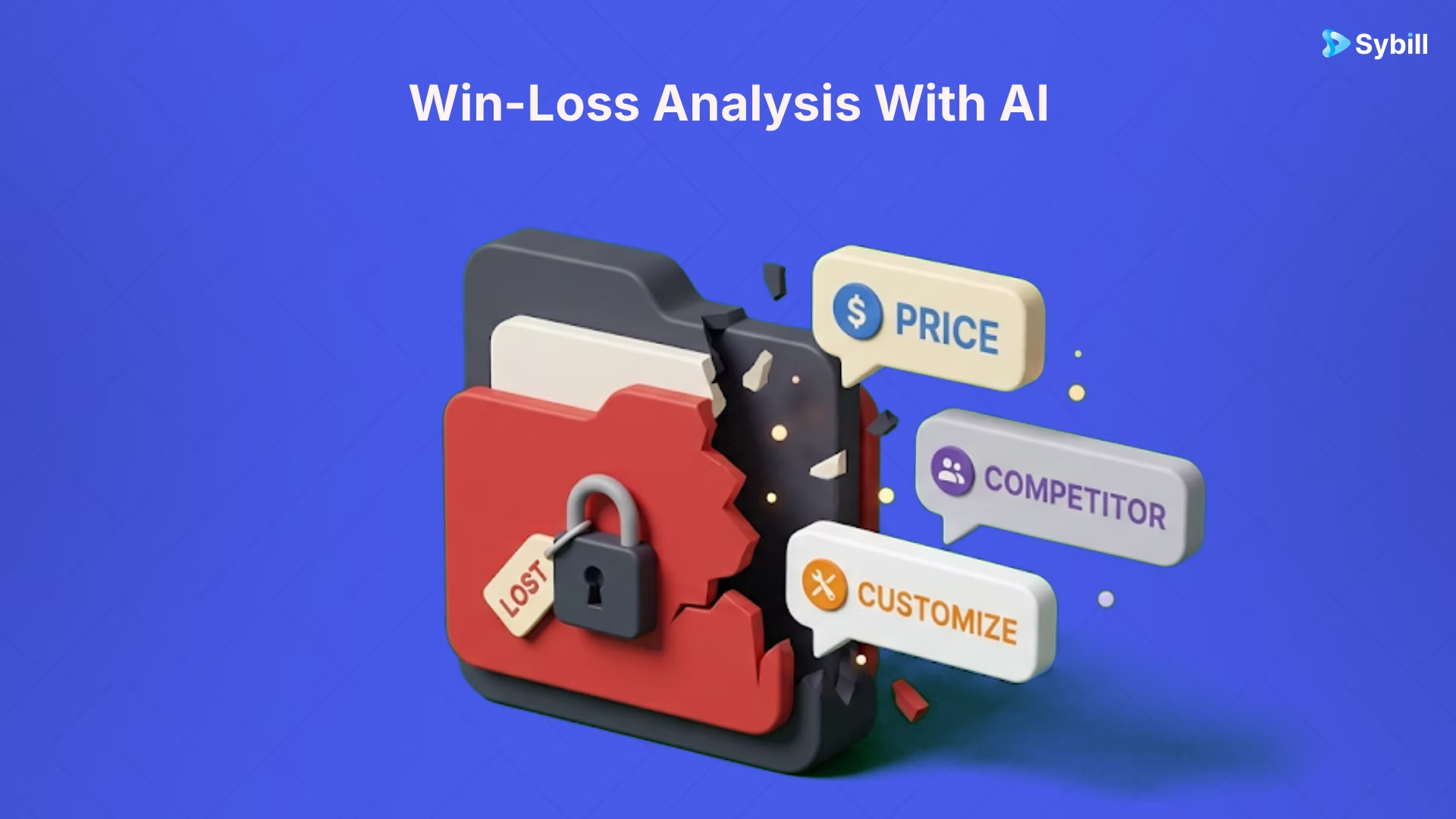
Every closed deal ends the same way: a rep picks a close reason from a dropdown, and the single most expensive lesson your company just paid for gets compressed into two words. "Pricing." "Competitor." "Timing." The real answer, the one worth money next quarter, is sitting in the calls, emails, and meetings of the deal itself, and until recently nobody had time to go get it.
That is the whole case for AI in win-loss analysis. Not replacing the discipline, but replacing the part that never scaled: reading every conversation from every deal and telling you what actually repeats. Here is what win-loss analysis is, why the traditional version keeps failing, and a six-step process for running it with AI on the conversations you already have.
Win-loss analysis is the structured practice of determining why deals are won or lost, by examining the evidence from each deal (conversations, timelines, stakeholders, competitive dynamics) and aggregating it into patterns you can act on. Done well, it tells you which objections actually kill deals, where competitors beat you and where they don't, and which behaviors your wins share. Done with AI, the evidence base expands from a sampled handful of deals to every deal, because the analysis runs on the recorded conversations themselves.
The payoff is documented: Gartner research, as reported by win-loss specialist Clozd, found that companies conducting win-loss analysis regularly improve win rates by 15 to 30%. The mechanism is unglamorous. Knowing the real "why" behind outcomes, instead of the dropdown version, is what makes every downstream fix (positioning, pricing, playbooks, coaching) aim at something true. For the foundational method, our complete win-loss analysis guide covers the discipline itself; this post is about running it with AI.
Not because teams don't believe in it. Because the traditional inputs are structurally weak:
None of this is anyone's fault. It is what happens when the primary source (what was actually said, deal after deal) is too expensive for humans to read at scale.
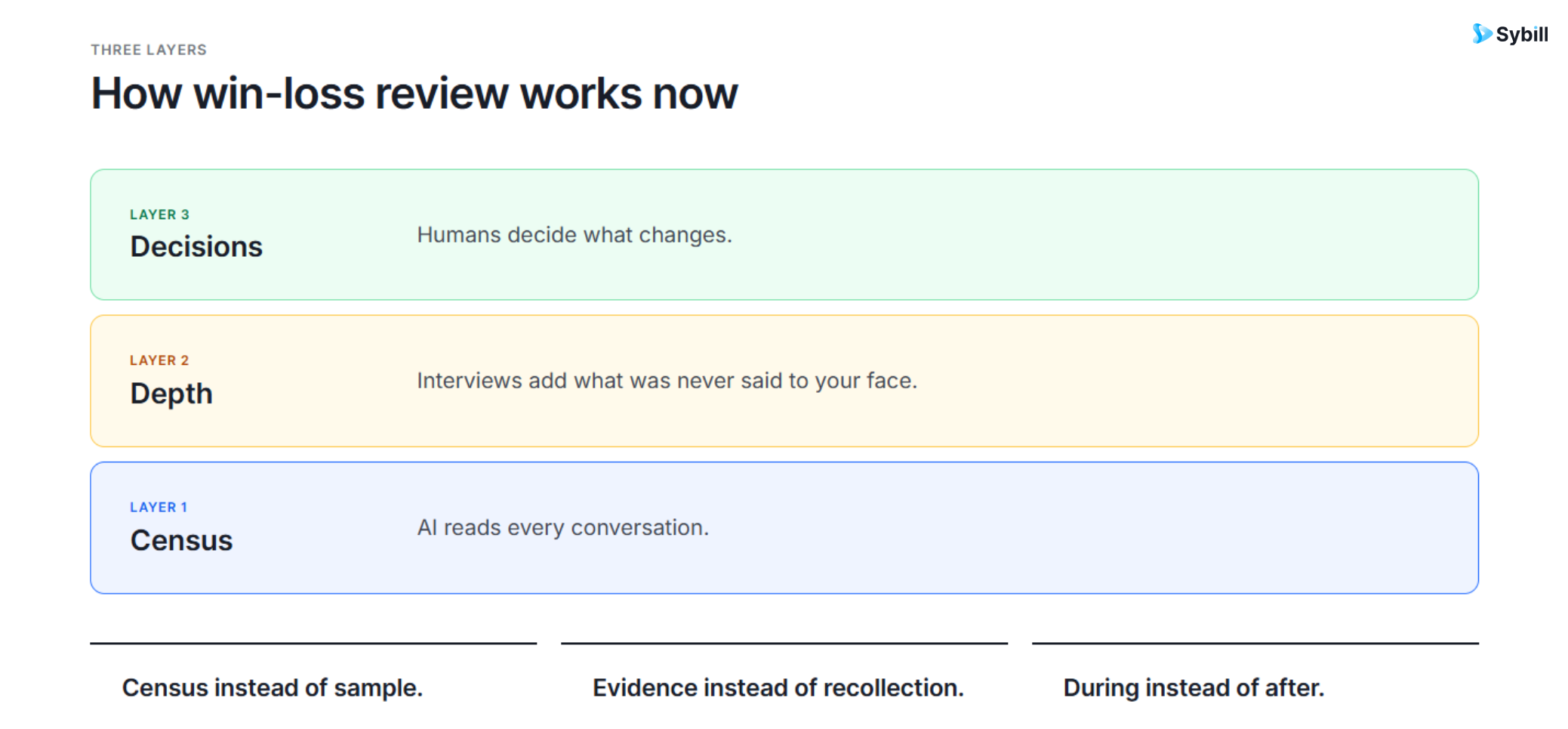
One thing, fundamentally, with several consequences: the conversations become the dataset. Every call, meeting, and email thread from every deal is analyzable, which flips three defaults:
What AI does not change: buyer interviews still capture what never got said to your face, and human judgment still decides what to do about the patterns. The honest architecture is AI for the census, interviews for the depth, humans for the decisions.
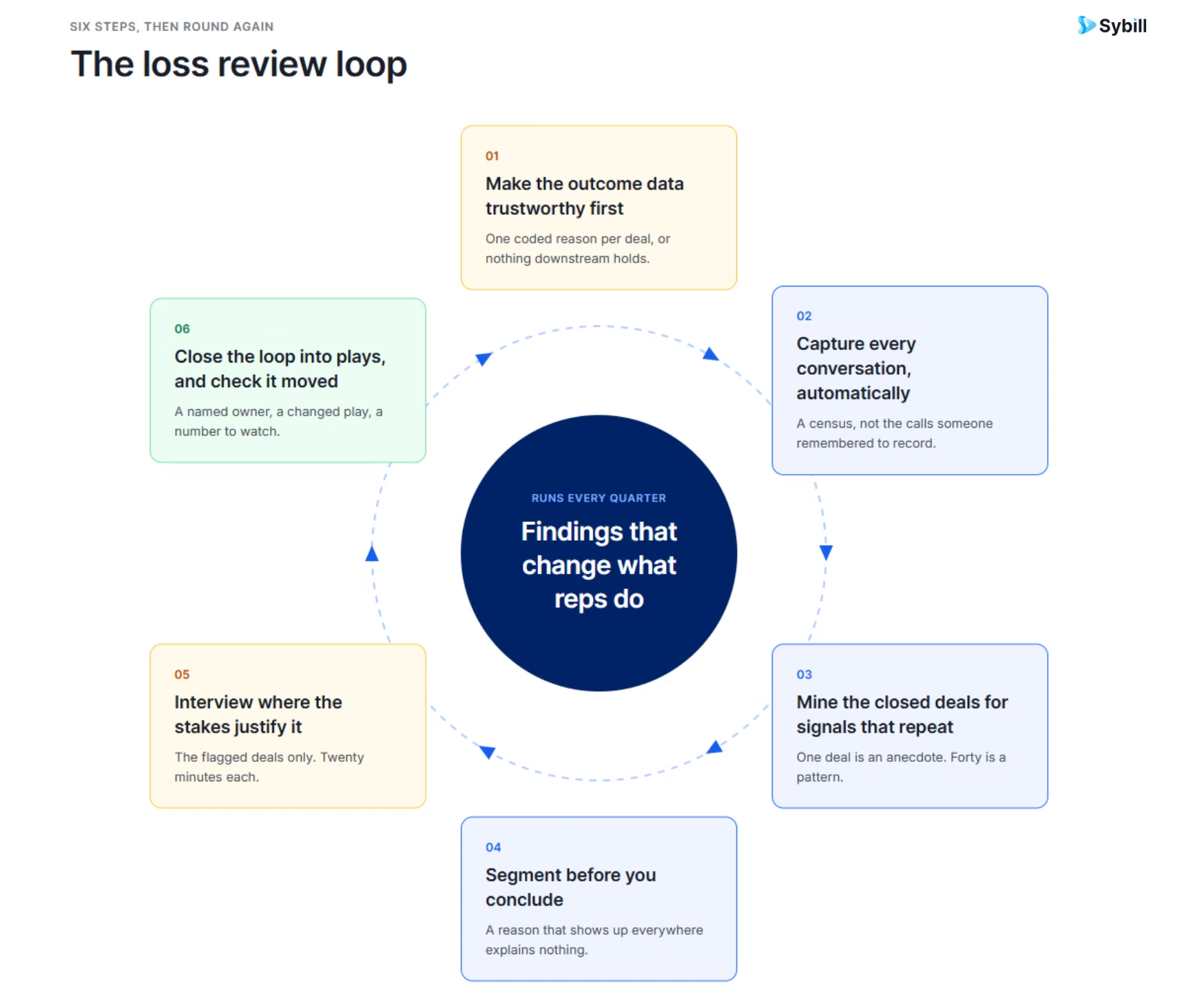
Step 1: Make the outcome data trustworthy first. AI aggregates whatever your CRM says happened, so garbage close reasons become confidently wrong charts. Tighten the closed-won and closed-lost definitions, require a competitor field where one was present, and let CRM automation maintain the records at the source instead of trusting end-of-quarter memory.
Step 2: Capture every conversation, automatically. The analysis is only as complete as the record. Every call and meeting should produce a summary and CRM fields that fill themselves as a side effect of selling, not as rep homework, with recording consent configured once at the platform level.
Step 3: Mine the closed deals for the signals that repeat. This is the step AI actually owns. Run every closed deal's conversations through the same questions: which objections appeared and were they handled, which competitors were named and in what context, when did pricing enter and how did the tone of engagement change after, how many stakeholders were genuinely engaged. Ask Sybill makes this literal: ask the question across your deals and get answers drawn from the conversations themselves.
Step 4: Segment before you conclude. Aggregate win-loss numbers lie by averaging. Split the patterns by segment, deal size, competitor, and source before believing any of them, since "we lose on price" often turns out to be "we lose on price in one segment we shouldn't be selling to," which is a lead scoring conclusion, not a pricing one.
Step 5: Interview where the stakes justify it. Reserve human interviews for the deals the census flags as strategic: the flagship loss, the surprise win, the competitor that suddenly started winning. Walk in armed with the conversation evidence, and the interview gets past the polite answers faster.
Step 6: Close the loop into plays, and check it moved. Findings become positioning changes, objection responses, and coaching priorities, or they become shelfware. Feed them into your sales plays so guidance from past wins and losses reaches reps inside live deals, route the coaching signals into rep development, and re-run the same analysis next quarter to verify the needle moved. The loop, not the report, is the product.
The census is only as good as its questions. The signal families that pay, deal after deal:
This is a topic where the usual disclosure runs the other direction: win-loss analysis from conversation data is not adjacent to what Sybill does, it is what Sybill does, so read this section as the vendor explaining its own machine, and discount accordingly.
Sybill has analyzed around 33 million sales conversations, and the six-step workflow above maps onto it step for step. Every call and meeting is captured into summaries and self-filling CRM fields, which is steps one and two running as a side effect of selling. Ask Sybill answers the mining questions across closed deals in plain language, competitor intelligence tracks who shows up and with what claims, and deal inspection surfaces the same signals while deals are still open, which is the census of steps three and four.
And sales plays push what the wins and losses taught back into live deals, closing step six's loop, with the pipeline view holding it together for RevOps.
For how Sybill compares with the other tools in this category, our win-loss software roundup does the honest side-by-side.
Your losses already paid for the lesson. Collect it. Sybill turns every won and lost deal's conversations into patterns, plays, and coaching signals, automatically. Get started for free with Sybill.
Win-loss analysis was never a bad idea; it was an underpowered one, running on samples and memory because reading everything was impossible. It isn't anymore. Teams that point AI at their full conversation record get the census, reserve human interviews for the deals that deserve depth, and ship the findings into plays instead of decks, and the compounding is real: every closed deal makes the next open one smarter. The teams still picking dropdown reasons are donating that compounding to whoever beat them.
Open the box on every deal. Then act like you looked.
Get started for free with Sybill or book a demo and turn every outcome into evidence.
Win-loss analysis is the structured practice of determining why deals are won or lost by examining the evidence from each deal (conversations, timelines, stakeholders, competitive dynamics) and aggregating it into patterns that inform positioning, pricing, playbooks, and coaching. Gartner research reported by Clozd links regular win-loss programs to win-rate improvements of 15 to 30%.
AI makes the deal conversations themselves the dataset: every call, meeting, and email from every deal becomes analyzable, replacing sampled rep recall with a census of evidence. Patterns (objections, competitor entries, pricing dynamics, stakeholder breadth) surface across all deals, including the no-decision pile, and signals appear while deals are still open rather than a quarter later.
No, and programs that drop interviews lose the layer AI cannot reach: what buyers never said to your face. The effective architecture uses AI for the census across every deal, reserves human interviews for strategically flagged deals (flagship losses, surprise wins, a surging competitor), and arrives at those interviews with conversation evidence in hand.
Two foundations: trustworthy outcome data (clean closed-won and closed-lost definitions, competitor fields, disciplined close reasons in the CRM) and complete conversation capture, with every call and meeting recorded, summarized, and logged automatically under properly configured recording consent. Weak outcome data is the main failure mode, since AI aggregates whatever the CRM claims happened.
The families that repay analysis deal after deal: objection patterns by stage and handling, competitor mentions and the claims they win with, what precedes and follows pricing conversations, stakeholder breadth (single-threaded versus multi-threaded), buyer priorities in their own words by segment, and the under-analyzed no-decision losses where urgency never got built.
Continuously for signal capture and quarterly for synthesis. AI-powered programs monitor deals as they close and while they are open, then run a structured quarterly pass to segment patterns, choose the changes worth shipping into plays and coaching, and verify last quarter's changes actually moved the numbers.
Win-loss analysis is the structured practice of determining why deals are won or lost by examining the evidence from each deal (conversations, timelines, stakeholders, competitive dynamics) and aggregating it into patterns that inform positioning, pricing, playbooks, and coaching. Gartner research reported by Clozd links regular win-loss programs to win-rate improvements of 15 to 30%.
AI makes the deal conversations themselves the dataset: every call, meeting, and email from every deal becomes analyzable, replacing sampled rep recall with a census of evidence. Patterns (objections, competitor entries, pricing dynamics, stakeholder breadth) surface across all deals, including the no-decision pile, and signals appear while deals are still open rather than a quarter later.
No, and programs that drop interviews lose the layer AI cannot reach: what buyers never said to your face. The effective architecture uses AI for the census across every deal, reserves human interviews for strategically flagged deals (flagship losses, surprise wins, a surging competitor), and arrives at those interviews with conversation evidence in hand.








