Find us at booth #83, join us for a harbor side happy hour, or catch Gorish’s talk.

Sept, 16-18 > Learn more


Mamta Tainwala

September 13, 2026
TL;DR: Win-loss analysis software splits into three kinds of evidence. Conversation-based tools (Sybill, Gong, Avoma) analyze what buyers actually said across every deal, continuously. Interview platforms (Clozd, Klue Win-Loss, Primary Intelligence) go deep on a sample of deals through structured buyer conversations. Competitive intelligence suites (Klue, Crayon) push findings into battlecards where reps use them. The best programs combine record-based coverage with interview-based depth. Pick by which gap you have: coverage, depth, or activation.
Most "best win-loss software" lists rank an interview agency, a battlecard platform, and a call recorder against each other as if they do the same job. They do not. One tells you what a buyer said in a debrief weeks after the decision. One tells you what the buyer said on the actual calls. One makes sure a rep sees either before the next competitive deal.
So this list sorts seven tools by the evidence they run on, then asks the question that matters: does this tool tell you why deals are won and lost across your whole pipeline, or across the ten deals you had time to study?
Disclosure: Sybill is on this list and we make it. We have placed it by category, given the interview specialists their due, and kept every pricing claim honest about what is and is not published.
Win-loss analysis software collects evidence about why deals closed the way they did, finds patterns across many deals, and routes those findings to the teams that can act on them: sales, product, marketing, and competitive intelligence. Tools differ mainly in their evidence source: buyer interviews, sales conversations, or CRM data.
The evidence source determines everything else about a tool: its coverage, its depth, its speed, and its cost.
The classic program lives almost entirely in the middle column, and it has a coverage problem nobody says out loud: a diligent team interviews maybe one closed deal in seven. The other six close in silence, even though every one left a full evidence trail in recorded calls. Our complete win-loss analysis guide covers the methodology; this post covers the tools.
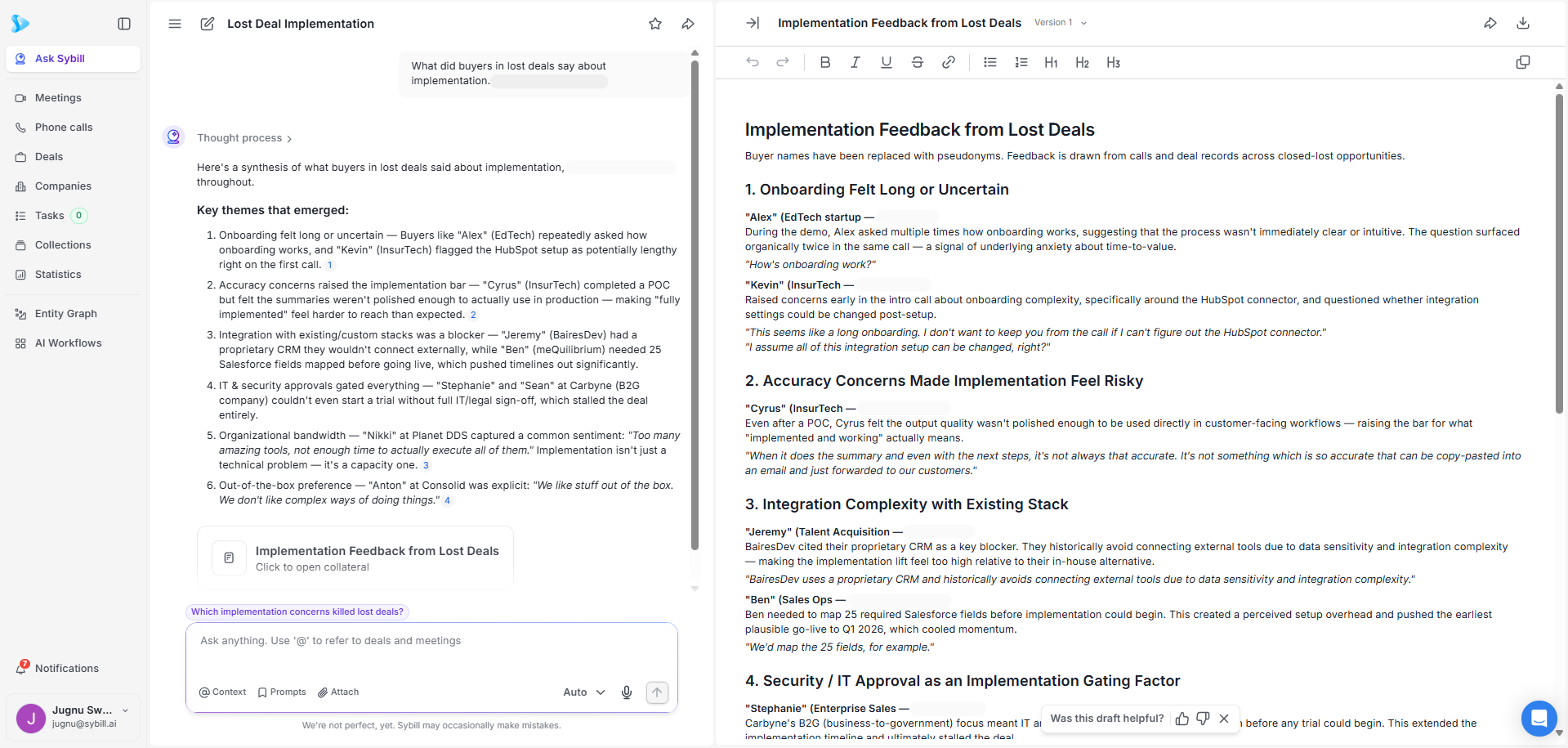
Sybill captures every customer call, extracts what buyers said about competitors, objections, pricing, and priorities, and lets you analyze wins against losses across the entire pipeline in a single question. Findings feed directly into sales plays, so the lesson from last quarter's losses changes what reps do on this quarter's deals.
Yes, this is us. The honest case for the category: the buyer's stated reason for a loss and the conversational evidence frequently disagree. Across around 33 million sales calls analyzed, "we lost on price" turns out, more often than anyone is comfortable with, to be "we never got past the security review in call three." An interview asks the buyer to remember. The record shows you.
What it does for win-loss
Pros: Covers every deal, not a sample. No buyer participation required. Insight available during the deal, not weeks after. Free plan to start.
Cons: It analyzes what was said on calls, so it cannot capture the buyer's internal politics or the meeting you were not in. That is what interviews are for, and the strongest programs run both.
Pricing: Free plan at $0. Pro at $30 per user per month billed annually ($36 monthly). Business at $90 per user per month billed annually ($108 monthly). Enterprise is custom.
Best for: Revenue teams that want win-loss to run continuously on every deal and turn into changed rep behavior, not a quarterly PDF. For the workflow, see how to use AI for win-loss analysis.
Get started for free with Sybill
Clozd is the most mature dedicated win-loss provider on this list. Its platform connects to your CRM to monitor closed opportunities, then runs structured buyer interviews and surveys, with expert consultants conducting the conversations and analyzing the findings. The output is analyst-grade narrative on why specific deals went the way they did.
Credit where it is due: if you need a rigorous, third-party interview program with methodology you can defend to a board, Clozd is the standard. Buyers are more candid with a neutral interviewer, and Clozd's are very good at the follow-up that turns "price" into the real answer.
The limits are the category's: a sample, weeks of turnaround, and dependence on buyers agreeing to talk, which the ones who rejected you do not owe you.
What it does for win-loss
Pros: Deepest qualitative insight available. Neutral third party. Strong methodology and reporting.
Cons: Sample-based. Weeks to insight. Enterprise positioning and price. Findings still need someone internal to activate them.
Pricing: Quote-based per program. Clozd does not publish pricing.
Best for: Enterprise teams with strategic deal sizes that justify analyst-grade depth on a sample, ideally paired with record-based coverage of everything else.

Klue built its reputation in competitive enablement, then moved into win-loss by acquiring DoubleCheck Research, a respected interview firm, in 2023. The result: buyer feedback from interviews flows into the same battlecards and competitor profiles reps already use, which solves the activation problem most standalone interview programs never do.
Credit where it is due: this is the right architecture when findings need to reach sellers. Klue offers several capture methods, from expert human interviews to AI-moderated ones to importing your own, and its competitive intelligence side is the strongest in the category.
The trade-off: still interview-based evidence at its core, with the sampling and lag that implies, and packaged for organizations with a dedicated competitive or product marketing owner.
What it does for win-loss
Pros: Best-in-class activation into rep workflows. Multiple capture methods. Mature competitive intelligence.
Cons: Sample-based evidence. Needs a program owner. Contracts run annual with long notice windows, so read the terms.
Pricing: Quote-based; Klue does not publish list pricing. Third-party procurement benchmarks (Vendr) place typical mid-market contracts in the $20,000 to $40,000 per year range, with enterprise higher. Treat as directional, not a quote.
Best for: Mid-market and enterprise teams running competitive intelligence and win-loss together, with someone whose job is to own both.
Primary Intelligence has run win-loss and customer experience research programs for years, and its TruVoice platform delivers buyer interview findings alongside program analytics. Its differentiator is orientation: the research is framed around the sales experience itself, meaning how the buyer experienced your reps, your process, and your competitors' processes, not just your feature checklist.
Credit where it is due: for a sales leader who suspects the losses are about the selling rather than the product, this framing produces findings a coaching program can use.
Same category constraints: sampled, retrospective, dependent on buyer participation, quote-based.
What it does for win-loss
Pros: Sales-experience framing that feeds coaching. Experienced research team. Strong CX crossover for post-sale programs.
Cons: Sample-based. Retrospective. Less activation tooling than Klue.
Pricing: Quote-based; not published.
Best for: Sales organizations whose primary hypothesis is that losses trace to the buying experience, and who want a research partner rather than a self-serve tool.
Crayon is a competitive intelligence platform first: it monitors competitor websites, pricing pages, job postings, reviews, and news, scores the signals with AI, and publishes battlecards to reps in Salesforce, Slack, Highspot, and Seismic. It is on this list because win-loss findings need somewhere to live, and Crayon is one of the two places that do it well.
An important distinction: Crayon does not run native win-loss interviews. It integrates with Clozd and TruVoice to bring their findings into battlecards, so it is an activation layer, not an evidence source. If you already run one of those programs and your reps live in Crayon, that is clean. If you are buying Crayon expecting it to tell you why you lost, it will not.
What it does for win-loss
Pros: Deepest competitor monitoring. Strong distribution into rep workflows. Mature integrations.
Cons: No native win-loss evidence. Assumes a dedicated CI owner. Quote-based.
Pricing: Quote-based; not published. Third-party procurement benchmarks (Vendr) place typical mid-market contracts in the $25,000 to $40,000 per year range. Directional only.
Best for: Teams with a dedicated competitive intelligence function who already run an interview program and need the findings distributed to sellers.
Gong records and analyzes sales conversations at scale, and its deal analytics surface patterns across won versus lost deals: competitor mentions, talk patterns, topics correlated with outcomes. For a large org already running Gong for coaching and forecasting, that is real win-loss signal without another tool.
Credit where it is due: Gong's analytics depth is real, and its competitor tracking across conversations is a legitimate win-loss input. The nuance is orientation: Gong's center of gravity is in-flight deal and rep analytics for large teams, and win-loss falls out as a byproduct rather than the job. Teams wanting a dedicated why-we-won-and-lost workflow with findings routed into plays often build it on top. See Sybill vs Gong for where each sits and Sybill plus Gong for running both.
What it does for win-loss
Pros: Enterprise-proven analytics. Full conversation coverage. Broad ecosystem.
Cons: Win-loss is a byproduct, not a workflow. Enterprise pricing and contract structure. Heavier than a 20-rep team needs.
Pricing: Quote-based; Gong does not publish per-seat pricing. Budget for a platform fee plus per-user licensing.
Best for: Large sales organizations already standardized on Gong who want to mine its conversation data for win-loss patterns.
Avoma is a meeting assistant and conversation intelligence platform for growing teams, bundling scheduling, notes, transcription, and analytics. Its win-loss relevance is theme detection: surfacing recurring why-we-won and why-we-lost topics from the conversations and CRM context it already captures.
Credit where it is due: for a small team wanting one modest tool for notes, coaching snippets, and some outcome analysis, Avoma covers a lot of ground affordably. The trade-off is depth and activation: theme detection is lighter than a dedicated workflow, and findings do not flow into rep-facing plays. Our Avoma vs Sybill comparison has the detail.
What it does for win-loss
Pros: Affordable. All-in-one meeting workflow. Easy to adopt.
Cons: Lighter analysis. No activation into plays. Better for notes than for structured win-loss.
Pricing: Avoma has a free trial, but the basic plan starts at $19/seat for basic recording, transcription and AI features. Can be customized with upgrade options available per seat.
Best for: Small teams that want meeting management plus a first look at win-loss themes in one tool.
Compare win-loss software on four questions: what evidence it runs on, how much of your pipeline it covers, how fast a finding arrives, and whether findings reach reps. Most tools are strong on one or two. The best programs pair a coverage tool with a depth tool and make sure both feed the same activation layer.
Choose by diagnosing your gap. If you have no idea why most deals close the way they do, you have a coverage gap, and a conversation-based tool fixes it fastest. If you know the patterns but not the buyer's reasoning, you have a depth gap, and an interview program fixes it. If you have findings that never change behavior, you have an activation gap, and the fix is plumbing into plays or battlecards.
Three questions get you to a shortlist:
How many closed deals do you actually understand? If the honest answer is "the ones someone complained about," start with coverage. Conversation-based analysis gives you a baseline across every deal and tells you which deals are worth the expense of an interview.
Who owns the program? Interview platforms and CI suites assume a dedicated owner who runs the program weekly. Without that person, they become expensive report generators. Conversation-based tools need less stewardship because the evidence collects itself, but someone still has to turn findings into plays.
Where do findings need to end up? "In front of reps before the next competitive deal" means tools with an activation layer: Sybill's plays or Klue's battlecards. "In a board deck" means a research provider's report.
Quick picks:
The strongest architecture uses two of these: a conversation-based tool for what happened across every deal, an interview program for what it meant on the deals that matter most, one activation layer for both.
The most common mistake is buying depth when the problem is coverage. A team interviews fifteen deals a quarter, produces a beautiful report, and never notices that the other hundred deals died for reasons the report does not mention, because nobody looked.
Losses are tuition. The software question is whether you collect the lesson from every deal or from the fifteen you had time to ask about. If the work that pays you happens in customer conversations, start with the tool built on them.
Get started for free with Sybill
It depends on your gap. For continuous analysis across every deal that feeds rep behavior, a conversation-based tool like Sybill. For analyst-grade depth on a sample of strategic deals, an interview provider like Clozd. For win-loss integrated with competitive battlecards, Klue Win-Loss. Most mature programs pair a coverage tool with a depth tool.
Conversation-based tools start free or at per-seat rates; Sybill's Pro plan is $30 per user per month billed annually as of September 2026. Interview platforms and competitive intelligence suites (Clozd, Klue, Crayon, Primary Intelligence) are quote-based and do not publish pricing; third-party procurement benchmarks place typical mid-market Klue and Crayon contracts in the $20,000 to $40,000 per year range.
For the deals that matter most, yes. Conversation intelligence tells you what happened on every call. Interviews tell you what the buyer thought, what they compared you against in meetings you were not in, and how they perceived you before the process started. The strongest programs use records for coverage and interviews for depth.
Both capture and analyze sales conversations, so both produce win-loss signal: competitor mentions, topics correlated with outcomes, recurring themes. Neither is built around a dedicated win-loss workflow with findings routed into rep-facing plays, so teams often build that layer on top or add a purpose-built tool.
Not natively. Crayon is a competitive intelligence platform that integrates with win-loss providers such as Clozd and TruVoice to bring their findings into battlecards. It is an activation layer for win-loss, not an evidence source. If you buy Crayon alone, you still need something that tells you why deals were lost.
Route every finding to a specific artifact with an owner: competitive patterns into refreshed sales plays or battlecards, objection patterns into coaching sessions and the objection playbook, messaging wins into decks. Tools with a built-in activation layer, such as Sybill's sales plays or Klue's battlecards, remove the step where findings sit in a report nobody reopens.
What is the best win-loss analysis software?
Conversation-based tools start free or at per-seat rates; Sybill's Pro plan is $30 per user per month billed annually as of September 2026. Interview platforms and competitive intelligence suites (Clozd, Klue, Crayon, Primary Intelligence) are quote-based and do not publish pricing; third-party procurement benchmarks place typical mid-market Klue and Crayon contracts in the $20,000 to $40,000 per year range.
For the deals that matter most, yes. Conversation intelligence tells you what happened on every call. Interviews tell you what the buyer thought, what they compared you against in meetings you were not in, and how they perceived you before the process started. The strongest programs use records for coverage and interviews for depth.