Find us at booth #83, join us for a harbor side happy hour, or catch Gorish’s talk.

Sept, 16-18 > Learn more

%20(1).avif)
Mamta Tainwala

February 10, 2026
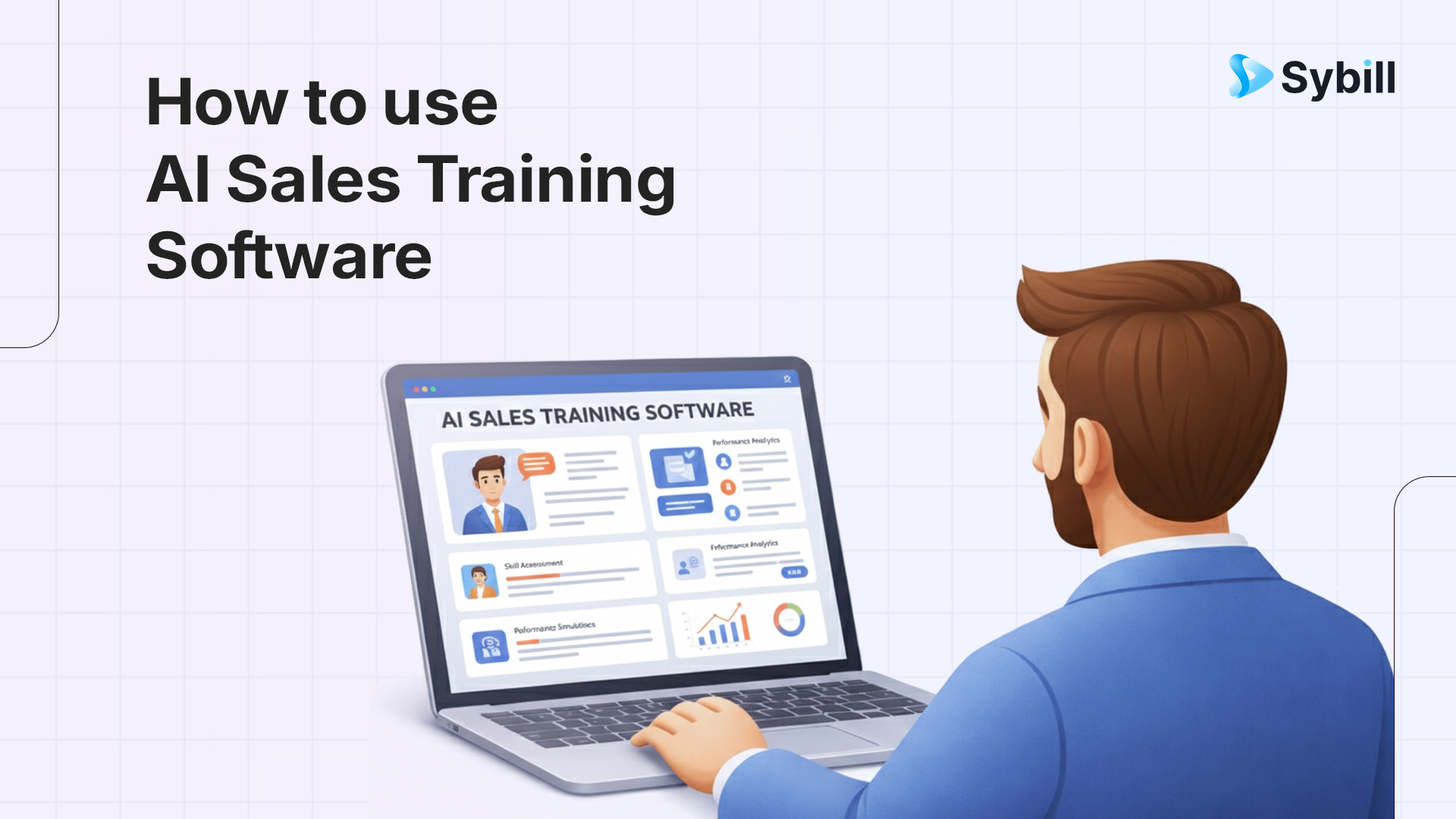
TL;DR: AI sales training transforms how reps learn and improve by offering personalized coaching after every call, realistic role-play simulations, automated CRM hygiene, and smarter lead qualification. This guide walks you through a practical, stage-by-stage approach to implementing AI training across your sales org, so your team stops winging it and starts winning it.
There is a scene in Moneyball where Brad Pitt's character tells his old-school scouts that they are not adapting. The game has changed, he says, and the people who refuse to change with it get left behind. The scouts push back. They trust their gut. They have decades of experience. And they lose.
Sales training is having its Moneyball moment right now.
For years, the playbook looked the same: classroom sessions, static role-plays with a manager pretending to be a tough buyer, a shared Google Doc of "best objection responses," and the occasional ride-along. Reps either figured it out through trial and error or they didn't. Managers coached when they could, which usually meant rushed 1:1s squeezed between pipeline reviews.
The problem was never effort. It was scale. A great sales manager might have eight to twelve direct reports. Coaching each one meaningfully after every call? Physically impossible. So reps got feedback on a fraction of their conversations, learned slowly, and repeated mistakes they didn't even know they were making.
AI sales training changes that equation entirely. It gives every rep access to something that used to be reserved for the top performers who happened to sit next to the best manager: consistent, data-backed, personalized coaching on every single interaction.
Let's walk through how to actually make it work, stage by stage.
Before diving into implementation, it helps to be precise about what AI sales training actually means in 2026.
AI sales training refers to using artificial intelligence to analyze sales conversations, deliver personalized feedback, simulate practice scenarios, and automate the non-selling tasks that eat into a rep's learning time. It is not a replacement for human managers. It is not a magic button. And it is definitely not another dashboard nobody checks.
Think of it as the difference between a rep reviewing their own call recording (which almost nobody does voluntarily) and having an intelligent assistant that listens to every call, flags specific moments where the rep missed a buying signal or fumbled an objection, and surfaces that feedback before the next conversation even starts.
The best AI training tools do three things well:
That last point is easy to overlook, but it matters enormously. A rep who spends 90 minutes a day on admin is a rep who has 90 fewer minutes to practice, prospect, and close. Freeing up that time is training by subtraction.
Every successful AI sales training implementation starts with an honest assessment. You need to know where your team is struggling before you can point AI at the right problems.
Identify your coaching gaps. Are reps losing deals because they cannot handle pricing objections? Is discovery too shallow? Are follow-ups landing days late and reading like form letters? Talk to your managers. Look at your win/loss data. The answers are usually hiding in plain sight.
Audit your current tech stack. AI training works best when it plugs into the tools your team already uses. If reps have to log into a separate platform, learn a new workflow, and remember to check another tab, adoption will flatline. Look for solutions that integrate natively with your CRM, calendar, Slack, and email.
Start with one high-impact use case. Trying to overhaul everything at once is a recipe for overwhelm. Pick the area with the biggest gap between where your team is and where it needs to be. For most teams, that is either post-call coaching or CRM hygiene. Start there and expand.
Set a baseline you can measure against. Before you flip the switch, document your current metrics. Average deal cycle length, win rate by stage, talk-to-listen ratio, and follow-up response rates all make good starting points. You cannot prove ROI if you do not know where you started.
This is where AI sales training gets genuinely exciting. Generic training treats every rep the same way, which means it is too basic for your top performers and too advanced for new hires. AI flips that model entirely.
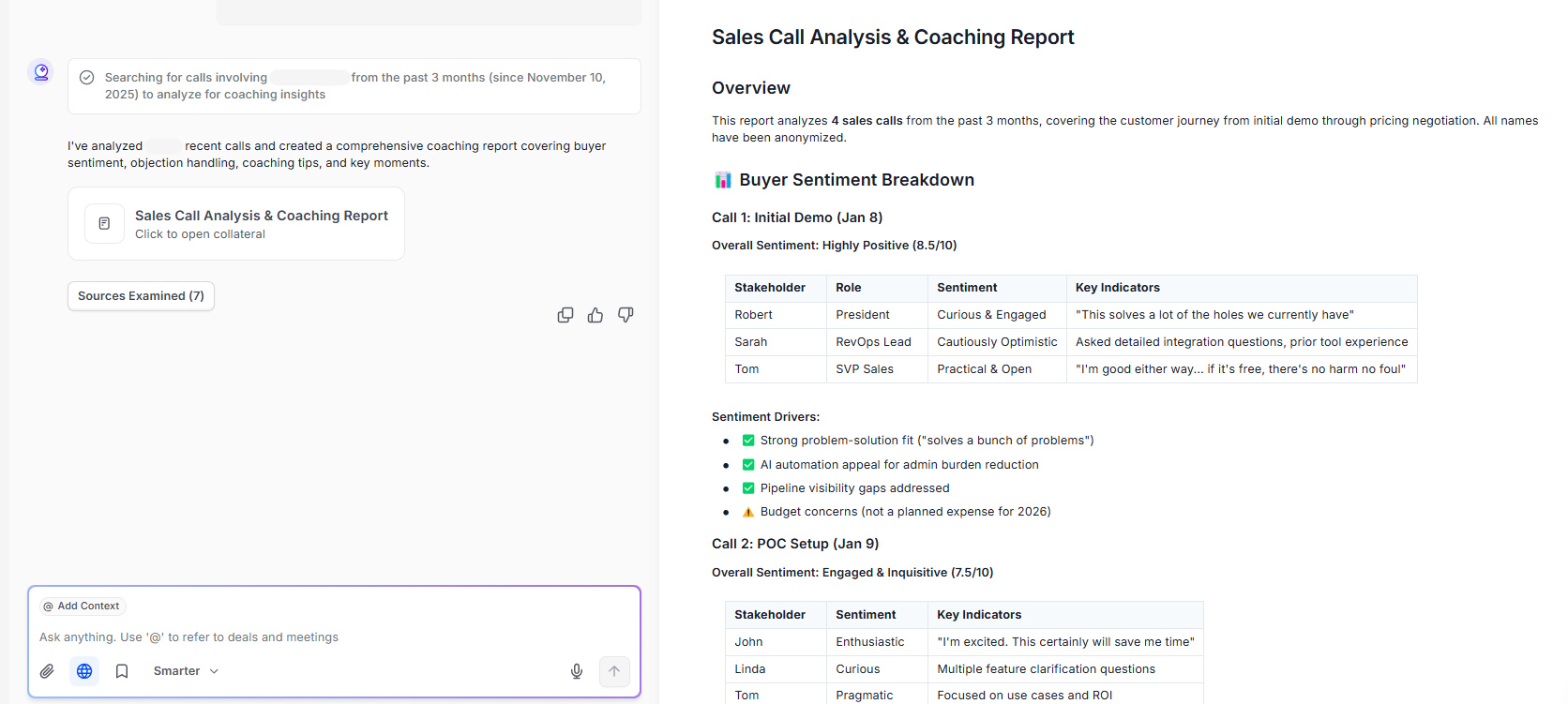
Individualized feedback after every call. Instead of waiting for a manager to have time to review a call recording, AI analyzes every conversation automatically. It identifies specific moments where a rep talked past a buying signal, failed to explore a pain point, or let an objection go unaddressed. That feedback lands in the rep's inbox or Slack channel within minutes of hanging up.
Sybill does this through its AI-powered meeting summaries, which go beyond simple transcription. They capture key takeaways, buyer pain points, next steps, and the emotional tone of the conversation. A rep does not just get a transcript; they get a debrief that tells them what mattered and what to do about it.
Pattern recognition across calls. One fumbled objection is a bad moment. The same fumbled objection across ten calls is a coaching opportunity. AI spots these patterns far faster than any human can. Managers get visibility into which reps need help with what, without having to listen to hours of recordings.
This is a game-changer for sales coaching at scale. Instead of spending 90% of a 1:1 chasing CRM updates, managers can walk in with specific, data-backed coaching points. "Hey, I noticed you've been rushing through discovery on enterprise calls. Let's work on that." That is a fundamentally different conversation than "How are your deals looking?"
Behavior and engagement signals. Some AI tools, including Sybill, go beyond words to analyze non-verbal cues like buyer engagement and sentiment. If a prospect disengaged during a pricing slide or leaned in during a customer story, that context shapes how a rep should follow up. It is the kind of insight that used to require a decade of selling experience to develop intuitively. Now it is available to every rep on your team.
Let's be honest. Traditional sales role-play is awkward. Your manager pretends to be a CFO, you pretend you do not know they are your manager, and the whole exercise feels about as realistic as a school play. Everyone knows the script, and the "feedback" is usually vague enough to be useless.
AI-powered role-play simulations fix most of what is broken about the old model.
Dynamic scenarios that adapt in real time. AI does not stick to a script. It responds to what the rep actually says, creating a conversation that feels organic. If a rep handles the first objection well, the AI escalates. If they fumble, it gives them room to recover. This kind of adaptive practice builds genuine muscle memory, not rehearsed lines.
Practice without pressure (or witnesses). One of the biggest barriers to role-play is social discomfort. Reps do not want to look foolish in front of their peers or manager. AI removes that audience entirely. A rep can practice a difficult pricing conversation ten times at 10 PM on a Sunday if they want to, and nobody needs to know.
Instant, specific feedback. After each practice session, AI delivers detailed analysis: where the rep was persuasive, where they lost momentum, and what specific language changes could improve the outcome. Sybill's co-founder Nishit Asnani has written about using ChatGPT role-play for objection handling as a way to build this skill between live conversations. The key insight is that practice needs to be frequent and low-stakes, and AI makes both possible.
Building confidence through repetition. Confidence in sales comes from preparedness. A rep who has practiced handling the "your competitor is cheaper" objection fifteen times in simulated environments will handle it very differently the first time a real prospect says it. That is not theory. That is how skill acquisition works across every domain from sports to surgery.
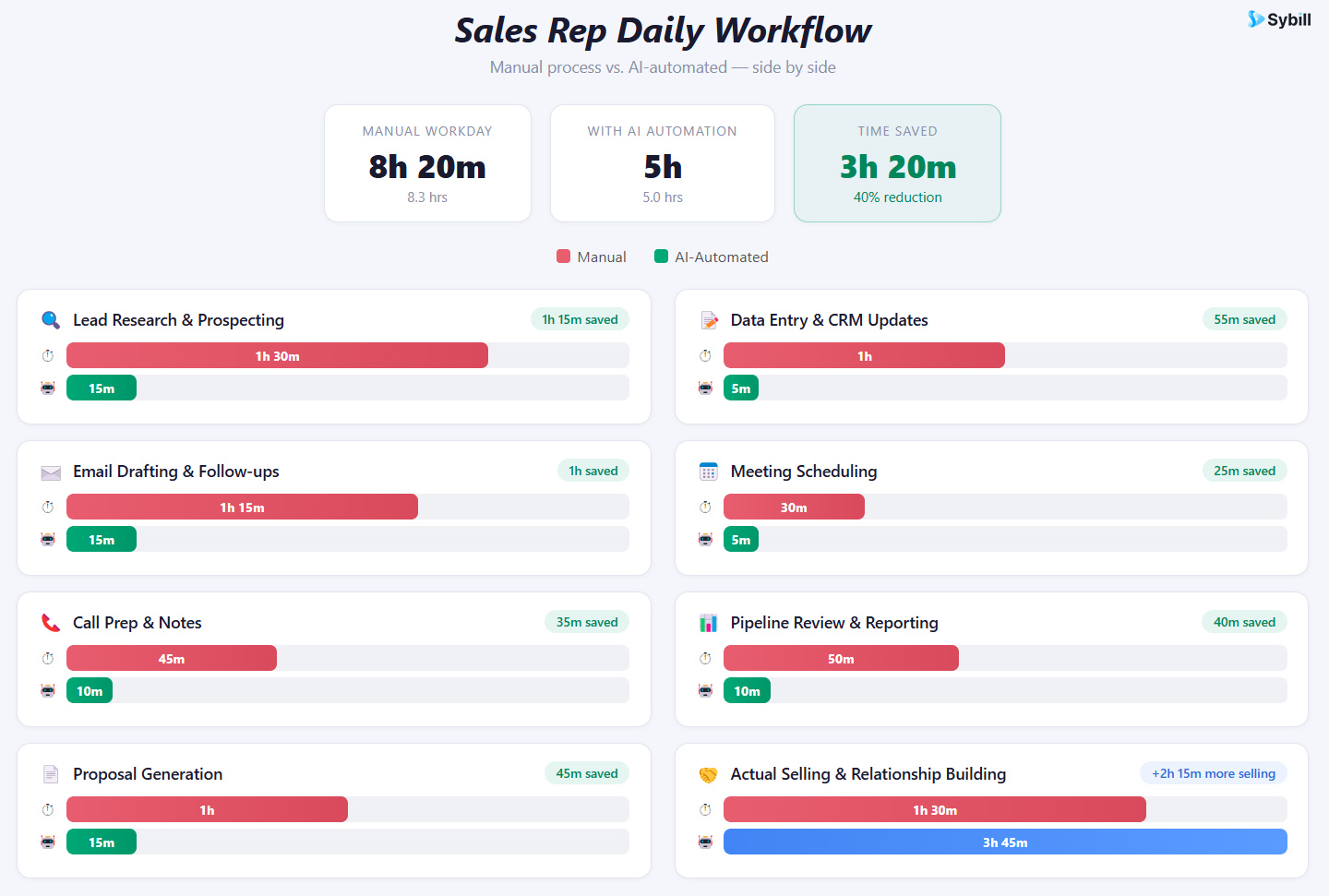
Here is a stat that should make every sales leader wince: reps spend only about a third of their time actually selling. The rest goes to CRM updates, email drafting, call prep, internal reporting, and the other administrative tasks that are necessary but deeply un-fun.
AI sales training is not just about making reps better at conversations. It is also about freeing them to have more of those conversations in the first place.
Automated CRM updates. After every call and email interaction, AI can update your CRM automatically, filling in fields like next steps, objections raised, competitor mentions, and deal stage criteria. Sybill's CRM Autofill does this by analyzing conversation context and writing entries that sound like an actual AE wrote them, not a bot that summarized three bullet points.
This matters for training in two ways. First, reps get time back. Second, managers get accurate CRM data to coach from. When CRM entries are actually reliable, pipeline reviews become coaching sessions instead of data-entry audits.
AI-drafted follow-up emails. The window between a call ending and a follow-up email landing in a prospect's inbox is critical. AI can draft that email within minutes, pulling in specific pain points discussed, next steps agreed upon, and the right tone for the relationship. The rep reviews, tweaks, and sends. What used to take 20 minutes now takes two.
Pre-meeting briefs that actually brief. Instead of spending 30 minutes Googling a prospect and scrolling through old CRM notes, reps can get an AI-generated brief that includes deal history, recent news, attendee backgrounds, and likely objections. Sybill generates these pre-meeting briefs automatically, so reps walk into every call prepared and present.
Get started for free with Sybill and see how much time your team gets back when AI handles the admin.
AI training does not stop at improving how reps sell. It also improves what they sell to and when.
Prioritizing the right leads. AI analyzes your historical deal data, engagement patterns, and buyer signals to score and prioritize leads. Instead of working a list alphabetically or by gut feeling, reps focus on the prospects most likely to convert. That is better training through better reps: reps who spend more time with qualified buyers develop sharper instincts faster.
Personalized outreach at scale. Generic emails get generic results. AI uses prospect data, past interactions, and deal context to draft outreach that feels relevant and human. Sybill's follow-up email templates pull in pain points, objections, and next steps automatically, so every touchpoint advances the conversation.
Cross-deal intelligence. One of the most powerful and underused aspects of AI in sales is the ability to learn across your entire team's conversations. What objections come up most? Which talk tracks lead to higher close rates? What do winning reps do differently in discovery? Tools like Sybill let you ask questions across all your deals, surfacing patterns that would take a human analyst weeks to find.
This cross-deal intelligence feeds directly back into training. When you can identify that your team's close rate drops 40% when competitors get mentioned in discovery but nobody addresses it, you have a specific, measurable coaching opportunity. That is the loop: AI y niceobserves, surfaces insights, informs coaching, and measures improvement.
The biggest risk with AI sales training is treating it as a one-time implementation rather than an ongoing practice. The teams that get the most value are the ones that build AI-assisted learning into their daily rhythm.
Weekly coaching powered by data. Use AI-surfaced insights to drive your 1:1s and team meetings. Instead of asking "how did that call go?", managers can say "I see you've improved your discovery depth this month, but there's still a pattern of rushing through technical objections. Let's workshop that."
Shared libraries of winning moments. Most AI tools let you create clip playlists of specific call moments, like a rep handling a tough pricing conversation brilliantly, or a discovery call that uncovered a pain point nobody expected. These become a living training library your whole team can learn from.
Reps coaching themselves. This is the ultimate unlock. When reps have access to their own performance data, conversation analysis, and personalized improvement suggestions, the best ones become self-correcting. They do not wait for a manager to flag an issue. They see it themselves and fix it. Sybill's Ask Sybill feature enables exactly this kind of self-directed improvement, letting reps query their own performance data conversationally.
Iterate your playbook based on real data. Your sales playbook and ICP should not be a static document collecting dust in a shared drive. AI gives you the data to continuously refine which messaging works, which objection responses convert, and which discovery frameworks lead to the strongest pipeline. Use it.
Implementing AI sales training is not without risks. Here are the mistakes that trip most teams up:
AI sales training is not about replacing human judgment with algorithms. It is about giving every rep on your team access to the kind of consistent, personalized, data-driven coaching that used to only happen when the stars aligned and a great manager had time.
The teams adopting AI training right now are building a compounding advantage. Every call analyzed, every pattern surfaced, every coaching moment acted on makes the team incrementally better. And in sales, incrementally better compounds fast.
The choice is the same one Billy Beane faced in Moneyball: adapt to what the data is telling you, or keep trusting the old model and wonder why the results stay the same.
Get started for free with Sybill and give your team the AI-powered coaching edge they have been missing.
What is AI sales training software?
AI sales training software uses artificial intelligence to analyze sales calls, deliver personalized coaching feedback, simulate practice scenarios through role-play, and automate administrative tasks like CRM updates and follow-up emails. It helps reps improve faster by providing consistent, data-backed insights after every interaction.
How does AI improve sales coaching for managers?
AI gives managers visibility into rep performance across every call, not just the ones they have time to review. It surfaces coaching patterns like recurring objection-handling gaps or shallow discovery, so 1:1s become targeted skill-building sessions instead of status updates.
Can AI role-play really replace traditional sales role-play?
AI role-play complements traditional practice rather than fully replacing it. The advantage is that reps can practice anytime, in private, against dynamic scenarios that adapt to their responses. The feedback is instant and specific, which accelerates skill development between live coaching sessions.
How much time can AI save sales reps on admin tasks?
Most teams report saving five or more hours per week per rep by automating CRM updates, follow-up email drafting, and call prep. That time goes directly back into selling, prospecting, and skill development.
What should I look for when choosing an AI sales training tool?
Prioritize tools that integrate with your existing tech stack (CRM, Slack, calendar, email), deliver feedback in the flow of work rather than a separate platform, and solve your team's specific coaching gaps. Look for conversation intelligence, automated CRM updates, and personalized coaching capabilities.
Is AI sales training only useful for large teams?
No. Solo reps and small teams often see the biggest immediate impact because they typically lack dedicated coaching resources. AI provides the consistent feedback loop that a dedicated sales trainer would, regardless of team size.
AI sales training software uses artificial intelligence to analyze sales calls, deliver personalized coaching feedback, simulate practice scenarios through role-play, and automate administrative tasks like CRM updates and follow-up emails. It helps reps improve faster by providing consistent, data-backed insights after every interaction.
AI gives managers visibility into rep performance across every call, not just the ones they have time to review. It surfaces coaching patterns like recurring objection-handling gaps or shallow discovery, so 1:1s become targeted skill-building sessions instead of status updates.
AI role-play complements traditional practice rather than fully replacing it. The advantage is that reps can practice anytime, in private, against dynamic scenarios that adapt to their responses. The feedback is instant and specific, which accelerates skill development between live coaching sessions.