Find us at booth #83, join us for a harbor side happy hour, or catch Gorish’s talk.

Sept, 16-18 > Learn more


Tamanna Mishra

March 11, 2026
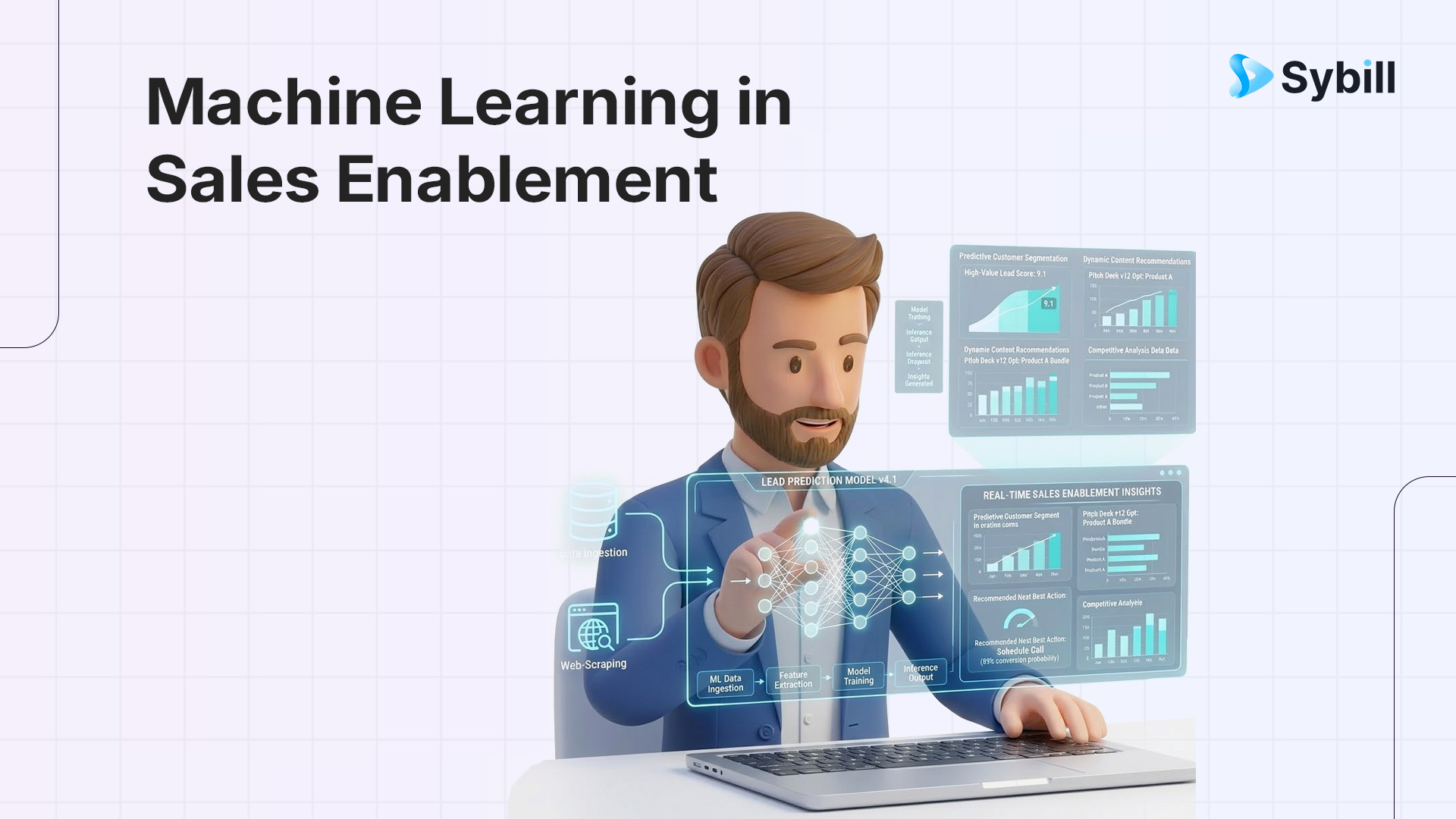
Sales teams today are drowning in tools.
CRM. Sales engagement. Call recording. Enablement platforms. Dashboards. Forecast sheets. Slack threads. “Just one more tool” that promises clarity.
And yet most reps still ask the same question before a big call:
“What should I actually focus on?”
It feels like Silicon Valley, where everyone builds something brilliant, but no one can explain why.
This is exactly where machine learning in sales enablement steps in. Not as another dashboard. Not as another shiny feature. But as an autopilot that turns raw data into decisions.
In this guide, we’ll break down what machine learning in sales enablement actually means, how ML in sales enablement works, what it enables, and why teams that ignore it are quietly handing deals to competitors who move faster and smarter.
Also read:
Before machine learning for sales enablement entered the picture, enablement was mostly manual orchestration.
Sales enablement traditionally focused on three core functions:
On paper, this sounds perfectly structured. In reality, it often meant:
Content overload was rampant, leading to low utilization rates and wasted enablement investment.
Coaching was inconsistent. Forecasting was reactive. Performance analysis was backward-looking.
Sales enablement was helpful. But it was not predictive.
Machine learning in sales enablement changes that fundamental limitation.
Also read: Machine Learning for Sales Enablement: Real Use Cases That Drive Revenue in 2026
Artificial intelligence is the broader umbrella. It includes rule-based systems, automation, and generative capabilities.
Machine learning in sales enablement is a subset of AI focused specifically on identifying patterns in data and making predictions and recommendations based on those patterns.
In simple terms:
AI can automate tasks.
ML learns from behavior.
Machine learning for sales enablement works by analyzing:
ML models ingest this data, detect recurring patterns, and continuously refine their predictions.
For example:
Unlike static reporting, ML in sales enablement improves over time as it processes more interactions.
That’s the difference between a dashboard and intelligence.
Machine learning in sales enablement is not theoretical. It shows up in specific, measurable capabilities.
One of the most mature ML in sales enablement use cases is predictive lead scoring.
Instead of scoring leads manually or relying solely on demographic filters, ML models analyze historical conversion patterns to predict which prospects are most likely to close.
The result is smarter allocation of selling time and improved pipeline efficiency.
Traditional enablement pushes content to reps.
Machine learning for sales enablement flips the model. It recommends content dynamically based on:
Rather than asking reps to search, ML surfaces the most relevant collateral at the moment it’s needed.
This directly impacts buyer experience and reduces friction inside deals.
Call data is a goldmine. But manually reviewing it is unrealistic.
ML in sales enablement can analyze call transcripts to detect:
Instead of “I think this deal feels good,” teams get data-backed insight into what actually happened.
Conversation intelligence is a major contributor to that lift.
Sales managers rarely have time to review every call.
Machine learning models can detect recurring patterns across rep interactions, such as:
Instead of generic coaching, managers receive focused recommendations.
This turns enablement from reactive training sessions into continuous improvement loops.
Forecasting has historically relied on rep judgment.
Machine learning for sales enablement introduces predictive modeling based on historical deal progression, engagement frequency, and buyer involvement.
ML does not eliminate human judgment. It strengthens it with probability signals.
That reduces surprises at the end of the quarter.
Now let’s connect capabilities to outcomes.
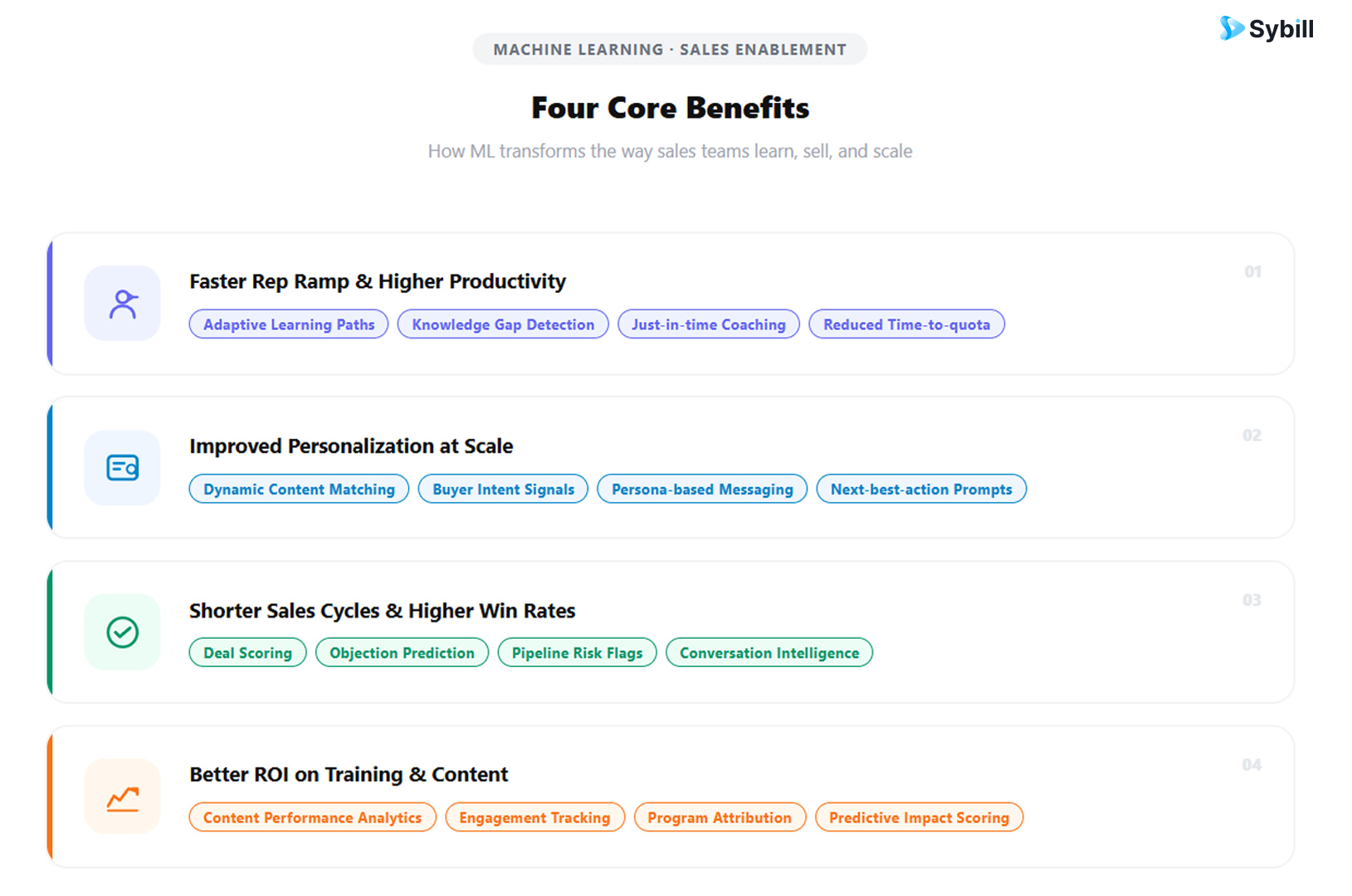
Salesforce’s 2026 State of Sales reports once again shows that reps spend roughly 40% of their time actually selling.
ML reduces manual admin, surfaces insights faster, and eliminates time spent searching for information.
That means more time in active conversations and faster onboarding for new hires.
Machine learning in sales enablement supports this by identifying patterns in buyer behavior and suggesting relevant content, messaging angles, or next steps.
Personalization moves from manual effort to scalable intelligence.
Short sales cycles are every rep’s dream. When reps act on predictive signals rather than intuition alone, deals move with greater precision.
ML highlights:
Teams that can act earlier in the cycle reduce stagnation and increase close probability.
Enablement investments are expensive.
Machine learning for sales enablement tracks which content actually influences deals and which coaching interventions improve performance.
That alignment reduces wasted spend and strengthens revenue attribution.
It’s important to clarify what machine learning in sales enablement does not do.
It does not replace sales reps.
It does not eliminate human judgment.
It is not a magic button that guarantees closed-won outcomes.
And it is not just a feature checkbox on a vendor comparison sheet.
Machine learning works best when paired with experienced sellers who know how to interpret and act on insights.
Think of ML as augmented intelligence. It expands decision-making capacity. It does not override it.
Human strategy plus machine precision is the winning formula.
Sales has entered its Moneyball era.
The teams that rely solely on intuition will not disappear. They will simply get outpaced.
Understanding machine learning in sales enablement is no longer optional. It is a prerequisite for competitive advantage.
Platforms like Sybill operationalize this shift by turning sales conversations into structured insights, surfacing automated summaries, highlighting coaching signals, and helping teams act on real patterns instead of assumptions.
Machine learning for sales enablement equips sellers with intelligence that compounds over time.
And in the 2026 sales game, compounding intelligence wins.
Machine learning in sales enablement is critical in 2026 because sales cycles are more complex, buying committees are larger, and gut-based forecasting is no longer reliable. ML in sales enablement turns raw sales data into predictive insights, helping teams detect deal risk early, prioritize high-value opportunities, personalize engagement, and coach reps more effectively. It transforms enablement from content distribution into revenue intelligence.
Artificial intelligence is the broader category that includes automation, rule-based systems, and generative tools. Machine learning for sales enablement is a subset of AI focused specifically on recognizing patterns in data and making predictive recommendations. In short, AI can automate tasks, while ML in sales enablement learns from behavior to guide smarter decisions.
Machine learning for sales enablement improves forecasting accuracy, accelerates rep ramp time, enables personalized outreach, and supports data-driven coaching. By reducing manual admin and surfacing actionable insights, ML for sales enablement helps revenue teams prioritize better, shorten sales cycles, and increase win rates without replacing human judgment.
Machine learning in sales enablement is critical in 2026 because sales cycles are more complex, buying committees are larger, and gut-based forecasting is no longer reliable. ML in sales enablement turns raw sales data into predictive insights, helping teams detect deal risk early, prioritize high-value opportunities, personalize engagement, and coach reps more effectively. It transforms enablement from content distribution into revenue intelligence.
Artificial intelligence is the broader category that includes automation, rule-based systems, and generative tools. Machine learning for sales enablement is a subset of AI focused specifically on recognizing patterns in data and making predictive recommendations. In short, AI can automate tasks, while ML in sales enablement learns from behavior to guide smarter decisions.
Machine learning for sales enablement improves forecasting accuracy, accelerates rep ramp time, enables personalized outreach, and supports data-driven coaching. By reducing manual admin and surfacing actionable insights, ML for sales enablement helps revenue teams prioritize better, shorten sales cycles, and increase win rates without replacing human judgment.