Find us at booth #83, join us for a harbor side happy hour, or catch Gorish’s talk.

Sept, 16-18 > Learn more


Tamanna Mishra

March 12, 2026
Rep says, “Deal looks good.”
Manager asks, “Based on what?”
Silence.
We’ve all been there. The pipeline “feels” healthy. The forecast “looks” solid. Confidence is high. Until it isn’t.
This is the exact moment where gut instinct collides with reality.
It’s the same shift baseball went through in Moneyball. Teams that trusted intuition and tradition got outplayed by teams that trusted data patterns. Not because the old managers were lazy. Because they were guessing in a game that no longer rewarded guessing.
Sales is in its Moneyball era right now.
Buyers are more informed. Cycles are longer. Stakeholders are invisible until late stage. And intuition alone is not enough because it often comes from happy ears.
That is where ML in sales enablement use cases come into play. Not as abstract AI hype. Not as another dashboard layered on top of your stack. But as intelligence that reads patterns across deals, conversations, and buyer behavior.
Machine learning in sales enablement is the shift from “I think this will close” to “Here’s what the data says about why it will or won’t.”
In this blog, we are breaking down real ML in sales enablement use cases that modern revenue teams are applying today to drive productivity, improve forecasting, strengthen coaching, and win more deals.
Less guesswork.
More signal.
Smarter pipelines.
The sales environment has changed. Dramatically.
Buyers are more informed than ever. By the time a prospect agrees to a discovery call, they have already compared competitors, read reviews, scanned pricing pages, and built internal consensus. Sales cycles are longer. Buying committees are larger. Risk tolerance is lower.
At the same time, reps are stretched thin. According to Salesforce’s recent State of Sales research, sellers spend roughly 40 percent of their time actually selling. The rest is consumed by admin work, internal updates, research, and tool switching.
That gap is expensive.
High-performing teams are responding differently. Research consistently shows that top revenue organizations are significantly more likely to embed AI and ML tools into their sales workflows. Not as experiments. As operating systems.
Sales enablement itself is evolving. It used to focus on distributing content and running training sessions. Today, it is shifting toward decision intelligence.
Also read: What is machine learning in sales enablement?
This is where machine learning for sales enablement moves from a nice enhancement to revenue infrastructure.
ML for sales enablement helps teams prioritize the right deals, surface the right insights, and coach the right behaviors at the right time. ML in sales enablement is becoming a competitive differentiator because it reduces guesswork in an environment that punishes guesswork.
The market is not slowing down. Buyers are not getting simpler. Complexity is the new baseline.
So let’s get concrete. Here are the ML in sales enablement use cases that actually move numbers.
Theory is interesting. Revenue is better.
Here are five ML in sales enablement use cases that modern sales teams are applying right now to drive measurable impact. Each one follows the same pattern: problem, ML capability, real execution, business outcome.
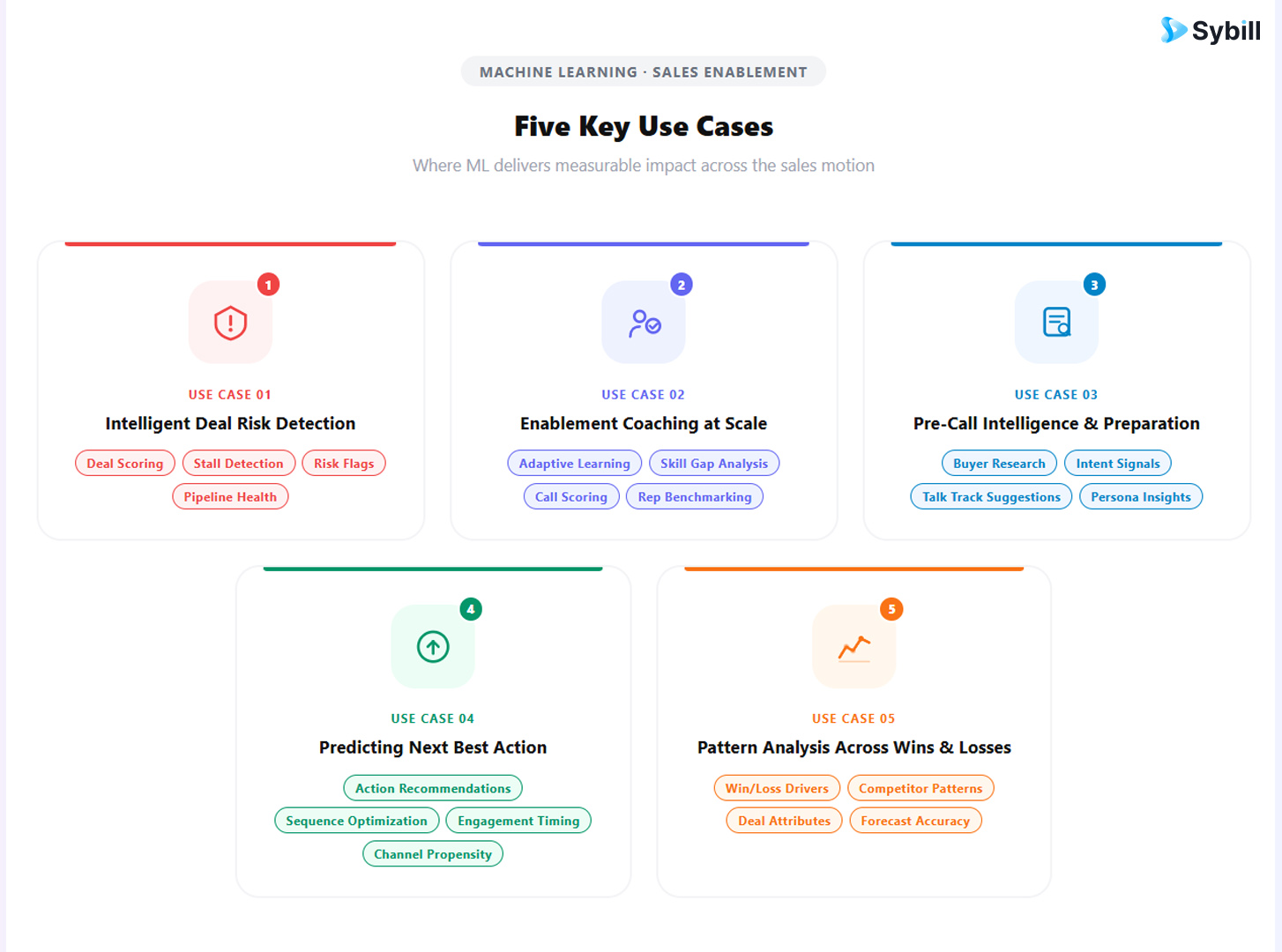
Problem:
Managers often discover deal risk at the worst possible time. End of quarter. Forecast locked. Pressure high. Suddenly a “strong” deal goes dark.
The issue is not lack of effort. It is lack of signal.
ML capability:
Machine learning in sales enablement analyzes patterns across:
Instead of waiting for reps to flag risk manually, ML models detect early warning signals.
This is one of the most critical ML in sales enablement use cases because it directly protects revenue.
How Sybill delivers machine learning in sales enablement:
Outcome:
Proactive intervention instead of reactive damage control.
Problem:
Sales managers do not have time to review every call. Coaching becomes selective, inconsistent, or reactive.
Top performers get better. Struggling reps stay stuck.
ML capability:
Conversation intelligence models detect patterns such as:
Machine learning for sales enablement turns every call into analyzable data.
This transforms coaching from random sampling to systematic improvement.
How Sybill delivers machine learning in sales enablement:
Outcome:
Scalable coaching without calendar overload.
This is where ML for sales enablement becomes performance infrastructure, not just analytics. It embeds improvement into daily workflows.
Problem:
Reps often walk into calls underprepared. They skim notes. They rely on memory. They forget past objections.
Buyers notice.
ML capability:
Machine learning in sales enablement aggregates:
Instead of digging through CRM manually, ML compiles contextual insight automatically.
How Sybill delivers machine learning in sales enablement:
Outcome:
Higher-quality discovery conversations. Stronger buyer trust. More strategic positioning.
Among ML in sales enablement use cases, this one directly impacts buyer perception.
Problem:
Complex deals stall because reps hesitate. They are unsure whether to escalate, bring in an executive, send content, or push for a close.
Uncertainty creates stagnation.
ML ccapability:
ML analyzes patterns across successful deals to identify:
Machine learning for sales enablement shifts reps from reactive to guided execution.
How Sybill delivers machine learning in sales enablement:
Outcome:
Reduced deal stagnation. Faster velocity. More confident execution.
This is one of the most practical ML in sales enablement use cases because it directly influences daily behavior.
Problem:
Post-mortems are often anecdotal.
“We lost on price.”
“They liked a competitor.”
“It just wasn’t the right time.”
Without structured analysis, teams repeat the same mistakes.
ML capability:
Machine learning in sales enablement aggregates thousands of interactions to identify:
Instead of isolated deal reviews, ML builds pattern intelligence.
How Sybill delivers machine learning in sales enablement:
Outcome:
Data-backed enablement strategies instead of gut instinct.
Among all ML in sales enablement use cases, this one compounds over time. The more data you feed the system, the smarter your strategy becomes.
Also read:
Not all ML is created equal.
When evaluating machine learning for sales enablement, prioritize operational impact over feature count.
Use this checklist:
If the answer is no to most of these, you are buying reporting, not intelligence.
Machine learning in sales enablement should make work lighter, decisions sharper, and outcomes more predictable.
Anything less is just tech noise.
Machine learning in sales enablement can be a revenue accelerator. Or it can become an expensive science project.
Here’s where teams go wrong.
1. Treating ML like a reporting dashboard
If your ML for sales enablement tool just shows charts after the fact, that’s not intelligence. That’s analytics.
Machine learning should influence decisions before deals slip, not explain them after they’re lost.
2. Not aligning ML insights with enablement programs
Insights without action are noise.
If ML flags weak discovery skills but your training doesn’t adapt, you’ve wasted the signal. ML in sales enablement must connect directly to coaching and behavior change.
3. Ignoring adoption and workflow integration
If reps have to log into another system to “check the ML,” it’s already dead.
Machine learning in sales enablement only works when it lives inside CRM, call workflows, and daily execution.
4. Buying tools that don’t surface real ML in sales enablement use cases
Buzzwords are cheap.
Ask: What real decisions does this change? What real behaviors does this improve?
If it cannot point to concrete ML in sales enablement use cases tied to revenue, it is decoration, not infrastructure.
Machine learning should reduce friction, not add complexity.
If it feels heavier after implementation, something is wrong.
Automation saves time. Advantage wins revenue.
Machine learning for sales enablement is transforming how revenue teams operate because it shifts sales from reactive execution to pattern-driven precision. It moves teams from “I think” to “Here’s the signal.” From guesswork to guided action.
The real power of ML in sales enablement is not in flashy dashboards. It’s in everyday decisions. Which deal needs attention. Which rep needs coaching. Which message moves this buyer forward. Which signal predicts risk.
That is where Sybill fits.
Sybill operationalizes ML in sales enablement use cases inside daily workflows. It does not sit on top of your stack as another tool to check. It works inside it.
It turns conversations into structured intelligence.
It turns intelligence into clear next steps.
It turns next steps into momentum.
The teams that win in 2026 will not be the ones with the biggest pipelines.
They will be the ones with the smartest ones.
Machine learning in sales enablement refers to the use of data-driven models that analyze sales conversations, CRM activity, buyer engagement, and historical deal patterns to generate predictions and recommendations. Unlike static reporting, ML in sales enablement continuously learns from new interactions to improve lead prioritization, coaching insights, forecasting accuracy, and next-best-action guidance.
ML in sales enablement improves performance by identifying patterns humans miss. It can detect deal risk early, highlight coaching gaps, recommend relevant content, and suggest next steps based on successful past deals. Machine learning for sales enablement reduces guesswork, increases rep productivity, and supports more accurate forecasting, which directly impacts revenue outcomes.
Common ML in sales enablement use cases include predictive lead scoring, deal risk detection, automated CRM data capture, conversation analysis for coaching, and next-best-action recommendations. These use cases help revenue teams prioritize high-value opportunities, personalize outreach, scale coaching, and make data-backed decisions throughout the sales cycle.
Machine learning in sales enablement refers to the use of data-driven models that analyze sales conversations, CRM activity, buyer engagement, and historical deal patterns to generate predictions and recommendations. Unlike static reporting, ML in sales enablement continuously learns from new interactions to improve lead prioritization, coaching insights, forecasting accuracy, and next-best-action guidance.
ML in sales enablement improves performance by identifying patterns humans miss. It can detect deal risk early, highlight coaching gaps, recommend relevant content, and suggest next steps based on successful past deals. Machine learning for sales enablement reduces guesswork, increases rep productivity, and supports more accurate forecasting, which directly impacts revenue outcomes.
Common ML in sales enablement use cases include predictive lead scoring, deal risk detection, automated CRM data capture, conversation analysis for coaching, and next-best-action recommendations. These use cases help revenue teams prioritize high-value opportunities, personalize outreach, scale coaching, and make data-backed decisions throughout the sales cycle.