Find us at booth #83, join us for a harbor side happy hour, or catch Gorish’s talk.

Sept, 16-18 > Learn more

%20(1).avif)
Mamta Tainwala

February 28, 2026
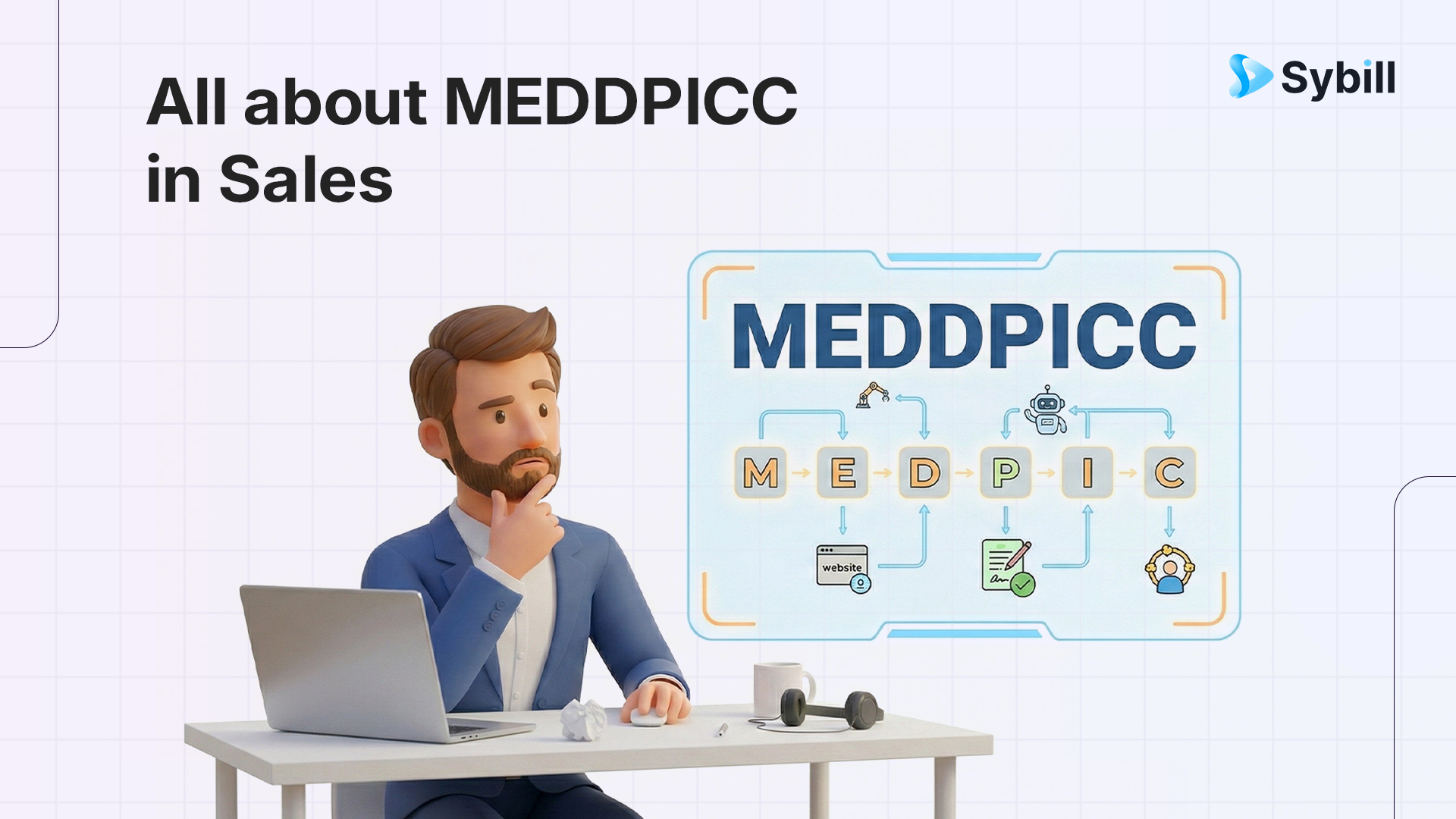
TL;DR If you cannot name your Economic Buyer, confirm your champion has real influence, or tell your manager what the paper process looks like, you do not have a qualified deal. You have a relationship. MEDDPICC is the 8-element framework that forces those answers early, before you sink weeks into a deal that was never going to close. Teams running it properly report 30% higher win rates and 40% shorter sales cycles. The biggest reason most teams fail at it is not the framework itself but the documentation burden that comes with it. Reps skip logging after calls, CRM fields stay empty, and the framework becomes a training slide nobody references. The fix is AI that captures qualification signals from every call automatically and pushes them into your CRM without reps lifting a finger. That is what this guide is about: running MEDDPICC in a way that actually sticks.
MEDDPICC is the Moneyball of B2B sales qualification.
Most sales teams lose deals not because their product is wrong, but because they chased the wrong deals with the wrong information and got surprised at the finish line. MEDDPICC removes that surprise. It gives every rep a structured lens to evaluate whether a deal is genuinely progressing, or whether it is a well-disguised pipeline fantasy sitting in your CRM making your forecast look better than it is.
This guide breaks down everything you need to implement MEDDPICC effectively, from each element and the questions that unlock it, to the metrics that tell you it is working, to how Sybill takes the documentation burden off your reps so the framework actually gets used in real deals.
MEDDPICC is a sales qualification framework designed for complex, high-value B2B deals where multiple stakeholders are involved, decision timelines are long, and the cost of chasing the wrong opportunity is high.
It was derived from MEDDIC, which originated at PTC in the 1990s and became one of the most adopted enterprise sales frameworks in history. MEDDPICC expands the original by adding Paper Process and Competition, making it especially relevant for today's B2B environment, where procurement red tape and competitive pressure are constants, not exceptions.
The framework works by ensuring that before any rep invests serious time in a deal, they can answer eight fundamental questions about it. If they cannot, they know exactly where to focus their next conversation.
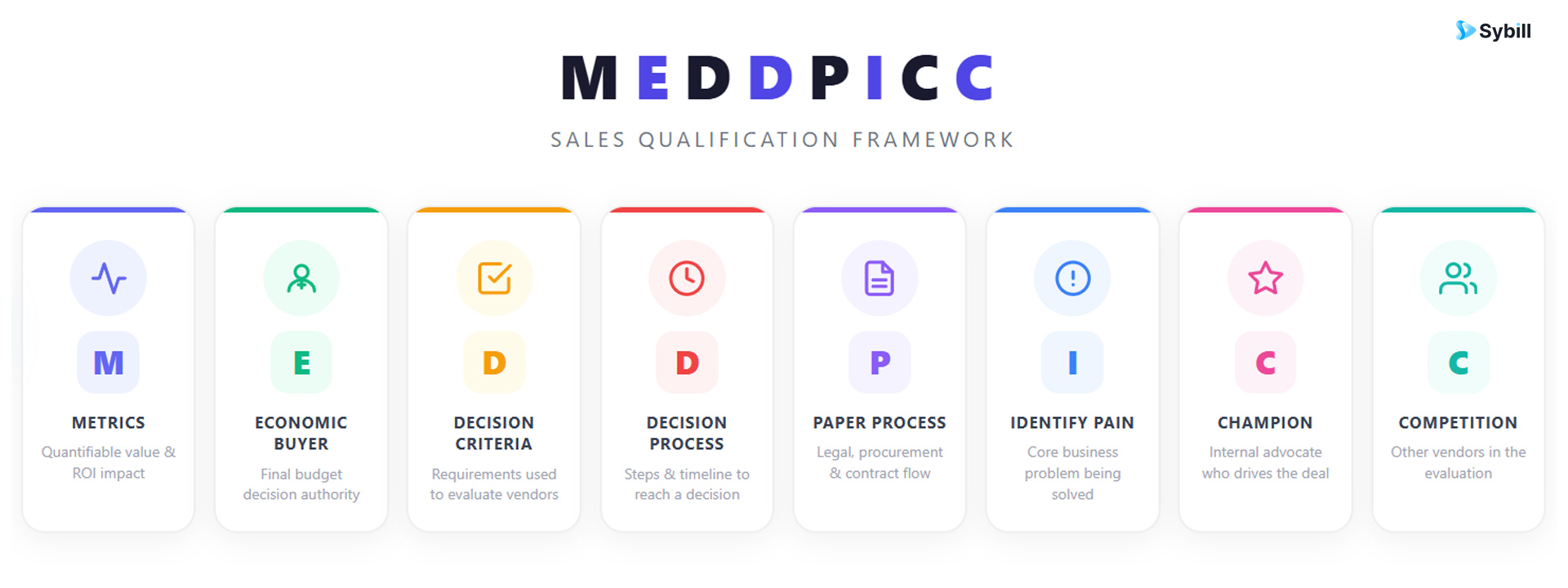
What measurable outcome does the customer expect from your solution? Cost savings, revenue growth, time saved, error reduction? If a prospect cannot articulate a specific number they are trying to move, you are not talking to someone who is ready to buy. Metrics also become your ammunition later: they make the business case concrete and give the Economic Buyer something to defend internally.
This is the person who can say yes when everyone else says no, and no when everyone else says yes. They may not be your day-to-day contact. In fact, they often are not. Understanding who the Economic Buyer is, what they care about, and whether your champion has real access to them is one of the clearest signals of deal health.
How will they evaluate solutions? What matters most, and why? Decision criteria are often heavily influenced by whoever set them, so understanding the origin of those criteria tells you a lot about where your competitors stand and where you need to strengthen your position.
Who is involved in making the decision, what are their roles, and what does the sequence of approvals look like? Knowing the process means you are never caught off guard by a "we need to loop in legal" the week you expected to close. It also helps you time your outreach and content to match each stakeholder's moment in the journey.
This is the one element most reps discover too late. Paper process covers legal review, procurement timelines, vendor approval processes, and signature authority. In enterprise deals, the paper process alone can add four to eight weeks to a close. Understanding it early means you can build it into your timeline before your manager asks why Q4 deals are slipping.
Pain is what creates urgency. A prospect who cannot articulate a specific, felt problem has no real reason to buy. The goal here is not just to surface the pain but to implicate it: help the buyer connect what is wrong today to what it is costing them, and position your solution as a painkiller rather than a vitamin. For more on surfacing buyer needs effectively, Sybill's buyer needs and intent intelligence gives revenue teams a structured view of what buyers are actually saying across every call.
Your champion is the insider who wants you to win and has the credibility to make it happen. They attend the internal meetings you are not in. They ask the questions on your behalf. They are the difference between a deal that moves and a deal that stalls while everyone "circles back." A champion without influence is just a fan. Qualifying champion strength is one of the most underrated skills in enterprise sales.
Who else is in this deal, and what do they have that you do not? How aware is your buyer of those gaps, and how are you addressing them? Understanding the competitive landscape helps you sharpen your positioning and ensures you are not surprised when the prospect mentions a competitor's feature in the final demo. Sybill's competitor intelligence feature tracks when and how competitors show up across your deals automatically.
Great qualification is not an interrogation. It is a series of conversations where the right questions open doors. Here are the essential ones:
Metrics: "What does success look like in measurable terms six months from now? What would need to change in your business to make this investment worth it?"
Economic Buyer: "Who ultimately has the authority to approve this purchase? Have you presented solutions to them before at this price point?"
Decision Criteria: "How are you evaluating your options? Who set those criteria, and are they likely to shift during the evaluation?"
Decision Process: "Walk me through how a decision like this typically gets made. Who needs to be aligned, and in what order do those conversations happen?"
Paper Process: "Once a decision is made, what does the contracting process look like? Is there a procurement or legal review involved, and how long has that typically taken?"
Identify Pain: "What happens if this problem is not solved in the next six months? What is it costing you today, in real terms?"
Champion: "Who else internally is behind solving this? How do they typically influence decisions like this?"
Competition: "Are you evaluating other solutions? What do you like about what you have seen so far?"
These questions surface the intelligence that separates a well-qualified deal from one that will ghost you at legal review. And when Sybill records and analyzes your calls, the answers to these questions are automatically captured, organized, and pushed into your CRM through CRM Autofill, so none of it gets lost between calls.
These three frameworks share the same foundation and differ only in scope:
MEDDIC (the original) covers Metrics, Economic Buyer, Decision Criteria, Decision Process, Identify Pain, and Champion. It is powerful for mid-market sales where competition and procurement complexity are lower.
MEDDICC adds a second C for Competition. This reflects how the B2B landscape changed, particularly in SaaS, where the "build vs. buy" question and multi-vendor evaluations are now standard parts of every deal.
MEDDPICC adds Paper Process on top of that. This is the version most enterprise sales teams need because legal and procurement timelines are often deal-breakers hiding in plain sight. For a team selling into larger organizations with legal review, InfoSec approvals, or multi-level signature authority, running MEDDIC without the P is like planning a road trip without checking for construction zones.
The right version for your team depends on your deal complexity, average contract value, and the size of the organizations you sell into. For most modern B2B sales teams, MEDDPICC is the one worth learning properly.
MEDDPICC works best for sales teams that:
It is not the right framework for transactional sales with short cycles and single decision-makers. In those cases, simpler qualification like BANT works fine. But for account executives working enterprise or mid-market deals, and for sales managers who need pipeline confidence heading into forecast calls, MEDDPICC is the standard worth committing to.
Adopting MEDDPICC without measuring its impact is like running a new playbook without watching the film. Here are the metrics that tell you whether the framework is working:
Win rate: The percentage of pursued deals that close. MEDDPICC should increase this number by helping reps disqualify bad-fit deals earlier rather than dragging them through to a no.
Sales cycle length: How long it takes from first meeting to closed deal. Better early qualification removes false deals from the pipeline and reduces the average time spent per won deal.
Average deal size: Teams running MEDDPICC tend to focus on higher-value opportunities, which often increases average contract value over time.
Conversion rate by stage: Where are deals dropping off? If deals consistently stall after the proposal stage, the Paper Process element likely needs more attention early in the cycle.
Champion engagement score: A qualitative but important signal. If your champion is responsive, attending calls, and advocating internally, the deal is healthy. If they go quiet, something has shifted.
For sales leaders trying to track these metrics without manual data collection, Sybill's deal inspection surfaces qualification gaps across the entire pipeline automatically, flagging deals with weak or missing MEDDPICC fields before they become forecast surprises.
Ready to run MEDDPICC without the documentation grind? Get started for free with Sybill and let AI handle the field updates while your reps handle the conversations.
There are a lot of sales frameworks out there. MEDDPICC has stuck around and spread because it solves a real problem: most sales reps are optimists by nature, and optimism without structure leads to bloated pipelines full of deals that will never close.
MEDDPICC gives reps a shared language for deal health. It gives managers a consistent lens for pipeline reviews. It gives leaders a more honest forecast because qualification criteria are explicit, not assumed.
Companies that implement MEDDPICC report average win rate increases of 30% and sales cycle reductions of 40%, according to MEDDIC Academy. Those are not small gains. They are the difference between hitting quota and missing it.
The framework also scales. Whether you have a team of five or fifty, MEDDPICC gives every rep the same qualification standard, which means your coaching conversations become less about chasing status updates and more about improving how deals are actually run. For a deeper look at how AI agents can help managers drive that kind of coaching at scale, AI agents for sales managers is worth a read.
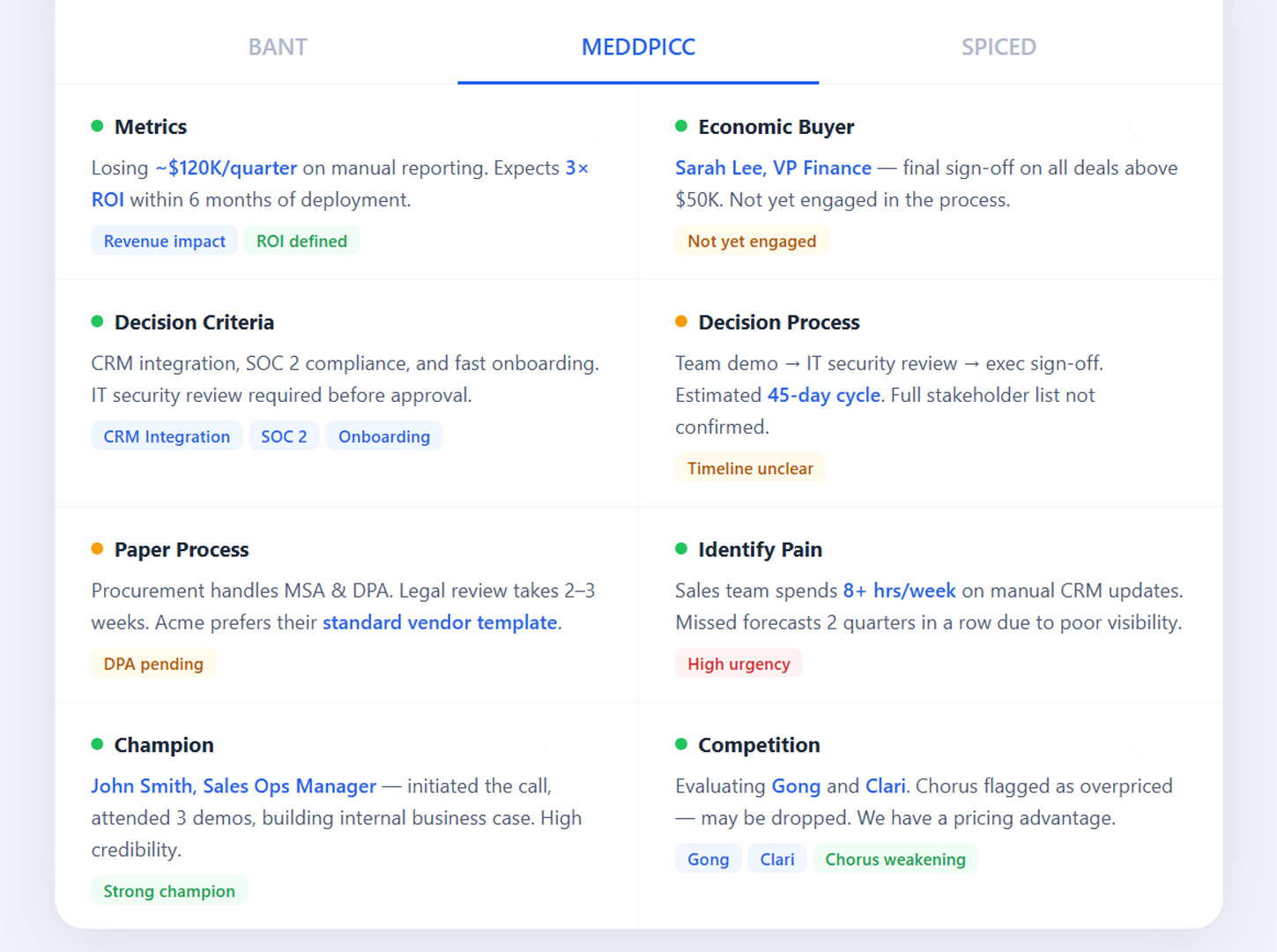
Here is the honest problem with MEDDPICC: the framework is excellent, and the documentation is painful. Reps finish a complex call with five new insights about the deal and zero appetite for logging them into CRM fields before their next meeting. So the fields stay empty. The pipeline stays opaque. The framework that was supposed to create clarity becomes wallpaper.
Sybill fixes this by removing documentation from the equation entirely.
When a rep finishes a call, Sybill's Magic Summaries produce a structured breakdown of what was discussed, including the buyer's pain points, expressed timeline, stated concerns, and next steps. The relevant MEDDPICC fields in your CRM update automatically through CRM Autofill, with no manual input from the rep. Champion strength, competition mentioned, paper process timeline, decision criteria shared: all of it is captured and pushed to the right place.
For reps, this means they walk into the next call already briefed on where the deal stands qualification-wise, using Sybill's pre-meeting briefs. For managers, it means deal inspection shows which deals have full qualification and which have gaps, without asking reps to update anything manually.
Beyond just call capture, Sybill's deal summaries synthesize the entire deal lifecycle, so qualification information does not live in a single call recording but in a running, updated picture of the opportunity. And when reps or managers need to dig into specifics across multiple calls, Ask Sybill lets them query across calls the way you would ask a colleague: "What did the CFO say about their budget timeline?" or "Has competition come up in any of the last three calls on this deal?"
The result is a team that actually runs MEDDPICC rather than one that knows about it but never finds the time to log it. Understanding how call summaries elevate sales teams and how AI makes sales call transcripts actionable gives useful context on why the capture layer matters just as much as the framework itself.
Start with one element at a time. Trying to enforce all eight elements on day one creates friction. Pick the two or three most commonly missing in your current deals and build rigor there first.
Make it part of pipeline reviews, not a separate exercise. MEDDPICC should be the language of your deal reviews, not a form reps fill out separately. When managers ask "who is the champion?" in every pipeline conversation, the habit forms naturally.
Use data to coach, not just status updates. Once MEDDPICC data is consistently in your CRM, you can see patterns: deals without confirmed Economic Buyer access close at a lower rate. Deals where paper process is undiscovered slip by an average of three weeks. That intelligence makes coaching conversations specific and credible. For more on best practices for CRM note-taking that support this, the full guide is worth bookmarking.
Customize to your deal type. MEDDPICC is a framework, not a scripture. Some teams weight Champion strength more heavily. Others find that paper process is rarely a factor in their deals. Tailor the emphasis to where your deals actually get stuck. For teams thinking about broader sales strategy in the context of SaaS, MEDDPICC sits naturally alongside other frameworks worth combining.
What does MEDDPICC stand for?
MEDDPICC stands for Metrics, Economic Buyer, Decision Criteria, Decision Process, Paper Process, Identify Pain, Champion, and Competition. It is an eight-element sales qualification framework used primarily in complex B2B sales cycles.
What is the difference between MEDDIC and MEDDPICC?
MEDDIC is the original six-element framework: Metrics, Economic Buyer, Decision Criteria, Decision Process, Identify Pain, and Champion. MEDDICC adds Competition. MEDDPICC adds both Competition and Paper Process. The right version depends on how competitive your market is and how complex the contracting process is for your typical deal.
Is MEDDPICC only for enterprise sales?
Not exclusively, but it is best suited to deals with multiple stakeholders, significant contract values, and longer sales cycles. Mid-market B2B sales teams increasingly use it as deal complexity in that segment has grown. Transactional SMB sales with short cycles are generally better served by simpler frameworks.
How does MEDDPICC improve forecast accuracy?
When every deal in your pipeline has explicit answers to all eight MEDDPICC elements, you can assess deal health objectively rather than relying on rep sentiment. Deals without a confirmed Economic Buyer or with unresolved paper process flags surface as risks early, not at the end of the quarter. That gap between a confident commit and actual close often lives in those missing fields.
How do you get reps to actually use MEDDPICC in deals?
The biggest barrier is documentation burden. If reps have to manually log eight fields after every call, compliance drops fast. The most effective teams solve this by automating capture: tools like Sybill pull MEDDPICC-relevant information directly from call recordings and update CRM fields automatically, so the framework lives in your data without adding to reps' admin load.
Can MEDDPICC be used alongside other sales methodologies?
Yes. MEDDPICC is a qualification framework, not a full sales methodology. It works well alongside SPIN Selling, Challenger, Command of the Message, or any methodology that guides how reps run conversations. MEDDPICC answers "should we be in this deal?" while other methodologies answer "how do we win it?"
MEDDPICC stands for Metrics, Economic Buyer, Decision Criteria, Decision Process, Paper Process, Identify Pain, Champion, and Competition. It is an eight-element sales qualification framework used primarily in complex B2B sales cycles.
MEDDIC is the original six-element framework: Metrics, Economic Buyer, Decision Criteria, Decision Process, Identify Pain, and Champion. MEDDICC adds Competition. MEDDPICC adds both Competition and Paper Process. The right version depends on how competitive your market is and how complex the contracting process is for your typical deal.
Not exclusively, but it is best suited to deals with multiple stakeholders, significant contract values, and longer sales cycles. Mid-market B2B sales teams increasingly use it as deal complexity in that segment has grown. Transactional SMB sales with short cycles are generally better served by simpler frameworks.