Find us at booth #83, join us for a harbor side happy hour, or catch Gorish’s talk.

Sept, 16-18 > Learn more


Tamanna Mishra

May 15, 2026
.png)
Sales coaching software helps managers move beyond random call reviews, generic advice, and CRM guesswork. The best AI sales coaching tools analyze real buyer conversations, surface coachable moments, connect insights to active deals, and help reps execute better after every call. If your coaching still depends on memory, scattered notes, and one-off feedback, you are not coaching. You are hoping.
Forecast calls. Pipeline reviews. Slack pings. CRM cleanup. Deal escalations. One rep needs help with pricing. Another forgot to send the follow-up. Someone updated the wrong close date. Someone else has “strong verbal interest” from a buyer who has not replied in nine days.
And somewhere inside this circus, the manager is supposed to coach.
That is why most sales coaching programs collapse under the weight of reality. Not because managers do not care. Not because reps do not want to improve. But because coaching is often built on broken inputs: a few call recordings, incomplete CRM notes, one rep’s version of events, and a manager’s already fried memory.
Sales coaching software changes that equation.
The right platform turns real sales conversations into coaching insights, deal context, CRM updates, follow-up actions, and performance patterns. It helps managers stop coaching from vibes and start coaching from evidence.
And no, this does not mean turning managers into dashboard goblins who spend their lives clicking through call snippets. The best AI sales coaching software gives managers sharper visibility and gives reps clearer next steps.
That is the whole point. Sales coaching should not feel like a quarterly performance autopsy. It should feel like a live operating system for better selling.
Sales coaching software helps sales managers analyze rep performance, review customer conversations, identify skill gaps, and coach sellers using real sales data.
At its simplest, it gives managers a better way to understand what is happening across calls, emails, CRM updates, and deal movement. At its best, it becomes the connective tissue between coaching, pipeline inspection, rep execution, and revenue outcomes.
Modern sales coaching tools can include:
But here is the important distinction: sales coaching software is not the same as sales training software.
Training teaches reps what good selling looks like. Coaching helps them apply it in real deals.
Training says, “Here is how to run discovery.”
Coaching says, “On this call, you asked three surface-level questions, missed the economic buyer’s priority, and moved to demo before understanding urgency.”
That level of specificity is where performance improves.
Traditional sales coaching usually looks great in a slide deck and terrible in the real world.
The manager is expected to review calls, inspect deals, identify rep-specific gaps, improve messaging, help with objection handling, track CRM hygiene, support onboarding, and still hit the number.
That is a lot. Even for the manager who color-codes everything and claims their calendar is “under control.”
The problem is not effort. The problem is visibility.
Most managers coach from partial information. They hear one call and assume it reflects a pattern. They read a CRM note and assume the deal is healthier than it is. They ask a rep how the meeting went and get a polished version of the truth.
Sales teams do not lose deals only because reps lack talent. They lose deals because nobody catches the weak signals early enough.
A vague next step. A pricing objection brushed aside. A champion who is not actually a champion. A buyer who seemed interested but never confirmed urgency. A competitor mentioned twice but never logged in CRM.
Traditional coaching catches these things too late.
AI sales coaching software catches them while they still matter.
AI sales coaching software gives managers a fuller picture of rep performance because it can analyze more conversations than any human manager realistically can.
That matters because sales coaching is not about one dramatic moment. It is about patterns.
Does a rep consistently interrupt prospects during discovery?
Do they talk about features before pain?
Do they fail to confirm next steps?
Do they avoid pricing conversations?
Do they miss competitor mentions?
Do they send weak follow-ups after strong calls?
These are coaching moments. But they are easy to miss when managers only review a few calls a week.
AI helps by turning sales conversations into structured insight. It can identify themes, objections, buyer sentiment, talk patterns, next steps, and deal risks. More importantly, it can help managers coach the actual behavior that affects pipeline, not just the obvious surface-level stuff.
A rep with low conversion may not need “more confidence.”
They may need to stop accepting vague answers during discovery.
A rep with stalled deals may not need “more activity.”
They may need to identify the real decision-maker earlier.
A rep with poor follow-through may not need “better time management.”
They may need automated next steps and stronger post-call execution.
That is where AI sales coaching software becomes more than a call review tool. It becomes a revenue performance system.
Sybill fits naturally into sales coaching because it does not treat coaching as a separate activity trapped inside call recordings.
It connects coaching to the full revenue workflow.
With Magic Summary, managers and reps get clean, accurate summaries from sales conversations without manually digging through recordings. With CRM Autofill, important deal context, buyer needs, pain points, objections, next steps, and qualification details can move into the CRM without reps spending their evening doing admin work.
That alone matters because coaching based on incomplete CRM data is like trying to diagnose a movie from five screenshots.
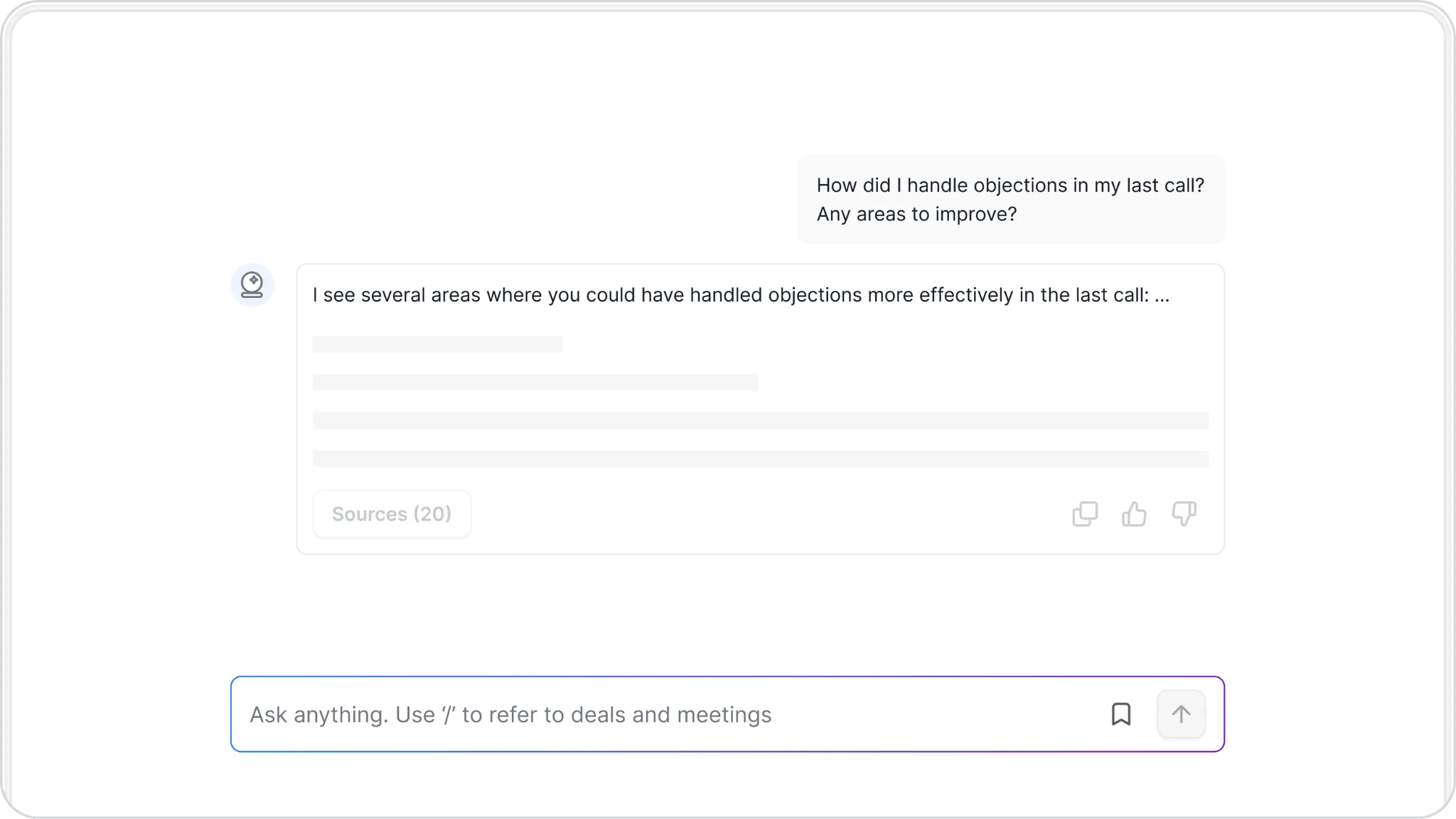
Sybill also helps managers inspect deal and rep performance through Ask Sybill. Instead of manually searching across calls, notes, and CRM fields, managers can ask questions like:
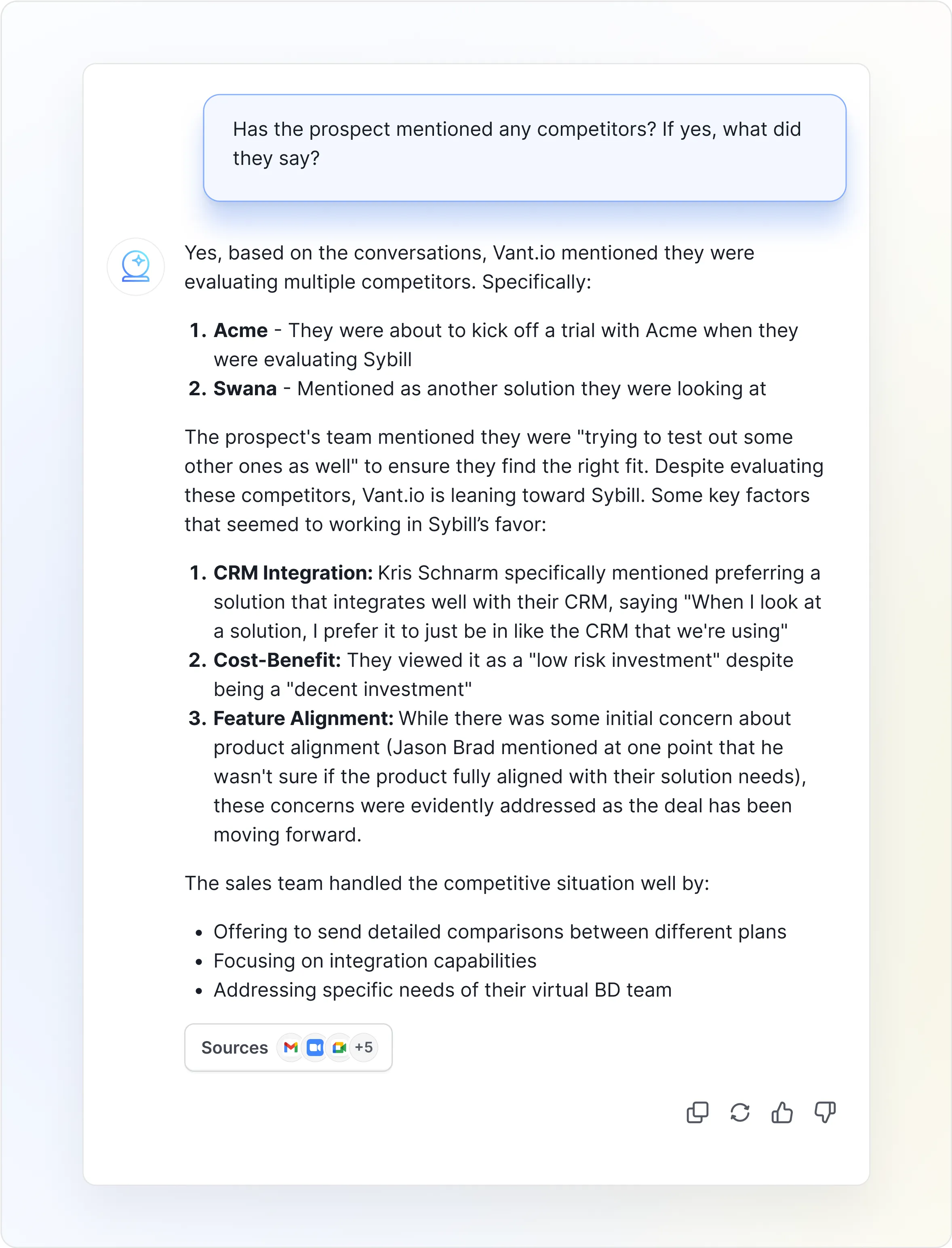
Then there is Personal Coach, which helps surface rep-level coaching opportunities. This is important because most coaching programs fail when every rep gets the same advice. The best reps do not need generic encouragement. They need sharper edges. Newer reps do not need information overload. They need specific, repeatable behaviors they can practice.
That is the difference between coaching as commentary and coaching as execution.
Sybill helps managers coach the gap between what happened in the buyer conversation and what the rep does next.

.png)
The point is not that AI replaces managers. But AI does remove the fog.
The manager still makes the judgment call. The manager still understands the person, the territory, the pressure, the deal dynamics, and the coaching relationship. But now they are not walking into every coaching conversation with three tabs open and a prayer.
Buying sales coaching software is tricky because every platform will claim it helps reps improve. That is the easy part. The harder question is whether the tool actually changes how managers coach and how reps execute.
.png)
A transcript is not coaching. It is a raw material.
Good sales call coaching software should help managers understand what happened in the conversation. That includes buyer objections, pain points, urgency, competitor mentions, stakeholder signals, pricing concerns, emotional cues, and follow-up commitments.
If the tool simply records the call and leaves managers to do the interpretation, it has only moved the work from one pile to another.
Sales conversations do not happen in a vacuum.
A rep may run a decent call, but the deal may still be at risk because the economic buyer is missing. A buyer may sound enthusiastic, but there may be no confirmed next step. A demo may feel smooth, but the conversation may reveal weak urgency.
This is why sales coaching software needs deal context.
Managers should be able to connect call behavior to pipeline reality. Otherwise, coaching becomes a performance review exercise instead of a revenue lever.
CRM hygiene is one of the most underrated coaching problems in sales.
If reps do not update the CRM properly, managers coach from bad data. If managers coach from bad data, reps get bad guidance. Then leadership wonders why the forecast looks like fiction with a login screen.
A strong sales coaching platform should reduce CRM admin and improve data quality. Sybill’s CRM Autofill is especially useful here because it helps capture important call and deal context without forcing reps to manually enter every detail.
Generic coaching is where momentum goes to die.
“Ask better questions” is not coaching.
“Build more urgency” is not coaching.
“Improve discovery” is not coaching.
Those are fortune cookie instructions.
Useful coaching sounds more like this:
“You asked about pain, but you did not quantify impact.”
“You accepted ‘we need to think about it’ without clarifying what still needs to be resolved.”
“You had a strong champion, but did not map the decision committee.”
“You moved to product features before confirming the business problem.”
Sales coaching software should help managers get to that level of specificity faster.
This is the part many coaching tools miss.
A great coaching insight is useless if nothing changes after the call. Reps need to follow up better, update CRM accurately, complete next steps, involve the right stakeholders, and keep momentum alive.
That is where Sybill’s Personalized Emails, AI Tasks, Deal Workspace, and Deal Pipeline become valuable. The platform helps connect coaching insight to actual sales execution.
Because the goal is not to produce prettier coaching notes. The goal is to move deals forward.
A tool does not magically create a coaching culture. You still need a system.
The best sales managers use AI sales coaching software to make coaching more consistent, specific, and tied to revenue outcomes.
Before you coach, diagnose.
Look across call data, CRM updates, deal outcomes, follow-up quality, and pipeline movement. Do not assume the loudest problem is the biggest problem.
For example, a manager may think a rep struggles with closing. But the real issue may be discovery. If the rep never builds urgency early, the close will always feel awkward later.
This is why conversation intelligence matters. It helps managers see where deals are really getting weak.
Bad coaching attacks identity.
“You need to be more assertive.”
“You are too passive.”
“You need more executive presence.”
That kind of feedback is vague, personal, and not especially useful.
Good coaching focuses on observable behavior.
“You did not ask who else would be involved in the decision.”
“You moved past the budget objection without clarifying whether it was a real blocker.”
“You sent a follow-up that summarized the call but did not confirm the next step.”
Behavior can be practiced. Personality labels just make people defensive.
Your best reps are already creating playbooks. They just may not be writing them down.
AI sales coaching software can help managers identify what top performers do differently. Maybe they ask sharper discovery questions. Maybe they handle pricing earlier. Maybe they confirm next steps more clearly. Maybe they involve executives before the deal stalls.
Once those patterns are visible, managers can turn them into coaching material for the rest of the team.
The goal is not to clone top reps. Nobody needs a sales floor full of identical LinkedIn avatars.
The goal is to make winning behaviors easier to understand, practice, and repeat.
Pipeline reviews and coaching should not live in separate rooms.
If a deal is stuck, there is usually a behavior behind it. Maybe the rep did not create urgency. Maybe they failed to multi-thread. Maybe the buyer never confirmed business impact. Maybe the next step is too soft.
Managers should use pipeline reviews to identify coaching opportunities, not just interrogate close dates.
This is where tools like Sybill can help because deal context, call summaries, CRM updates, and rep actions are connected. Managers can inspect what happened, what changed, what is missing, and what the rep should do next.
A sales coaching program should not be judged by how many sessions managers complete.
That is activity theater.
Measure whether coaching changes behavior and improves execution.
Useful metrics include:
The point is not to reduce people into numbers. The point is to stop pretending coaching is working just because it is happening.
Sales coaching software is useful across the rep lifecycle, from onboarding to performance improvement to deal rescue.
For new reps, it helps managers review early calls, identify gaps, and coach before bad habits become muscle memory. Instead of waiting until the end of the quarter to discover that a rep has weak discovery skills, managers can intervene early.
For experienced reps, it helps sharpen specific behaviors. Senior sellers do not always need more training. Often, they need better deal inspection, stronger executive alignment, or help breaking patterns that used to work but no longer do.
For remote sales teams, sales coaching tools are especially valuable. Managers cannot rely on floor energy, overheard calls, or quick desk-side coaching. They need visibility into conversations, follow-ups, and deal health without micromanaging people into madness.
For pipeline management, coaching software can reveal why deals are stuck. A stage two deal that has no clear pain, no economic buyer, and no next step is not a “commit.” It is a polite ghosting in progress.
For sales methodology adoption, AI coaching tools can help managers see whether reps are actually following frameworks like MEDDIC, SPICED, BANT, or Challenger. Not in theory. In actual conversations.
That is the only version that matters.
Sybill is a strong fit for sales teams that want coaching to be connected to real sales execution.
It is especially useful if your managers are tired of reviewing calls manually, chasing reps for CRM updates, guessing why deals are stuck, or giving feedback without enough context.
That matters because sales performance is rarely improved by one heroic coaching session.
It improves when better behaviors become easier to repeat.
Sybill helps managers see the work, coach the work, and improve the work.
If your team wants AI sales coaching software that connects call insights, CRM automation, deal inspection, and post-call execution, Sybill gives managers and reps the context they need to sell better without drowning in admin.
Try Sybill to see how it helps sales teams turn conversations into coaching, cleaner CRM, stronger follow-ups, and better deal execution.
Sales coaching has always mattered. That part is not new. What has changed is the standard.
Managers can no longer afford to coach from memory, incomplete CRM notes, and occasional call reviews. Reps cannot afford vague feedback that sounds good in a one-on-one but changes nothing in the next buyer conversation.
Modern sales teams need coaching that is specific, timely, data-backed, and connected to execution.
That is what sales coaching software should deliver.
Not more dashboards. Not more admin. Not another tool that tells managers what they already know too late.
The real promise of AI sales coaching software is simple: help managers see what is happening, understand what needs to change, and help reps act faster.
That is how coaching becomes more than a management ritual.
That is how it becomes a revenue advantage.
Sales coaching software is a tool that helps sales managers improve rep performance using call insights, conversation intelligence, CRM data, coaching workflows, and performance analytics. It helps managers identify skill gaps, review real sales conversations, coach specific behaviors, and track whether reps are improving over time.
The best sales coaching software depends on what your sales team needs. If you only need call recording, a basic conversation intelligence tool may be enough. If you want coaching connected to CRM updates, deal context, follow-ups, and next steps, Sybill is a strong option because it connects coaching insights to actual sales execution.
Sales training software teaches reps skills, concepts, and processes. Sales coaching software helps managers improve how reps apply those skills in real buyer conversations. Training is usually structured and curriculum-based. Coaching is ongoing, personalized, and tied to actual performance.
AI helps sales coaching by analyzing conversations, identifying objections, surfacing buyer signals, tracking rep behavior, summarizing calls, detecting deal risks, and helping managers personalize feedback. Instead of manually reviewing every call, managers can use AI to find patterns and coach the moments that matter most.
Look for conversation intelligence, deal context, CRM automation, rep-specific coaching insights, pipeline visibility, and execution support. The best AI sales coaching software should not just tell you what happened on a call. It should help managers understand what it means and help reps act on it.
Sales coaching software can improve the behaviors that influence win rates, such as discovery quality, objection handling, follow-up speed, next-step clarity, stakeholder mapping, and CRM accuracy. It does not magically close deals for reps, but it helps managers coach the skills and actions that make better outcomes more likely.
Sales managers use sales coaching tools to review calls, identify rep skill gaps, inspect deal risks, track methodology adoption, improve follow-ups, support onboarding, and coach reps based on real buyer conversations. The best managers use these tools to make coaching more specific, consistent, and connected to revenue.
Sales coaching software is a tool that helps sales managers improve rep performance using call insights, conversation intelligence, CRM data, coaching workflows, and performance analytics. It helps managers identify skill gaps, review real sales conversations, coach specific behaviors, and track whether reps are improving over time.
The best sales coaching software depends on what your sales team needs. If you only need call recording, a basic conversation intelligence tool may be enough. If you want coaching connected to CRM updates, deal context, follow-ups, and next steps, Sybill is a strong option because it connects coaching insights to actual sales execution.
Sales training software teaches reps skills, concepts, and processes. Sales coaching software helps managers improve how reps apply those skills in real buyer conversations. Training is usually structured and curriculum-based. Coaching is ongoing, personalized, and tied to actual performance.