Find us at booth #83, join us for a harbor side happy hour, or catch Gorish’s talk.

Sept, 16-18 > Learn more


Mamta Tainwala

May 19, 2026

The best sales reps do not wait for a manager to tell them what to improve. They self-diagnose, self-correct, and self-coach after every call. The right conversation intelligence tool makes that possible. Sybill leads the category with Ask Sybill (a natural language interface that lets reps query their own calls, get personalized coaching, run self-assessment prompts, and build self-improving feedback loops), plus call snippets, clip libraries, and win/loss analysis. Other tools with legitimate self-coaching capabilities include Outdoo (AI roleplay practice from real deal scenarios), Zoom Revenue Accelerator (real-time coaching during live calls), Jiminny (structured self-review with scorecards), and Modjo (call scoring and performance tracking). Here is what each delivers and where they fall short.
Here is an uncomfortable truth about sales coaching: most reps are undercoached. A study found that while 74% of reps say they would perform better with better coaching, only 26% feel they actually receive it. The bottleneck is not willingness. It is time. The average frontline sales manager has 8 to 10 direct reports, each running dozens of active deals. There are not enough hours to sit in on every call, review every recording, and deliver personalized feedback to every rep every week.
That gap between available coaching and needed coaching is where self-coaching becomes essential. Not as a replacement for manager-led development, but as the daily practice layer that makes scheduled coaching sessions dramatically more productive.
Self-coaching means a rep can finish a call, review their own performance, identify what worked and what did not, compare their approach to top performers, and walk into the next call with a specific improvement in mind, all without waiting for a 1:1 that might be three days away.
The best AI sales tools make self-coaching a natural part of the daily workflow rather than an extra task. They are platforms that actively surface coachable moments, let reps ask questions about their own patterns, and provide evidence-backed feedback on demand.
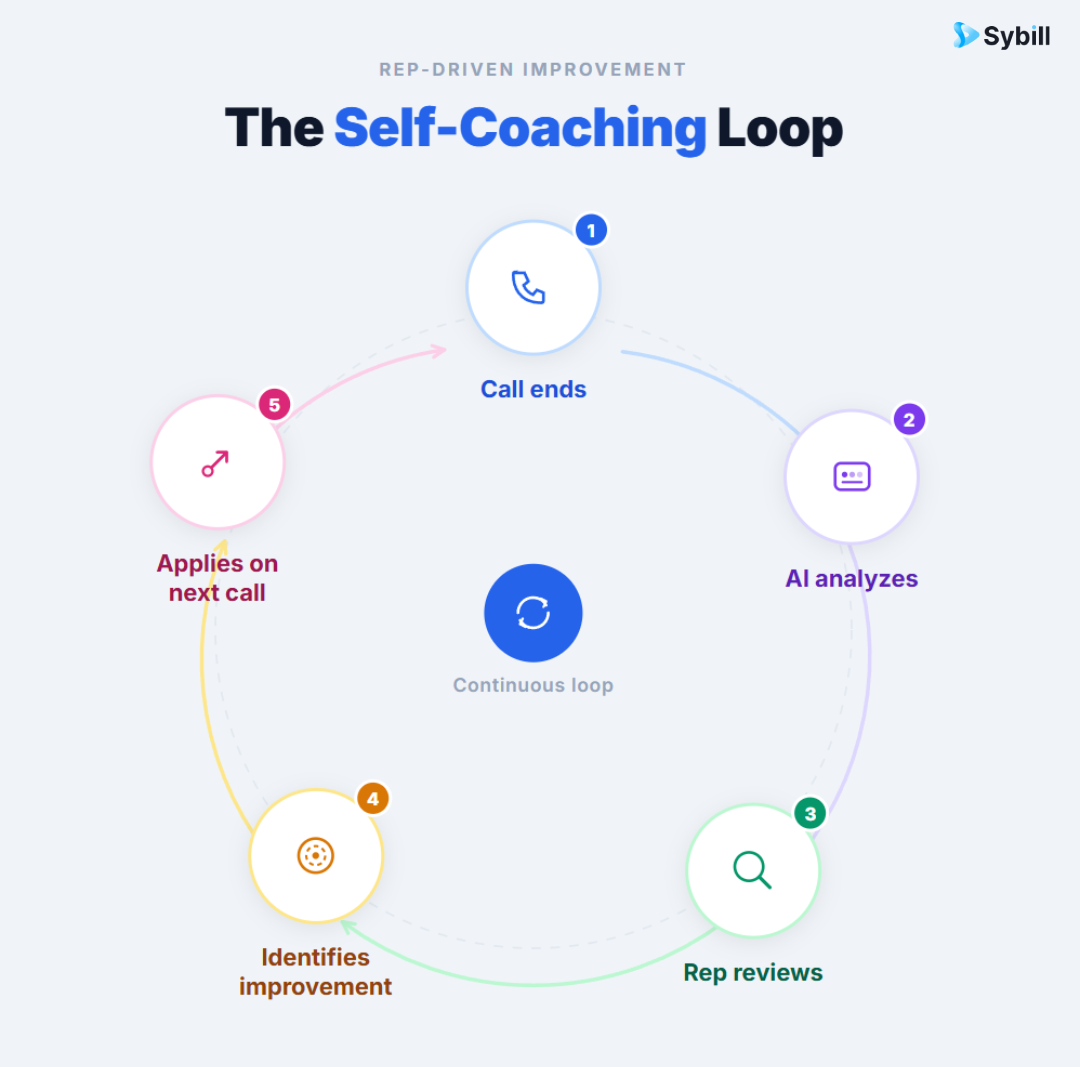
Not every tool that claims "coaching" is built for self-coaching. Many conversation intelligence platforms have coaching dashboards that are designed for managers, not reps. A rep-facing self-coaching tool should offer:
On-demand performance feedback. The rep should be able to ask "How did I handle objections on my last three calls?" and get a specific, evidence-backed answer. Not a talk-to-listen ratio. An actual analysis of what they said, how the buyer responded, and what could improve.
Pattern recognition across calls. A single call review helps. But the real insight comes from patterns across 10, 50, or 100 calls. Does this rep consistently miss asking about decision-makers? Do they rush through discovery? Do they lose buyer engagement during pricing discussions?
Comparison to winning behaviors. Self-coaching is most effective when reps can benchmark against what actually works on their team. That means seeing how top performers handle the same objections, run the same discovery questions, and manage the same deal stages.
Clip libraries and collections. The ability to save, organize, and rewatch specific call moments, both great and terrible, is how reps build muscle memory. If pro athletes watch film to improve, sales reps should too.
Actionable, specific suggestions. "Be more consultative" is not coaching. "In your last three discovery calls, you asked an average of two pain-point questions versus the team average of five" is coaching. Self-coaching tools should deliver the latter.
Best for: Reps who want an always-available AI coach that knows their deals
Sybill's self-coaching features are built around Ask Sybill, a natural language interface that lets reps (not just managers) query their own performance, deals, and patterns in plain English. This is not a dashboard you stare at. It is a conversation with an AI that has watched every one of your calls and read every one of your emails.
Self-coaching prompts reps actually use:
"What are my most coachable moments from the past two weeks?" "How do I handle pricing objections compared to the team's top closer?" "Which discovery questions get the best buyer engagement on my calls?" "What did I miss in the Acme deal that I should address in the next meeting?" "Show me calls where I lost buyer momentum during the demo section."
Each query returns specific, evidence-backed answers drawn from actual call data. Not generic advice. Feedback rooted in your conversations, your deals, your patterns.
Beyond Ask Sybill, the platform offers:
Snippets and clip libraries. Reps can cut specific moments from calls and save them to themed collections: winning objection handling, strong discovery sequences, weak closes. Over time, this becomes a personal film library for self-improvement.
Win/loss analysis. Ask Sybill to compare behaviors across won and lost deals. What did you do differently in deals that closed? What patterns show up in deals that stalled? This is the kind of insight that usually requires a dedicated rev ops analyst.
Scheduled coaching prompts. Set your favorite self-coaching questions to run automatically, daily, weekly, or at a specific time. Every Monday morning, get a report on last week's coachable moments without lifting a finger.
MEDDIC and framework tracking. See how well you are qualifying deals against your methodology. If your MEDDIC fields are consistently weak on "Decision Criteria," that is a self-coaching signal.
Role-play with Sybill. Ask Sybill how it would handle a specific objection or use case, and get responses informed by what has actually worked on your team's calls. It is practice grounded in real deal data.
Critically, Sybill's self-coaching is a natural extension of a platform that already handles call summaries, CRM autofill, follow-up emails, pre-meeting briefs, and deal intelligence. You do not need a separate coaching tool. Self-coaching is built into the same system that runs your post-call workflow.
Pricing: Free tier available. Essentials at $19/user/month. Business at $79/user/month.
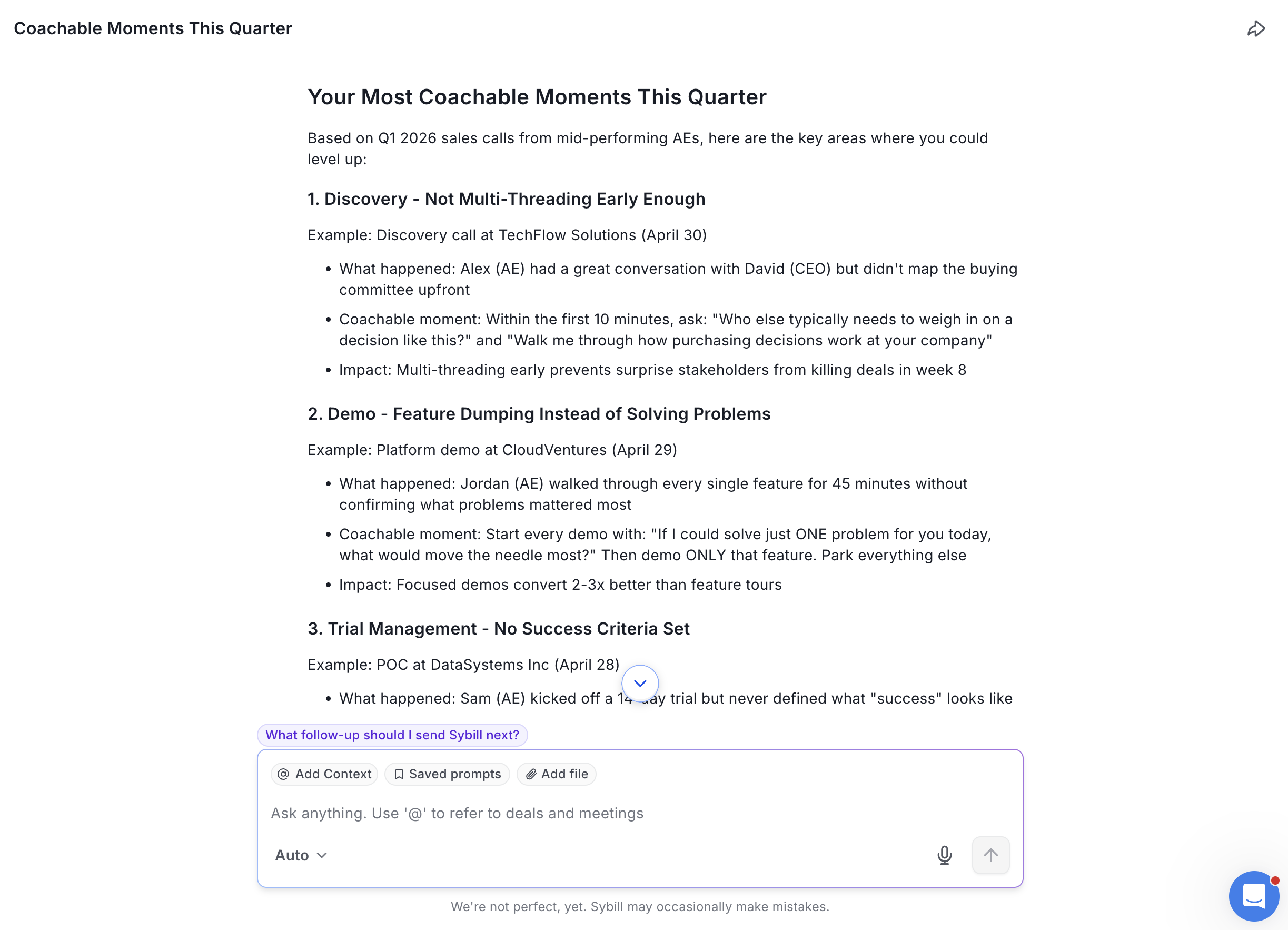
Get started for free with Sybill and use Ask Sybill to query your own performance, identify patterns, and level up on every deal.
Best for: Reps who want AI roleplay practice built from real deal scenarios
Outdoo takes a different approach to self-coaching by combining conversation intelligence with AI roleplay simulations. The platform records and analyzes calls like other tools, but it also generates practice scenarios from your actual deals. If you have a tough negotiation coming up, Outdoo can create a roleplay based on the specific objections and buyer dynamics from your pipeline.
The platform tracks whether coaching translates into improved call performance over time, closing the loop between practice and execution. It also offers call scoring, deal health tracking, and structured coaching workflows.
Where it falls short: Outdoo is a newer, smaller platform. CRM automation and follow-up generation are not as deep as Sybill. Cross-deal querying in natural language is limited compared to Ask Sybill. The roleplay feature is strong for practice, but it does not replace the need for on-demand performance analysis across real calls. No pre-meeting briefs or follow-up email generation.
Pricing: Custom pricing, typically mid-market.
Best for: Reps on Zoom who want real-time coaching during live calls
Zoom Revenue Accelerator (formerly Zoom IQ for Sales) offers something most tools do not: real-time coaching during the call itself. It surfaces battlecards, objection-handling suggestions, and monologue alerts while you are speaking. After the call, it generates AI scorecards that evaluate performance and provides immediate feedback.
The platform also includes AI Playbooks that embed your sales methodology into the conversation flow, automatically analyzing whether reps followed the prescribed framework. Call libraries and shareable clips support self-review.
Where it falls short: It requires Zoom as your meeting platform. Real-time alerts can be distracting if not well-calibrated. Post-call analytics are less deep than dedicated conversation intelligence platforms. No natural language querying across your full call history. No CRM autofill, no follow-up generation, no pre-meeting briefs. Coaching is more prescriptive (follow this playbook) than reflective (here is what you can improve based on your patterns).
Pricing: Requires Zoom Workplace with Revenue Accelerator add-on. Enterprise pricing.
Best for: Teams that want structured coaching scorecards with self-review workflows
Jiminny is a UK-based conversation intelligence platform that offers coaching scorecards reps can use for self-assessment. The platform scores calls based on configurable criteria (did the rep ask about budget, did they confirm next steps, did they identify the decision-maker) and presents the results in a format reps can review independently.
The self-coaching workflow involves reviewing your own scorecard after each call, identifying gaps, and tracking improvement over time. Managers can add comments and feedback on specific call moments, creating an asynchronous coaching thread.
Where it falls short: The self-coaching is more structured and scorecard-driven than conversational. Reps cannot ask open-ended questions about their own performance the way they can with Ask Sybill. Call querying is limited. CRM integration pushes notes but does not autofill structured deal fields at the depth Sybill offers. No follow-up email generation. Smaller ecosystem than category leaders.
Pricing: Starts around $85/user/month on annual contracts.
Best for: European sales teams wanting call scoring and performance benchmarks
Modjo offers call scoring, performance tracking across reps, and AI-generated coaching insights. Reps can review how they performed against team benchmarks, see which topics they handled well or poorly, and track improvement over time. The platform also supports clip sharing for peer learning and manager feedback loops.
Modjo's strength is its EU data hosting and GDPR compliance, making it a strong choice for European teams where data residency is non-negotiable. It supports MEDDPICC natively and integrates with Salesforce, HubSpot, and Dynamics 365.
Where it falls short: Self-coaching features are more dashboard-driven than conversational. No natural language querying for on-demand performance analysis. No AI roleplay. Pricing starts around $108/user/month with a 15-seat minimum, making it expensive for smaller teams. No pre-meeting briefs or follow-up email generation.
Pricing: Starts at approximately $108/user/month.
Having the tool is only half the equation. Here is how top performers actually use self-coaching features:
Spend five minutes after every call. Not reviewing the full summary. Asking one question: "What is the one thing I could have done better?" With tools like Ask Sybill, this takes seconds.
Set a weekly self-review prompt. Schedule an Ask Sybill query for Monday mornings: "What were my most coachable moments last week?" Start every week knowing exactly what to work on.
Build your personal clip library. Save your best and worst moments. Before a big call, review a clip of yourself handling a similar objection well. Before a coaching 1:1, come prepared with specific moments you want to discuss.
Compare yourself to what works. Ask the AI to show you how top performers on your team handle the scenarios you struggle with. Self-coaching without a benchmark is just self-reflection. The benchmark turns it into development.
Bring self-coaching insights to your 1:1. The reps who get the most out of manager coaching are the ones who show up with specific questions, not the ones who wait for the manager to drive the agenda. "I noticed I keep losing engagement during the pricing section. Can we roleplay that?" is a dramatically more productive coaching conversation than "How am I doing?"
Self-coaching features let sales reps independently analyze their own call performance, identify patterns, compare their approach to winning behaviors, and get AI-generated feedback without waiting for manager input. The best tools offer natural language querying (like Ask Sybill), call scorecards, clip libraries for reviewing specific moments, win/loss pattern analysis, and scheduled coaching prompts that deliver insights automatically.
No, and it should not try to. AI self-coaching fills the gap between manager-led coaching sessions, which typically happen weekly at best. It gives reps a daily practice layer for self-improvement while making scheduled 1:1s more productive because both the rep and manager come prepared with specific, data-backed talking points. The combination of manager coaching and AI self-coaching is where the real performance gains happen.
Sybill offers the deepest self-coaching capabilities through Ask Sybill, which lets reps query their own performance in natural language across all their calls and deals. Reps can ask specific questions about their patterns, compare themselves to top performers, review win/loss behaviors, build clip libraries, and schedule automated coaching prompts. Other tools offer partial self-coaching: Outdoo for AI roleplay, Zoom Revenue Accelerator for real-time call coaching, Jiminny for scorecard-based self-review, and Modjo for performance benchmarking.
Five minutes after every call and 15 to 20 minutes once a week is enough to see meaningful improvement. After each call, ask one question: "What could I have done better?" Weekly, run a broader self-assessment across your recent calls to identify recurring patterns. The goal is consistent, small improvements, not marathon review sessions.
Yes, and arguably they are even more valuable during onboarding. New reps can use self-coaching tools to review top performer call recordings, build clip libraries of winning examples, roleplay tough scenarios, and get instant feedback on their early calls. This accelerates ramp time significantly. Organizations using AI-assisted coaching during onboarding report 40% to 50% faster new rep productivity.
Every call is a chance to get better. But only if you have a system that surfaces what to improve, shows you what good looks like, and tracks whether you are actually getting there.
Sybill gives every rep an always-on, evidence-backed AI coach that knows their deals, their patterns, and their team's winning behaviors. No waiting for 1:1s. No generic advice. Personalized coaching from the AI that has watched every one of your calls.
Get started for free with Sybill and turn self-coaching from a good intention into a daily competitive advantage.
Self-coaching features let sales reps independently analyze their own call performance, identify patterns, compare their approach to winning behaviors, and get AI-generated feedback without waiting for manager input. The best tools offer natural language querying (like Ask Sybill), call scorecards, clip libraries for reviewing specific moments, win/loss pattern analysis, and scheduled coaching prompts that deliver insights automatically.
No, and it should not try to. AI self-coaching fills the gap between manager-led coaching sessions, which typically happen weekly at best. It gives reps a daily practice layer for self-improvement while making scheduled 1:1s more productive because both the rep and manager come prepared with specific, data-backed talking points. The combination of manager coaching and AI self-coaching is where the real performance gains happen.
Sybill offers the deepest self-coaching capabilities through Ask Sybill, which lets reps query their own performance in natural language across all their calls and deals. Reps can ask specific questions about their patterns, compare themselves to top performers, review win/loss behaviors, build clip libraries, and schedule automated coaching prompts. Other tools offer partial self-coaching: Outdoo for AI roleplay, Zoom Revenue Accelerator for real-time call coaching, Jiminny for scorecard-based self-review, and Modjo for performance benchmarking.