Find us at booth #83, join us for a harbor side happy hour, or catch Gorish’s talk.

Sept, 16-18 > Learn more


Tamanna Mishra

March 25, 2026
Sales teams today run outreach across more channels than ever before.
Email.
Calls.
LinkedIn messages.
Video meetings.
CRM updates.
Follow-up reminders.
And yet most of these interactions still happen across disconnected tools.
What happens after?
Missed follow-ups.
Lost context.
Messy CRM records.
Deals that quietly stall because nobody realized a buyer went silent.
Sales reps are working harder than ever, but the infrastructure supporting those conversations hasn’t kept up.
That’s why sales engagement tools have become essential for modern revenue teams.
A sales engagement platform connects outreach, conversations, follow-ups, and CRM updates into one structured workflow. Instead of scattered activities across five tools, the entire engagement process becomes coordinated and visible.
In this guide, we will cover:
A sales engagement tool helps sales teams manage and automate communication with prospects and customers.
Every sales interaction counts as engagement.
That includes:
Without a system to coordinate these touchpoints, engagement quickly becomes chaotic.
That is where a sales engagement platform comes in.
It acts as the operational layer between prospecting and pipeline management.
Most sales engagement tools provide capabilities such as:
The goal is simple: make sure every prospect interaction is captured, tracked, and acted upon.
When implemented correctly, a sales engagement platform ensures no opportunity slips through the cracks.
Sales technology stacks have expanded rapidly over the past decade.
Most sales teams today rely on a mix of tools:
CRM systems
email outreach tools
dialers
LinkedIn messaging
meeting software
note-taking apps
Each tool solves a specific problem.
But when these tools operate independently, engagement data becomes fragmented.
That fragmentation leads to several common problems:
A sales engagement platform solves this by centralizing engagement workflows.
Instead of juggling multiple tools, sales teams manage outreach, conversations, and follow-ups within a single coordinated system.
This improves productivity, visibility, and consistency across the entire pipeline.
The category of sales engagement tools has evolved dramatically over time.
Each generation solved a different problem for sales teams.
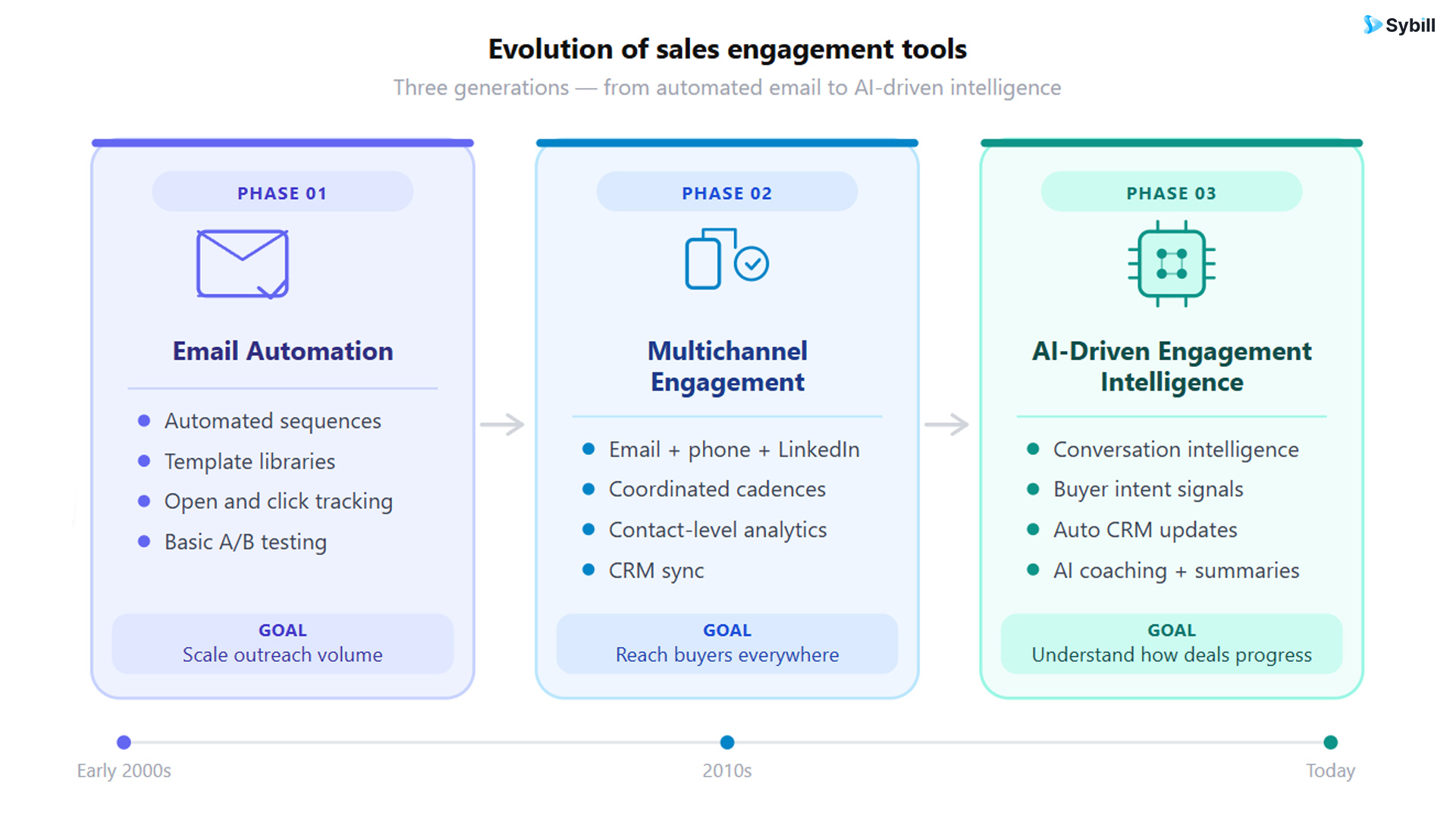
The earliest engagement tools focused on automating cold email outreach.
Sales reps could create email sequences, schedule follow-ups, and track basic metrics like opens and replies.
This made outbound sales more scalable.
But these tools focused only on activity, not insight.
Reps still had to manually analyze conversations and determine buyer intent.
The next generation expanded beyond email.
Sales engagement platforms began coordinating communication across multiple channels:
email
calls
LinkedIn
automated follow-ups
This made outreach more structured and predictable.
But insight was still limited.
Sales teams had more activity data, yet still relied on manual interpretation to understand what was happening inside deals.
Today’s sales engagement platforms are entering a third phase.
Instead of simply managing outreach activity, they analyze engagement signals.
Modern platforms now evaluate:
sales calls
email conversations
meeting transcripts
buyer behavior patterns
This enables capabilities like:
AI-generated follow-ups
conversation insights
CRM automation
deal risk detection
Sales engagement is shifting from activity management to engagement intelligence.
And that shift is redefining what teams expect from a modern sales engagement platform.
To understand the value of sales engagement tools, it helps to see what happens without them.
Consider a typical workflow.
A prospect replies to an email.
The rep reads the message but gets pulled into another meeting.
The follow-up never gets sent.
The CRM never gets updated.
A week later the opportunity quietly disappears.
This scenario happens far more often than sales leaders realize.
Without a coordinated system:
Sales engagement platforms exist to prevent exactly this kind of breakdown.
A sales engagement platform sits at the center of the revenue workflow.
It connects prospecting, conversations, and CRM systems together.
A typical sales workflow looks like this:
Lead generation
↓
Prospecting tools
↓
Sales engagement platform
↓
Meetings and conversations
↓
CRM updates
↓
Pipeline forecasting
Without an engagement platform, this workflow becomes fragmented.
Reps switch between tools constantly, and valuable context gets lost between systems.
With the right platform in place, every interaction becomes part of a structured engagement process.
The best sales engagement tools today do far more than automate outreach.
They help teams understand buyer behavior and act on it.
Modern platforms typically include several advanced capabilities.
Analyzing sales calls and meetings to identify objections, buying signals, and engagement patterns.
Also read: Best conversation intelligence software in 2026
Automatically generating contextual follow-up messages based on conversations.
Automatically logging activities, updating records, and keeping CRM data accurate.
Using engagement insights to tailor communication without increasing workload.
Surfacing risks, objections, and signals that help sales leaders manage pipeline health.
Together, these capabilities transform sales engagement from a communication tool into a strategic revenue system.
Also read: AI sales assistants comparison
AI is rapidly reshaping the sales engagement platform category.
Instead of relying on manual analysis, platforms can now automatically interpret conversations and engagement signals.
AI enables capabilities such as:
This dramatically reduces administrative work while improving engagement insights.
Platforms like Sybill represent this shift by combining conversation intelligence, CRM automation, and engagement analytics into a single system.
As AI adoption accelerates, these capabilities are becoming the standard expectation for modern sales engagement tools.
Also read: AI sales intelligence tools
Not every organization adopts engagement platforms immediately.
But several signals indicate it is time.
Teams often invest in sales engagement tools when they experience:
A simple rule of thumb:
If reps switch between five or more tools to manage prospect engagement, a dedicated sales engagement platform can dramatically improve efficiency.
Sales engagement started as simple email automation.
Today it is evolving into something much bigger.
Modern sales engagement tools unify outreach, conversations, CRM updates, and deal insights into one coordinated system.
AI is accelerating that transformation.
The platforms that succeed in this category will not simply manage activity.
They will help sales teams understand engagement, detect buyer intent, and guide the next best action.
And for modern revenue teams, that capability is quickly becoming essential.
Sales engagement tools help sales teams manage interactions with prospects and customers across channels like email, calls, and meetings. They automate outreach workflows, track engagement activity, and integrate with CRM systems.
A sales engagement platform coordinates outreach, follow-ups, and conversations within a single workflow. It helps reps manage engagement while keeping CRM data accurate and up to date.
No. CRM systems store customer data and pipeline records. Sales engagement tools manage the interactions and workflows that move deals forward.
They improve productivity, ensure consistent follow-ups, capture engagement signals, and give sales leaders better visibility into pipeline activity.
AI enables conversation analysis, automated follow-ups, CRM updates, and engagement insights. This helps sales teams understand buyer behavior and act on signals faster.
Sales engagement tools help sales teams manage interactions with prospects and customers across channels like email, calls, and meetings. They automate outreach workflows, track engagement activity, and integrate with CRM systems.
A sales engagement platform coordinates outreach, follow-ups, and conversations within a single workflow. It helps reps manage engagement while keeping CRM data accurate and up to date.
No. CRM systems store customer data and pipeline records. Sales engagement tools manage the interactions and workflows that move deals forward.