Find us at booth #83, join us for a harbor side happy hour, or catch Gorish’s talk.

Sept, 16-18 > Learn more


Tamanna Mishra

April 17, 2026
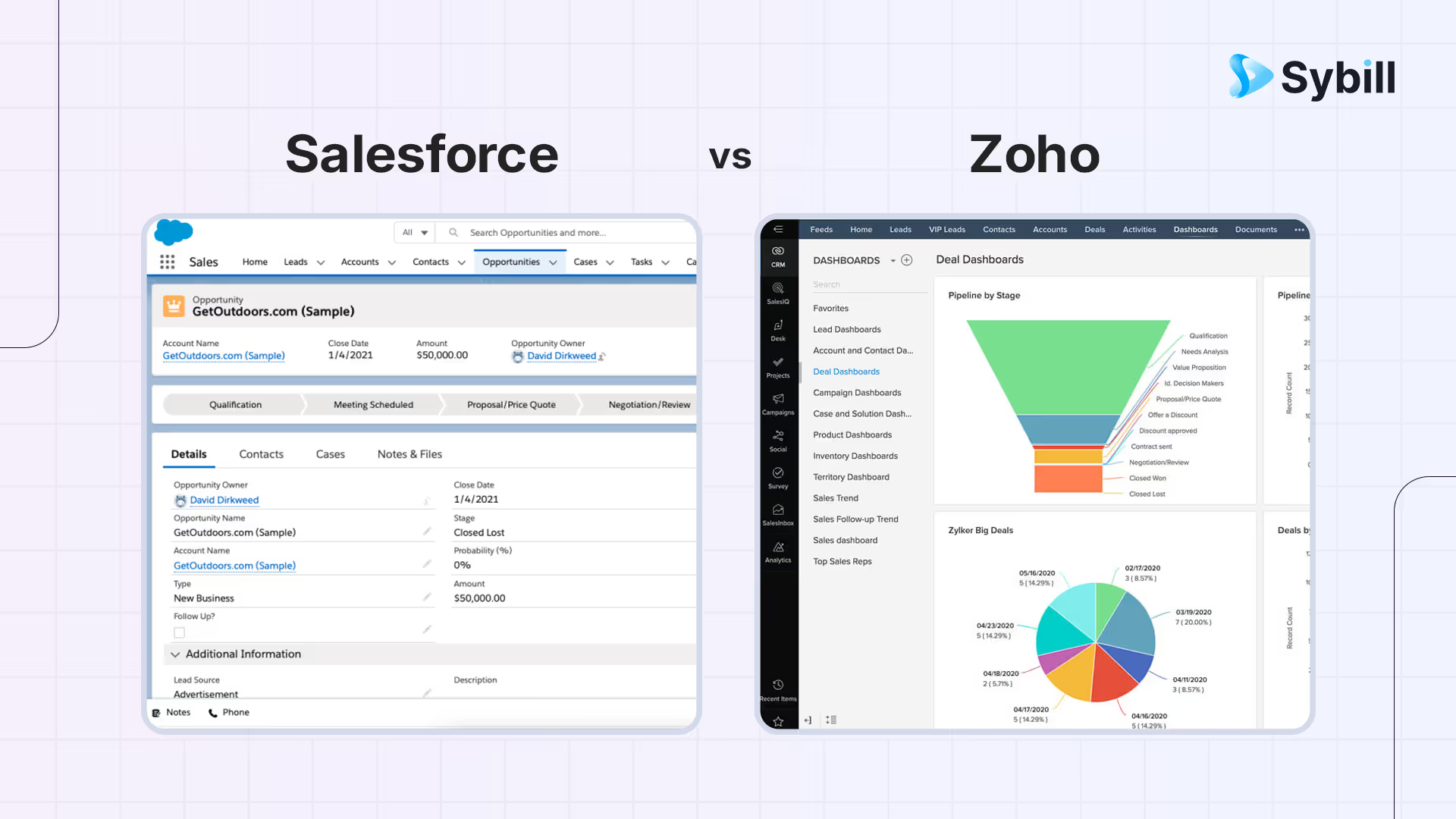
TLDR: Salesforce vs Zoho CRM (2026 Comparison)
If you want raw power, deep customization, and enterprise-grade forecasting, Salesforce CRM is the heavyweight champion.
If you want speed, simplicity, and pricing that doesn’t punch you in the face, Zoho CRM is the smarter pick for small and mid-sized teams.
The real secret is that neither platform wins without CRM automation.
CRMs aren’t glorified contact lists anymore. They’re acceleration engines for modern sales teams that automate follow-ups, forecast revenue, and (on a good day) make your reps look like clairvoyants.
Salesforce is the better CRM for enterprise teams that need deep customization, advanced forecasting, AppExchange ecosystem breadth, and complex multi-department workflows, while Zoho CRM is the better choice for small to mid-sized teams that want an intuitive interface, aggressive pricing starting at $14/user/month, and a full business suite with 45+ integrated Zoho apps. Salesforce wins on scalability, AI capabilities with Einstein, and third-party integrations; Zoho wins on total cost of ownership, ease of setup, and built-in suite features without add-on costs. Whichever CRM you choose, pairing it with an AI sales assistant like Sybill that auto-fills fields from conversations and drafts follow-ups eliminates the manual data entry that limits CRM ROI regardless of platform.
And when it comes to choosing one, the battle of Salesforce vs Zoho is like watching David take on Goliath with better UX and a cheaper subscription plan.
Salesforce CRM is the industry giant. Powerful, scalable, and built for companies that can afford both a CRM license and a full-time admin to keep it running. Zoho CRM, on the other hand, is the scrappy challenger redefining what “smart” can mean for smaller teams - lightweight, intuitive, and surprisingly feature-packed for its price.
The debate over Zoho vs Salesforce isn’t about who’s bigger anymore. We want to know who’s building the smarter CRM for how sales teams actually work in 2026. Automated, AI-assisted, and allergic to manual data entry.
Let’s break it down.
Every few years, a new wave of CRM tools promises to “redefine selling.” Yet close to 2026, the debate over Salesforce CRM vs Zoho CRM still holds up, because these two have managed to dominate opposite ends of the market without losing their grip.
Salesforce is the go-to CRM software for enterprises that need complexity, customization, and control. With over 150,000 customers across the globe, Salesforce has become synonymous with enterprise-grade scalability and integrations that touch every corner of the tech stack.
Zoho, on the other hand, has built quiet dominance in the small and mid-sized business space. Its 250,000+ customers rely on its simplicity, affordability, and deep ecosystem of connected apps. And now, it’s steadily expanding into the mid-market and enterprise tiers.
But the real reason the Salesforce vs Zoho comparison still matters is the changing face of sales itself. In 2026, CRMs aren’t judged just on pipeline visibility or contact tracking. The new frontier is AI-powered CRM automation, agentic assistants that think like reps, and low-code tools that let anyone customize workflows in minutes. Both Salesforce and Zoho are racing to deliver that intelligent, omnichannel experience.
So which one helps sales teams sell smarter? Let’s dig in.
Launched in 1999, Salesforce CRM was the first major player to prove that sales software could live entirely in the cloud. What started as a simple contact management tool has evolved into one of the most powerful enterprise CRM software platforms in the world.
The company’s core offerings - Salesforce Sales Cloud, Service Cloud, and Marketing Cloud - work together to create a complete revenue ecosystem. Add Slack integration to the mix, and you get a platform designed for collaboration across global sales teams.
What makes Salesforce stand out is its scale and flexibility. From custom workflows and reporting to its Einstein AI, the platform can automate forecasting, deal scoring, and follow-ups with remarkable precision. Salesforce integrations, too, are unmatched, with over 4,600 applications on the AppExchange marketplace supporting every possible use case.
But power comes at a price. Salesforce’s complexity can make it intimidating for new users, and most companies end up hiring dedicated admins or consultants to manage configurations. The platform’s cost also rises quickly as teams scale, especially when additional features or modules are added.
Still, for large enterprises or fast-growing organizations managing multi-region sales teams, Salesforce remains the gold standard. It’s the kind of CRM software that can keep pace with the most ambitious growth plans, provided you have the resources and patience to master it.
Founded in 2006, Zoho CRM is part of Zoho’s all-in-one SaaS suite that includes tools like Zoho Mail, Zoho Books, and Zoho Desk. Over the years, it has earned a reputation as one of the most affordable CRM tools for growing businesses that want power without the complexity.
Its core offerings - Zia AI, SalesSignals, Canvas UI, and Zoho Flow - bring automation, analytics, and customization together in a single, easy-to-use interface. Zia, Zoho’s AI assistant, predicts deal outcomes, prioritizes leads, and even recommends the best times to reach out. The Canvas UI lets users design their dashboards exactly how they want, while Zoho Flow simplifies automation between apps without requiring technical expertise.
When you compare Zoho vs Salesforce, it’s clear that Zoho plays to its strengths: simplicity, quick setup, and predictable pricing. It’s built for small and mid-sized teams that need a system that just works. No steep learning curve, no hidden costs, and no army of admins.
Of course, Zoho CRM does have its limits. It’s not as scalable for large enterprises and offers fewer external integrations than Salesforce. Its analytics capabilities, while solid, don’t yet match the depth of advanced enterprise platforms.
Still, for startups and SMBs searching for the best CRM for small business, Zoho delivers an impressive balance of affordability, usability, and innovation. It’s the kind of tool that helps teams sell faster and smarter without needing a six-month onboarding plan.
When it comes to choosing between Salesforce vs Zoho CRM, the real test lies in how these two heavyweights perform where it counts - usability, automation, pricing, and support. Below is a detailed breakdown of how both CRM tools stack up in 2026, based on market data, user reviews, and feature depth.
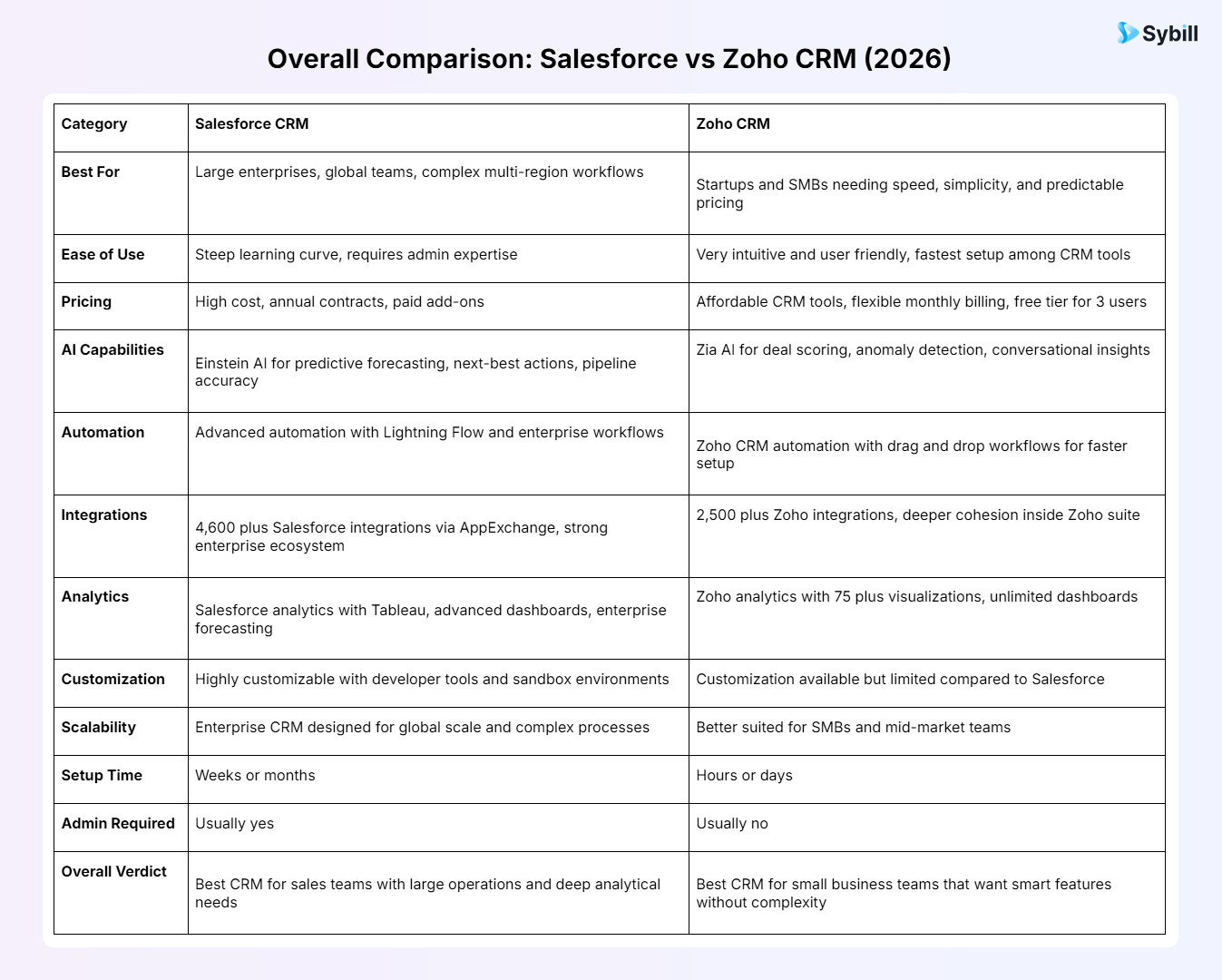
If ease of use is your top priority, Zoho CRM vs Salesforce usability comparisons show a clear winner. Zoho CRM is built for quick adoption, offering intuitive navigation, simple setup, and no requirement for a full-time administrator. Most teams can get up and running in a day, which makes it one of the most easy CRM setup experiences available today.
Salesforce CRM, while powerful, comes with a noticeable learning curve. The platform’s deep customization options make it more complex to configure and maintain, especially for smaller sales teams. Many users describe onboarding as time-consuming and often dependent on certified Salesforce administrators.
G2 data show both platforms holding strong overall ratings of around 4.3 out of 5, but Zoho consistently scores higher for usability and onboarding experience. As one reviewer put it, “Salesforce feels like a cockpit. Zoho feels like a dashboard.”
Verdict: For ease of use and fast onboarding, Zoho clearly leads in the Zoho CRM vs Salesforce comparison. Salesforce delivers more power but demands more time, admin support, and training, while Zoho offers the kind of intuitive, quick-start experience most sales teams want in an easy CRM setup today.
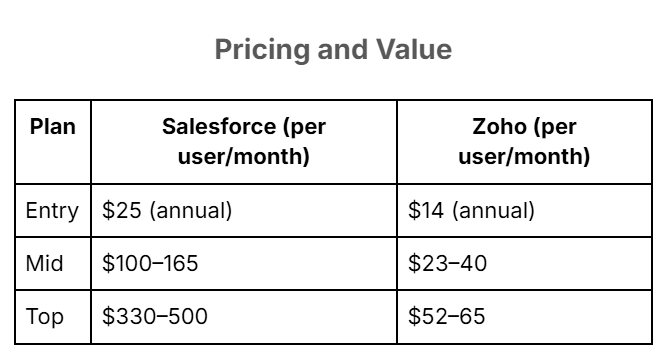
Pricing often determines the Salesforce vs Zoho debate, and here, Zoho wins the affordability battle. Zoho CRM cost is budget-friendly, offering a free plan for up to three users and flexible monthly billing options. That makes it one of the most affordable CRM tools for small and mid-sized teams looking to scale gradually.
Salesforce CRM cost tends to be higher, especially when you factor in annual contracts, implementation support, and paid add-ons. However, larger organizations often justify the expense through Salesforce’s ROI at scale, thanks to its advanced automation, analytics, and integrations.
Verdict: Zoho wins on cost predictability and flexibility, while Salesforce wins on long-term enterprise ROI.
AI is where the Salesforce vs Zoho CRM competition gets truly interesting. Salesforce Einstein delivers enterprise-grade intelligence, powering predictive forecasting, next-best-action recommendations, and automated workflows across the sales cycle. It’s built for organizations that want to leverage data science without building their own models.
Zoho Zia, on the other hand, offers conversational and contextual AI designed for everyday users. It helps with deal scoring, anomaly detection, and workflow recommendations. Zia’s biggest advantage is accessibility. Sales teams can use it without technical expertise, making it a favorite among SMBs adopting AI CRM tools for the first time.
Verdict: Both CRMs integrate AI across sales, marketing, and service, but Einstein still leads in analytical depth and scalability, while Zia wins on simplicity and cost-effectiveness.
In terms of integrations, Salesforce CRM dominates. Its AppExchange marketplace hosts more than 4,600 pre-built apps, ranging from accounting software to advanced analytics tools. Combined with enterprise-level partnerships like Slack, Tableau, and MuleSoft, Salesforce provides near-limitless possibilities for expansion.
Zoho integrations, while fewer in number, excel in cohesiveness. The Zoho Marketplace offers around 2,500 plug-ins and extensions that connect seamlessly within the company’s own ecosystem, including Zoho Books, Zoho Desk, and Zoho Campaigns.
When comparing Zoho vs Salesforce integrations, it comes down to strategy. Salesforce offers unmatched extensibility for enterprise use cases, while Zoho delivers a tightly integrated environment ideal for smaller teams that want everything under one roof.
Verdict: Salesforce wins for extensibility; Zoho wins for ecosystem cohesion.
Data-driven sales teams often look closely at Salesforce analytics capabilities, and for good reason. Salesforce offers advanced dashboards, Tableau-powered visualizations, and forecasting accuracy tools that are second to none. It’s the ideal choice for organizations with complex pipelines and layered territories.
Zoho analytics offers 75+ visualization options, unlimited dashboards on every plan, and real-time syncing with other Zoho apps. While it’s not as sophisticated as Salesforce’s analytics engine, Zoho makes up for it with ease of use and quick insight generation — a big plus for smaller teams without dedicated analysts.
Verdict: Salesforce is built for data-heavy organizations, while Zoho is perfect for teams that want simplicity without sacrificing insight quality.
When it comes to sales automation, Salesforce CRM leads with its Lightning Flow and advanced pipeline orchestration tools. Reps can automate follow-ups, set custom deal triggers, and build rule-based workflows that scale across multiple teams.
Zoho CRM automation tools are simpler but highly effective. Its drag-and-drop workflow builder allows reps to automate lead scoring, task assignment, and follow-ups with minimal setup. While Salesforce handles multi-departmental automation better, Zoho keeps things accessible for smaller teams that value agility.
Verdict: Salesforce is ideal for large-scale automation; Zoho is better for teams seeking flexible, easy-to-manage workflows.
Customer support often reflects a platform’s target market, and that’s clear in Salesforce vs Zoho CRM. Salesforce offers 24/7 enterprise-grade assistance, a vast learning platform through Trailhead, and its own global event, Dreamforce, that doubles as a training ecosystem.
Zoho support includes chat, email, and a highly active community forum where users help each other troubleshoot. While helpful, it’s not as comprehensive for complex enterprise needs.
Verdict: Salesforce wins for enterprise reliability and professional support; Zoho wins for responsiveness and accessibility for smaller teams.
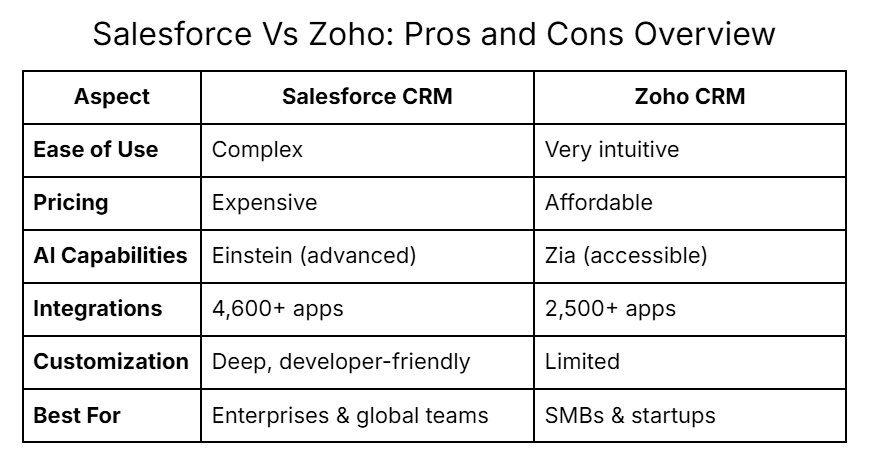
After breaking down every feature, integration, and automation edge, the final Salesforce vs Zoho CRM verdict comes down to what kind of sales team you’re running, and how fast you’re growing.
Choose Salesforce CRM if your organization is scaling rapidly, managing multiple regions, or dealing with complex sales pipelines that demand deep forecasting and automation. Its AI-powered insights, enterprise integrations, and customization depth make it the best CRM for sales teams that want complete control and long-term scalability. Salesforce is built for the big leagues - the kind of teams that see data as a strategy, not just a report.
Choose Zoho CRM if you value simplicity, affordability, and quick deployment. It’s ideal for startups and SMBs that want automation without hiring a CRM administrator. Zoho’s intuitive design, predictable pricing, and native integrations make it perfect for lean sales teams focused on agility over complexity.
The truth is, neither platform is standing still. Both Salesforce and Zoho are rapidly evolving with embedded AI, low-code customization, and automation that brings context into every customer interaction. Whether you’re comparing enterprise CRM vs SMB CRM solutions or just looking for the smartest platform for your next growth phase, the best choice is the one that helps your team spend less time entering data - and more time closing deals.
Here’s the 2026 reality: sales reps are still spending 20 to 30 percent of their time performing repetitive admin tasks. Updating CRMs manually takes a big chunk of that time - it’s one full day each week lost to typing notes, logging calls, and chasing data instead of closing deals.
No matter how advanced your CRM software is - and whether it’s Salesforce or Zoho - the problem isn’t the platform, it’s the process.
What’s worse, manual data entry doesn’t just kill time. It kills accuracy. When key buyer insights are buried in meeting notes or never logged at all, you lose pipeline visibility and forecasting precision. That’s why CRM automation is no longer a nice-to-have. It’s the only way to keep your data clean, your forecasts sharp, and your follow-ups timely.
That’s where Sybill comes in. Sybill’s CRM Autofill captures context directly from your sales calls - buyer pain points, next steps, and deal details - and automatically updates your CRM. No copy-pasting, no manual notes, no missed insights. It’s how sales teams automate CRM data entry and reclaim hours that actually move deals forward.
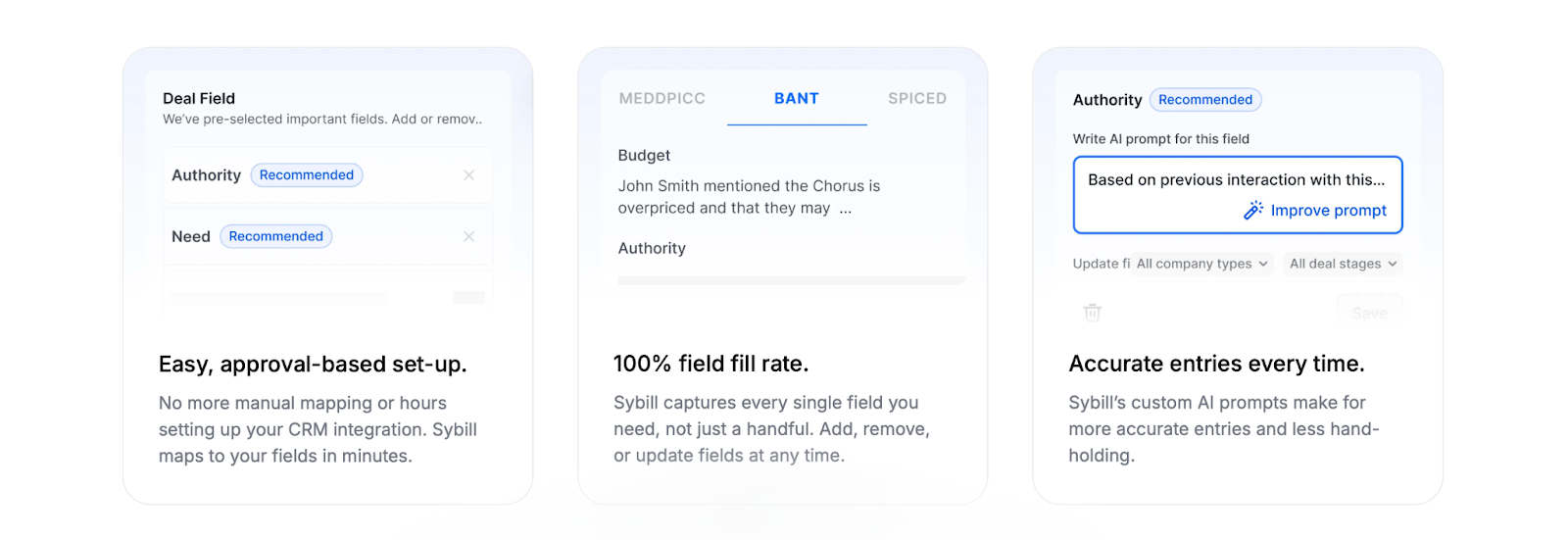
If you’re serious about boosting efficiency, pairing your CRM with automation tools like Sybill is the smartest way to improve sales performance. After all, the best sales productivity tools don’t just manage data. They make sure you never have to enter it twice.
Click here to try Sybill’s CRM Autofill for free.
In the Salesforce vs Zoho CRM story, there’s no clear villain. What we do have are just two very different heroes. Salesforce is the powerhouse that can run entire enterprises on precision, data, and scale. Zoho is the agile competitor that thrives on simplicity, speed, and affordability. Both can transform your sales operations, but only if your team actually uses them.
Because the smartest sales teams in 2026 aren’t the ones with the most expensive tech stack. They’re the ones that use CRM automation for sales to cut the noise, streamline workflows, and act on real buyer signals. Power without adoption is just potential left untapped.
So here’s the question worth asking: are you paying for a CRM, or are you actually selling with it?
It depends on your team size and complexity. Salesforce vs Zoho isn’t a one-size-fits-all comparison. Salesforce CRM is best for large enterprises that need deep customization, global scalability, and AI-powered analytics. Zoho CRM works better for small to mid-sized teams that want affordability, simplicity, and quick setup. Both platforms now include CRM automation features to help sales teams save time on data entry and focus more on selling.
In the CRM space, Zoho CRM has become one of Salesforce’s strongest competitors, especially for SMBs that want a lighter, more affordable platform. Others like HubSpot and Microsoft Dynamics also compete at different levels. Still, the Salesforce vs Zoho debate stands out because both are expanding rapidly with AI, low-code tools, and CRM automation that makes data management effortless for sales teams.
Salesforce CRM continues to hold the top spot globally, leading in market share, integrations, and enterprise adoption. However, Zoho’s rapid growth and focus on usability have positioned it as a fast-rising challenger. The real takeaway from the Salesforce vs Zoho comparison is that the “best” CRM in 2026 is the one that fits your workflow and automates your manual tasks with smart CRM automation tools.