Find us at booth #83, join us for a harbor side happy hour, or catch Gorish’s talk.

Sept, 16-18 > Learn more

%20(1).avif)
Mamta Tainwala

April 6, 2026
Only 43% of sales leaders forecast within 10% accuracy. The other 57% are presenting numbers that are, functionally, guesses in a spreadsheet.
The problem is rarely effort. Sales leaders spend hours each week compiling forecasts, reviewing pipeline, and interrogating reps about deal confidence. The problem is foundation: disconnected tools, incomplete CRM data, and forecasting platforms that analyze inputs that were never accurate in the first place.
The best sales forecasting tools in 2026 do not just produce a number. They connect predictions to execution. They surface risks before they become surprises. And critically, they depend on clean pipeline data, which means the tool you use to capture deal information is just as important as the tool you use to forecast it.
This guide compares 10 sales forecasting tools across the dimensions that actually matter for B2B revenue teams: AI capabilities, CRM integration depth, pricing transparency, data requirements, and who each tool is best suited for. We will also explain the architectural question most comparison articles ignore: why forecasting accuracy depends on a data layer that most forecasting tools do not provide.
Before evaluating specific platforms, understand what separates useful forecasting tools from expensive dashboard generators.
AI that adjusts in real time. Static stage-based probabilities are the forecasting equivalent of using yesterday's weather to plan tomorrow's picnic. Good tools analyze engagement signals, conversation patterns, and deal velocity to produce dynamic probability scores that update as new data flows in.
CRM integration depth. A forecasting tool is only as good as the CRM data feeding it. Shallow integrations that read basic stage and close-date fields produce shallow forecasts. Deep integrations that read activity data, custom fields, and qualification frameworks produce meaningful intelligence.
Pipeline inspection, not just prediction. The forecast number matters less than the ability to inspect why it looks the way it does. Which deals are at risk? Where is pipeline coverage thin? Which rep's commit is overstated? Tools that answer these questions are more valuable than tools that just produce a topline number.
Clean data dependency. This is the uncomfortable truth about every forecasting tool: garbage in, garbage out. If your CRM fields are empty, if deal stages are stale, and if rep notes are spotty, no algorithm can compensate. The best forecasting stack includes a data capture layer (like Sybill's CRM Autofill) that ensures the data feeding the forecast is complete, current, and accurate.
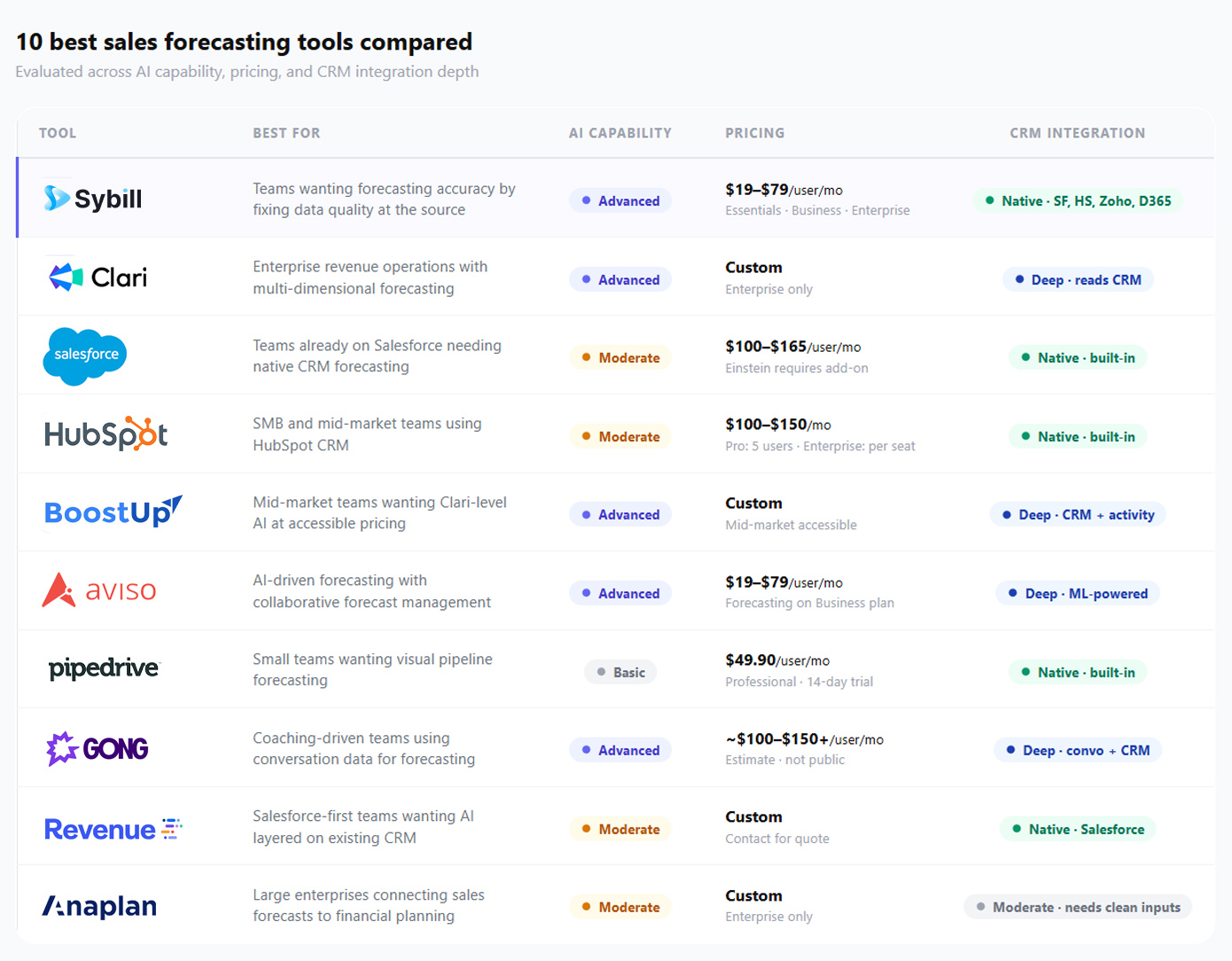
Sybill approaches forecasting differently than every other tool on this list. Instead of building another dashboard on top of your CRM, Sybill solves the root cause of inaccurate forecasts: the data feeding them.
After every sales call, Sybill automatically captures buyer sentiment, objections, commitment signals, next steps, stakeholder roles, and qualification criteria, then writes structured data into 30+ CRM fields. This means every forecasting method that relies on CRM data, from simple weighted pipeline to sophisticated AI models, immediately becomes more accurate because the inputs are complete and current.
Ask Sybill provides the pipeline intelligence layer. Managers can ask questions like "Which deals in commit have declining buyer engagement?" or "Where are we single-threaded this quarter?" and get instant, evidence-backed answers sourced from actual conversations, not CRM stage labels. The deal workspace shows every deal's health, stakeholder coverage, and risk indicators in one view.
Best for: B2B sales teams of any size that want forecasting accuracy by solving the data quality problem at the source. Particularly strong for teams whose existing CRM data is unreliable and who need both the capture layer and the intelligence layer in one tool.
Pricing: Essentials at $19/user/month. Business at $79/user/month (includes CRM Autofill, Ask Sybill, Deal Workspace). Enterprise pricing for 20+ seats.
CRM integration: Native with Salesforce, HubSpot, Zoho, and Dynamics 365.
Key differentiator: Sybill is not just a forecasting tool. It is the data layer that makes every other forecasting tool work better. Teams that add Sybill to their existing stack (whether they use Salesforce's native forecasting, Clari, or Gong) see forecast accuracy improve because the underlying CRM data is finally reliable.
Clari is the gold standard for enterprise-grade forecasting and pipeline management. Its RevAI engine processes CRM data, activity signals, and historical patterns to produce AI-adjusted forecasts with deal-level granularity. The platform excels at rolling forecasts across segments, geographies, and product lines, giving CROs and CFOs a unified view of revenue predictability.
With the Salesloft merger completed in late 2025, Clari now has access to sales engagement data alongside its forecasting engine. The long-term vision is a unified platform, though the integration is still in progress.
Best for: Enterprise organizations (200+ reps) with dedicated RevOps teams who need multi-dimensional forecasting, scenario modeling, and board-level revenue reporting.
Pricing: Custom pricing, typically enterprise-only. Expect significant annual commitments.
Limitation: Clari reads CRM data but does not populate it. If your reps are not updating Salesforce, Clari's forecasts inherit that inaccuracy. This is why many Clari customers also use Sybill: Sybill fills the CRM, Clari analyzes it.
Salesforce's built-in forecasting tools are the most widely used in B2B, primarily because they live inside the CRM where the data already resides. Einstein AI adds predictive deal scoring, and collaborative forecasting lets managers and reps submit, review, and adjust forecasts within a unified interface.
Best for: Teams already on Salesforce who want forecasting without adding another vendor. The native integration eliminates data latency issues that external tools face.
Pricing: Professional plan at $100/user/month. Enterprise at $165/user/month. Einstein features require higher tiers or add-ons.
Limitation: Salesforce forecasting is only as good as Salesforce data. The platform's well-known adoption problem (reps hate manual data entry) directly undermines forecast accuracy. Teams that pair Salesforce with Sybill solve this: Sybill auto-populates the CRM fields that Salesforce uses to forecast.
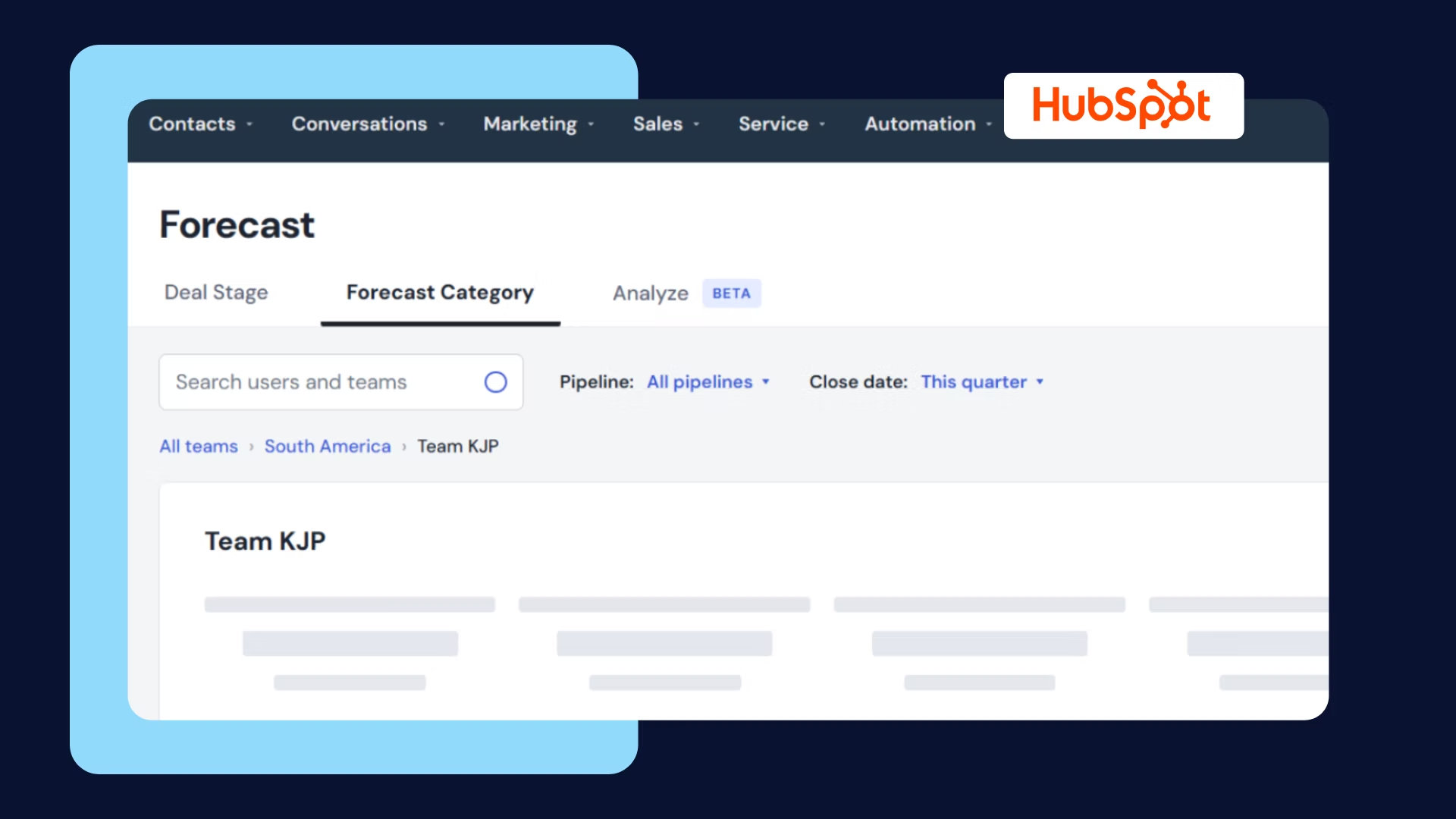
HubSpot's forecasting tools provide solid pipeline-based predictions within an intuitive interface. Deal-level forecasting, custom forecast categories, and integration with HubSpot's marketing and service tools create a unified view for growing teams.
Best for: SMB and mid-market teams (10 to 100 reps) who use HubSpot CRM and want forecasting without the complexity or cost of enterprise platforms.
Pricing: Professional at $100/month (for 5 users). Enterprise at $150/month per seat. Forecasting features are not available on lower tiers.
Limitation: HubSpot's AI forecasting is less sophisticated than Clari's or Gong's. For teams outgrowing HubSpot's native capabilities, layering Sybill on top adds the AI deal intelligence and automated data capture that HubSpot lacks.
BoostUp provides AI-powered forecasting with strong pipeline analytics and risk detection. The platform analyzes engagement patterns and historical conversion data to score deal health and surface at-risk opportunities proactively.
Best for: Mid-market B2B teams (50 to 200 reps) who want Clari-level intelligence without Clari-level pricing and implementation complexity.
Pricing: Custom pricing. Generally more accessible than Clari for mid-market budgets.
Aviso's RevBI engine uses machine learning to process CRM data, email activity, and calendar events to generate predictive insights about deal health and closing probability. Collaborative forecasting features let managers and reps submit and adjust forecasts within a unified interface.
Best for: Organizations seeking AI-driven forecasting with strong pipeline analytics and collaborative forecast management. Works well with clean, structured CRM data.
Pricing: Plans start at $19/user/month. Forecasting features require the Business plan at $79/user/month.
Pipedrive's Forecast View provides a visual, intuitive way to project revenue based on deal stages and close dates. The platform tracks deal volume, conversion rates, and pipeline velocity to support data-driven planning.
Best for: Small teams (under 20 reps) who want straightforward, visual forecasting without enterprise complexity. Pipedrive's simplicity is its strength.
Pricing: Professional plan at $49.90/user/month (forecasting features require this tier). Free 14-day trial.
Gong Forecast ties conversation intelligence data to forecasting. By analyzing what was actually said on calls (objections raised, pricing discussed, competitors mentioned, commitment language used), Gong produces deal health scores grounded in buyer behavior rather than rep judgment.
The platform's strength is connecting coaching insights to forecast accuracy: managers can see exactly where discovery depth or objection handling quality correlates with deal outcomes.
Best for: Coaching-driven organizations that want conversation data to inform both rep development and forecast accuracy. Teams with 50+ reps where call analytics at scale are worth the investment.
Pricing: Not publicly available. Industry estimates put it at $100 to $150+/user/month. Minimum seat requirements and annual contracts are standard.
Limitation: Gong is primarily a conversation intelligence platform that added forecasting, not a purpose-built forecasting solution. Pipeline inspection and scenario modeling are not as deep as Clari's.
Revenue.io extends Salesforce by combining CRM pipeline data with real engagement signals from calls, meetings, and buyer interactions. Instead of relying only on stage-based estimates, it analyzes deal momentum and conversation activity.
Best for: Salesforce-first teams that want AI-powered forecasting layered directly on top of their existing CRM without switching platforms.
Pricing: Custom pricing. Contact for a quote.
Anaplan extends beyond sales forecasting into territory planning, quota management, compensation modeling, and financial planning. It is the tool of choice for large enterprises that need to connect sales forecasts to broader financial models.
Best for: Enterprise organizations (500+ employees) where sales forecasting must integrate with finance, supply chain, and workforce planning.
Pricing: Enterprise-only. Significant annual commitments.
Limitation: Anaplan is a planning platform, not a sales execution tool. It requires clean data inputs from CRM and engagement platforms to produce accurate sales forecasts.
Under 20 reps: Pipedrive or HubSpot for native CRM forecasting. Add Sybill for data capture and deal intelligence.
20 to 100 reps: HubSpot Enterprise or Salesforce Sales Cloud for CRM forecasting. Layer Sybill for automated CRM data capture and Ask Sybill for pipeline intelligence. Consider BoostUp or Aviso for dedicated AI forecasting.
100 to 500 reps: Clari or Gong for enterprise forecasting. Sybill as the data layer to ensure CRM accuracy feeds the forecasting engine.
500+ reps: Clari plus Anaplan for unified revenue and financial planning. Sybill across the team for CRM data integrity.
Need clean CRM data first: Start with Sybill. Every other tool on this list works better when CRM fields are complete, current, and accurate.
Need enterprise revenue visibility: Clari provides the deepest multi-dimensional forecasting for large organizations.
Need conversation-powered forecasting: Gong ties call analytics directly to deal health and forecast accuracy.
Need affordable, visual forecasting: Pipedrive or HubSpot for straightforward pipeline-based predictions.
Need to connect sales forecasts to financial planning: Anaplan bridges revenue forecasting with broader enterprise planning.
The highest-performing revenue teams in 2026 do not use one tool for forecasting. They use a stack:
Layer 1: Data capture. Sybill automatically populates CRM fields from every conversation, ensuring the pipeline data feeding all downstream tools is complete and accurate.
Layer 2: CRM. Salesforce or HubSpot serves as the system of record. With Sybill feeding clean data in, the CRM becomes the trustworthy foundation it was always supposed to be.
Layer 3: Forecasting and intelligence. Sybill's Ask Sybill provides the AI-driven analysis layer that turns clean pipeline data into actionable forecasts, risk alerts, and coaching insights.
Every tool on this list, from Pipedrive to Clari, analyzes CRM data to produce forecasts. But here is the uncomfortable truth: most B2B CRM data is incomplete, outdated, or wrong.
Sales reps spend less than 30% of their time selling. Much of the rest goes to admin tasks they skip or rush through. Deal stages go unupdated for weeks. Close dates are fictional. Qualification fields are empty. Next steps are vague or missing. The CRM shows one version of reality while the actual deals live in reps' heads, email threads, and Slack messages.
When a forecasting tool applies AI to this data, it produces AI-powered inaccuracy at scale. The model is sophisticated. The inputs are garbage. The forecast misses.
This is why the data capture layer is not optional. It is the prerequisite. Sybill's CRM Autofill exists specifically to solve this problem. After every call, Sybill extracts structured deal data from the conversation and writes it directly into the CRM. No manual entry. No reliance on rep memory. No stale fields.
When the CRM is reliably populated, every forecasting tool on this list works better. Weighted pipeline calculations actually reflect reality. AI models have the signals they need. Pipeline reviews start from a place of truth rather than interrogation.
The teams forecasting within 10% accuracy in 2026 are not the ones with the fanciest forecasting dashboard. They are the ones whose CRM data is clean enough to forecast from.
What is the best sales forecasting tool in 2026?
The best tool depends on your team size, CRM, and primary need. For enterprise revenue operations, Clari leads. For conversation-powered forecasting, Gong is strongest. For SMB and mid-market teams, HubSpot or Pipedrive provide solid native forecasting. For teams that need the data foundation that makes all other tools accurate, Sybill's automated CRM capture and Ask Sybill intelligence layer is the highest-leverage investment.
How much do sales forecasting tools cost?
Pricing ranges widely. Pipedrive starts at $49.90/user/month. Sybill starts at $19/user/month (Essentials) and $79/user/month (Business). HubSpot Enterprise runs $150/seat/month. Gong and Clari do not publish pricing but typically range from $100 to $200+/user/month with enterprise contracts. Budget should also account for implementation fees, which range from $0 (Sybill, Pipedrive) to $8,000+ (Salesforce, Clari).
What is the difference between CRM forecasting and AI forecasting?
CRM forecasting (Salesforce, HubSpot, Pipedrive) uses pipeline stage data and historical conversion rates to produce weighted projections. AI forecasting (Clari, Gong, Sybill) adds engagement signals, conversation analysis, and behavioral patterns to produce dynamic, continuously updated deal health scores. AI forecasting is more accurate but requires cleaner data inputs to deliver on its promise.
Do I need a separate forecasting tool if I already use Salesforce?
Salesforce's native forecasting works for basic weighted pipeline projections. Teams that need AI-driven deal scoring, scenario modeling, or conversation-powered risk detection typically layer a dedicated tool (Clari, Gong, or Sybill) on top. The most common limitation of Salesforce-only forecasting is data quality: if reps are not updating fields, the native forecast inherits that inaccuracy.
What is the most important factor for forecast accuracy?
Data quality. Every forecasting method and tool depends on CRM data being complete, current, and accurate. Companies using AI-driven forecasting achieve ~79% accuracy compared to ~51% for manual methods, but only when the data feeding the AI is reliable. This is why automated data capture (like Sybill's CRM Autofill) is the highest-leverage investment for forecast accuracy: it solves the root cause rather than compensating for bad data with better algorithms.
Can I use Sybill with Clari or Gong?
Yes. Sybill operates as the data capture and CRM automation layer that feeds clean data into whatever forecasting tool sits on top. Teams using Clari for enterprise forecasting add Sybill to ensure the CRM fields Clari analyzes are complete and current. Teams using Gong for conversation intelligence add Sybill for the CRM automation and follow-up execution that Gong does not handle.
The difference between a forecast that earns trust and one that erodes it is not the sophistication of the dashboard. It is the reliability of the data underneath.
Every tool on this list can produce a number. The question is whether that number reflects what is actually happening in your pipeline or what your CRM says is happening, which are two very different things in most organizations.
Sybill closes that gap. It captures deal intelligence from every conversation, keeps CRM fields accurate without manual entry, and gives managers instant pipeline visibility through Ask Sybill. Whether you use it as your primary forecasting intelligence layer or as the data foundation that makes Clari, Gong, or Salesforce forecasting actually reliable, the result is the same: forecasts your leadership team can act on with confidence.
Get started for free with Sybill and start forecasting from data you can trust.
The best tool depends on your team size, CRM, and primary need. For enterprise revenue operations, Clari leads. For conversation-powered forecasting, Gong is strongest. For SMB and mid-market teams, HubSpot or Pipedrive provide solid native forecasting. For teams that need the data foundation that makes all other tools accurate, Sybill's automated CRM capture and Ask Sybill intelligence layer is the highest-leverage investment.
Pricing ranges widely. Pipedrive starts at $49.90/user/month. Sybill starts at $19/user/month (Essentials) and $79/user/month (Business). HubSpot Enterprise runs $150/seat/month. Gong and Clari do not publish pricing but typically range from $100 to $200+/user/month with enterprise contracts. Budget should also account for implementation fees, which range from $0 (Sybill, Pipedrive) to $8,000+ (Salesforce, Clari).
CRM forecasting (Salesforce, HubSpot, Pipedrive) uses pipeline stage data and historical conversion rates to produce weighted projections. AI forecasting (Clari, Gong, Sybill) adds engagement signals, conversation analysis, and behavioral patterns to produce dynamic, continuously updated deal health scores. AI forecasting is more accurate but requires cleaner data inputs to deliver on its promise.