Find us at booth #83, join us for a harbor side happy hour, or catch Gorish’s talk.

Sept, 16-18 > Learn more


Tamanna Mishra

July 4, 2026
%20(23).png)
Early traction is a dangerous drug.
Your first customers love you. Demos feel electric. Product feedback is glowing. The team starts saying things like “we are onto something,” which is usually when the spreadsheet quietly starts plotting revenge.
Then growth slows.
Bigger deals stall. Sales cycles stretch. Champions go quiet. Procurement appears from the fog. The product roadmap becomes a group therapy session. Everyone asks the same cheerful little question: “Why did this stop working?”
That is usually where Crossing the Chasm comes back into the room.
Geoffrey Moore’s classic framework was built for high-tech companies trying to move from early adopters to mainstream customers. Moore describes the transition as a move from early adopters who buy into the entrepreneur’s vision to pragmatist mainstream customers who want proof, relevant use cases, and referenceable customers. His framework also emphasizes choosing a target segment, identifying the compelling reason to buy, building the whole product, aligning sales and marketing, and positioning against incumbents. (Geoffrey Moore)
The question is not whether the chasm still exists. It does.
The better question is: what does the chasm look like in modern SaaS, where buyers self-educate, buying committees are massive, AI categories are crowded, and “we liked the demo” means absolutely nothing until someone owns the budget?
Let’s get into it.
Crossing the chasm is the move from selling to early adopters who love new technology to selling to mainstream buyers who need proof, reliability, and a very good reason not to pick the safer option.
Moore’s work builds on the Diffusion of Innovations model, which categorizes technology adoption into innovators, early adopters, early majority, late majority, and laggards. The chasm sits between early adopters and the early majority because these two groups do not buy the same way.
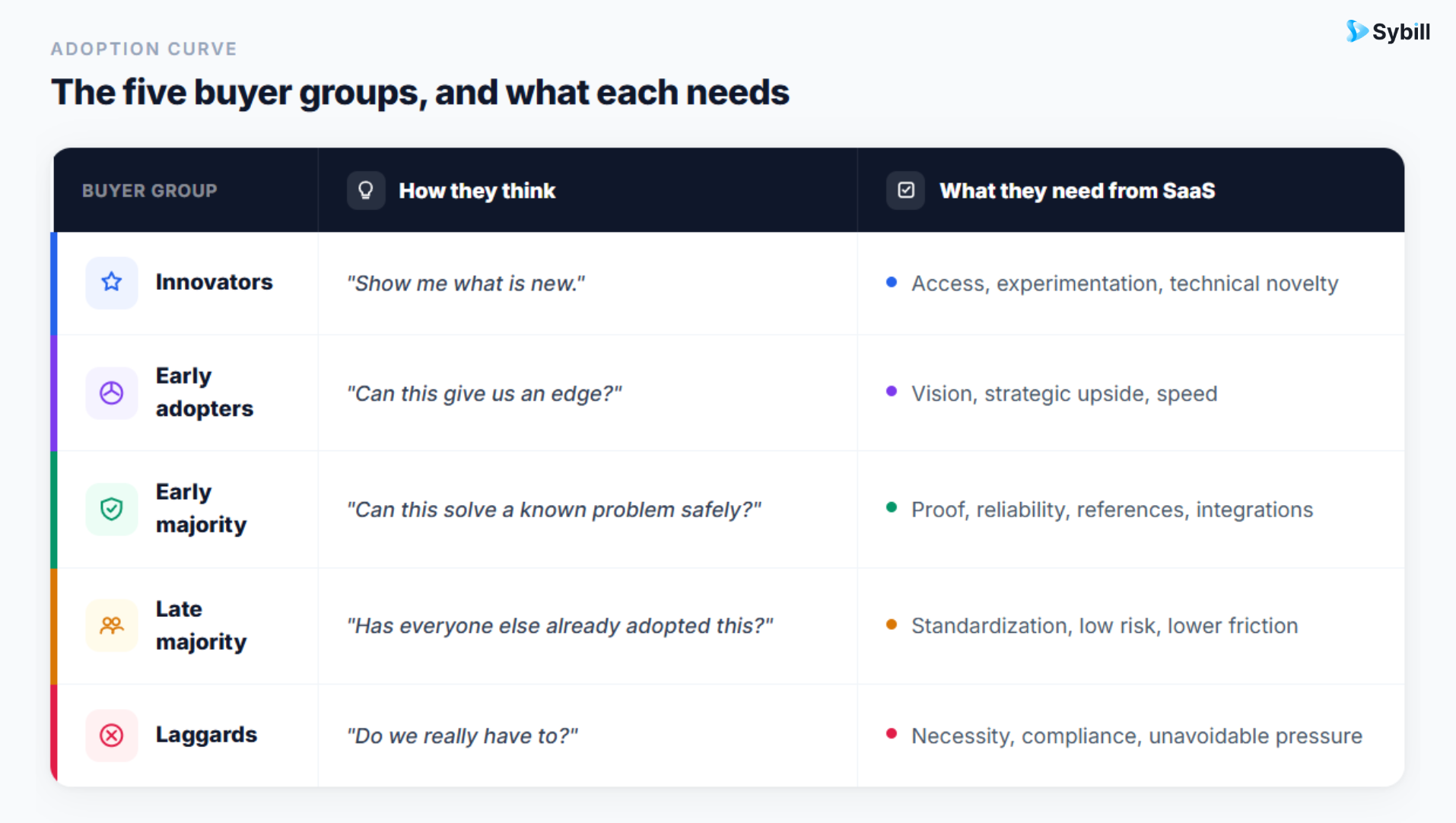
Early adopters buy possibilities. Mainstream buyers buy reduced risk.
That is the whole knife twist.
A SaaS company can win early customers because the product feels exciting, but lose the early majority because the product does not yet feel inevitable, safe, or operationally complete.
The SaaS chasm is not always dramatic. It does not always look like a crash. Sometimes it looks like a very respectable pipeline full of deals that never quite close.
The most common mistake is confusing enthusiasm with repeatable demand.
Early customers are forgiving. They tolerate bugs. They accept manual workarounds. They will sit on calls with founders. They will co-create the product because they want the upside. Lovely people. Dangerous sample size.
Mainstream buyers are different. They want the whole thing.
They want onboarding, security, integrations, admin controls, ROI, customer proof, procurement comfort, stakeholder alignment, and a clear internal business case. They do not want to become your product team’s unpaid QA department with a logo.
That is why SaaS companies get stuck even when the product is good. The problem is not always product-market fit. Sometimes it is go-to-market fit.
You may have a real product, but not yet a repeatable sales motion. You may have happy users, but not enough executive proof. You may have strong demos, but weak business cases. You may have passionate champions, but no buying committee alignment.
That is the chasm wearing a Patagonia vest.
Read more: How to Spot Deal Risk Before Forecast Review
The old chasm was about moving from visionary buyers to pragmatic buyers. That still matters. But modern SaaS has made the gap messier.
Forrester’s 2026 State of Business Buying report found that the typical buying decision now includes 13 internal stakeholders and nine external influencers, with that number rising for more complex or strategic purchases.
Gartner reports that 75% of B2B buyers prefer a rep-free sales experience, but also notes that self-service digital purchases are more likely to result in purchase regret. Translation: buyers want control, but they still need confidence.
McKinsey’s 2024 B2B Pulse Survey also points to omnichannel sales as a path to sustainable growth, which means the modern buyer journey is no longer neatly sales-led, marketing-led, or product-led. It is all of them, usually at once, because apparently B2B buying needed more chaos.
A buyer may read your website, compare you on review sites, ask an AI tool, lurk on LinkedIn, talk to peers, and still walk into the buying meeting with no internal agreement on urgency, ownership, budget, or success metrics.
That is why crossing the chasm is not just about educating the buyer. It is about helping the buyer’s team agree.
Read more: How To Use AI To Research Multiple Stakeholders Before A Demo
Product-led growth changed SaaS because users can now experience value before talking to sales. OpenView and Pendo’s Product Benchmarks report looked at PLG adoption, growth levers, tooling, and product funnel metrics across more than 1,000 participants.
But PLG does not magically erase the chasm.
A product can spread across teams and still hit a wall when IT asks about security, finance asks about ROI, procurement asks about commercial terms, and leadership asks whether this is strategic or just another tool people forgot to expense properly.
AI SaaS companies can get early excitement fast. Everyone wants the demo. Everyone wants to see the magic trick.
But mainstream buyers do not only ask, “Is this cool?” They ask:
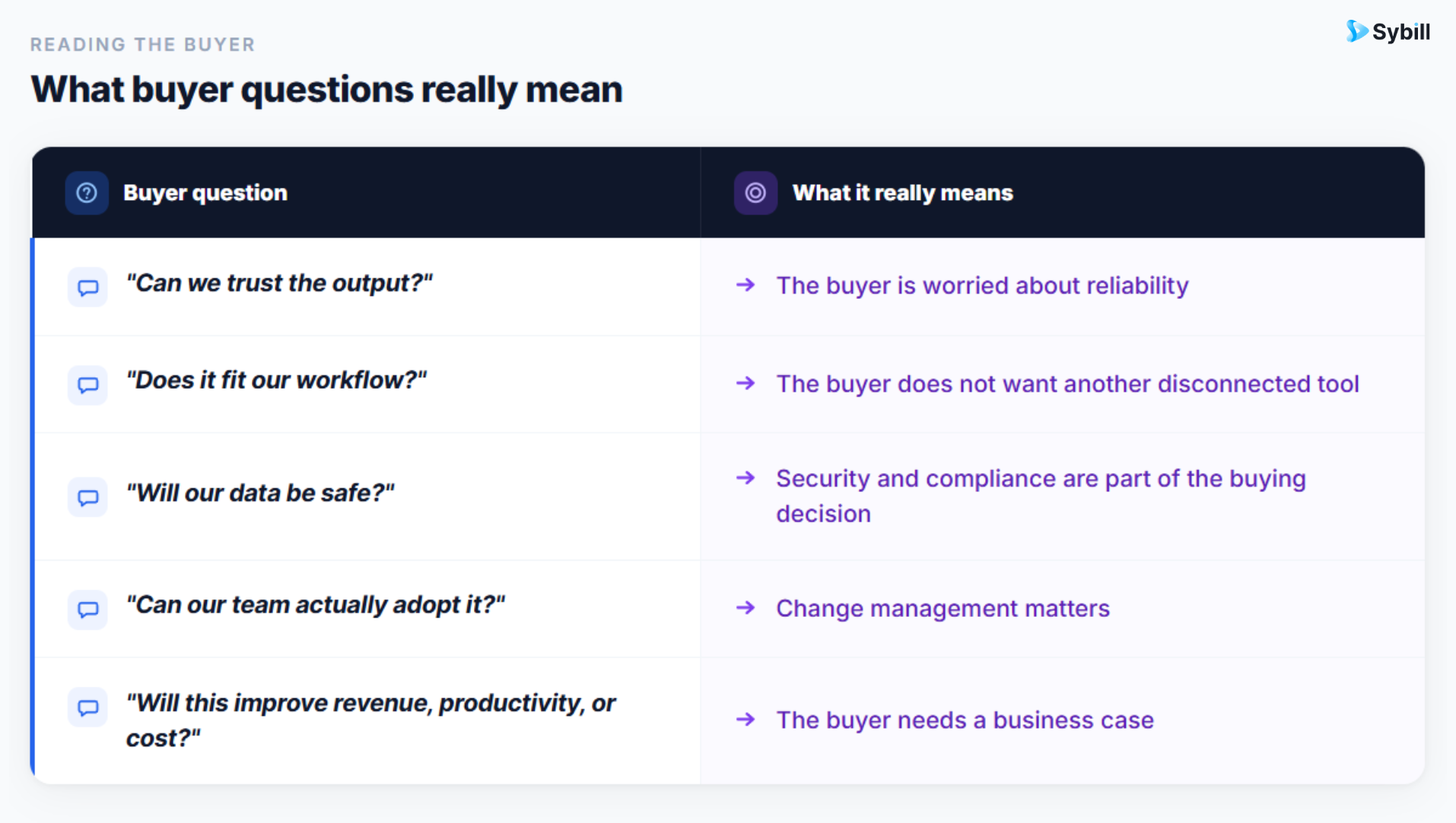
That is the AI chasm. It is the gap between “wow” and “we should standardize this across the team.”
You may be in the chasm if your growth problem sounds like this:
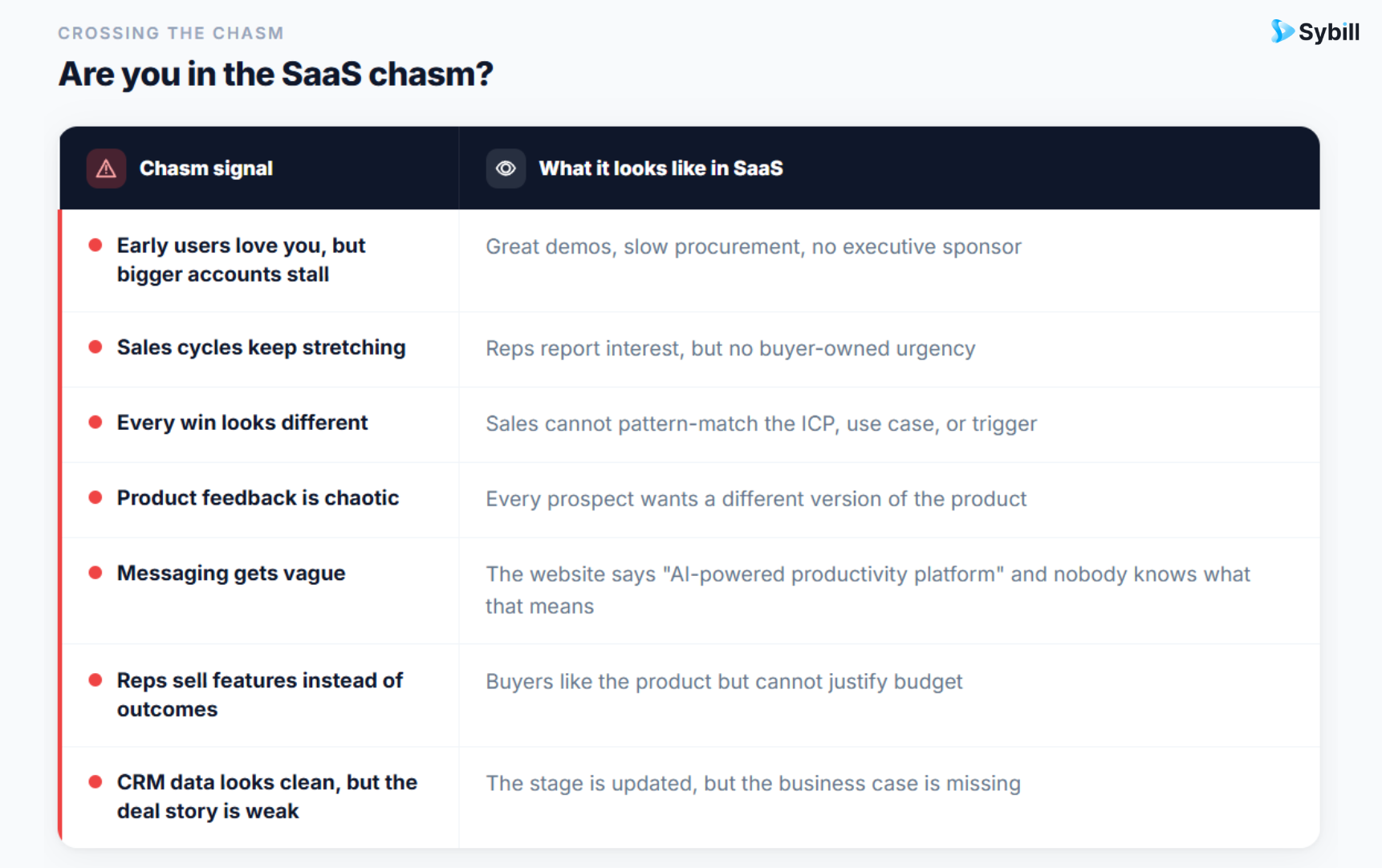
The chasm is not only a market problem. It is a learning problem.
Your team is hearing objections, pain points, competitor mentions, pricing concerns, security questions, adoption blockers, and stakeholder priorities every week. The problem is that this intelligence often stays trapped in calls, notes, Slack threads, and rep memory.
That is where Sybill fits. Ask Sybill lets teams ask deal questions in plain English instead of digging through dashboards, filters, or transcripts, while Competitor Intelligence helps teams understand how competitors are showing up in buyer conversations.
Because crossing the chasm is not powered by vibes. It is powered by evidence.
Read more: How To Find Deal Answers Without Digging Through Call Transcripts
Moore’s advice still holds up, but the modern SaaS version needs sharper GTM execution.
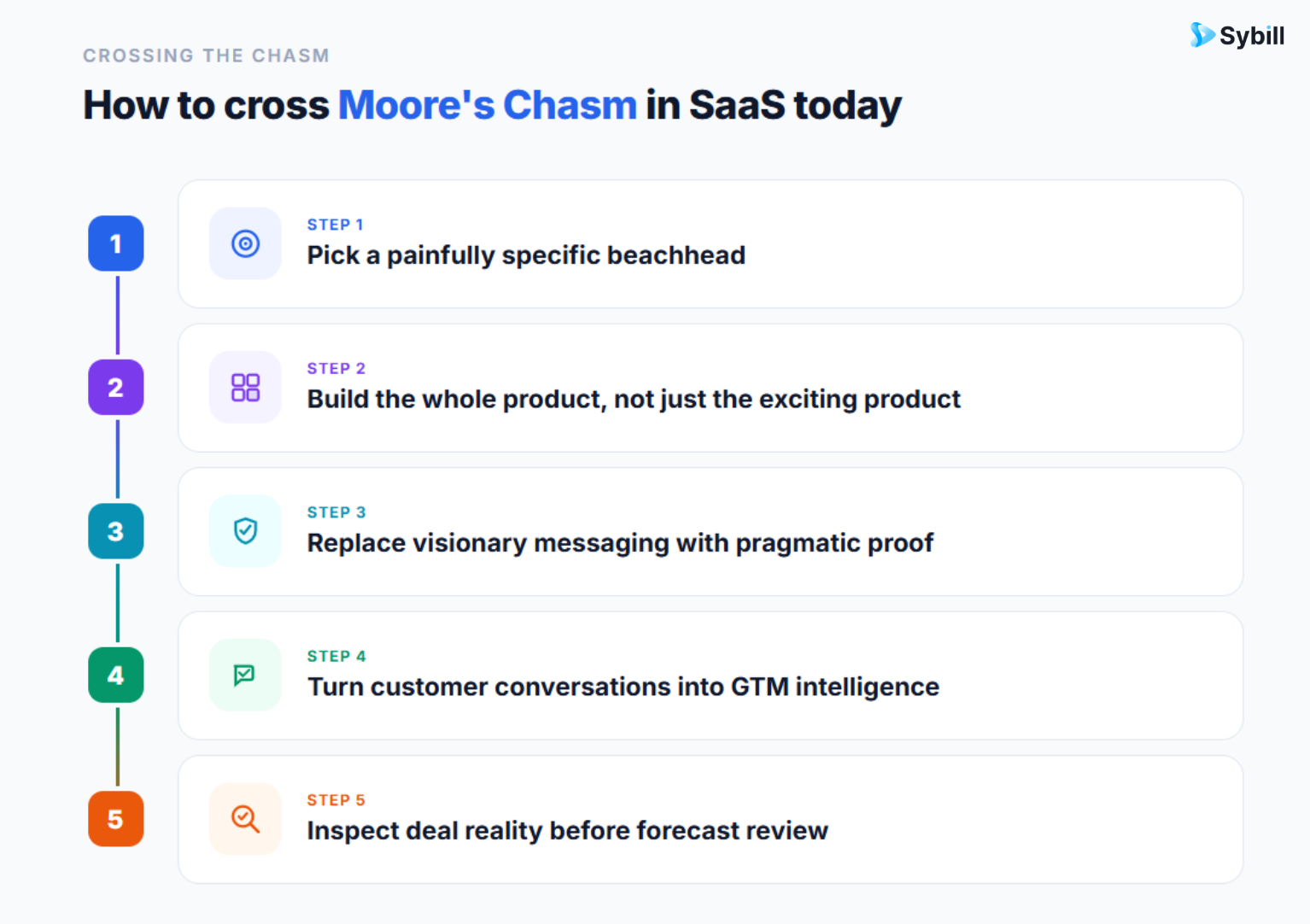
“Sales teams” is not a beachhead. It is a zip code.
A real beachhead sounds more like this:
Mid-market B2B SaaS sales teams with 20 to 100 reps that struggle with CRM hygiene, follow-up consistency, and forecast visibility.
That kind of specificity helps marketing write sharper copy, sales qualify better, product prioritize faster, and customer success onboard with less interpretive dance.
Mainstream buyers do not only buy the core feature. They buy the complete experience around it.
For SaaS, the whole product includes:
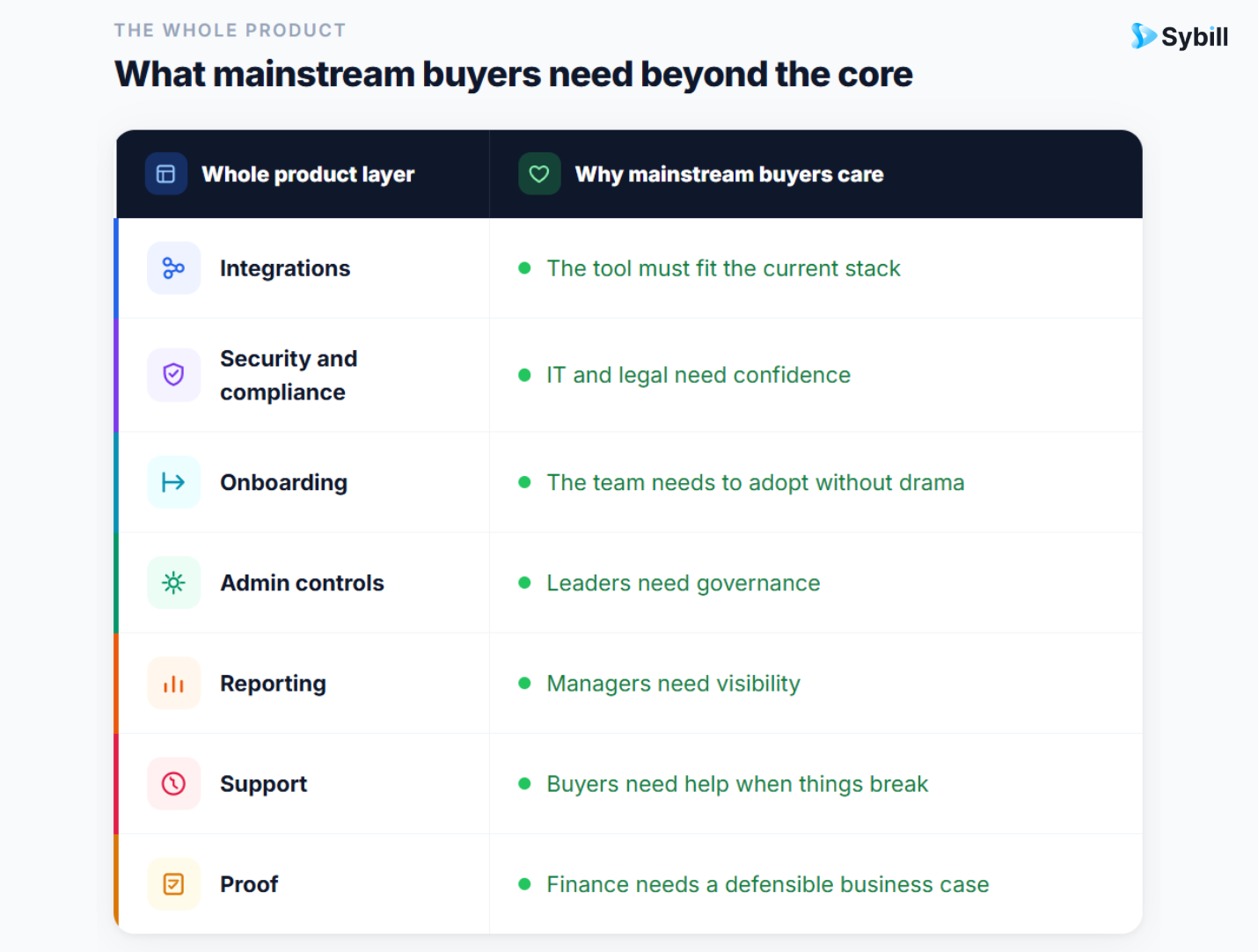
The feature gets attention. The whole product gets approval.
Early adopters respond to vision. Mainstream buyers respond to proof.
That means your messaging has to evolve from:
“Transform your sales workflow with AI.”
To:
“Save reps hours every week by automating CRM updates, follow-ups, and meeting summaries while giving managers clearer deal visibility.”
One sounds like a conference keynote. The other sounds like budget.
The fastest way to understand your chasm is to listen to the market better.
Not through one heroic founder call. Not through a quarterly win-loss deck that arrives after everyone has already changed the strategy. Through continuous buyer intelligence.
Your team should know:
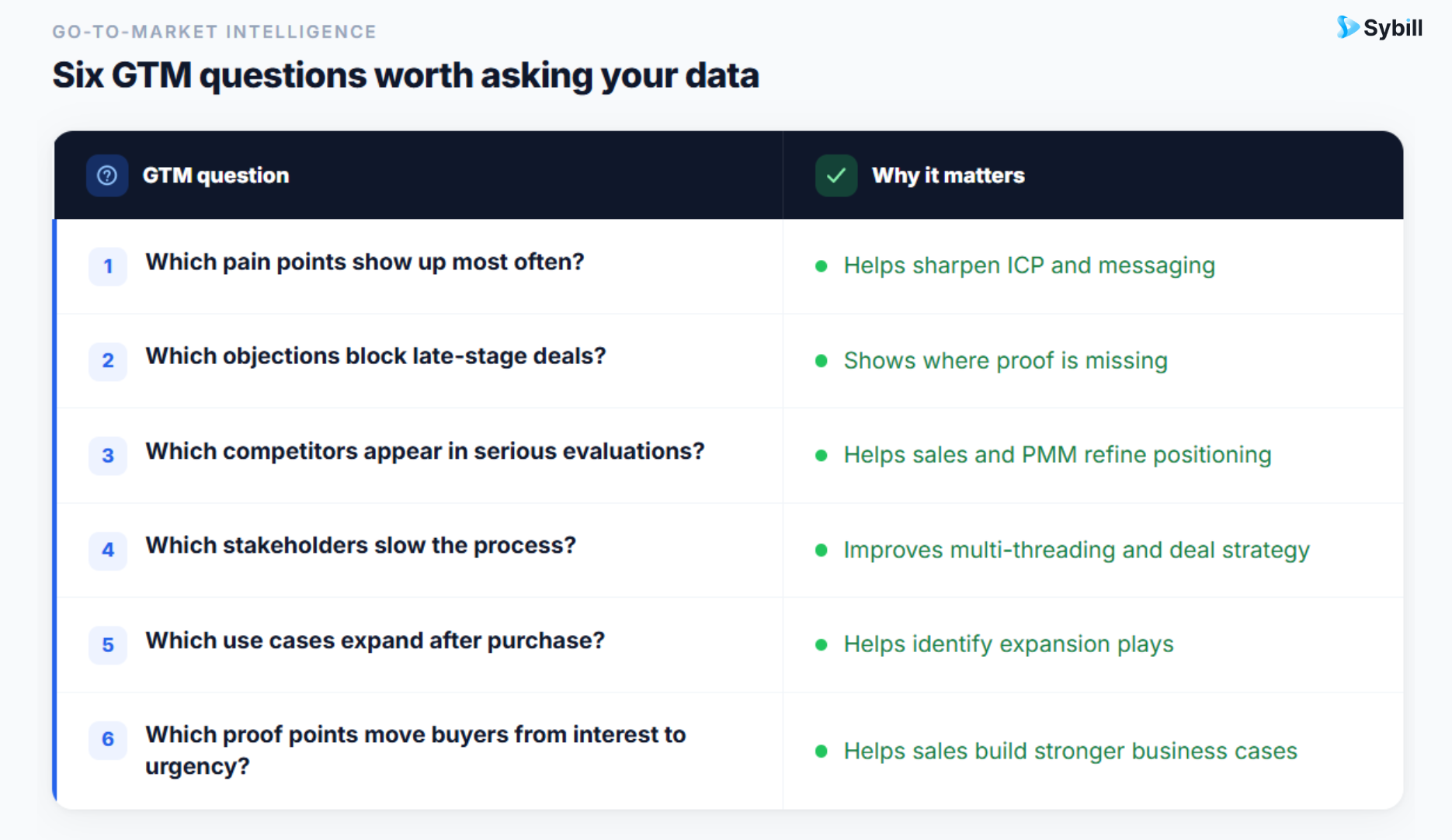
This is why conversation intelligence has to evolve into revenue execution. Teams do not need more transcript archaeology. They need answers about what changed, what buyers care about, what risk showed up, and what to do next.
Read more: What Is Conversation Intelligence?
5. Inspect deal reality before forecast review
The chasm widens when leadership believes pipeline sentiment and buyer reality are the same thing.
They are not.
A deal can look healthy in CRM and still be quietly decomposing. The close date is updated. The amount is entered. The stage is correct. But the economic buyer is missing, the champion is alone, the competitor is gaining ground, and the next step is “we will circle back.”
That is not pipeline. That is fan fiction.
Use Deal Inspection to understand stage, risk, buyer engagement, and momentum before the forecast call.
Read more: How to Run a Sales Pipeline Review Meeting
Mainstream buyers are not allergic to innovation. They are allergic to unnecessary risk.
That means the sales motion has to change.
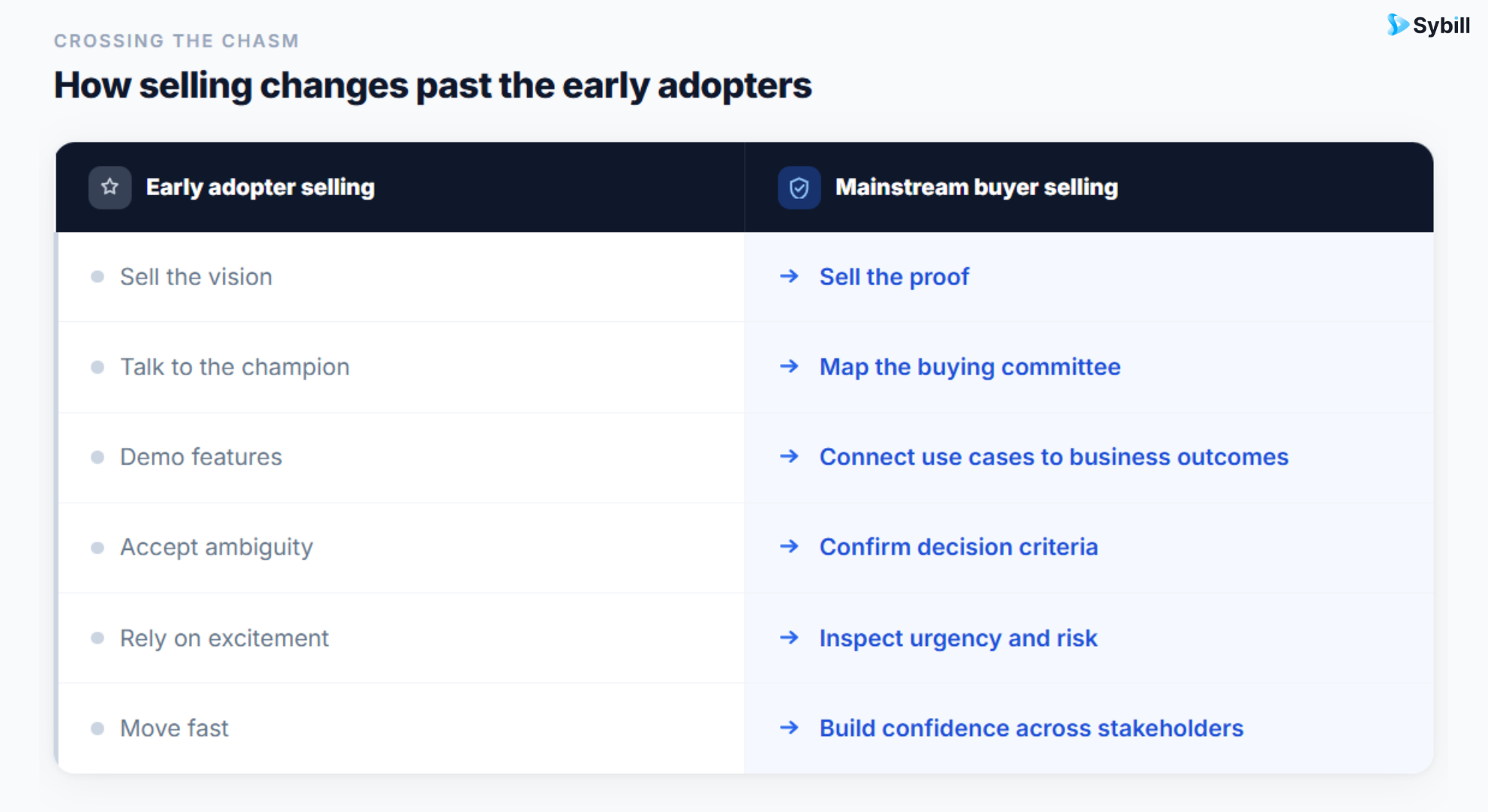
This does not mean reps should become robotic procurement whisperers. It means they need better context.
They need to know what the buyer said last time, what changed since then, who cares about what, what objection is unresolved, which competitor came up, and what next step is actually buyer-confirmed.
A modern rep does not cross the chasm by being louder. They cross it by being more relevant.
Use this checklist before deciding whether your growth problem is product, sales, marketing, or strategy.
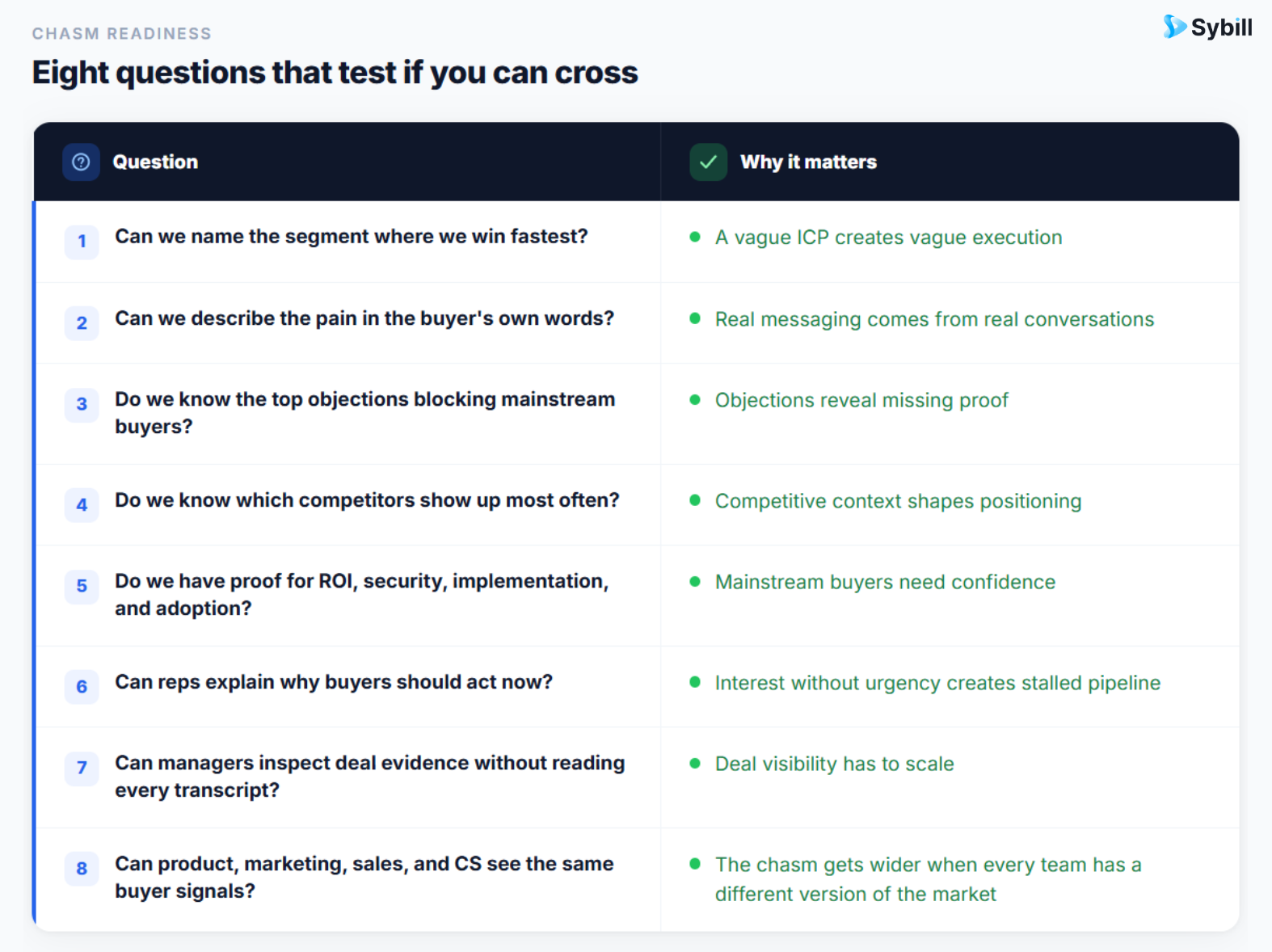
Crossing the chasm is not one big heroic leap. It is a series of boring, sharp, disciplined decisions.
Pick a narrower market. Build the missing proof. Sell to the real committee. Inspect deals earlier. Learn from every customer conversation. Stop pretending a good demo means a real deal.
The companies that cross are not always the flashiest. They are the ones that turn early love into repeatable trust.
Yes. Crossing the Chasm is still relevant because early adopters and mainstream buyers still behave differently. Early adopters are more willing to accept risk for potential advantage. Mainstream buyers need proof, reliability, internal alignment, and a clear business case before they commit.
In SaaS, the chasm is the gap between early customers who are excited by the product and mainstream buyers who need evidence that the product is reliable, valuable, easy to adopt, and safe for the business. It often appears when early traction slows and larger deals become harder to close.
SaaS companies cross the chasm by choosing a focused ICP, building a complete product experience, proving value with customer evidence, sharpening positioning, and enabling sales teams to handle risk-averse buyers with better deal intelligence.
SaaS startups often stop growing after early traction because early customers are not always representative of the mainstream market. The next stage requires stronger proof, clearer positioning, better onboarding, more stakeholder alignment, and a repeatable sales process.
Product-led growth helps users experience value faster, but it does not eliminate the chasm. A product can gain user adoption and still struggle with enterprise readiness, procurement, security, budget approval, stakeholder alignment, and expansion.
Yes. Crossing the Chasm is still relevant because early adopters and mainstream buyers still behave differently. Early adopters are more willing to accept risk for potential advantage. Mainstream buyers need proof, reliability, internal alignment, and a clear business case before they commit.
In SaaS, the chasm is the gap between early customers who are excited by the product and mainstream buyers who need evidence that the product is reliable, valuable, easy to adopt, and safe for the business. It often appears when early traction slows and larger deals become harder to close.
SaaS companies cross the chasm by choosing a focused ICP, building a complete product experience, proving value with customer evidence, sharpening positioning, and enabling sales teams to handle risk-averse buyers with better deal intelligence.