Find us at booth #83, join us for a harbor side happy hour, or catch Gorish’s talk.

Sept, 16-18 > Learn more

%20(1).avif)
Mamta Tainwala

August 2, 2026
%20(62).png)
A customer data platform (CDP) is software that collects customer data from every source (website, product, email, ads, support, transactions), resolves it into unified customer profiles, and makes those profiles available to other tools for segmentation and activation. It differs from a CRM, which records rep-entered relationship data. CDPs earn their cost in high-volume, multi-channel businesses; many B2B sales teams get more value from a clean CRM, enrichment, and conversation data first.
That last clause is the part most CDP content will not tell you, because most CDP content is written by CDP vendors. Let us do the honest version.
A CDP ingests behavioral, transactional, and demographic data from all your customer touchpoints, stitches records belonging to the same person into one profile through identity resolution, and exposes those unified profiles to downstream systems: marketing automation, ad platforms, analytics, and the CRM. Leading names include Segment, Salesforce Data Cloud, Tealium, mParticle, and RudderStack, plus the "composable CDP" pattern built on the data warehouse.
The mechanics matter more than the marketing, so here is the pipeline in plain terms:
Collection. SDKs and integrations pull events from everywhere a customer touches you: pages viewed, features used, emails opened, tickets filed, purchases made. This is machine-generated behavioral exhaust, at volumes no human enters anywhere.
Identity resolution. The hard part, and the reason the category exists: recognizing that the anonymous website visitor, the trial user on a personal Gmail, and the contact in your CRM are the same human, and merging them into one profile. Done well, this is genuinely valuable. Done badly, it is an expensive way to have three copies of Hannah.
Activation. Unified profiles and segments flow out to the tools that act: the ad platform suppresses existing customers, the marketing automation triggers on product behavior, the CRM record gets enriched with usage context.
Note who the primary operator is in that pipeline: marketing and data teams. The CDP is fundamentally martech infrastructure, which is exactly why a sales-eye view of it, what it does for your pipeline, and whether you need one, deserves its own treatment rather than a recycled vendor pitch.
The CRM is a system of record for relationships: contacts, accounts, deals, and activity, largely entered by or on behalf of reps. The CDP is a system of unification for behavior: machine-collected event data from every channel, resolved into profiles. The CRM answers "what is the state of this deal?"; the CDP answers "what has this person actually done across all our touchpoints?" They complement rather than compete, and neither replaces the other.
This is the number-one confusion in the category for sales audiences, so the side-by-side, concretely:
Data origin. CRM data is declared: reps log calls, set stages, type notes (or, in 2026, automation does it for them). CDP data is observed: events fire automatically from websites, products, and campaigns. Nobody types anything into a CDP.
Unit of organization. The CRM organizes around deals and accounts; the CDP organizes around individual identities and their event streams.
Primary consumer. The CRM serves sales and CS workflows; the CDP serves marketing activation, analytics, and increasingly product teams.
Failure mode. The CRM's classic failure is staleness and fiction, which is a hygiene problem with known fixes. The CDP's classic failure is becoming a very expensive pipe: data unified beautifully and activated by no one.
Where a CDP is in place, sales gets three concrete wins: behavioral context on every prospect (what they actually did before and between conversations), better lead prioritization (product and web behavior feeding scoring models), and cleaner segment targeting for outbound (suppressing customers, surfacing lookalikes of your best accounts). The value is real, and it is secondhand: sales consumes what the CDP was built for marketing to produce.
Played out in the workflows:
Pre-conversation context. A rep walking into a first call knows the prospect visited pricing three times, used the trial's export feature heavily, and opened the case-study email. That context turns discovery from interrogation into confirmation, and it stacks naturally with pre-meeting briefs assembling everything known into a two-minute read.
Scoring with behavior in it. Lead scoring built on titles and firmographics alone is a guess; scoring that includes product usage and engagement events is a measurement. This is the CDP's cleanest contribution to pipeline quality, and in product-led motions it is close to mandatory, since PQLs are literally behavioral definitions.
Segments that respect reality. Outbound lists that exclude current customers, ABM audiences built from actual engagement against a sharply defined ICP, expansion candidates flagged by usage before they show up in your retention numbers: all downstream of unified profiles, and all dependent on sales and marketing actually sharing definitions.
All genuinely useful. And all of it assumes the organization has the data volume, channel spread, and operating maturity for the machine to have something to unify, which brings us to the question vendor content skips.
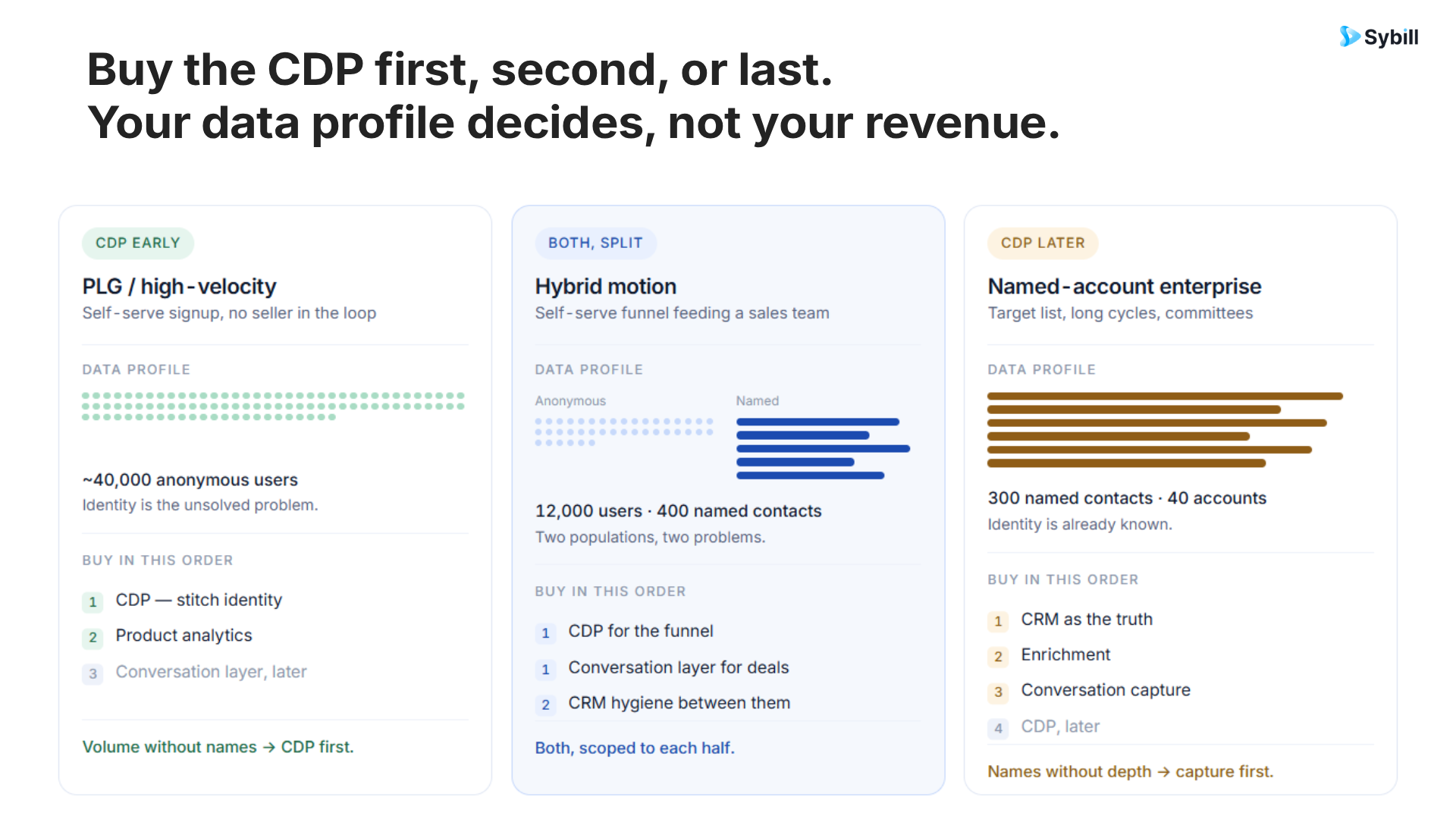
You likely need a CDP when you have high volumes of anonymous and known traffic across multiple channels, a product generating usage events (PLG), meaningful B2C or high-velocity B2B motion, and a marketing/data team ready to operate it. You likely do not need one when your revenue comes from a few hundred named accounts through rep-led conversations; there, a clean CRM, data enrichment, and conversation intelligence deliver more insight per dollar.
Let us be adults for a second, because this section is the reason to rewrite this post at all. The CDP category was built for businesses drowning in behavioral events: e-commerce, consumer apps, PLG products with thousands of self-serve users. In those contexts, identity resolution across channels is a genuine, hard, valuable problem.
Now look at a classic enterprise B2B sales motion: 300 target accounts, deals built across eight conversations with named humans, a buying committee your reps know personally. What exactly is the CDP unifying? The behavioral exhaust of a dozen stakeholders who mostly interact with you by talking to your team. The expensive identity-resolution engine solves a problem this motion barely has, while the motion's actual data problem, capturing what happens in those conversations, sits untouched.
The honest decision heuristic:
Buying a CDP because the category is hot, while your CRM is fiction and your calls evaporate unrecorded, is installing a planetarium in a house with no roof.
The richest customer data in B2B never touches a CDP. It is spoken on calls. Sybill captures every conversation and turns it into profiles, context, and CRM truth. Get started for free with Sybill.
Conversation data: the single richest customer data stream in B2B is what buyers and customers say in meetings, and it flows through no CDP pipeline. Stated needs, objections, competitor comparisons, budget language, and commitments are spoken, not clicked, so the "unified customer profile" of a B2B account is missing the substance of the relationship. Conversation intelligence is the collection layer for that stream.
This is not a knock on CDPs; it is an architecture observation. CDPs unify what can be instrumented: clicks, events, transactions. But run the thought experiment on your best account: rank everything you know about them by importance. The top of the list is conversational: why they bought, what they are worried about, what the champion said about next year's budget, which competitor they almost chose. None of it fired an event. All of it was said out loud, on calls.
Sybill has analyzed around 33 million sales conversations, and the pattern is consistent: the intent, risk, and expansion signals that decide B2B revenue appear in conversation before they appear in any behavioral stream. Which means the practical "unified customer view" for a sales organization has two halves: the instrumented half (CDP and product analytics territory) and the conversational half, where buyer intelligence extracts needs and priorities from every call, Ask Sybill makes the whole history queryable, and CRM autofill writes the substance into the system of record where RevOps and every downstream model can finally use it.
Lane marker, stated plainly: Sybill is not a CDP and does not do identity resolution across your ad channels. It is the collection-and-intelligence layer for the data stream CDPs structurally cannot see. If you run both, the CDP tells you what the account did; the conversation layer tells you what the account means.
Here is the whole post compressed into a purchasing principle: data infrastructure should be bought for a named, felt problem, not for a category's momentum. If your team genuinely cannot resolve identities across channels and it is costing you targeting and experience, that is a CDP problem, and the category solves it well. If your team genuinely cannot remember what customers said, promised, and objected to across a hundred conversations a week, that is a conversation problem, and no CDP on earth will fix it.
Most B2B sales organizations, examined honestly, have the second problem screaming and the first one whispering. Fund accordingly, in that order, and revisit as your motion evolves.
The data wave metaphor can stay retired. This is just knowing which water you are actually in.
Get started for free with Sybill or book a demo and unify the half of your customer data that talks.
CDP stands for customer data platform: software that collects customer data from every touchpoint, resolves records belonging to the same person into unified profiles via identity resolution, and makes those profiles available to marketing, analytics, and sales tools for segmentation and activation.
No. The CRM is a system of record for relationships and deals, built on declared data entered by or for reps. The CDP is a system of unification for behavior, built on machine-observed events from websites, products, and campaigns. They complement each other, and neither substitutes for the other.
Segment (Twilio), Salesforce Data Cloud, Tealium, mParticle, and RudderStack are among the category's established names, alongside the growing "composable CDP" approach that builds equivalent capability on the data warehouse with activation tools layered on top. Fit depends on data volume, stack, and the team available to operate it.
Often not as a first investment. CDPs earn their cost in high-volume, multi-channel, PLG, or B2C-like motions where identity resolution is a real problem. Named-account B2B teams typically get more insight per dollar from a clean CRM, data enrichment, and conversation intelligence, revisiting the CDP as channel volume grows.
Conversation data: what buyers and customers actually say in sales and success meetings, including needs, objections, competitor mentions, and commitments. CDPs unify instrumented events (clicks, usage, transactions), so the substance of B2B relationships requires a conversation intelligence layer feeding the CRM alongside any CDP.
CDP stands for customer data platform: software that collects customer data from every touchpoint, resolves records belonging to the same person into unified profiles via identity resolution, and makes those profiles available to marketing, analytics, and sales tools for segmentation and activation.
No. The CRM is a system of record for relationships and deals, built on declared data entered by or for reps. The CDP is a system of unification for behavior, built on machine-observed events from websites, products, and campaigns. They complement each other, and neither substitutes for the other.
Segment (Twilio), Salesforce Data Cloud, Tealium, mParticle, and RudderStack are among the category's established names, alongside the growing "composable CDP" approach that builds equivalent capability on the data warehouse with activation tools layered on top. Fit depends on data volume, stack, and the team available to operate it.