Find us at booth #83, join us for a harbor side happy hour, or catch Gorish’s talk.

Sept, 16-18 > Learn more


Tamanna Mishra

March 13, 2026
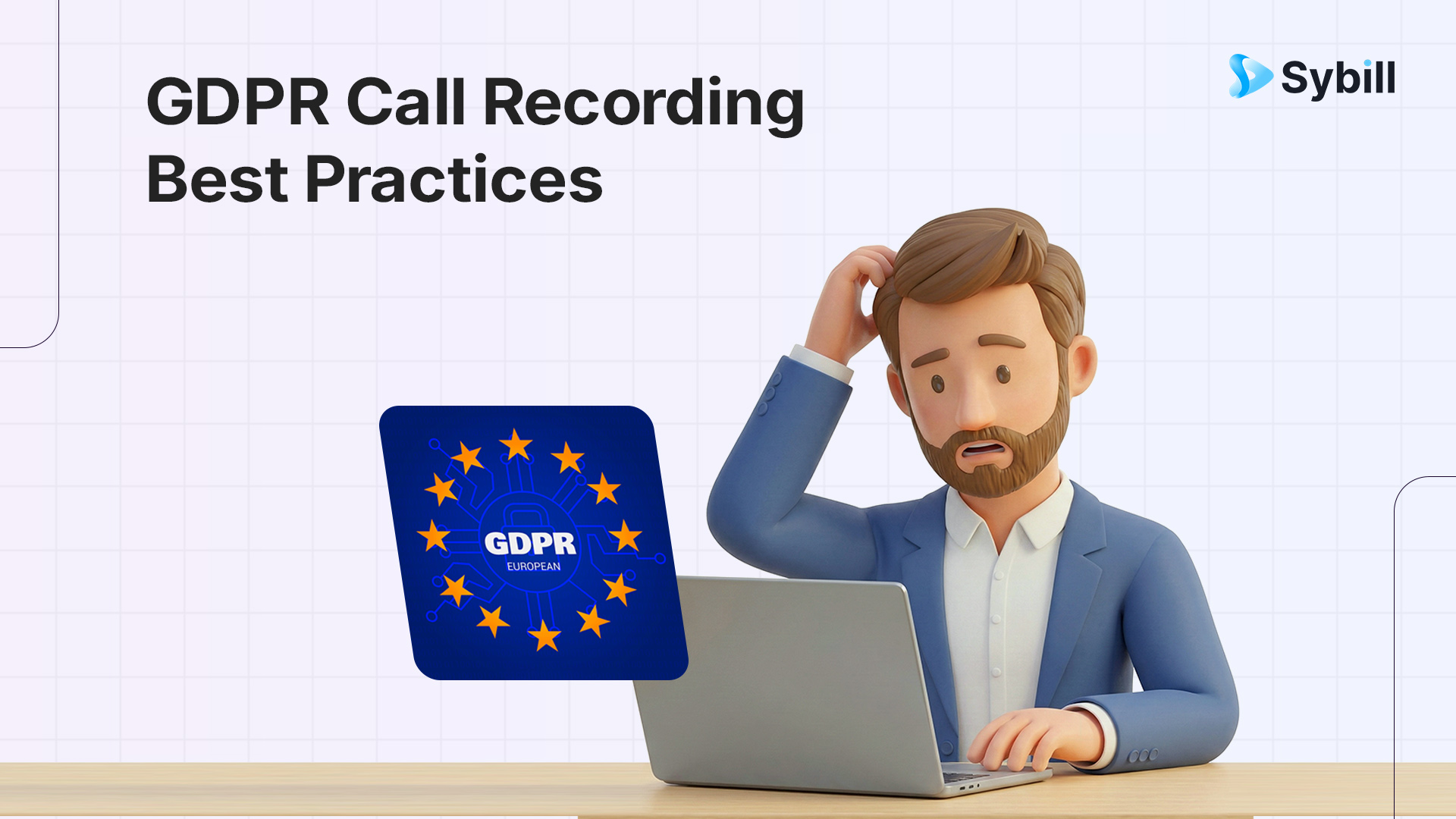
GDPR fines can cost organizations €20 million or 4% of global annual turnover.
Yet most sales reps hit “record” on a sales call recording tool without knowing what lawful basis they are operating under. They assume the standard line, “This call may be recorded for quality and training purposes,” is enough. It is not. Under GDPR call recording rules, vague disclosure is not a magic shield. It is often a liability.
But GDPR call recording best practices are not just legal’s responsibility. They sit inside your revenue engine. Every recorded discovery call, demo, negotiation, and follow-up contains personal data. Names. Job titles. Opinions. Buying intent. Sometimes even sensitive information. Once that conversation is stored, shared, summarized, or analyzed, you are processing data under GDPR.
Sales call recording is now standard in modern revenue teams. You use it for coaching. For pipeline visibility. For AI summaries. For forecasting accuracy. It drives performance. But GDPR call recording changes the stakes. One sloppy consent workflow or unclear retention policy can turn your enablement tool into regulatory risk.
The good news is this: compliance does not have to slow you down.
This guide breaks down GDPR call recording best practices for sales teams in plain English. No legal jargon. Just clear, actionable steps so you can record confidently, sell effectively, and sleep at night.
Also read: GDPR Compliant Call Recording Solutions For 2026
Most reps think GDPR call recording is a compliance checkbox.
It is not.
It is baked into how you sell.
Sales teams process personal data all day, every day.
Names. Job titles. Email addresses. Buying timelines. Budget signals. Objections. Internal politics. Sometimes even health data or sensitive operational details.
The moment you press record on a sales call recording tool, that conversation becomes stored personal data.
And that triggers GDPR call recording obligations.
GDPR applies if:
It does not matter where your headquarters sits. If EU data is involved, the rules apply.
This is where many revenue teams get complacent.
Legal writes the policy.
Sales hits record.
But regulators and enterprise buyers look at accountability across the organization. Sales managers own how their teams use sales call recording tools. That includes how consent is collected, how long recordings are stored, and who has access.
If your team cannot explain your GDPR call recording best practices clearly, you have a governance gap.
The biggest risk areas are surprisingly common:
The real-world impact is not just regulatory fines.
Deals are lost when buyers do not trust how their data is handled. Enterprise prospects increasingly ask about security, retention, and data rights during procurement. If your answers are vague, confidence drops.
Strong GDPR call recording best practices are a signal of maturity.
Also read:
GDPR call recording is not about adding a disclaimer and moving on. It is about lawful processing, clear communication, and disciplined data handling.
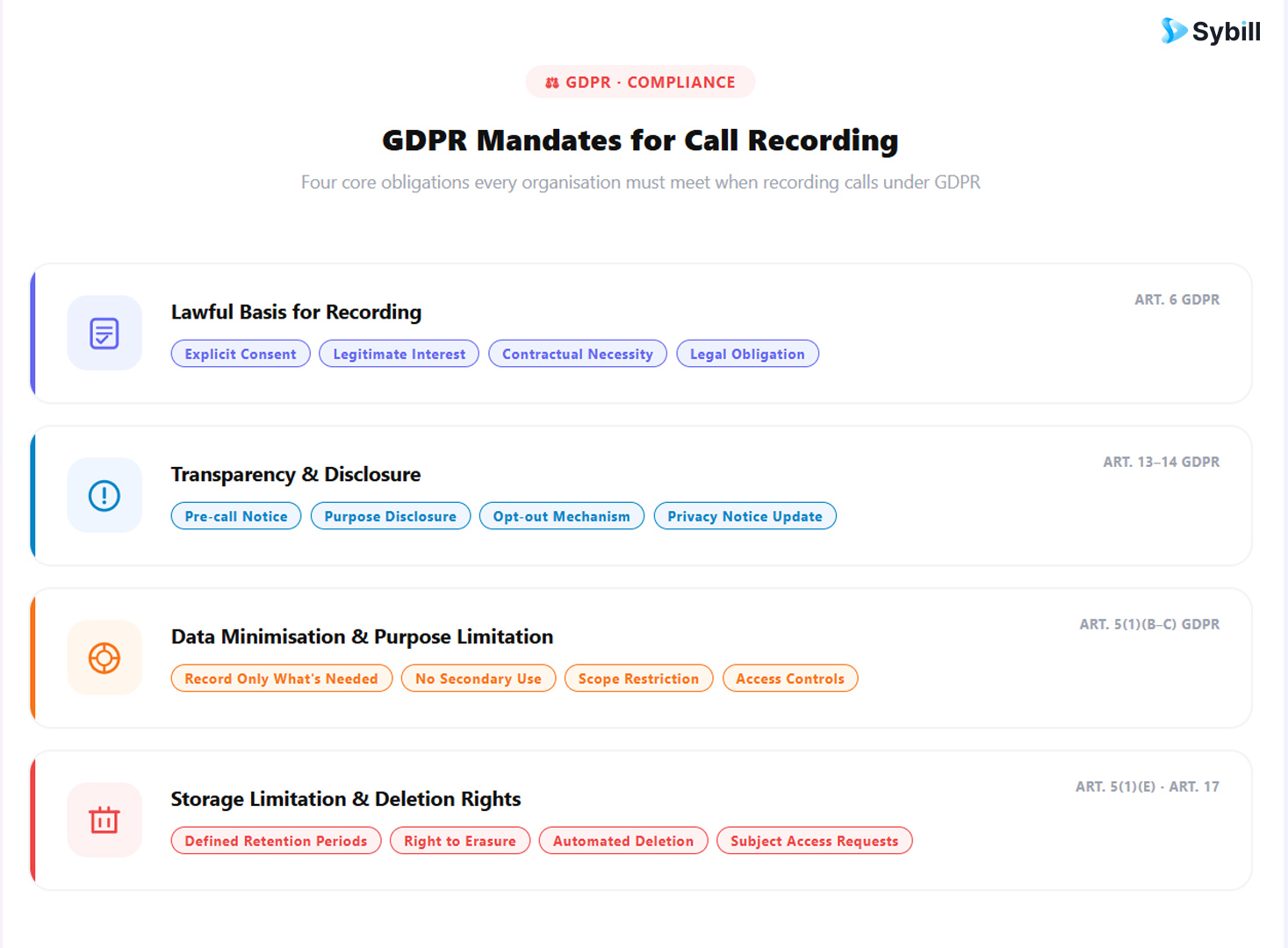
Here is what GDPR call recording best practices actually require from sales teams.
Before you record a sales call, you need a lawful basis.
There are two common ones:
1. Consent
2. Legitimate interest
They are not interchangeable.
If you rely on consent, it must be:
Pre-ticked boxes do not count.
Silence does not equal consent.
Continuing the call without objection is not automatic approval.
If you rely on legitimate interest, you must conduct and document a balancing test. You need to prove that your interest in recording does not override the individual’s rights.
Sales teams cannot “assume” compliance because the tool allows recording. The lawful basis must be intentional and defensible.
GDPR call recording requires clarity, not vague scripts.
At minimum, you must clearly state:
“This call may be recorded for quality and training purposes” is often too generic if it does not reflect actual usage.
If you use recordings for coaching, analytics, AI summaries, or pipeline forecasting, say so in plain language.
Your privacy policy must support what you disclose. And prospects should be able to access it easily.
Just because you can record does not mean you should record everything.
GDPR call recording best practices require:
Purpose limitation is critical.
If you record a sales call for training and quality, you cannot later reuse that data for unrelated marketing campaigns without a valid lawful basis.
Sales call recording must align strictly with the declared purpose. No scope creep.
You cannot keep sales recordings forever “just in case.”
GDPR requires:
You must also respect data subject rights, including:
If a prospect requests deletion, you need a practical workflow to find and remove their recording.
This is where many sales teams fall short.
GDPR call recording compliance is not just about consent at the start of the call. It extends to how long you store the data and how quickly you can delete it when required.
Discipline beats improvisation every time.
GDPR call recording best practices only work if they are operational. Not buried in a policy. Not sitting in legal’s folder. Embedded in how your reps run calls.
Here is what high-performing revenue teams actually do.
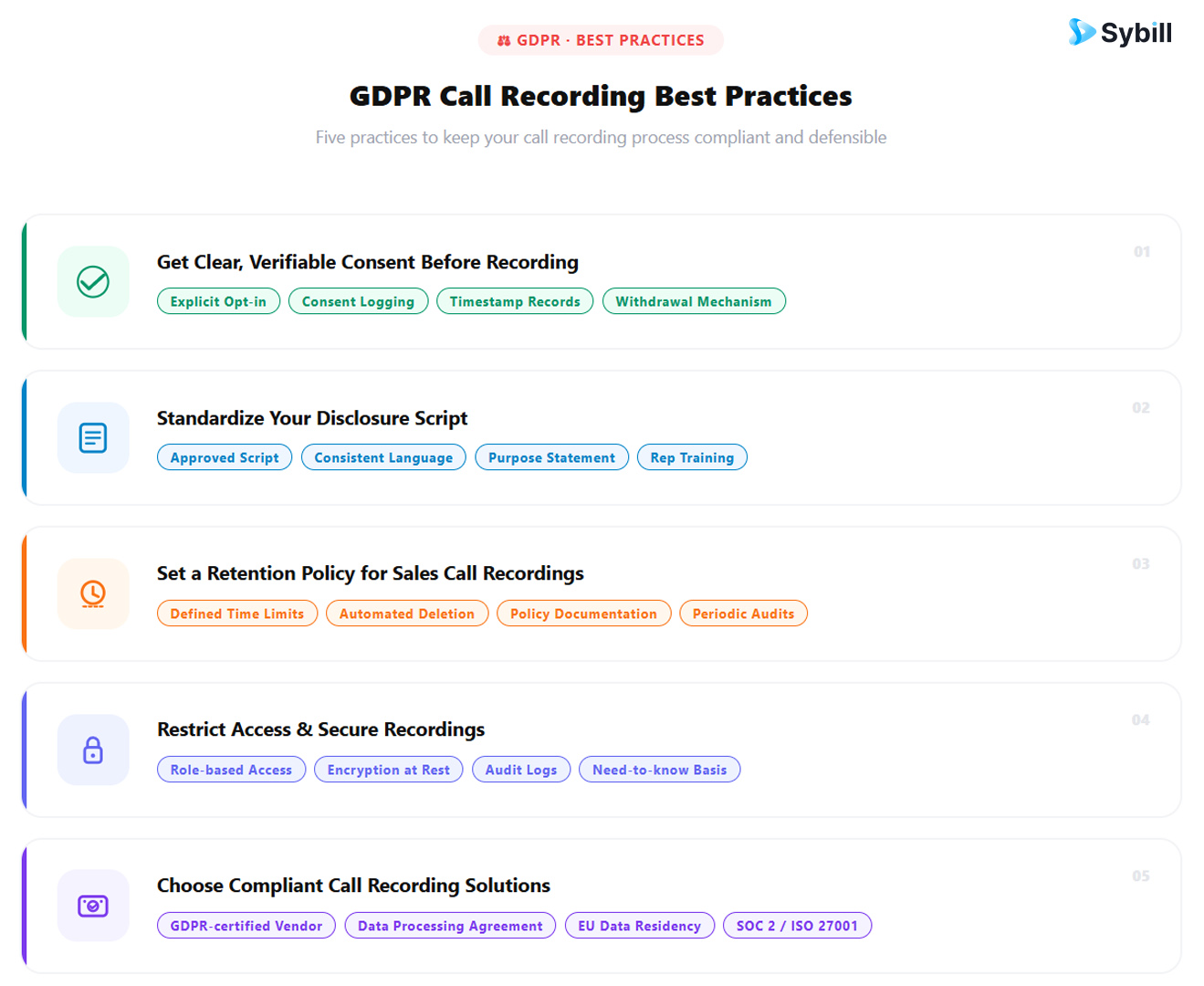
Consent is not implied. It is captured.
At the start of every recorded sales call recording, you should:
Best-in-class workflows include:
What to say:
“Before we begin, I’d like to let you know this call is being recorded for training, coaching, and internal analysis. Is that okay with you?”
Wait. Get a clear yes.
What not to say:
“This call may be recorded…” and then continue without confirmation.
That is vague. And risky.
Quick checklist:
If the answer is no, fix it.
Ad-libbed compliance is a bad strategy.
Your GDPR call recording best practices should include a standardized disclosure script that:
Train reps on it. Role-play it. Audit it.
If you operate across regions, account for nuance. Some countries expect stricter clarity. Others may require explicit opt-in before recording begins.
Example script:
“We record our sales calls to improve training, document agreements, and generate internal summaries. The recording is stored securely and retained for a limited period. You can request access or deletion at any time. Is that acceptable?”
Clear. Specific. Confident.
“Keep everything forever” is not a strategy. It is exposure.
Define a realistic retention window for sales call recording, such as:
Then operationalize it:
Managers need clarity. Reps need simplicity.
A strong GDPR call recording best practices framework includes a documented retention model, not guesswork. In the final blog, include a simple table showing example retention timelines by deal stage.
Recorded sales calls contain real business intelligence.
Treat them like it.
Your security baseline should include:
Ask hard questions about your vendor:
GDPR call recording compliance is as much about infrastructure as it is about scripts.
This is where many teams get it wrong.
They choose a sales call recording tool for features. Not for compliance maturity.
Your platform should:
Sales reps should not have to become compliance experts to do their job.
The right solution makes GDPR call recording best practices automatic, not stressful. It reduces legal anxiety. It prevents accidental over-retention. It ensures access is controlled.
When evaluating tools, compliance should not be an afterthought. It should be a core selection criterion.
Also read:
GDPR Compliant Call Recording Solutions
There is a lazy myth in revenue teams: compliance slows you down.
It does not.
Poor systems slow you down. Confusion slows you down. Scrambling during security reviews slows you down.
Strong GDPR call recording best practices do the opposite. They create clarity.
When reps know exactly how to introduce recording, log consent, and handle retention, they stop hesitating. They stop overthinking. They sell.
Enterprise buyers care deeply about data protection. Especially in Europe. Especially in regulated industries.
Security questionnaires now show up before pricing conversations. Legal reviews happen earlier. Procurement teams ask:
If your answers are vague, credibility drops.
If your answers are structured and confident, trust increases.
That trust accelerates deals.
Think about it from the buyer’s perspective.
A vendor who cannot explain how they handle GDPR call recording probably struggles with broader governance.
A vendor who can clearly articulate lawful basis, retention, and deletion workflows signals operational maturity.
Compliance becomes part of your brand.
The best sales teams treat compliance as a competitive advantage.
They do not hide from GDPR conversations.
They lead them.
They proactively explain how recordings are handled.
They demonstrate structured GDPR call recording best practices.
They make data protection part of their sales narrative.
High performance and compliance are not opposites.
They are infrastructure and output.
When the infrastructure is strong, performance compounds.
You should not need a law degree to run high-quality sales call recording.
Sybill is designed so revenue teams can focus on selling, while compliance stays structured in the background.
Here is how that matters for GDPR call recording:
When insights are captured through structured summaries and controlled workflows, risk drops. You are not forwarding audio files around Slack. You are not exporting recordings unnecessarily. You are operating inside a governed system.
The goal is simple: make responsible sales call recording the default, not an afterthought.
If you are evaluating sales call recording tools, make GDPR readiness part of your checklist. The right platform should support secure access, structured retention, and disciplined data handling from day one.
Click here to learn more about Sybill’s privacy policy.
Sales call recording is powerful. It sharpens coaching. It improves forecasting. It captures buying signals you would otherwise miss.
But power without guardrails is a risk.
GDPR call recording best practices is not about fear. It is about control. When you build clear workflows around consent, disclosure, retention, and access, compliance becomes predictable. Not reactive. Not chaotic.
The goal is confidence.
Confidence that every recorded call has a lawful basis.
Confidence that retention is defined.
Confidence that deletion requests can be handled cleanly.
Confidence that your team is not improvising under pressure.
Strong GDPR call recording best practices do not slow revenue teams down. They professionalize them.
Build structured processes.
Train your reps.
Choose compliant call recording solutions that make governance operational, not theoretical.
Make GDPR call recording part of your sales operating system, not a footnote in your policy document.
Because the best revenue teams do two things exceptionally well.
They close deals.
And they protect buyer trust.
Yes, GDPR call recording is legal if you have a valid lawful basis and you are transparent about it.
That means you must:
Recording itself is not the problem. Recording without structure is.
In many cases, yes.
If you rely on consent as your lawful basis, it must be explicit, informed, and documented. Silence or passive participation does not count.
Some organizations rely on legitimate interest, but that requires a documented balancing test proving that your interest in recording does not override the individual’s rights.
If you cannot clearly justify your approach, your GDPR call recording setup is vulnerable.
Yes.
GDPR applies if you process personal data of EU residents, even if your company is headquartered elsewhere.
If you sell into the EU, store EU customer data, or use vendors that process EU data, GDPR call recording rules may apply to your sales call recording practices.
Geography does not exempt you. Data jurisdiction matters more than office location.
Yes, GDPR call recording is legal if you have a valid lawful basis and you are transparent about it. That means you must: Establish consent or legitimate interest Clearly inform the participant that the call is being recorded Explain the purpose of recording Handle storage and retention responsibly Recording itself is not the problem. Recording without structure is.
In many cases, yes. If you rely on consent as your lawful basis, it must be explicit, informed, and documented. Silence or passive participation does not count. Some organizations rely on legitimate interest, but that requires a documented balancing test proving that your interest in recording does not override the individual’s rights. If you cannot clearly justify your approach, your GDPR call recording setup is vulnerable.
Yes. GDPR applies if you process personal data of EU residents, even if your company is headquartered elsewhere. If you sell into the EU, store EU customer data, or use vendors that process EU data, GDPR call recording rules may apply to your sales call recording practices. Geography does not exempt you. Data jurisdiction matters more than office location.