Find us at booth #83, join us for a harbor side happy hour, or catch Gorish’s talk.

Sept, 16-18 > Learn more


Tamanna Mishra

March 4, 2026
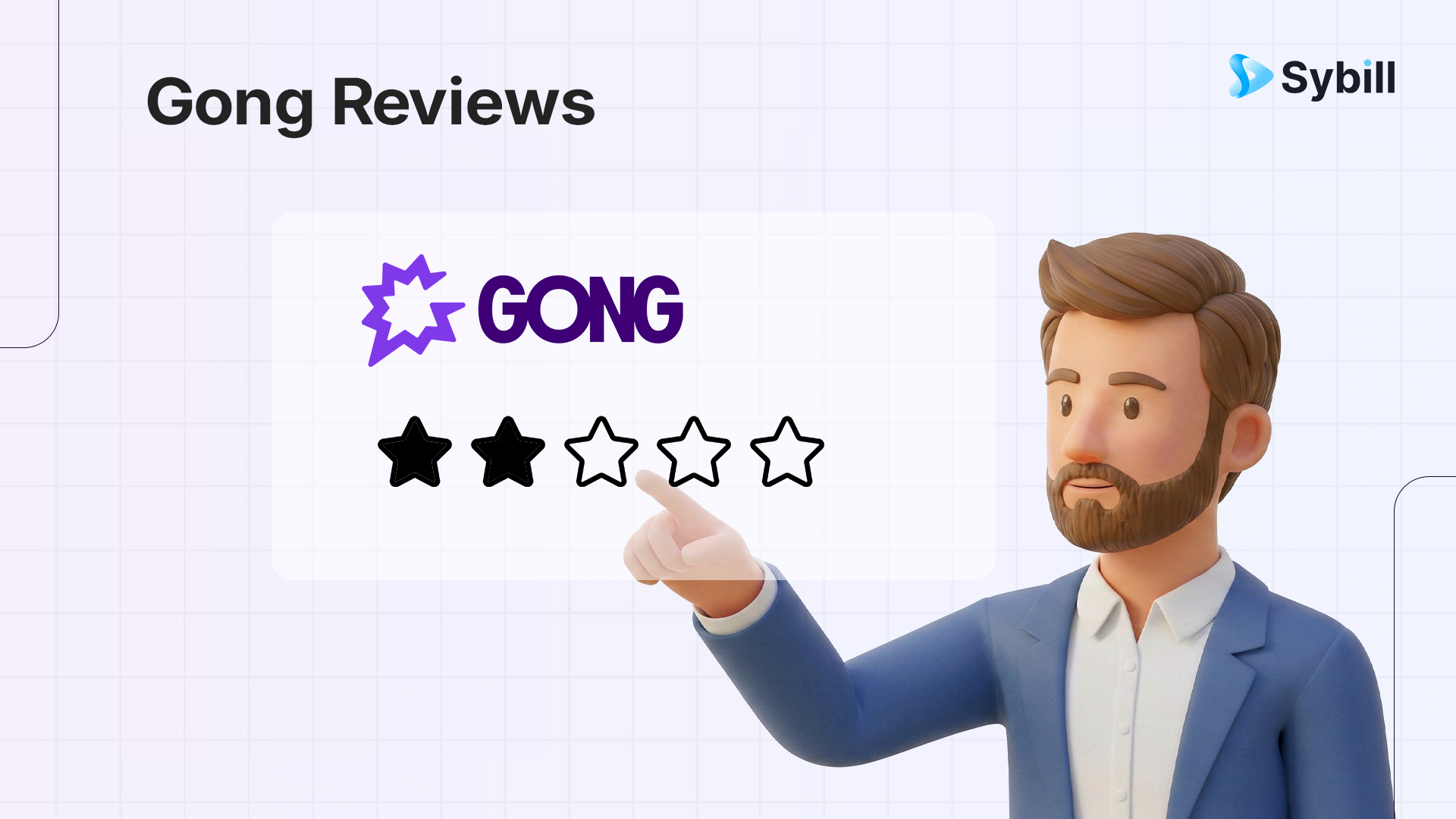
Gong deserves credit for building the revenue intelligence category. It normalized conversation capture, made coaching measurable, and turned sales calls into something more useful than “I think they said budget was Q3.”
But categories evolve. What Gong built is getting outdated.
In 2026, the bar is no longer “Can you record and analyze calls?”
The bar is “Can you help sellers execute inside the deal, without turning sales into surveillance theater?”
And if you read enough Gong reviews, the friction points are not random. They cluster into a few predictable themes: pricing, support, adoption, and AI maturity.
This article breaks down Gong reviews the way your RevOps brain actually wants: what Gong does, what it costs, what users praise, what users hate, and what your best next move is if you want revenue intelligence that actually moves deals forward.
At its core, Gong positions itself as a revenue intelligence platform.
Translation: it captures your sales conversations, turns them into transcripts and insights, and helps leaders coach reps and forecast pipeline using signals from real deal activity.
If you look at user language, the most consistent value prop is visibility. Gong helps solve the “black box” problem where the only person who truly knows what happened in the deal is the rep.
A 2.5/5 review sums up the positioning clearly: “Gong is a Revenue Intelligence Platform designed to give sales teams visibility into their deals by recording, transcribing, and analyzing every interaction” in Since we’ve been discussing the pros, cons, and specific problems Gong solves.
In practical terms, Gong is typically used for:
Gong also has products beyond conversation intelligence, like Gong Engage. But the reviews show a clear split: conversation intelligence is where Gong is still the most considered, and expansions into “engagement” and “sequencing” are where user frustration increases. See Broken Promises, Low Adoption: Why Gong Engage Misses the Mark.
Our POV: Gong is just a system of visibility. It gives leadership a lens. It does not fundamentally reduce seller admin work unless your team builds additional workflows around it.
That distinction matters more in 2026 than it did in 2016.
Gong does not publish simple public pricing, and one of the most consistent themes in Gong reviews is that cost can feel heavy, especially for smaller teams.
A direct callout in a 2.5/5 G2 review points to surprise platform fees: “Many teams are surprised by the high upfront platform fees (often $5,000+) before they even pay for individual user seats” in Since we’ve been discussing the pros, cons, and specific problems Gong solves.
Separately, multiple reviews describe the pain of commitment and value realization:
And if you want the most blunt non-G2 signal, a Capterra reviewer summarizes it as “fine at what it does” but no longer best-in-class: “It likely was the best choice for call recording a few years ago but it doesn't seem like that anymore” in Standard / fine call recording software.
Our POV: Gong pricing can make sense when:
But if you are a smaller or mid-market team trying to buy leverage for reps, Gong can feel like buying a category legacy tool at category legacy pricing.
That is why this quote from a Sybill user resonates so hard:
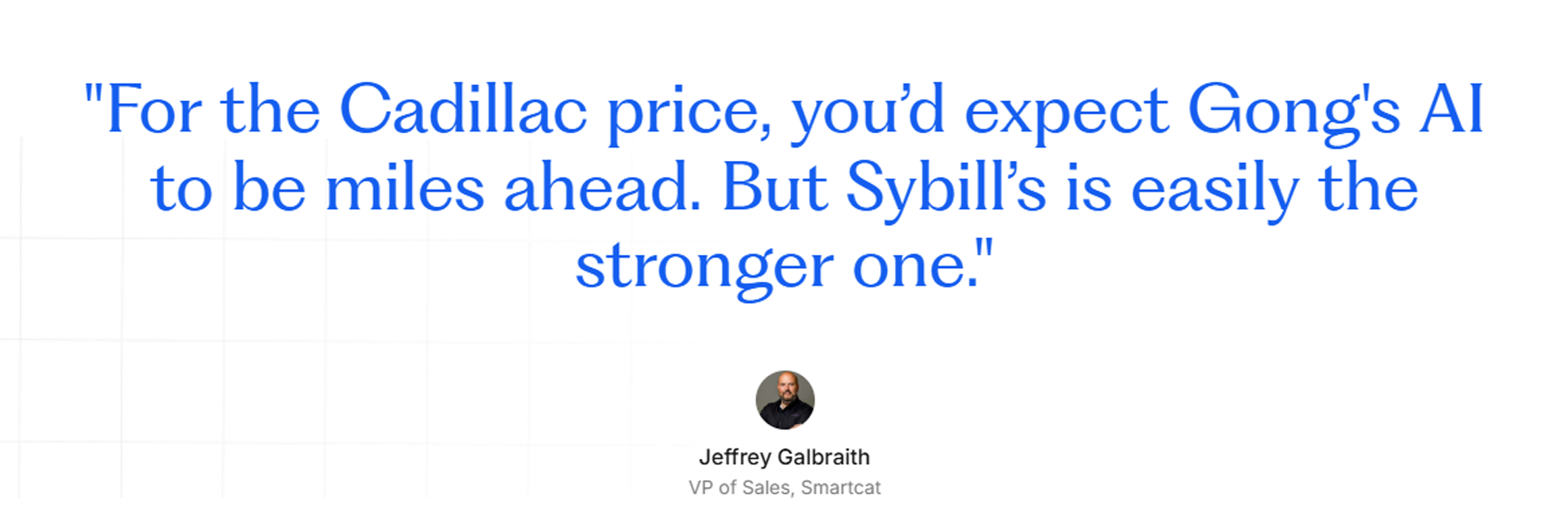
When you pay a premium, your expectations shift from “good enough” to “obviously superior.”
Let’s start fair. Gong is not hated. It is polarizing. And polarizing tools usually do one thing really well.
In Gong’s case, that “one thing” is conversation capture and analysis at scale.
A 4/5 reviewer describes the value as: “full visibility into customer conversations without requiring me to join every call… precise call transcription… deal insights” in Powerful call intelligence and deal insights that drive better decisions.
A 2/5 reviewer still acknowledges the concept is strong: “Gong allows sales managers to listen to calls… saves time” in Gong is good, not great..
In other words, even when people are unimpressed overall, they still respect the core idea.
One 3.5/5 review calls out seamless Zoom integration, ease of finding calls, and the snip tool as a major benefit in Ease of Use with Some Sales-Centric Limitations.
That matters because adoption is often won on tiny workflow details, not big promises.
If you have:
Then Gong can be a real advantage.
Even a 1/5 review that criticizes surveillance still admits Gong helps pull insights on what top reps are doing, and to coach to a sales process in Sales coaching and review platform.
Our POV: Gong works when your organization already has a coaching operating system and wants better instrumentation. It might make coaching measurable but it doesn’t automatically make coaching effective.
Now the part you actually came for.
If you read Gong reviews across different roles, the complaints are about the experience of running Gong in a real org.
This shows up repeatedly.
And this doesn’t just show up in public reviews. Gong’s AI features just don’t match up to what alternatives like Sybill offer. Here’s an interesting quote from our customer.
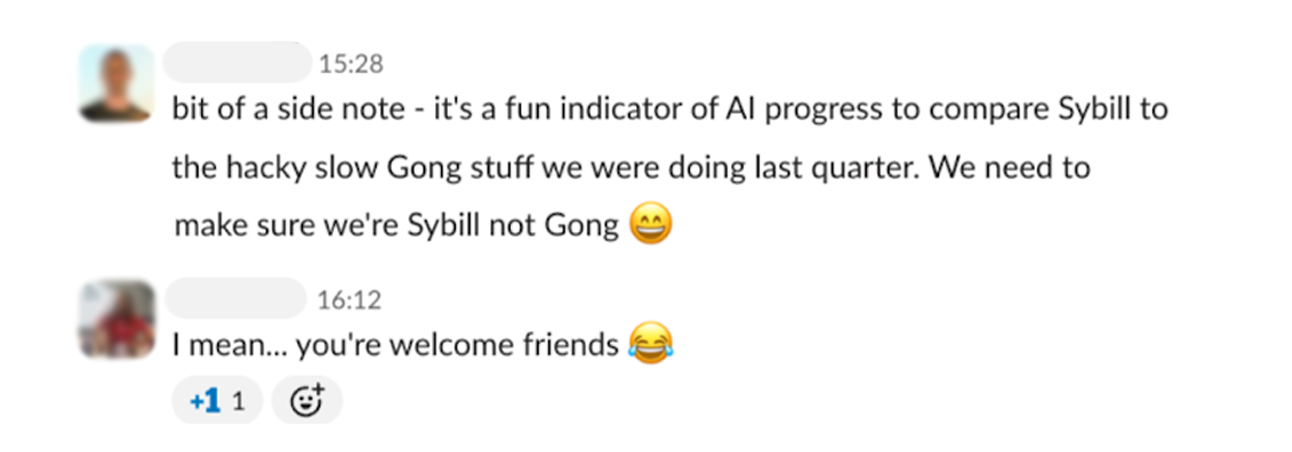
Our POV: In 2026, AI is not a checkbox feature. It is the entire product expectation. The moment users are exporting Gong data into another AI layer, you are no longer the intelligence platform. You are the recording layer.
Multiple reviews explicitly mention delays, outsourced onboarding, and slow ticket resolution.
Our POV: Enterprise tools often require enablement. That is not inherently bad. But when support becomes part of the adoption bottleneck, the tool starts to feel like a tax instead of a lever.
This is the most consistent theme across negative Gong reviews.
Our POV: If your core need is “get reps more time back,” pricing is not just a budget decision. It is an efficiency decision. Expensive visibility that does not reduce seller workload will be questioned every renewal.
This is the spiciest theme, and it is not rare.
The 1/5 review Sales coaching and review platform explicitly calls out:
Also, adoption issues are called out directly in Broken Promises, Low Adoption: Why Gong Engage Misses the Mark.
Our POV: Conversation intelligence can either build a learning culture or a compliance culture. The same data can coach, or it can police. When it feels like policing, reps start to disengage or worse, never adopt.
The ugly is not “this feature was confusing.” It is “this tool makes people regret the purchase.”
This is a brutal pattern in multiple reviews.
When a platform becomes “expensive call recording,” you do not have a revenue intelligence system. You have a compliance archive.
The review The tool that you didn't know you didn't need calls it “too complicated, and not intuitive at all” and highlights difficulty searching, navigating calls, and understanding pipeline management.
Even the 3.5/5 review Ease of Use with Some Sales-Centric Limitations flags that calls are not automatically labeled correctly and require manual organizing.
Strategic POV: Complexity is not just UX. It is adoption friction. And adoption friction destroys ROI faster than any missing feature.
This is sensitive territory. So we stick strictly to user claims.
The 0/5 review Poor value for money, lack of integrity claims:
You do not need 100 reviews like this for it to matter. You need one serious buyer to see it during procurement and ask the question.
But first, why are users looking for Gong competitors and alternatives? If the Gong reviews above don’t make it clear, try this article:
Buyers search for Gong competitors because something feels misaligned.
The competitive set for you depends on what you want Gong to be.
The Gong Engage reviewer explicitly suggests alternatives like Outreach, Salesloft, and Apollo in Broken Promises, Low Adoption: Why Gong Engage Misses the Mark.
That is the key takeaway: even Gong users do not always see Gong Engage as the best fit for engagement workflows.
Gong competes with conversation intelligence tools and sales enablement platforms. But in 2026, the meaningful split is not “who else records calls.”
The split is:
Gong is built for sales leaders. Sybill is built for sellers.
And that is the real shift.
Sybill’s core advantage is that it is AI-native and execution-first.
Sybill is:
Key differentiators:
And pricing is explicit:
Our POV: Gong built the category of revenue intelligence. Sybill is built for the next version of that category: revenue execution intelligence, where AI does the work sellers have been doing manually. If Gong was building for today, it would have built Sybill.
Yes.
You might like Gong for forecasting and leadership dashboards, but still hate:
Sybill’s your person.
Here is the honest answer based on the reviews we read.
You will likely align with reviews like:
You will likely resonate with:
Most “Gong reviews” articles ask the wrong question.
They ask: “Is Gong good?”
The better question is: “What are you buying Gong for?”
Because if you are buying Gong for:
Then yes, it works. It’s an exorbitant call recording tool.
But if you are buying Gong for:
Then the reviews suggest you will feel friction fast, and you will start stitching together other tools. That behavior shows up clearly in Lots of Hype with Little To Show For It, where the reviewer exports calls elsewhere for AI.
That is exactly where Sybill fits.
Over at Sybill, we are not trying to out-dashboard Gong.
We are trying to eliminate the after-call admin spiral and give teams cross-deal intelligence and revenue insights on demand.
If you are reading Gong reviews because you want the benefits of conversation intelligence but you do not want the trade-offs people complain about (price shock, slow support, weak AI, admin burden), this is the cleanest approach:
Keep Gong if you love it for forecasting and leader dashboards.
Layer Sybill on top to get cross-deal answers and automation that actually saves reps time.

Several Gong reviews suggest it can be hard to justify for smaller teams due to cost and time-to-value. See not great for small/startup teams - way too expensive when there are more affordable tools that work and Biggest downside is the price.
Some reviewers describe Gong being used as a monitoring layer, with management focusing on talk ratios, keyword usage, and timestamped nitpicking rather than holistic coaching. See Sales coaching and review platform.
Competitors depend on what you want Gong to do. For sequencing and engagement, the Gong Engage reviewer suggests alternatives like Outreach, Salesloft, and Apollo in Broken Promises, Low Adoption: Why Gong Engage Misses the Mark. For AI-native sales execution and cross-deal intelligence, Sybill is the seller-first platform.
Several Gong reviews suggest it can be hard to justify for smaller teams due to cost and time-to-value. See not great for small/startup teams - way too expensive when there are more affordable tools that work and Biggest downside is the price.
Some reviewers describe Gong being used as a monitoring layer, with management focusing on talk ratios, keyword usage, and timestamped nitpicking rather than holistic coaching. See Sales coaching and review platform.
Competitors depend on what you want Gong to do. For sequencing and engagement, the Gong Engage reviewer suggests alternatives like Outreach, Salesloft, and Apollo in Broken Promises, Low Adoption: Why Gong Engage Misses the Mark. For AI-native sales execution and cross-deal intelligence, Sybill is the seller-first platform.