
Find us at booth #83, join us for a harbor side happy hour, or catch Gorish’s talk.

Sept, 16-18 > Learn more

%20(1).avif)
Mamta Tainwala

June 1, 2026
.png)
Researching a prospect before a sales call takes most reps 15 to 30 minutes when done manually. It should take 10 minutes or less if you follow a structured process, and under 2 minutes if you use an AI tool that assembles the brief automatically. The goal is not to know everything about the prospect. It is to know the five things that will make the conversation feel personalized, relevant, and informed, so the buyer trusts you enough to share what actually matters.
Top-performing reps spend 6x more time on pre-call research than average reps, according to data from sales performance studies. But spending more time is not the point. Spending the right time on the right information is. A rep who spends 25 minutes reading the prospect's entire LinkedIn history knows a lot of trivia. A rep who spends 10 minutes understanding the company's current challenges, the buyer's role in solving them, and what has already happened in this deal knows everything they need to run a great call.
This guide gives you a repeatable 10-minute framework, a clear checklist of what to look for and where, and a section on how to automate the entire process so pre-call research happens before every meeting without eating into selling time.

Structure your pre-call research into four blocks. Each one answers a specific question that shapes how you open, what you ask, and where you steer the conversation.
What you need to know: What does this company do, who do they sell to, how big are they, and what is happening in their world right now?
Where to find it:
Start with the company's website. Scan the homepage and About page for positioning, target market, and recent messaging changes. If they have recently rebranded, launched a product, or changed their tagline, that tells you where leadership attention is focused.
Check for recent news. A quick search for the company name filtered to the past 30 days surfaces funding rounds, leadership changes, product launches, layoffs, partnerships, or earnings reports. Any of these is a conversation opener that signals you did your homework.
Look at their LinkedIn company page. Employee count and recent growth trends (is the sales team hiring? is engineering shrinking?) tell you about priorities and budget. Recent company posts reveal what they want the market to know about them.
If you sell to a specific function (sales, marketing, finance, engineering), check whether they are hiring for roles related to your product's use case. A company posting three "Revenue Operations Manager" listings has a different set of problems than one posting for "Sales Development Representatives."
What you are building: A 2-sentence mental model of the company's current situation. Example: "Series B fintech, 200 employees, growing sales team aggressively, just announced a new enterprise product line. Probably dealing with scaling pains around pipeline management and forecast accuracy."
What you need to know: Who is this person, what do they care about professionally, and what might be driving them to take this call?
Where to find it:
LinkedIn is the primary source. Look at their current title and how long they have been in the role. A VP of Sales who started three months ago has different priorities than one who has been in the seat for four years. The new VP is likely evaluating the existing stack, setting new targets, and proving early wins. The tenured VP is optimizing, not rebuilding.
Scan their recent posts and activity. If they posted about a specific challenge, a conference they attended, or a thought leadership piece they shared, that is gold. Referencing something they chose to put into the world is the most natural rapport-builder available. It shows you paid attention to them as a person, not just a lead record.
Check mutual connections. A shared connection is not just a rapport tool. It is a credibility shortcut. "I saw you're connected with [name] at [company]. We worked together on [context]" can establish trust in seconds.
Look at their career path. Did they come from a company that uses your product or a competitor? That context shapes what they already know and what biases they might carry into the conversation.
What you are building: A 2-sentence mental model of the buyer. Example: "VP Sales, 4 months in role, came from a Gong shop, recently posted about CRM data quality challenges. Likely evaluating new tools and has budget authority for this quarter."
What you need to know: What has already happened between your company and this prospect? What was said in previous calls? What commitments were made? What objections were raised?
Where to find it:
Your CRM is the first stop. Check the opportunity record for deal stage, previous call notes, email history, and any logged activity. If your CRM data is sparse (and for most teams, it is), check your email for prior threads with this contact or company.
If you use a conversation intelligence platform, search for previous call recordings or summaries. What the buyer said in their own words during a prior call is more valuable than any external research. Did they mention a specific pain point? Did they name a competitor? Did they express a timeline or budget constraint?
If this is a first call with no prior history, check whether anyone else on your team has interacted with this company. A colleague's notes from a conference conversation, a marketing-qualified lead score, or a webinar attendance record all provide context.
What you are building: Awareness of where this deal stands and what the buyer has already told you (or your company). The worst thing a rep can do is ask a question the prospect already answered. The second worst is forgetting a commitment you made.
What you need to know: What is the one thing you want to accomplish on this call, and what are the two or three questions that will get you there?
This is not a full call script. It is a focusing exercise. Based on what you learned in the first 8 minutes, decide:
Your opening reference. One specific, relevant thing you will mention in the first 60 seconds to signal that this is not a generic call. It could be the recent funding round, their LinkedIn post, a mutual connection, or something from a prior conversation.
Your primary objective. What outcome would make this call successful? Confirming budget? Identifying the decision-making process? Getting access to the economic buyer? Understanding the competitive landscape? Pick one.
Your two or three discovery questions. Not generic questions ("What keeps you up at night?") but questions informed by your research. "I saw you are scaling the sales team from 15 to 30 reps this year. How is that affecting your [onboarding/CRM accuracy/forecast reliability]?" is a question that demonstrates knowledge and opens a conversation about a problem you can solve.
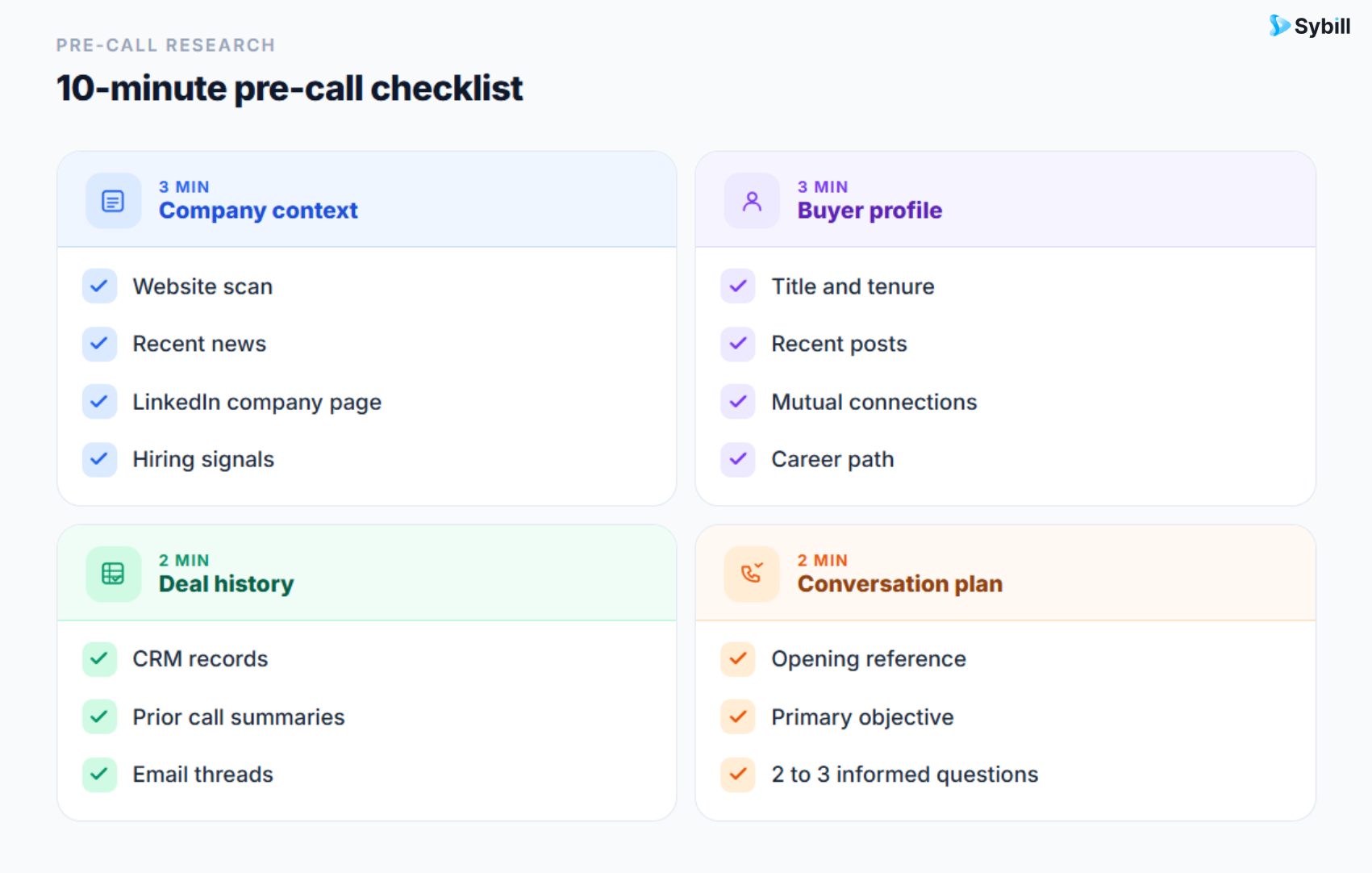
The framework above works when followed. Most reps do not follow it, and not because they are lazy. They fail at pre-call research for three structural reasons.
Reading the prospect's entire career history, every company blog post from the last year, and all their social media activity feels thorough. It is not. It is procrastination disguised as preparation. You need 5 relevant data points, not 50. The framework above is designed to produce exactly those 5 in 10 minutes.
External research (LinkedIn, company website, news) is easy and feels productive. Internal research (CRM records, prior call notes, email threads) is harder because CRM data is often incomplete or outdated. But deal history is the highest-value research you can do. What the buyer told you (or your colleague) in a previous conversation is more relevant than anything on their LinkedIn profile.
This is where CRM data quality becomes a research problem, not just an ops problem. If your CRM fields are empty because reps do not update them after calls, then every subsequent rep interaction with that prospect starts from scratch. The buyer repeats themselves. The rep asks redundant questions. Trust erodes.
Teams using Sybill's CRM Autofill solve this at the source: every call and email automatically populates 30-plus structured CRM fields with pain points, objections, next steps, stakeholder information, and qualification criteria. That means the deal history research step takes 30 seconds instead of 5 minutes because the data is already there and it is accurate.
The most common failure mode is researching well and then not using the research. The rep reads the prospect's LinkedIn, checks the company news, reviews the CRM, and then opens the call with "So, tell me a little about what you do." All that preparation evaporates.
Every piece of research should translate into either an opening reference or a discovery question. If it does not inform something you will say or ask on the call, it was not useful research. The "Conversation Plan" step in the framework above exists specifically to force this conversion.
The 10-minute framework is effective but manual. For a rep running 5 to 8 calls per day, that is 50 to 80 minutes of daily research time. Over a week, that is 4 to 6 hours that could be spent selling.
The better approach is automating the research so it arrives in your inbox before every call without any manual effort.
Sybill's AI pre-meeting brief assembles everything from the 10-minute framework automatically and delivers it before the meeting starts. Here is what the brief includes:
Attendee profiles. For every person on the call, Sybill pulls their current title, company, role context, and LinkedIn profile. You know who you are talking to without opening a browser tab.
Company context. Company size, industry, recent news, and relevant signals that shape the conversation.
Prior call history. If you or anyone on your team has spoken with this prospect or company before, the brief includes summaries from those conversations. Not raw transcripts. Structured summaries with pain points discussed, objections raised, commitments made, and next steps agreed. This is the deal history block from the framework, completely automated.
Email thread summaries. If there have been email exchanges between your team and this prospect, the brief summarizes the key threads so you walk in knowing the full communication context, not just the call context.
CRM deal data. Current deal stage, MEDDPICC qualification status, outstanding action items, and any fields that are incomplete or need attention on this call.
Suggested agenda. Based on the deal stage, prior conversation history, and outstanding qualification gaps, the brief suggests what to cover on this call. Not a rigid script, but a directional guide: "Budget was discussed but not confirmed in the last call. Decision timeline is unclear. Consider confirming both and identifying the procurement process."
The brief lands in your inbox before the meeting. No browser tabs. No LinkedIn scrolling. No CRM digging. No email searching. The research is done and organized by the time you join the call.
For a detailed breakdown of how the pre-meeting brief works and how it compares to manual research approaches, read the full guide: AI Pre-Meeting Briefs for Sales Calls.

Use this as a quick reference before any sales call. It works whether you do the research manually or review an AI-generated brief.
Company: What do they do? How big are they? What has changed recently (funding, hiring, leadership, product launches)?
Buyer: What is their title and tenure? What have they posted or shared recently? Do you have mutual connections? Where did they work before?
Deal history: What was said in previous calls? What commitments were made? What objections were raised? What CRM fields are incomplete?
Conversation plan: What is your opening reference? What is your primary objective for this call? What are 2 to 3 informed questions you will ask?
After the call: Does your CRM update automatically with what was discussed? If not, you are creating the same research problem for the next call.
The best pre-call research is the kind that happens automatically. Sybill's pre-meeting brief assembles attendee profiles, company context, prior call summaries, email threads, CRM deal data, and a suggested agenda, and delivers it to your inbox before every call. No browser tabs. No manual research. No winging it.
Start free with Sybill and walk into every call prepared without spending a minute on research.
Ten minutes is the practical ceiling for manual research. Beyond that, you hit diminishing returns. Structure your time into four blocks: 3 minutes on company context, 3 minutes on buyer profile, 2 minutes reviewing deal history, and 2 minutes building a conversation plan. AI tools like Sybill's pre-meeting brief reduce this to under 2 minutes by assembling all context automatically before each call.
Focus on five things: the company's current situation (size, stage, recent changes), the buyer's role and tenure (new in seat versus established), what has already been discussed in prior interactions (call history, email threads), what CRM data exists about the deal (qualification status, outstanding action items), and one specific reference point for your opening (a LinkedIn post they wrote, a company announcement, a mutual connection).
Top performers spend more time on deal history and less time on generic company research. They review what the buyer said in previous conversations, identify qualification gaps, and plan specific questions that advance the deal rather than generic discovery. They also convert every piece of research into either an opening reference or a question. Research that does not inform something you will say or ask on the call is wasted preparation.
Yes. Sybill's pre-meeting brief automates the full pre-call research workflow: attendee profiles, company context, prior call summaries, email thread summaries, CRM deal data, and a suggested agenda based on deal stage and outstanding qualification gaps. The brief arrives in your inbox before the meeting with no manual effort. Other approaches include using LinkedIn Sales Navigator for manual research or building DIY workflows with general-purpose AI tools, but none combine external prospect data with your own deal history the way a purpose-built pre-meeting brief does.
Researching breadth instead of depth. Spending 20 minutes reading a prospect's entire LinkedIn history and company blog archive feels thorough but produces trivia, not leverage. The second biggest mistake is skipping deal history entirely, meaning what was said in prior conversations, what commitments were made, and what objections were raised. Deal history is the highest-value research source and the one most reps neglect because their CRM data is incomplete.
Ten minutes is the practical ceiling for manual research. Beyond that, you hit diminishing returns. Structure your time into four blocks: 3 minutes on company context, 3 minutes on buyer profile, 2 minutes reviewing deal history, and 2 minutes building a conversation plan. AI tools like Sybill's pre-meeting brief reduce this to under 2 minutes by assembling all context automatically before each call.
Focus on five things: the company's current situation (size, stage, recent changes), the buyer's role and tenure (new in seat versus established), what has already been discussed in prior interactions (call history, email threads), what CRM data exists about the deal (qualification status, outstanding action items), and one specific reference point for your opening (a LinkedIn post they wrote, a company announcement, a mutual connection).
Top performers spend more time on deal history and less time on generic company research. They review what the buyer said in previous conversations, identify qualification gaps, and plan specific questions that advance the deal rather than generic discovery. They also convert every piece of research into either an opening reference or a question. Research that does not inform something you will say or ask on the call is wasted preparation.








