
Find us at booth #83, join us for a harbor side happy hour, or catch Gorish’s talk.

Sept, 16-18 > Learn more


Tamanna Mishra

April 17, 2026

Most business proposals are skimmed with the enthusiasm of someone reading the terms and conditions on a software update.
A buyer opens the PDF. Scrolls once. Maybe twice. Looks at pricing. Then closes the tab and says, “We’ll review internally.”
Translation: Your proposal did not move them.
The problem is not usually pricing. It is not even your product. It is that most proposals feel generic, bloated, and painfully obvious in how templated they are.
Buyers can instantly tell when a rep:
And when that happens, trust drops.
Because buyers start thinking:
“If this rep cannot even tailor the proposal to us, how tailored will their solution actually be?”
That is why learning how to write a business proposal properly matters. A proposal is not paperwork. It is one of the most important persuasion assets in your sales process.
A business proposal is a document that outlines your recommended solution to a prospect’s problem and explains why your company is the right choice to solve it.
Its goal is simple: Move the buyer toward a decision.
A business proposal is not the same as:
Think of the proposal as the bridge between discovery and close.
It should help the buyer confidently say:
“Yes, this is the right partner for us.”
If you want to know how to write a business proposal that actually wins deals, start here.
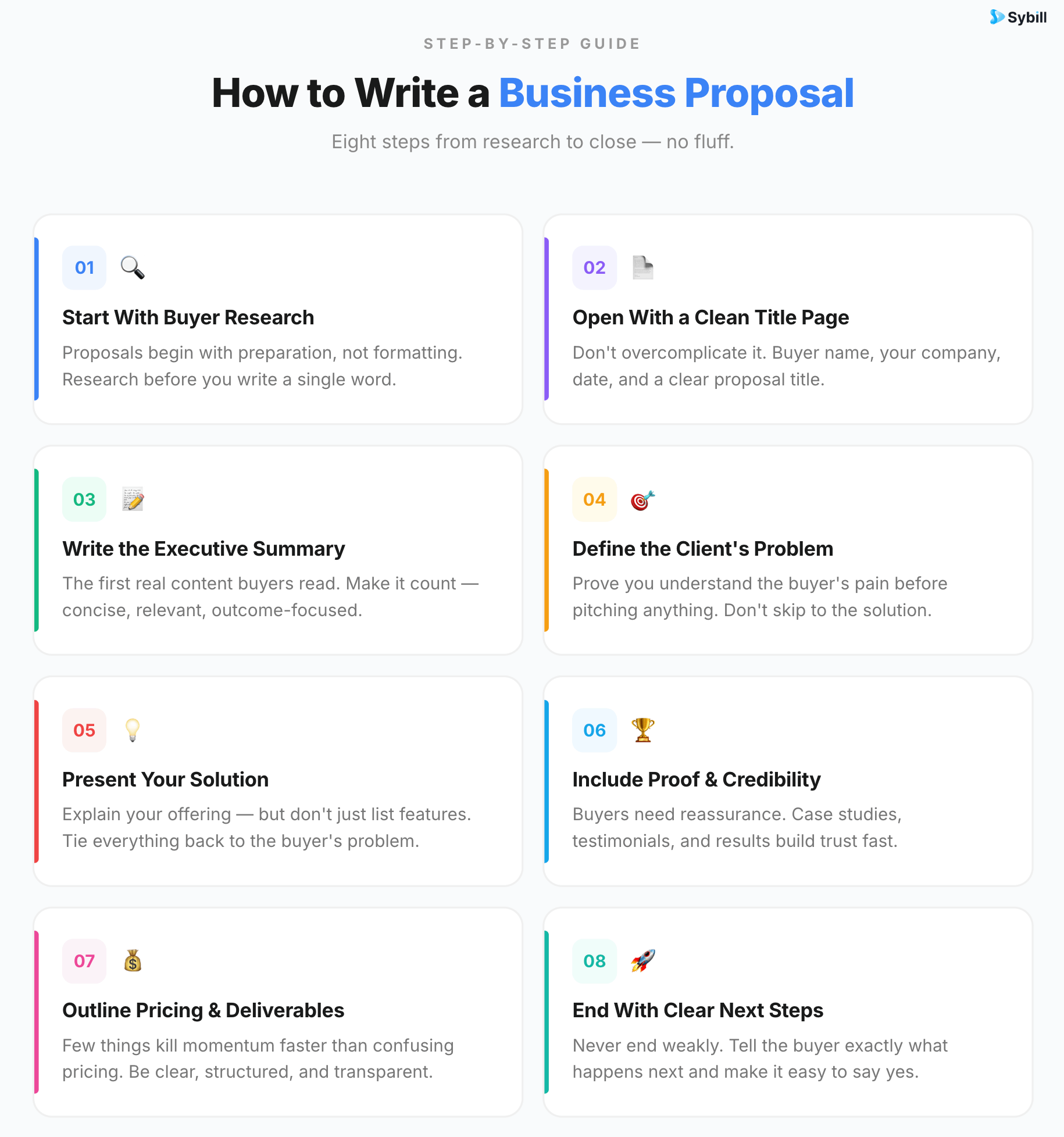
The biggest proposal mistake reps make happens before they even open PowerPoint or Google Docs.
They start writing too early.
Elite reps know proposals begin with preparation, not formatting.
Before drafting anything, review:
If you skip this step, your proposal will sound generic no matter how polished it looks.
The best proposals feel custom because they are built on real buyer insight.
Do not overcomplicate this.
A strong title page should include:
It should look professional and polished, but not overdesigned. You are not making a wedding invitation.
Your executive summary is the first real content buyers will read.
It should immediately communicate:
We will break this down further in its own section below because this part matters a lot.
This is where many reps lose the plot.
They jump straight into talking about their solution before fully articulating the buyer’s challenge.
Bad move.
You need to prove you understand the buyer’s pain before pitching anything.
Strong problem statements:
For example:
Weak:
Your team needs better CRM automation.
Better:
Your sales team currently spends over eight hours weekly on manual CRM updates, reducing selling time and creating inconsistent pipeline data.
See the difference? The second one shows understanding. It feels informed.
Now explain your offering. But here is the catch:
Do not just list product features.
Tie every part of your solution directly to the buyer’s challenge.
Bad:
Better:
Features tell. Outcomes sell.
Buyers need reassurance.
That means adding proof points like:
If possible, make the proof relevant.
A healthcare company cares more about your healthcare case study than your fintech success story.
Specific proof always beats generic proof.
Few things kill momentum faster than confusing pricing.
Be painfully clear about:
If your pricing makes buyers feel like they need a forensic accountant to decode it, you are creating friction.
Clarity builds confidence.
Never end weakly.
Do not just write:
Let us know if you have questions.
Tell the buyer exactly what happens next.
Example:
Momentum dies in ambiguity.
The executive summary is arguably the most important section of your proposal. Why? Because many stakeholders will read only this section before deciding whether the rest is worth their time.
Here is how to write an executive summary for a business proposal effectively.
Lead with what the client is trying to achieve.
Example:
Your organization is looking to improve outbound sales productivity while reducing time spent on manual administrative work.
This instantly frames the proposal around them.
Next, explain your proposed approach at a high level.
Example:
We recommend implementing an AI sales intelligence platform that automates call summaries, CRM updates, and proposal preparation.
Keep this strategic, not overly detailed.
Explain the business impact.
Example:
This is expected to reduce admin time by 30 percent, improve CRM accuracy, and increase rep selling time across the team.
Buyers want outcomes. Not features.
Your executive summary should be:
If it reads like legal paperwork, rewrite it.
Want your proposals to stand out? Follow these best practices.
Nobody wants to read three paragraphs about your founding story before learning how you solve their problem.
Make the proposal about them, not you.
Avoid robotic corporate nonsense like:
“Leveraging synergies to maximize strategic alignment…”
Nobody talks like that.
Write like a smart human explaining value clearly.
Use charts, screenshots, diagrams, and visuals to clarify ideas.
But do not overload slides just to look fancy.
Visuals should support understanding, not distract from it.
Specific numbers increase credibility.
Instead of:
Improve efficiency
Say:
Reduce manual admin time by approximately 8 hours per rep per week
Numbers make value tangible.
Busy executives skim.
Use:
Make important points easy to spot.
Generic proposals lose.
Every single time.
Tailor messaging to:
Yes, even when you are busy. Especially when you are busy.
Here is the modern reality: Writing proposals manually is becoming increasingly outdated. Why? Because reps are terrible at remembering every detail from discovery calls.
Not because they are lazy. Because they are human.
They forget:
And when reps rely on memory, proposals become watered down.
That is where AI changes everything.
Instead of manually rewatching recordings or digging through notes, top reps use AI tools to capture meeting transcripts automatically.
No more “wait, what exactly did the CFO say about implementation concerns?”
Modern AI can identify:
So reps stop guessing what matters most.
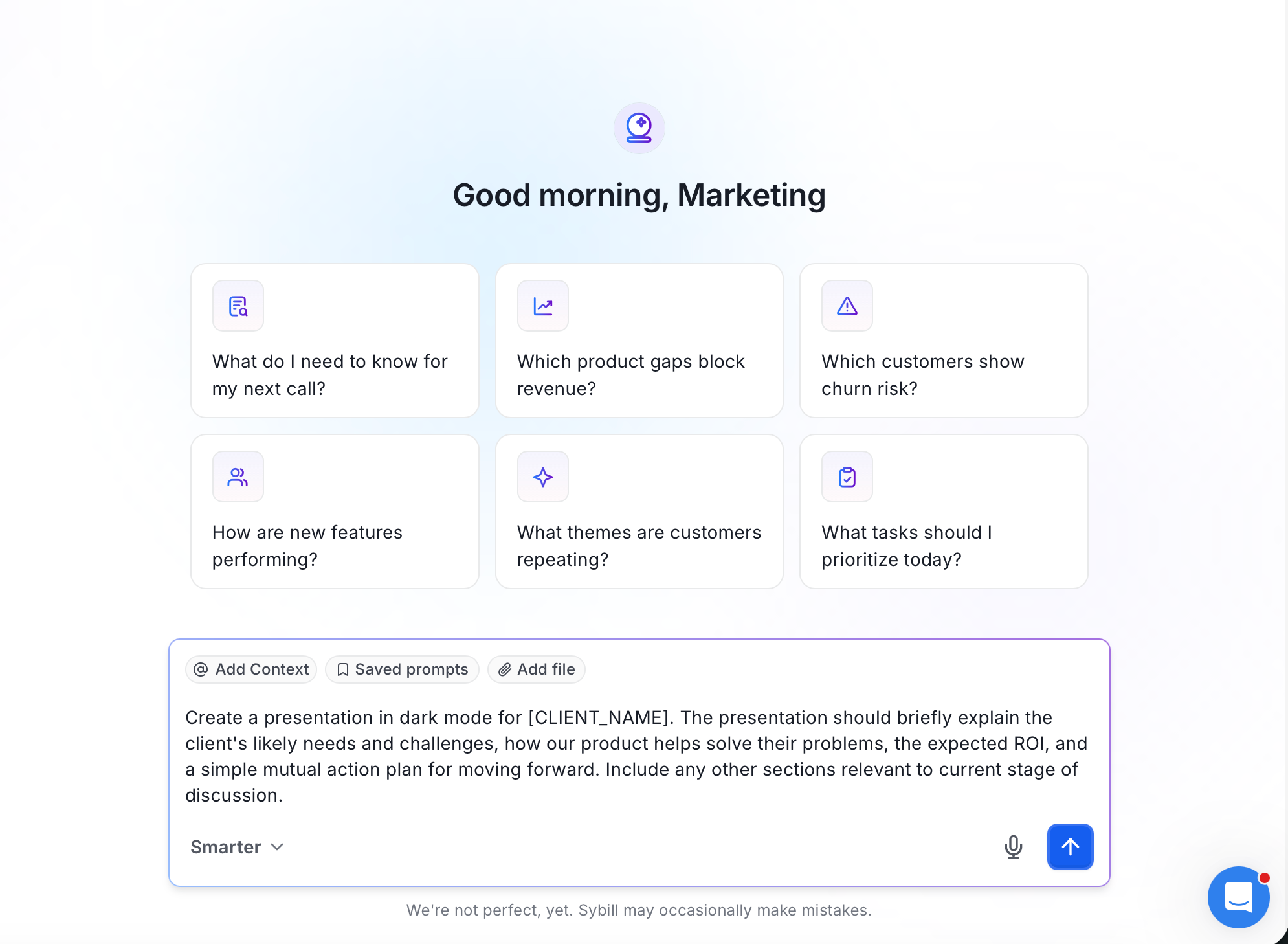
Sybill’s Deck Feature takes this even further.
It can generate proposal-ready sales decks directly from actual buyer conversations, using the context of your meetings to build strategic presentation drafts.
That means reps can create tailored decks covering:
Without starting from scratch.
This is where Sybill gets especially powerful.
Instead of staring at a blank slide deck wondering:
“Okay… what should I include for this prospect again?”
Reps can use Sybill to transform raw discovery conversations into polished, proposal-ready messaging in minutes.
That means:
If your team sends multiple proposals every week, that time savings adds up fast.
And more importantly?
It improves proposal quality because your messaging stays tied to what the buyer actually said, not what the rep vaguely remembers from Tuesday’s 4 PM demo.

The best sales reps do not treat proposals like admin work.
They treat them like strategic persuasion tools.
Because that is what they are.
A strong business proposal:
And increasingly, AI is making this process faster and smarter.
The future of proposal writing is not spending three hours tweaking PowerPoint slides after every discovery call.
It is using tools like Sybill to turn live sales conversations into strategic, personalized proposal content instantly.
The five core steps are understanding the buyer’s needs, defining their problem, presenting your solution, supporting it with proof, and ending with clear pricing and next steps. Some teams break this into more granular stages, but these five components form the foundation of nearly every strong proposal.
A business proposal should be only as long as necessary to clearly communicate value. For simple deals, 2 to 5 pages may be enough. For enterprise or complex sales, proposals may run longer. The key is keeping every section relevant. Buyers do not reward extra pages for effort.
Avoid unnecessary company history, generic boilerplate text, excessive jargon, irrelevant product features, or overly detailed technical information unless requested. Anything that does not help the buyer understand the value of your solution should be removed.
A standout proposal is highly personalized, clearly structured, easy to skim, and focused on outcomes rather than features. Strong proposals show deep buyer understanding, quantify ROI where possible, and make the decision-making process feel simple and low-risk.
Most business proposals follow this structure: title page, executive summary, problem statement, proposed solution, proof/social validation, pricing, and next steps. Some may also include implementation timelines, FAQs, or appendices depending on deal complexity.
The five core steps are understanding the buyer’s needs, defining their problem, presenting your solution, supporting it with proof, and ending with clear pricing and next steps. Some teams break this into more granular stages, but these five components form the foundation of nearly every strong proposal.
A business proposal should be only as long as necessary to clearly communicate value. For simple deals, 2 to 5 pages may be enough. For enterprise or complex sales, proposals may run longer. The key is keeping every section relevant. Buyers do not reward extra pages for effort.
Avoid unnecessary company history, generic boilerplate text, excessive jargon, irrelevant product features, or overly detailed technical information unless requested. Anything that does not help the buyer understand the value of your solution should be removed.








