Find us at booth #83, join us for a harbor side happy hour, or catch Gorish’s talk.

Sept, 16-18 > Learn more


Mamta Tainwala

June 7, 2026
Most sales call recap emails are meeting minutes with a "let me know if you have questions" at the bottom. Sent out of obligation, skimmed by the buyer, filed in a folder nobody opens again. The research on sales email examples that actually convert confirms what experienced reps already know: specificity is everything.
A well-written recap email does something different. It confirms shared understanding, creates documented accountability for next steps, and gives the buyer something worth forwarding to the colleagues they need to bring along. In a complex B2B deal, that email can do more work than a second meeting.
This guide covers exactly what to include, what to cut, and how to send a good recap email even when you just came off your fourth back-to-back call of the day.
Before getting to structure, it helps to understand what makes the average recap email ineffective. There are three failure modes that show up across almost every sales team.
They recap instead of advance. A recap email that only summarizes what was discussed looks backward. The buyer already knows what they said. What they need from you is clarity about what happens next, who owns what, and why moving forward matters. Summaries have their place, but they should serve the forward motion, not replace it.
They are too long and too generic. A seven-paragraph email that covers every topic discussed in sequence is not useful. It is homework. The buyer will skim it, miss the action items buried in paragraph five, and forget to respond. Brevity and specificity are the things that get recaps read and acted on.
They arrive too late. A recap email sent twenty-four hours after a call loses most of its value. The buyer has moved on to other things. The energy from the conversation has dissipated. Reps who follow up within an hour see significantly higher reply rates than those who wait until the next day. Timing matters, and it is the first thing that breaks down when reps have a full calendar.
A strong recap email has five components. Not all five need to appear in every email, but the best ones usually hit at least four. This structure applies whether you are writing manually or using AI sales tools to generate the first draft.

Do not open with "Thanks for your time today." Every email in their inbox opens that way. Open with a line that proves you were in the same conversation they were.
Reference something specific. A detail they shared. A challenge they described in their own words. A reaction they had to something you showed them. This line takes thirty seconds to write and it immediately separates your email from every generic follow-up they receive.
Good: "Based on what you shared about the Q3 forecasting crunch, the timing concerns make a lot of sense."
Not good: "Great speaking with you today. I wanted to follow up on our conversation."
One to three sentences that confirm what you both agreed was true coming out of the call. This is not a verbatim transcript. It is a confirmation that you heard them correctly and that you are aligned on the situation.
This section matters because misalignment discovered early is far less damaging than misalignment discovered at the proposal stage. If the buyer reads your summary and something is off, they will correct you now rather than go silent later.
Keep it tight. Two sentences is better than five.
This is the most important section of the email and the one most likely to be omitted or vague. Every next step should have three things: what it is, who owns it, and when it happens.
Bad: "I will send over some information and we can connect again soon."
Good:
When you document buyer commitments by name and date in the follow-up email, you do two things. You create a record of what was agreed. And you create a light accountability structure that makes it natural for both sides to follow through. A buyer who agreed to share something with their IT team on the call is much more likely to do it when it is sitting in writing in their inbox.
This is also the part of the email that moves deals that would otherwise stall. Most deals do not die because a buyer said no. They die because nothing happened next and neither side had enough structure to notice until it was too late.

One sentence or short paragraph that connects what was discussed to the outcome the buyer cares about. This is not a pitch. It is a reminder. You are reinforcing the reason the conversation mattered, in the buyer's language, based on what they told you.
This section matters especially when your recap email gets forwarded. A buyer who is building internal consensus needs something they can hand to a stakeholder who was not on the call. A well-written value anchor gives them a sentence they can use. "They can help us reduce the time our ops team spends on manual reporting by about six hours a week" is infinitely more useful in an internal email than "they seem like a good fit."
Do not end with "let me know if you have any questions." That is an invitation to silence. End with the specific next step you agreed to and a direct ask.
"Looking forward to the Tuesday call. In the meantime, if anything comes up from the IT conversation, feel free to reply here and I will loop in our solutions engineer."
That is an open door, a reminder of the next meeting, and a path to reengage, all in two sentences.
The five-part structure holds across most call types, but the weight of each section shifts depending on where you are in the deal.
Discovery call recap: Lead with the summary of shared understanding more heavily than usual. Discovery recaps are where you cement what you learned and show the buyer you actually listened. The next steps here are usually lighter (sharing a resource, booking the demo) but should still be explicit.
Demo recap: The value anchor carries more weight after a demo. You have just shown them something. Connect what they reacted to most strongly back to the outcome they described in discovery. This is where you can be a little more direct about the fit. Best discovery questions asked earlier in the cycle are what give you the specific language to use here.
Pricing or negotiation call: The next steps section is the entire point. Document exactly what was discussed, what was agreed, and what needs to happen on both sides before a decision. Vagueness after a pricing conversation is where deals quietly disappear. Sales email automation can get that structured email out within the hour, which matters more after a pricing call than almost any other call type.
Late-stage or closing call: Keep the email short and the next steps extremely specific. At this stage the buyer knows the value. They do not need another summary. They need clarity about exactly what the path to yes looks like. A mutual action plan is often the right output to attach or reference at this stage.
Here is the honest operational problem. You know what a good recap email looks like. You are also getting off a call at 3:45 PM with two more calls at 4:00 and 5:00 and a pipeline review at 5:30. The recap email is not getting written tonight, and if it does get written, it will not be your best work.
This is exactly the problem Sybill's AI follow-up emails solve.
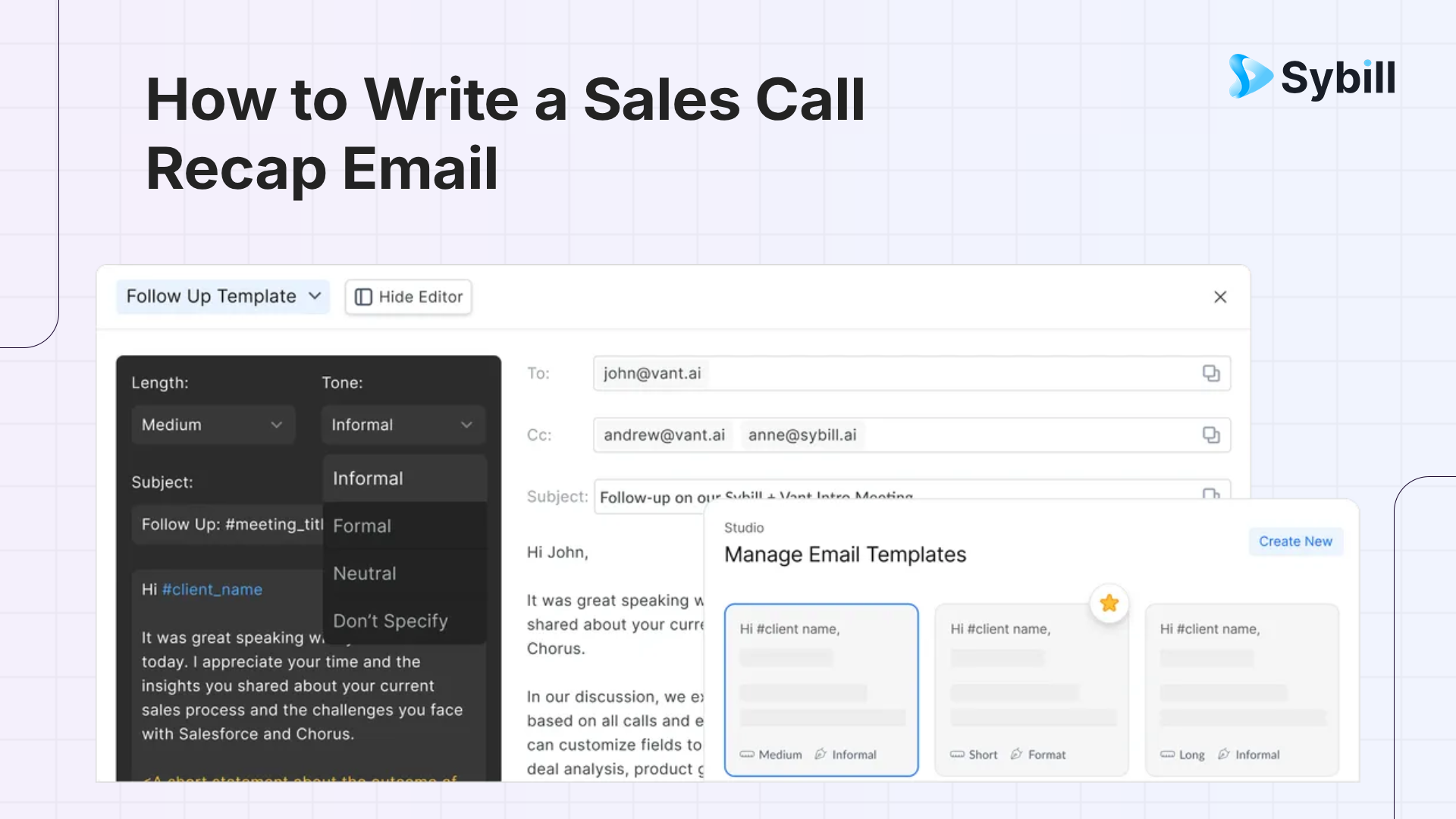
Sybill records and processes the call. Within minutes, a draft follow-up email appears. It references the buyer's actual pain points, specific objections raised, next steps both parties committed to, and the value framing most relevant to the conversation. It is written in the rep's voice, which Sybill learns over time based on tone, sentence structure, formality, and sign-off style.
The rep reviews the draft in one to two minutes, makes any adjustments, and sends. The entire process takes under five minutes. Compare that to the ten to fifteen minutes a well-crafted manual email takes, or the thirty seconds a bad one takes with all the deal damage that comes with it.
Critically, because Sybill has processed the full call via Magic Summary, the email pulls from actual conversation data, not approximations. The next steps are the ones that were literally committed to on the call, not the ones the rep remembered to write down. The buyer objections are real, not paraphrased from memory.

Want follow-up emails that go out within minutes of every call, in your voice, with the details that matter? Get started for free with Sybill and never write a recap email from scratch again.
Burying the next step. If the most important thing in the email (the call next week, the security review the buyer committed to) is in paragraph four, a meaningful percentage of buyers will not find it. Lead with what matters most or put next steps in a clearly labeled section that is impossible to miss.
Sending a transcript. An AI-generated wall of transcript is not a recap email. Buyers do not want to re-read a record of what they already experienced. They want a crisp synthesis. Magic Summaries and follow-up email drafts are different outputs for a reason.
Failing to document buyer commitments. You agreed to do something. They agreed to do something. If only your action items appear in the email, you have created a one-sided accountability structure. Name what they agreed to do. Name them by name. Do it politely but specifically.
Writing it in template voice. Buyers receive dozens of sales emails every week. An email that reads like it was filled into a template is processed unconsciously as noise. The best recap emails sound like a real person wrote them after a real conversation, because they were about that specific deal, that specific buyer, that specific conversation.
Not connecting the call to the decision. In a complex deal, every call should be explicitly linked to the path to a decision. Your recap email is the artifact that makes that link tangible. If a buyer reads your recap and cannot articulate why this conversation matters to their eventual decision, the email did not do its job. Understanding objection handling well enough to address unspoken resistance in a recap is what separates emails that generate replies from ones that generate silence.
Rather than generic templates that sound like every other sales email, use these as structural starting points and fill them with real specifics from the actual call.
Subject: [Company]: what we covered + next steps
Hi [Name],
Good conversation earlier. Based on what you described about [specific challenge they raised], I think there is a real fit worth exploring.
Here is where I think we landed: [Two-sentence shared understanding]
Next steps:
Looking forward to [Tuesday's call / the demo / connecting with your team].
[Sign-off]
Subject: [Company]: next steps after today's demo
Hi [Name],
The moment that seemed to resonate most was [specific reaction or statement from the call]. That aligns well with [the outcome they described in discovery].
What we confirmed: [One to two sentences of shared understanding]
For us to move forward:
If anything comes up before then, reply here and I will sort it out quickly.
[Sign-off]
What should a sales call recap email include?
A strong recap email includes a contextual opening that proves you were listening, a short summary of shared understanding, next steps with named owners and dates, a value anchor connecting the conversation to the buyer's outcome, and a clear specific call to action. The next steps section is the most important and the most commonly omitted.
How quickly should you send a recap email after a sales call?
Within an hour is the target. Reply rates are significantly higher when follow-ups go out quickly because the conversation is still fresh for both sides. AI tools like Sybill make same-day follow-up practical even for reps with back-to-back schedules, since the draft is ready within minutes of the call ending.
How long should a sales call recap email be?
Short enough to be read in sixty to ninety seconds. That typically means three to five short paragraphs or a structured section for next steps. An email that requires scrolling is an email that will be partially read. Say what matters, document the next steps, and stop.
How does Sybill help with sales call follow-up emails?
Sybill records and processes the conversation, then generates a draft follow-up email that references actual call content: the buyer's pain points, raised objections, committed next steps, and relevant value framing. The draft arrives within minutes of the call ending and is written in the rep's voice. Reps review and send in under two minutes rather than spending ten to fifteen minutes writing from scratch.
Should you include everything that was discussed in a recap email?
No. A recap email is a synthesis, not a transcript. Include the shared understanding you need to confirm, the next steps both parties committed to, and the one or two most important points from the conversation. Everything else belongs in your call summary and CRM notes, not in the email the buyer reads.
What makes a recap email actually advance the deal rather than just document it?
Three things: specificity in the next steps (who, what, when), documented buyer commitments (not just your own), and a value anchor that connects the conversation to the outcome the buyer cares about. An email that does all three gives the buyer something worth forwarding internally, which is often where deals actually move.
How do you write a good recap email when you have no time?
AI auto follow-up emails are the practical answer for reps with full calendars. Sybill generates a contextual draft immediately after the call. The rep reviews in sixty to ninety seconds and sends. The alternative, writing from scratch hours later when the details are fuzzier and the energy is gone, produces worse emails and slower deals.
A recap email is not paperwork. It is momentum.
Done well, it confirms alignment before misalignment becomes expensive, creates accountability for both sides without being pushy about it, and gives your champion something they can use to build internal consensus without you in the room.
Done poorly, or skipped entirely, it lets the energy from a good conversation quietly evaporate.
The structure is not complicated. The challenge is doing it consistently at quality, across every call, every week, without it becoming the thing that falls off when the calendar gets full. That is exactly the problem Sybill solves. The structure stays consistent. The quality stays high. The email goes out in minutes, not the next morning.
Get started for free with Sybill and make every call recap the kind of email that actually moves deals forward.
A strong recap email includes a contextual opening that proves you were listening, a short summary of shared understanding, next steps with named owners and dates, a value anchor connecting the conversation to the buyer's outcome, and a clear specific call to action. The next steps section is the most important and the most commonly omitted.
Within an hour is the target. Reply rates are significantly higher when follow-ups go out quickly because the conversation is still fresh for both sides. AI tools like Sybill make same-day follow-up practical even for reps with back-to-back schedules, since the draft is ready within minutes of the call ending.
Short enough to be read in sixty to ninety seconds. That typically means three to five short paragraphs or a structured section for next steps. An email that requires scrolling is an email that will be partially read. Say what matters, document the next steps, and stop.