
Find us at booth #83, join us for a harbor side happy hour, or catch Gorish’s talk.

Sept, 16-18 > Learn more

%20(1).avif)
Mamta Tainwala

June 19, 2026
%20(4).png)
The product being bad or the rep selling poorly are not the only reasons deals die. They die because the one person the rep built a relationship with got promoted, laid off, or simply stopped having the internal influence they once had. The champion went cold. The deal went with them.
Multi-threading is building relationships with multiple stakeholders across a buying committee simultaneously, so your deal does not depend on any single person's continued engagement or employment. Done well, it is also one of the strongest predictors of deal velocity.
This guide covers the practical mechanics of multi-threading, the most common mistakes reps make, and a ready-to-use AI prompt library you can run inside Sybill to stay on top of stakeholder context without digging through transcripts or scattered Slack threads.
Sales managers talk about single-threading as a best practices issue. It is actually a forecasting issue. A deal that looks strong in the pipeline but depends entirely on one champion is not a strong deal. It is a concentrated risk position dressed up as momentum.
Deals with multi-stakeholder engagement close at significantly higher rates. Yet most reps default to depth with one contact over breadth across the committee, not from laziness, but from comfort. The champion answers emails. The champion shows up to calls. The rest of the buying committee takes more effort to access.
That comfort is the risk. B2B buying decisions now involve six to ten stakeholders, each with different priorities and different definitions of success. If your deal strategy maps to one of those ten people, you are nine stakeholders short of a closed deal.
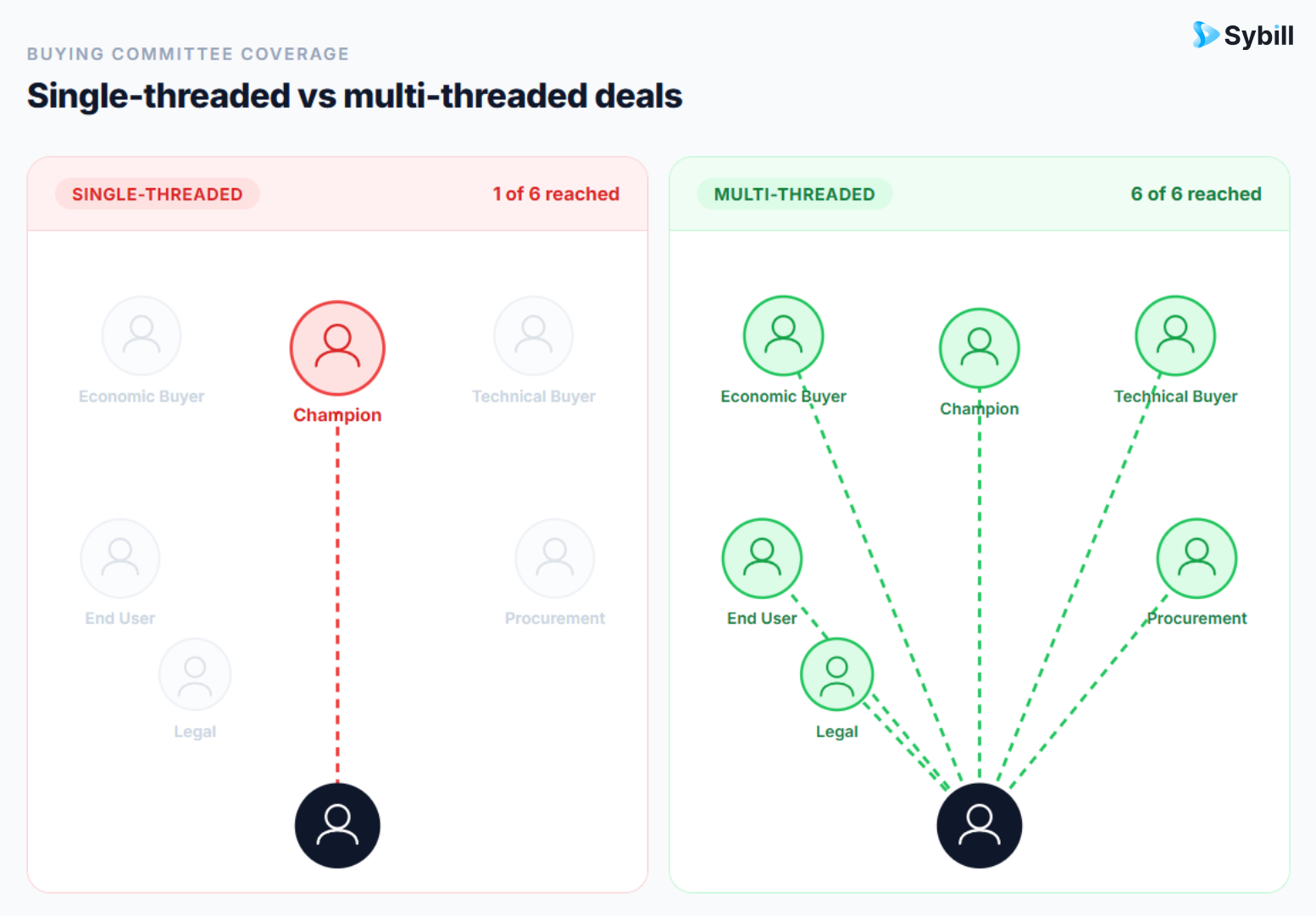
Before you can thread multiple relationships, you need to know who the threads should connect to. The Miller Heiman strategic selling methodology identifies four core buying influences that appear in virtually every complex B2B deal.
The Economic Buyer holds the budget authority and the ability to say yes and release funds. This person is often absent from early conversations, which is exactly the problem. Reps who build deep relationships with people who can influence but not decide will eventually lose to the stakeholder they never accessed.
The Technical Buyer evaluates your solution against requirements. They can say no; they typically cannot say yes on their own. Ignoring them until late is how evaluation-killing concerns surface at the worst possible moment.
The User Buyer will live with your product daily. Their resistance, voiced internally before you have a relationship with them, can quietly undermine a deal without the rep ever knowing it happened.
The Champion is your internal advocate, selling your solution when you are not in the room. Champions fight for you where supporters merely like you. Without a strong champion, you do not have a deal. You have an evaluation.
Multi-threading means having active, productive relationships with all four of these roles before your deal reaches late stages.
The worst time to introduce a new stakeholder is when your champion has gone dark. The best time is during active engagement, when the champion has enough momentum to facilitate introductions naturally.
The framing matters. "I want to make sure we build a strong business case for your leadership" is a very different ask than "can you introduce me to your CFO." The first serves the champion. Frame multi-threading as helping them succeed internally, not as hedging your bets.
After a successful first meeting, research the decision-making unit before the next call. The goal is not a complete organizational chart. It is a working hypothesis about who the Economic Buyer is, who will evaluate technically, who will use the product, and who might be a blocker.
Pre-meeting briefs pull together attendee context before every call. CRM Autofill captures every stakeholder mentioned across calls and emails automatically, so your stakeholder map builds without manual logging after every conversation.
A follow-up email that works for your Champion does not work for the CFO. Each stakeholder has different priorities, different risk concerns, and different definitions of a successful outcome. Sending the same deck to six people in a buying committee signals that you did not listen to any of them specifically.
Buyer intent is layered: the CFO's expressed need is ROI, their underlying objective might be cleaning up a forecasting mess, and their personal motivation might be avoiding another board meeting where revenue projections embarrassed leadership. Outreach that speaks to all three levels requires knowing what they have actually said, not guessing from their job title.
Managing context across five or six stakeholders without a system is how critical details fall through the cracks. What did the technical buyer flag two calls ago? What has procurement mentioned about their vendor onboarding process?
Ask Sybill lets reps query across all conversations and CRM data for a deal in plain English and get answers from actual call data in seconds. The prompt library below is built specifically around the questions that help reps multi-thread more effectively.
Most reps create one next step per call: the next meeting. Multi-threading requires a richer next-steps architecture. After every call, there should be explicit next steps connecting to each active stakeholder, not just the primary contact.
This is also where mutual action plans carry serious weight in multi-stakeholder deals. A MAP that names buyers by role and assigns them specific milestones creates a shared accountability structure that naturally extends the rep's reach across the committee. When the CFO sees their name next to "review business case by [date]," they have entered the deal in a documented way.
One of the earliest warning signs of deal risk is when a stakeholder who was previously engaged stops attending calls or responding. The VP came to the first two calls, sent their director to the third, and sent a coordinator to the fourth. That pattern is a signal. The deal is losing internal priority.
Sybill's deal intelligence tracks attendee patterns across every call. When key stakeholders drop off, the risk shows up in the deal workspace before a manager has to ask. That gives reps the chance to intervene proactively, by re-establishing relevance or escalating through the champion, rather than discovering the problem at quarter-end.
Ready to stop managing stakeholder context manually? Get started for free with Sybill and let every call automatically build your deal intelligence, stakeholder map, and multi-threading strategy.
The following prompts are designed to be run inside Ask Sybill, the natural-language query layer that lets you ask questions across all calls, emails, and CRM data for any deal. Each prompt targets a specific multi-threading challenge.
You can use these in your daily deal prep, in pipeline reviews, and as coaching material for managers reviewing deal health across the team.
Surface stakeholder gaps before they become deal-blockers.
Prompt 1: Find the Economic Buyer
"Who has been identified as having budget authority or final approval in this deal? If no Economic Buyer has been confirmed, what clues in the call transcripts suggest who it might be?"
When to use: Before any third or fourth call where you still do not have access to the person who controls the budget.
Prompt 2: Map the buying committee
"Who are all the stakeholders mentioned across calls and emails for this deal? What are their roles, what have they said their priorities are, and which roles in a typical buying committee are still missing from our conversations?"
When to use: Before a deal review or at the beginning of a new quarter when you want to audit stakeholder coverage across your pipeline.
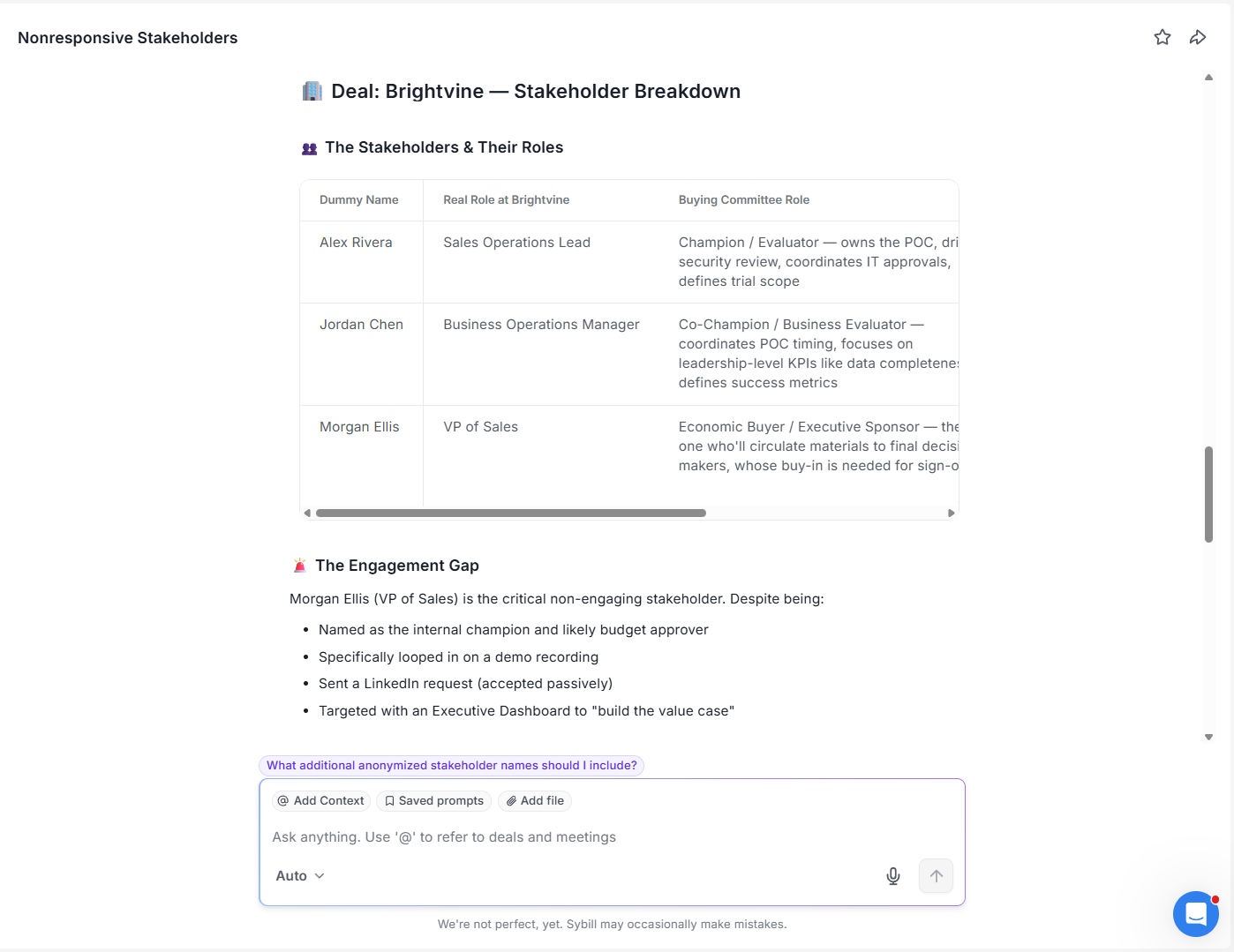
Prompt 3: Identify potential blockers
"Have any stakeholders raised concerns, hesitations, or objections across our conversations that were not fully resolved? What did they say, and in which calls?"
When to use: Before a late-stage call or proposal submission.
Generate outreach for each stakeholder role based on their actual stated priorities.
Prompt 4: CFO or Economic Buyer outreach
"Based on what has been discussed in this deal about budget, ROI, and business outcomes, what are the three most important value points I should include in a follow-up email to the CFO? What concerns or risks have been raised that they would likely want addressed?"
When to use: When preparing first or follow-up outreach to the Economic Buyer who has not yet been in your calls.
Prompt 5: Technical Buyer or IT stakeholder outreach
"What technical requirements, integration concerns, security questions, or implementation risks have come up across calls in this deal? What would a follow-up email to an IT or technical evaluator need to address to move the evaluation forward?"
When to use: Before a technical review call or when preparing materials for a stakeholder who evaluates implementation risk.
Prompt 6: Champion enablement
"What are the strongest business case points from our conversations that my champion could use to advocate internally? What objections have come up that they might face from leadership, and what responses do our calls suggest would land well?"
When to use: After a strong call where the champion needs to build internal consensus.
Prompt 7: End user or practitioner outreach
"What day-to-day pain points or workflow frustrations have been mentioned in this deal that relate to the people who would actually use our product? What would resonate most with someone who cares less about ROI and more about whether this makes their work easier?"
When to use: When engaging a practitioner or manager who will use your product daily and whose adoption matters for the renewal.
Surface risk signals that live in conversations, not CRM stage fields.
Prompt 8: Single-threading check
"How many unique stakeholders have been engaged in this deal across calls and emails? Is there evidence that the deal is single-threaded? What does the engagement pattern look like across the buying committee?"
When to use: In any pipeline review or deal inspection.
Prompt 9: Objection pattern check
"What objections or concerns have been raised more than once across calls in this deal? Are there any that were raised early but have not been formally addressed in subsequent conversations?"
When to use: Before a late-stage presentation, proposal, or executive call.
Prompt 10: Engagement trajectory
"How has buyer engagement changed across the last three to five calls in this deal? Are stakeholders attending at the same seniority level? Are responses and next-step commitments getting more or less specific over time?"
When to use: When a deal feels like it is progressing but you want to check whether the signals are actually pointing forward or sideways.
Build a stakeholder-by-stakeholder action plan, not a single next meeting.
Prompt 11: Next step by stakeholder
"Based on everything discussed in this deal so far, what is the most logical next step for each stakeholder we have engaged? What do we need from the Economic Buyer, the technical evaluator, and our champion before we can advance the deal?"
When to use: After any significant call where the deal is actively moving.
Prompt 12: Decision process mapping
"What has the buyer said about their internal decision-making process? Who needs to approve? What steps, reviews, or sign-offs have been mentioned? What is still unclear about how this decision actually gets made?"
When to use: Before moving a deal to proposal or late stage.
Prompt 13: Champion status check
"How active has our champion been across recent calls? Are they sharing internal context, facilitating introductions to other stakeholders, and committing to specific actions? Or have the signals of advocacy gotten weaker?"
When to use: Any time you feel less certain about your champion's internal standing or engagement level.
Prompt 14: Gap-to-close analysis
"Based on everything in this deal, what are the three biggest gaps between where we are now and a closed deal? What stakeholders have we not yet engaged? What qualification criteria are still missing? What commitments from the buyer are still outstanding?"
When to use: In a deal review with a manager or when preparing a late-stage push.
Most of what makes multi-threading hard is not the strategy. It is the operational overhead: tracking six stakeholders across fifteen calls, keeping context per person, and preparing persona-specific outreach for each one without falling back on the generic version.
Magic Summaries capture stakeholder names, titles, stated priorities, objections, and engagement signals from every call automatically. CRM Autofill writes that data into CRM fields immediately after the call, so the deal workspace reflects the full buying committee without manual logging.
Pre-meeting briefs arrive before every call with prior conversation context for each stakeholder, so reps walk in prepared with the right history.
And Ask Sybill, using the prompts above, lets reps query all of this context in seconds. For managers, the same system surfaces single-threaded deals in pipeline reviews before they become a quarter-end problem.
What is multi-threading in sales?
Multi-threading is building active relationships with multiple stakeholders in a buying committee simultaneously, rather than relying on a single contact. It reduces deal collapse risk when one person loses influence or goes dark, and typically accelerates deal velocity because more stakeholders are aligned earlier.
Why do single-threaded deals fail?
Because a single contact is a single point of failure. Champions leave companies, get reassigned, or simply have less influence than they appear to. When the rep's entire deal strategy runs through one person, any disruption to that person's position collapses the deal.
When should you start multi-threading a deal?
After a strong discovery call or demo, when there is enough positive momentum for your champion to facilitate introductions naturally. Multi-threading when a deal has already stalled signals desperation and puts the champion in an awkward position.
How do you get access to the Economic Buyer without damaging the champion relationship?
Frame it as serving the champion's internal success. "I want to build a strong business case for your leadership team. A 20-minute call with your CFO to understand their priorities would help us tailor the proposal to what they need to say yes." The champion benefits because a better business case makes their advocacy easier.
How does Sybill help with multi-threading specifically?
Sybill logs every stakeholder mentioned across calls and emails into the deal workspace automatically via CRM Autofill. Magic Summaries capture per-stakeholder priorities and engagement signals. Ask Sybill lets reps query stakeholder context, objection patterns, and engagement trajectories in plain English, enabling the prompt library above without manual transcript review.
What is the biggest multi-threading mistake reps make?
Waiting too long. Most reps try to multi-thread after they sense deal risk rather than before it. Multi-threading from the second or third call, framed around building a better solution for the buyer's full team, is the right approach.
A single-threaded deal is a gamble on one person's continued relevance, employment, and enthusiasm. In a buying committee with six to ten stakeholders, the math on that gamble is not favorable.
The prompt library above gives you a system for surfacing stakeholder gaps, preparing persona-specific outreach, and uncovering deal risk without spending hours in transcripts. Sybill gives you the data layer that makes those prompts useful, because the answers come from actual conversations, not memory.
Build the relationships early. Track them automatically. Ask better questions.
Get started for free with Sybill and give every deal in your pipeline the stakeholder coverage it needs to actually close.
Multi-threading is building active relationships with multiple stakeholders in a buying committee simultaneously, rather than relying on a single contact. It reduces deal collapse risk when one person loses influence or goes dark, and typically accelerates deal velocity because more stakeholders are aligned earlier.
Because a single contact is a single point of failure. Champions leave companies, get reassigned, or simply have less influence than they appear to. When the rep's entire deal strategy runs through one person, any disruption to that person's position collapses the deal.
After a strong discovery call or demo, when there is enough positive momentum for your champion to facilitate introductions naturally. Multi-threading when a deal has already stalled signals desperation and puts the champion in an awkward position.





.avif)
