Find us at booth #83, join us for a harbor side happy hour, or catch Gorish’s talk.

Sept, 16-18 > Learn more

%20(1).avif)
Mamta Tainwala

March 27, 2026
Two very different companies. Two very different philosophies about what business software should do. And one question that keeps coming up in sales leadership meetings, RevOps Slack channels, and vendor evaluation spreadsheets: Odoo or Salesforce?
Salesforce controls roughly 26.1% of the global CRM market and is the first name that comes up in enterprise procurement conversations. Over 80% of Fortune 500 companies run on it. It is the industry standard for a reason.
Odoo is the challenger. Founded in Belgium in 2005 as TinyERP, it has grown into a suite of 50-plus interconnected business applications covering sales, CRM, accounting, HR, manufacturing, inventory, and more, all at a fraction of Salesforce's cost. It holds a 15.51% share of the global ERP market and is growing at over 50% year over year.
These two platforms are not exactly the same category of software. Salesforce is purpose-built CRM, designed to support the full complexity of customer-facing revenue processes. Odoo is an open-source ERP that happens to have an excellent CRM module baked in. That distinction shapes every decision point in this comparison.
This guide covers features, pricing, hosting and deployment options, AI capabilities, ease of use, and the question no comparison ever answers honestly: what happens to your CRM data after the call ends?
Odoo is a modular, open-source business suite built on the premise that your sales, finance, operations, and HR tools should talk to each other without duct tape. Instead of buying separate software for CRM, accounting, inventory, and marketing and then paying consultants to connect them, Odoo gives you all 50-plus applications on a single data model. Every module shares the same customer record, the same reporting layer, and the same interface.
The CRM module within Odoo gives you a visual Kanban pipeline, lead and opportunity management, automated follow-ups, lead scoring, activity scheduling, and email integration. Because it sits inside the broader Odoo suite, a won deal can automatically trigger an invoice in accounting, a delivery in inventory, or a project in the project management module, all without any integration work.
Odoo is available in three editions. The Community edition is completely free and open-source. The Standard edition costs approximately $24.90 per user per month (billed annually) and includes every Odoo app, every integration, and all AI and automation features without add-ons or tiered unlocks. The Custom edition adds bespoke module development and enterprise support.
Best for: SMBs, growth-stage companies, and manufacturers or distributors that need CRM and operational tools in a single, affordable, unified system.
Salesforce invented the cloud CRM category in 1999 and has been the market leader ever since. It is not a single product but a constellation of connected clouds covering sales, service, marketing, commerce, analytics, and more. Sales Cloud, the core CRM offering, provides opportunity management, pipeline tracking, forecasting, AI-powered lead scoring through Einstein, and a customization architecture that can model almost any business process.
What makes Salesforce the enterprise standard is its configurability and ecosystem. The AppExchange marketplace has over 7,000 applications. Every field, workflow, and report can be tailored. Enterprises with complex, multi-stage, multi-department revenue cycles consistently choose Salesforce because it scales with that complexity without forcing workarounds.
The tradeoff is cost and complexity. Salesforce starts at $25 per user per month for the Starter Suite but scales to $330/user/month for the Unlimited plan, with meaningful features like AI, advanced automation, and API access gated behind higher tiers. Most enterprise teams also need implementation consultants to configure the platform properly, which adds $5,000 to $100,000 or more in year-one costs.
Best for: Mid-market to enterprise companies with complex, customized sales processes, dedicated Salesforce admins, and budgets that support sustained technical investment.
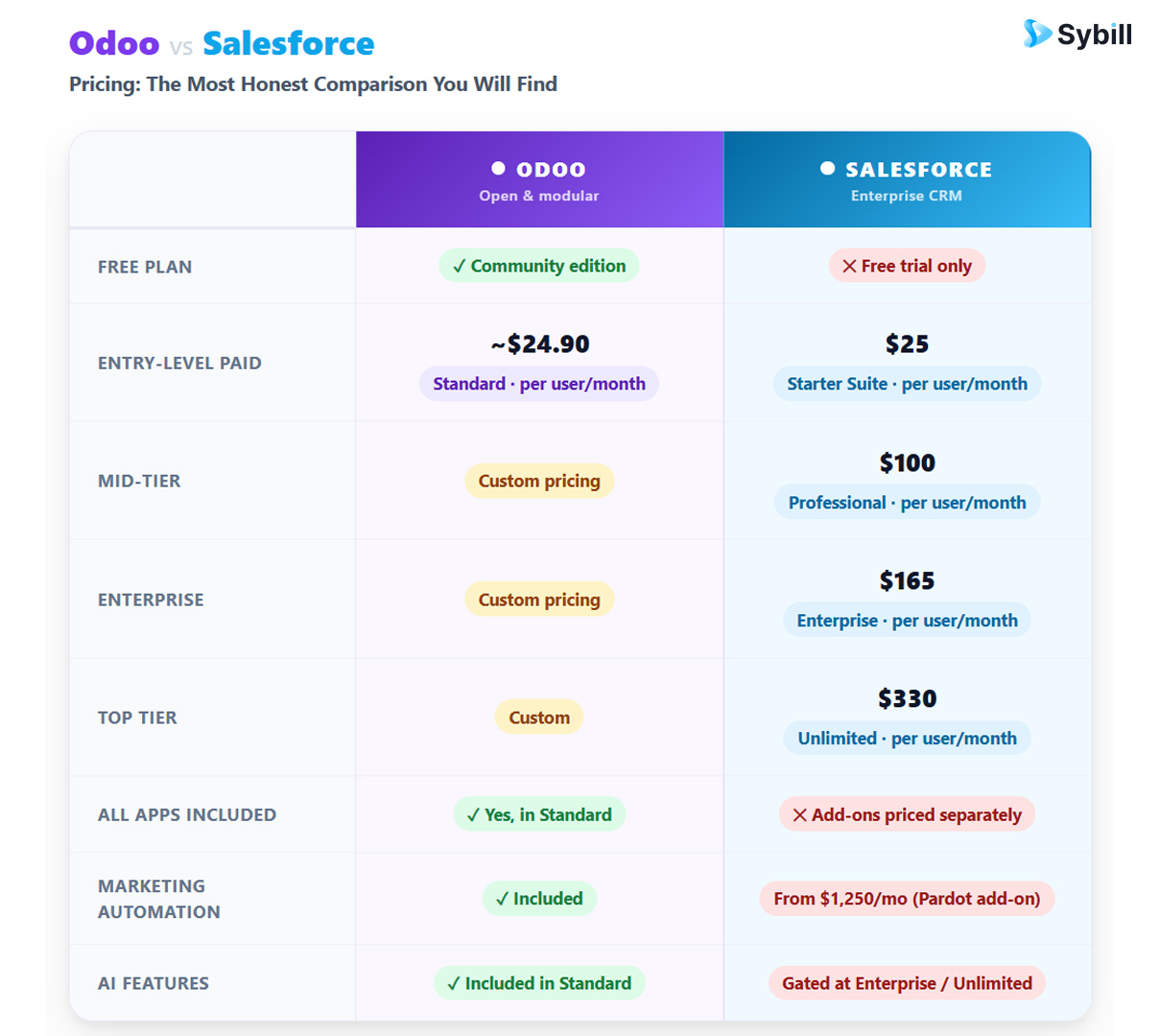
This table contains the most important pricing insight in the comparison: Odoo includes everything in one price. Salesforce does not.
At Odoo Standard ($24.90/user/month), you get every app in the suite, every integration, all AI features, and all automation capabilities. No add-ons. No tiered unlocks. If you want marketing automation in Salesforce, you add Pardot starting at $1,250 per month. If you want Agentforce AI agents, you need Enterprise or Unlimited. If you want full API access, that requires the Enterprise plan at $165/user/month or an add-on to Professional.
This is not a criticism of Salesforce's value proposition for the right buyer. At enterprise scale, the per-feature cost can still deliver strong ROI. But for any team evaluating the platforms at face value from a pricing page, the "Salesforce starts at $25" headline understates the real cost significantly.
For a 10-person sales team, Odoo Standard runs approximately $2,988 per year. Salesforce Professional for the same team runs approximately $12,000 per year in license fees alone, before implementation costs.
This is the category where Odoo and Salesforce diverge most sharply, and it is often the deciding factor for organizations with data residency requirements, compliance obligations, or technical teams that want infrastructure control.
Odoo offers three deployment paths:
Odoo Online (SaaS) is Odoo's fully managed cloud option. It handles server maintenance, automatic upgrades, security patches, and backups. You get up and running quickly without managing infrastructure, and the tradeoff is limited ability to install custom third-party modules or modify server configuration. This is the right choice for teams that want a clean, fast setup without technical overhead.
Odoo.sh (Managed Cloud) gives you the power of a cloud deployment with developer-grade flexibility. Custom module installation, GitHub integration, staging and testing environments, and automated backups are all available. This is the option for technical teams that need customization depth without running their own infrastructure. It costs more than Odoo Online and requires moderate technical knowledge to use fully.
Self-Hosted Odoo (Community or Enterprise) gives your organization complete control. You deploy on a VPS (AWS, DigitalOcean, Azure), a dedicated server, Docker containers, or Kubernetes clusters. Every configuration decision is yours: database management, security rules, backup schedules, data residency, and custom module development. This path demands the most technical expertise and ongoing maintenance overhead, but it is the only option for organizations with strict on-premises or regional data requirements.
Salesforce offers one deployment path:
Salesforce is a SaaS-only platform. You cannot self-host it. Microsoft Azure, AWS, and Google Cloud infrastructure hosts your data through Salesforce's Hyperforce architecture, which allows for geographic data residency selection across regions. Within that constraint, Hyperforce provides strong compliance certifications, low-latency regional hosting, and elastic scalability. Salesforce handles all infrastructure, maintenance, and updates automatically.
The practical implication for buyers: If deployment flexibility, on-premises options, or deep infrastructure control are requirements, Odoo is the only choice. If a fully managed, zero-maintenance cloud CRM with global compliance certifications is what you need, Salesforce's model is simpler. Most sales teams evaluating CRMs on features rather than IT architecture will find Salesforce's approach less of a constraint than it sounds on paper, since the infrastructure never requires their attention.
Odoo CRM's pipeline is built around a visual Kanban board with drag-and-drop stage management, activity-based selling, and lead assignment automation. Leads generated from website visits, inbound email, web forms, or imported lists land directly in the pipeline. AI-powered lead scoring ranks opportunities by estimated win probability, and smart assignment rules route leads to the right rep based on filters like region, language, or product line. The interface is clean and quick to learn. Most sales reps are productive in Odoo CRM within a day or two without dedicated training.
Salesforce's pipeline management is deeper and more analytically rich. Opportunity stages, forecast categories, AI-powered pipeline inspection through Einstein, deal health scoring, and territory management give revenue leaders an exceptionally granular view of pipeline health. At Enterprise and Unlimited tiers, next-best-action recommendations and Einstein Conversation Insights surface deal risks proactively. The tradeoff is that this depth comes with configuration overhead. What you see in Salesforce depends entirely on how the instance was built.
For straightforward B2B sales pipelines where reps need fast, intuitive deal management and their CRM data connects directly to quotes, invoices, and inventory, Odoo's pipeline is excellent and dramatically faster to set up. For complex enterprise sales with multi-team pipeline visibility, advanced forecasting models, and AI-guided rep activity, Salesforce's capabilities remain the benchmark.
Odoo's automation lives in its workflow engine. Follow-up emails triggered by stage changes, lead assignment rules based on territory or score, automatic activity scheduling, and marketing automation through the integrated Email Marketing and Marketing Automation apps all work out of the box and are included in the Standard plan. Because Odoo's apps share a data model, automation can span modules: a won opportunity can automatically generate a sales order, a project, and an invoice without any custom code.
Salesforce's automation capabilities are more powerful at the high end but more expensive to unlock. Flow Builder for workflow automation is accessible to admins without coding and covers most practical sales automation needs. More complex automation, including multi-step approval processes, territory-based routing, and AI-driven next-best-action workflows, requires higher plan tiers or Apex development. Agentforce, Salesforce's AI agent platform for building autonomous sales and service agents, is available starting at the Enterprise tier.
For teams that want meaningful automation without a dedicated CRM admin or ongoing development investment, Odoo's included automation at $24.90/user/month is difficult to beat. For enterprises that need automation spanning sales, service, marketing, and operations at scale, Salesforce's ceiling is higher.
Understanding which CRM automation tools your team will actually use day to day is a more practical evaluation criterion than which platform's automation is theoretically more powerful.
Salesforce Einstein is among the most mature AI engines embedded in any commercial CRM. At mid-tier and above, Einstein delivers predictive lead scoring, opportunity health scoring, next-best-action recommendations, and AI-generated summaries of stalling deals. At Enterprise and Unlimited tiers, Agentforce allows businesses to deploy custom AI agents that autonomously handle lead qualification, contract summarization, and call coaching. The AI is genuinely powerful. Activating it meaningfully requires proper data history and configuration.
Odoo AI covers lead scoring, demand forecasting, natural-language reporting, business card scanning for instant contact creation, and priority-based routing. These features are included in the Standard plan and do not require add-ons. They are not as deep as Einstein's predictive analytics at the high end, but they are available to a $24.90/user/month customer rather than requiring a $165+ per user commitment.
The more important AI conversation for any CRM buyer in 2025 is not which platform has a better scoring algorithm. It is what happens to the intelligence captured in your actual sales conversations. Both Odoo and Salesforce depend on what reps choose to enter manually after each call. Neither platform is in the room when your prospect reveals their real timeline, raises a competitor concern, or signals genuine buy-in. That conversation-layer intelligence is where AI sales assistants are increasingly delivering the advantage that CRM-native AI alone cannot.
Odoo's interface has been consistently praised for its clean design and fast learning curve. The Kanban pipeline view is intuitive without training. Navigation across modules is consistent. Most sales reps get operational within a day, and the visual familiarity of the interface reduces the adoption friction that kills many CRM rollouts.
Salesforce has a steeper learning curve. Because the platform is highly configurable, what a rep sees depends entirely on how the instance was built. A well-implemented Salesforce instance with clean views, logical navigation, and relevant fields can be excellent to use. A poorly configured one, with outdated layouts, redundant fields, and navigation built for a previous team's process, sends reps back to spreadsheets and email threads within weeks. Both outcomes are genuinely common, which is why Salesforce adoption is a full-time job for many RevOps teams.
If rep adoption is your primary concern, Odoo's out-of-the-box usability is a legitimate advantage. If your team already runs on Salesforce and has a well-maintained instance, this concern is largely resolved.
Salesforce's AppExchange has over 7,000 applications. For enterprise teams with complex, multi-tool technology stacks, Salesforce almost certainly connects to every system in use. The integration breadth is unmatched. The tradeoff is that many AppExchange integrations are paid add-ons, and complex integrations require developer effort to configure and maintain.
Odoo's integration story is different. Within the Odoo ecosystem, integrations between modules are native and seamless. CRM data flows directly into accounting, inventory, project management, HR, and marketing without any middleware. For integrations outside the Odoo suite, the platform connects with popular third-party tools including Google Workspace, Stripe, PayPal, WhatsApp, FedEx, and Amazon, all included in the Standard plan. For more exotic connections, Odoo's open-source architecture means a global community of developers has built thousands of third-party modules.
The integration question ultimately comes down to what is already in your stack. Teams deeply invested in the Salesforce ecosystem, including Slack, Pardot, and Service Cloud, benefit from keeping CRM inside that network. Teams that want a single system eliminating the need for separate accounting, HR, and inventory tools will find Odoo's native suite integration more practical than building a comparable stack around Salesforce.
Salesforce's reporting is the deepest available in a commercial CRM. Custom dashboards, AI-powered forecasting, real-time pipeline snapshots, and granular cross-object reporting give leadership teams exceptional revenue visibility. At Enterprise and Unlimited tiers, Einstein Analytics produces forecast models that account for historical performance, deal velocity, and engagement signals.
Odoo's reporting is strong and covers the practical needs of most sales teams. Custom dashboards, CRM-specific reports, and cross-module analytics (linking sales pipeline data with accounting and inventory) are all available in the Standard plan. It does not reach the analytical depth of Salesforce at the high end, but it delivers meaningful insight at a fraction of the cost.
The important context: both platforms' reporting is only as accurate as the data feeding it. Inaccurate CRM data and poor hygiene corrupt reporting in Odoo and Salesforce equally. Forecast models built on manually entered, memory-dependent pipeline stages are not forecasts. They are best-case guesses dressed in dashboard clothing. Solving the data input problem matters more than choosing between reporting engines.
Odoo's open-source foundation has real implications beyond the philosophical. Because the source code is publicly available, a developer with Odoo expertise can modify the platform at any level: change the CRM workflow logic, build entirely custom modules, or integrate with systems that have no public API. There are over 44,000 community-built add-ons available in Odoo's marketplace, many of them free.
Salesforce is proprietary. Customization happens within the boundaries the platform defines. Apex (Salesforce's programming language) and the Lightning component framework are powerful but exist on Salesforce's terms. Deep customization requires certified Salesforce developers, and changes that would be a one-day task in Odoo can be a two-week project in Salesforce.
For teams with development resources and specific process requirements not covered by standard CRM functionality, Odoo's open-source model delivers a meaningfully lower cost of customization. For teams that want a fully supported, maintained, and updated platform without worrying about what a custom module breaks during the next upgrade, Salesforce's controlled environment is a feature rather than a limitation.
Image suggestion 3 (Decision Guide): A clean two-path flowchart. Left path: "Your business needs CRM + operations in one platform, you want affordable pricing, you're SMB to mid-market." Arrow leads to Odoo logo. Right path: "You're enterprise, you need advanced AI and analytics at scale, you have a dedicated Salesforce admin." Arrow leads to Salesforce logo. Alt text: "Odoo vs Salesforce decision guide for sales teams based on company size, budget, and technical resources"
Choose Odoo if:
Choose Salesforce if:
Here is what Odoo and Salesforce have in common that no comparison ever talks about: they are both recording systems. They store what your reps choose to type in. That single dependency quietly undermines everything else both platforms promise.
The average sales rep spends 15 to 30 minutes after every call logging notes, updating pipeline stages, and recording next steps. That is five or more hours per week of pure admin that produces incomplete, memory-dependent data. The prospect's offhand comment about their internal approval process. The competitor name that came up twice. The genuine budget hesitation that the rep interpreted as interest. None of that makes it into Odoo or Salesforce automatically, because neither platform was on the call when it happened.
This is why sales forecasting methods built on conversation signals are consistently more accurate than those built on pipeline stages alone. And it is why revenue teams at companies using both platforms cite CRM data quality as their number one RevOps challenge.
Get started for free with Sybill and see what your pipeline looks like when the data reflects what actually happened in your deals.
Sybill integrates natively with Salesforce and connects with Odoo via Zapier, which means it works on top of whichever platform you choose from this comparison. It is not a CRM replacement. It is the conversation intelligence and automation layer that closes the data gap both platforms leave open.
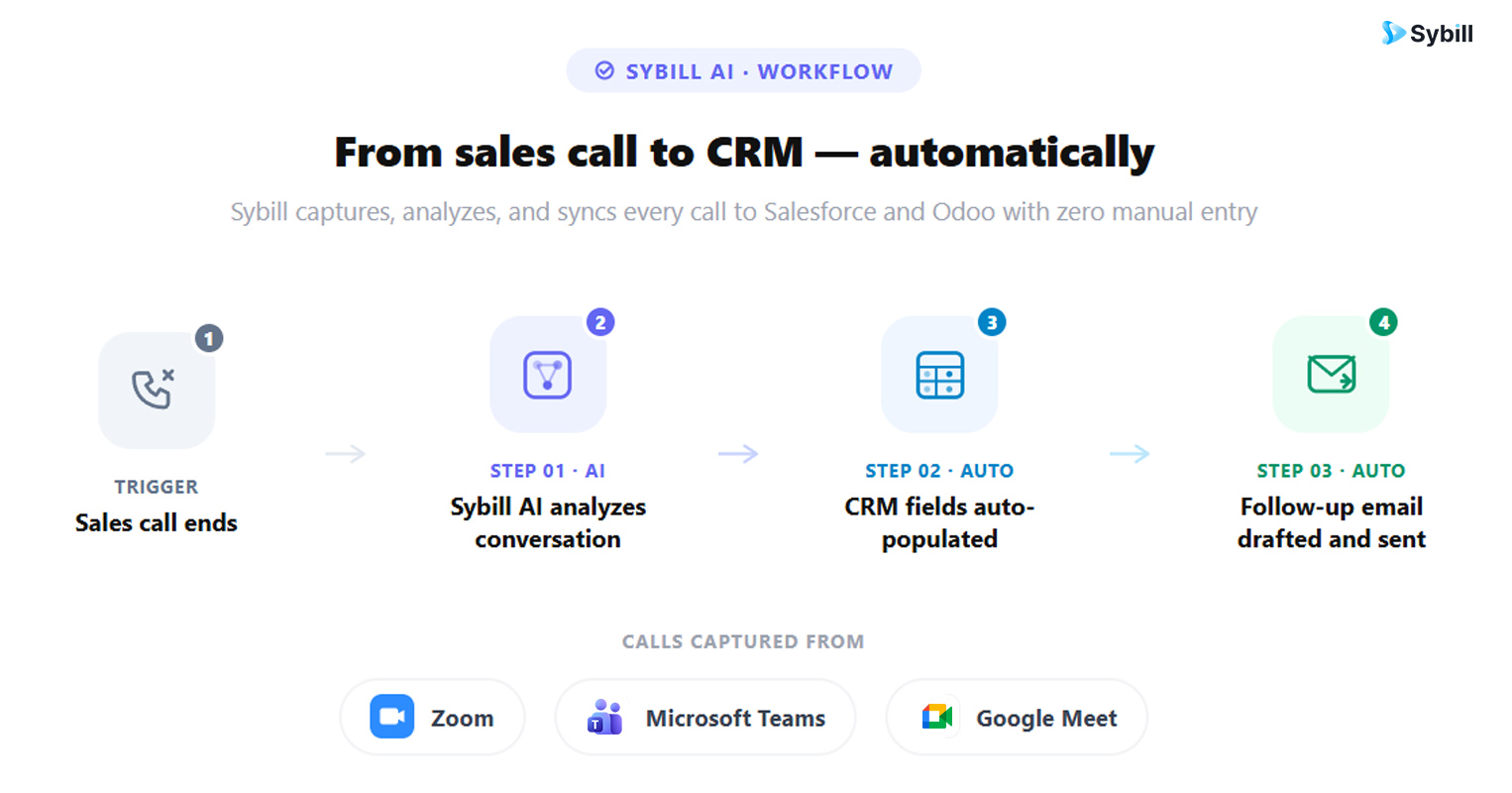
After every call and email, Sybill's AI extracts deal-relevant signals and writes them directly into your CRM fields: pain points, budget signals, decision-maker identity, objections, agreed next steps, MEDDPICC or BANT criteria, competitor mentions, and more. The outputs are human-sounding and field-specific, populated automatically without the rep opening the CRM.
CRM Autofill means zero manual entry after calls. Sybill auto-discovers your CRM fields, including custom ones, and populates them with accurate, context-specific outputs derived from the conversation itself. AEs using Sybill report saving four to six hours per week on CRM updates alone.
Magic Summary delivers a structured call output within minutes of every call ending: the call outcome, buyer pain points, objections raised, key takeaways, and engagement signals. Sales call transcripts become decision-ready action plans rather than recordings no one reviews.
Ask Sybill is a natural-language querying interface across all your deals, calls, emails, and CRM data. Ask which accounts have gone quiet after the proposal stage. Ask which deals have raised a pricing objection in the last 30 days. Ask which reps are consistently skipping discovery questions. Get answers in seconds without pulling a report. This is conversation intelligence software turning raw meeting data into searchable, actionable deal intelligence.
Non-Verbal AI Analysis tracks body language and engagement signals on video calls, identifying which stakeholders in a multi-person meeting are genuinely engaged and who checked out after the intro slide. For multi-threaded B2B enterprise deals, knowing your real champion before the follow-up email is written changes the conversation entirely.
Pre-Meeting Briefs are auto-generated before every call, pulling from full deal history, previous meeting summaries, and relevant CRM context. Reps walk in prepared without spending 20 minutes navigating records across tabs.
AI Follow-Up Emails are one-click drafts in the rep's own voice, written specifically from what was discussed on the call. Not templates. Emails that actually reference the conversation, delivered in seconds.
For sales managers, Sybill generates rep-level coaching briefs, deal health snapshots, and automated pipeline reviews. The AI agents for sales managers use case is particularly valuable for teams running MEDDPICC, BANT, or SPICED qualification, where field completeness directly drives forecast confidence. Sybill enforces completeness at the source rather than at the weekly nag meeting.
This directly addresses the top challenge for RevOps teams across both platforms: pipeline data is incomplete, forecasts are unreliable, and reps spend too much time on admin. Sybill solves all three simultaneously by automating the data layer that both Odoo and Salesforce depend on but cannot collect on their own.
For teams evaluating the best AI sales tools to layer on top of their CRM investment, Sybill delivers the post-call execution that most platforms still leave entirely manual.
Get started for free with Sybill and let any CRM you choose actually work the way it was designed to.
What is the main difference between Odoo and Salesforce?
Odoo is an open-source ERP suite with a built-in CRM module. It is designed for businesses that want sales, accounting, operations, and HR in a single, unified platform at an affordable per-user price. Salesforce is a purpose-built CRM platform designed for customer-facing revenue operations at scale. It offers deeper CRM customization, more powerful enterprise analytics, and a larger third-party integration ecosystem, but at a significantly higher total cost and with more implementation complexity. The choice between them depends primarily on whether you need a full business operations platform (Odoo) or a best-in-class CRM that connects to your existing tools (Salesforce).
Can Odoo replace Salesforce for enterprise teams?
For most large enterprises with complex, multi-department revenue processes and existing Salesforce infrastructure, Odoo is not a direct replacement. Salesforce's advanced analytics, Agentforce AI capabilities, AppExchange ecosystem, and enterprise-grade compliance certifications serve needs that Odoo's CRM module does not fully cover. For mid-market companies or enterprises without heavy CRM-specific requirements, Odoo's combination of CRM plus full business operations at a fraction of the cost can be a compelling migration path. The deciding factors are sales process complexity, IT resources, and whether you need ERP capabilities alongside CRM.
How does Odoo hosting compare to Salesforce hosting?
Odoo offers three hosting options: Odoo Online (fully managed SaaS), Odoo.sh (managed cloud with developer flexibility and custom module support), and self-hosted deployment on VPS, dedicated servers, Docker, or Kubernetes clusters. Salesforce offers only one option: a fully managed SaaS deployment through its Hyperforce architecture, which supports geographic data residency across major cloud providers. Odoo's deployment flexibility is a meaningful advantage for organizations with strict on-premises requirements, data sovereignty rules, or technical teams that want infrastructure control. Salesforce's single-model approach is simpler to operate but leaves no room for self-hosting or on-premises deployment.
Is Odoo cheaper than Salesforce?
Significantly, especially when comparing included features rather than headline license prices. Odoo Standard at approximately $24.90/user/month includes every app in the suite, all AI features, all integrations, and all automation capabilities. Salesforce starts at $25/user/month but gates most meaningful features, including AI, advanced automation, API access, and marketing automation, behind higher tiers or separate add-on purchases. For a 10-person team with typical CRM and automation requirements, Odoo's total cost is often three to five times lower than Salesforce's over a comparable feature set. Read more about how AI CRM tools affect total cost of ownership for teams evaluating both platforms.
Which CRM is better for small businesses: Odoo or Salesforce?
Odoo is the stronger choice for most small businesses. The free Community edition, the affordable Standard plan, the included ERP modules, the fast setup, and the absence of mandatory add-ons make Odoo much more accessible for teams with limited budgets and without dedicated CRM administrators. Salesforce's Starter Suite is usable for small teams but offers limited functionality and quickly pushes users toward more expensive plans as needs grow. The best CRM software for small businesses is always the one that gets used consistently, and Odoo's lower cost and simpler interface typically drive higher adoption in smaller organizations.
Does Sybill work with Odoo CRM?
Yes. Sybill connects with Odoo via Zapier, enabling automatic CRM field updates after every sales call and email. After each conversation, Sybill extracts deal-relevant information (pain points, next steps, qualification criteria, objections, and more) and writes it into your Odoo CRM fields without any manual entry. It also generates AI call summaries, drafts follow-up emails, and enables cross-deal querying through Ask Sybill. Sybill also integrates natively with Salesforce for teams on that platform. Learn more about CRM data hygiene and why it matters for both Odoo and Salesforce users.
What are the hidden costs of Odoo and Salesforce?
Odoo's hidden costs are primarily implementation and customization. Self-hosted deployments require server infrastructure, technical maintenance, and update management. Complex module customizations on Odoo.sh or self-hosted instances require developer time. Partner implementation fees for Odoo can range from $5,000 to $50,000 depending on complexity. Salesforce's hidden costs are more significant: Pardot for marketing automation starts at $1,250/month, Einstein AI and Agentforce require Enterprise-tier licensing, API access requires Enterprise or a Professional add-on, and implementation consulting typically costs $5,000 to $100,000 or more in year one. Improving pipeline accuracy through conversation intelligence reduces the ROI pressure on whichever platform's premium features you are paying for.
Odoo is an open-source ERP suite with a built-in CRM module. It is designed for businesses that want sales, accounting, operations, and HR in a single, unified platform at an affordable per-user price. Salesforce is a purpose-built CRM platform designed for customer-facing revenue operations at scale. It offers deeper CRM customization, more powerful enterprise analytics, and a larger third-party integration ecosystem, but at a significantly higher total cost and with more implementation complexity. The choice between them depends primarily on whether you need a full business operations platform (Odoo) or a best-in-class CRM that connects to your existing tools (Salesforce).
For most large enterprises with complex, multi-department revenue processes and existing Salesforce infrastructure, Odoo is not a direct replacement. Salesforce's advanced analytics, Agentforce AI capabilities, AppExchange ecosystem, and enterprise-grade compliance certifications serve needs that Odoo's CRM module does not fully cover. For mid-market companies or enterprises without heavy CRM-specific requirements, Odoo's combination of CRM plus full business operations at a fraction of the cost can be a compelling migration path. The deciding factors are sales process complexity, IT resources, and whether you need ERP capabilities alongside CRM.
Odoo offers three hosting options: Odoo Online (fully managed SaaS), Odoo.sh (managed cloud with developer flexibility and custom module support), and self-hosted deployment on VPS, dedicated servers, Docker, or Kubernetes clusters. Salesforce offers only one option: a fully managed SaaS deployment through its Hyperforce architecture, which supports geographic data residency across major cloud providers. Odoo's deployment flexibility is a meaningful advantage for organizations with strict on-premises requirements, data sovereignty rules, or technical teams that want infrastructure control. Salesforce's single-model approach is simpler to operate but leaves no room for self-hosting or on-premises deployment.