Find us at booth #83, join us for a harbor side happy hour, or catch Gorish’s talk.

Sept, 16-18 > Learn more

%20(1).avif)
Mamta Tainwala

April 9, 2026
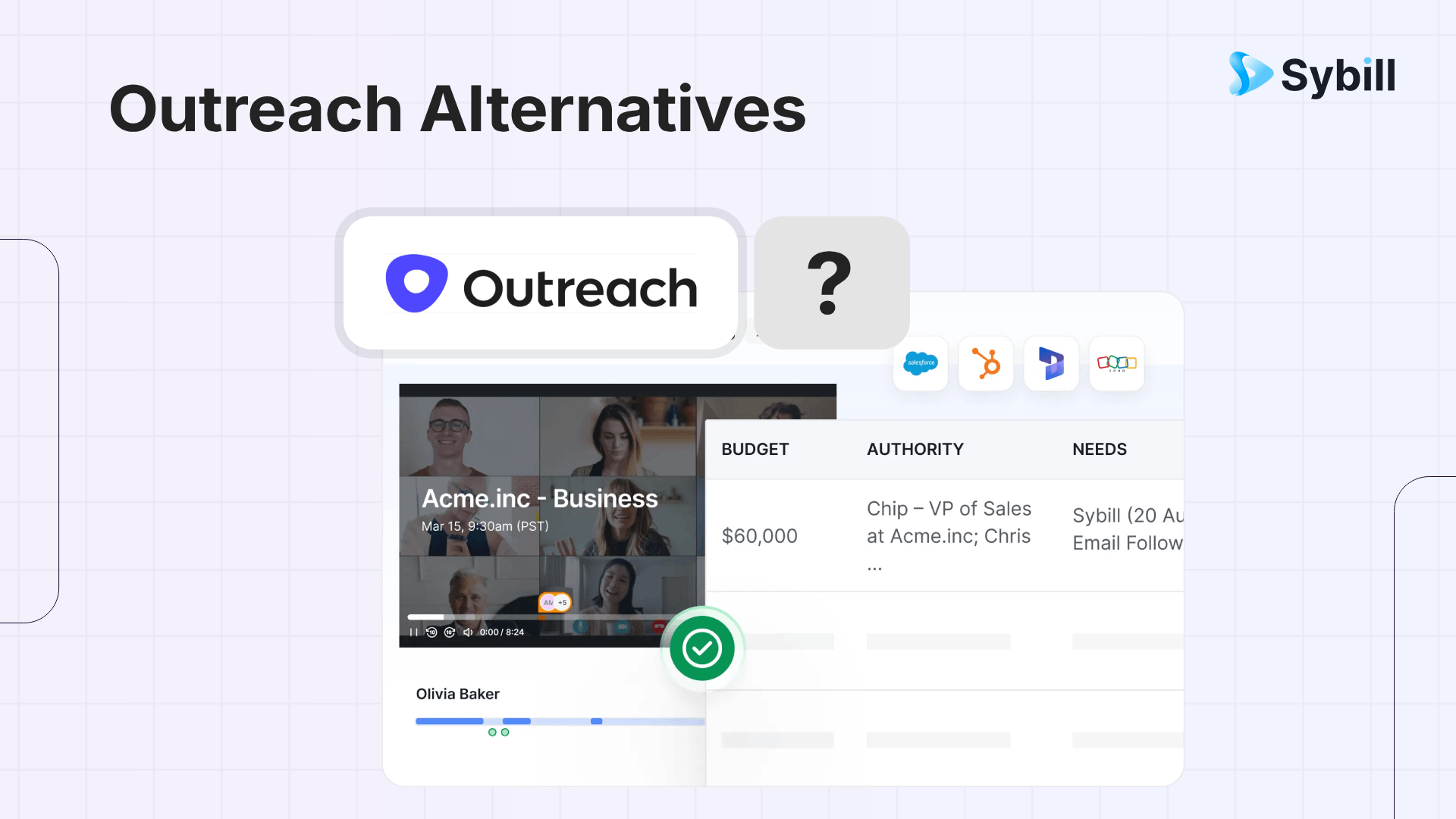
Outreach helped define the sales engagement category. Multi-channel cadences, automated sequences, AI-powered prioritization, and embedded conversation intelligence through Kaia made it the default for enterprise outbound teams. But according to Gartner, the category itself is transitioning from "sales engagement" to "revenue action orchestration," and that shift is pushing teams to rethink what they need from their engagement stack.
The reasons teams start looking beyond Outreach are consistent: opaque pricing that often lands between $100 and $160 per user per month, a steep learning curve that demands dedicated RevOps support, feature bloat from aggressive expansion into forecasting and deal management, and the "Franken-stack" problem where Outreach handles execution but still requires separate tools for data, enrichment, and conversation intelligence.
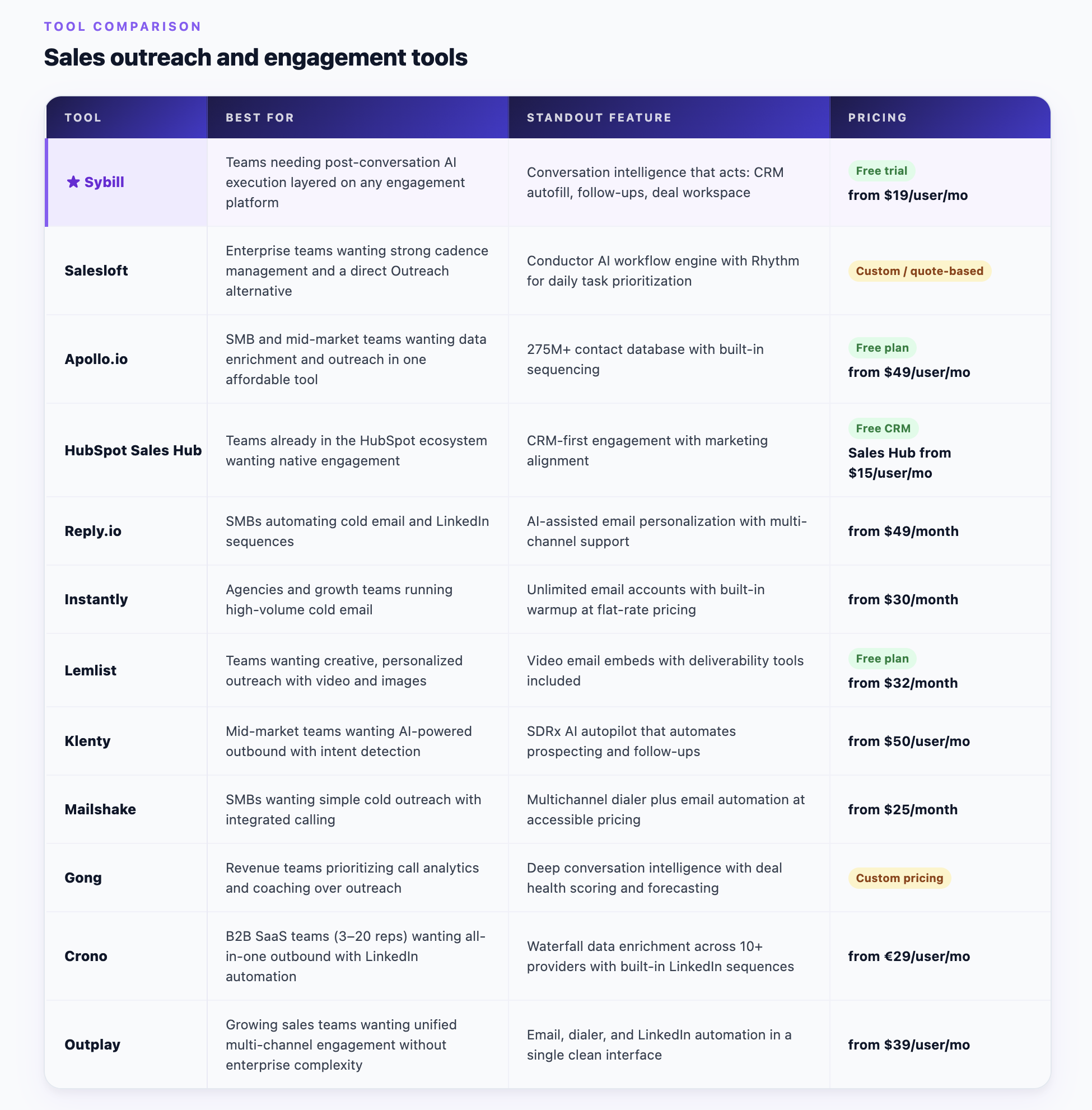
If any of that sounds familiar, this guide is for you. We break down 12 Outreach alternatives, covering who each tool is built for, what it actually costs, and where it falls short. We also address the fundamental question most alternatives articles ignore: why switching engagement platforms rarely solves the real problem.
In this guide, you will find:
Understanding why teams leave Outreach helps you avoid the same problems with your next platform. Here are the patterns:
Pricing that punishes growth. Outreach operates on per-seat pricing that industry reports place between $100 and $160 per user per month, with annual contracts and substantial implementation fees. For a 20-person team, that is $24,000 to $38,400 per year before you add data tools, dialers, or conversation intelligence. The total cost of ownership per rep can exceed $400 per month when you factor in the supporting stack Outreach requires.
Feature bloat from category expansion. Outreach expanded aggressively into revenue intelligence, forecasting, and deal management. For enterprise teams that use all of those capabilities, the platform delivers. For mid-market teams or lean startups, the administrative overhead required to configure and maintain Outreach is disproportionate to the value extracted. Setting up triggers, mapping fields, and managing governance rules often demands a dedicated RevOps administrator.
The "Franken-stack" problem. Outreach handles message execution. It does not natively provide the data (who to contact), the enrichment (verified emails and phone numbers), or the post-call intelligence (what the buyer actually said) without expensive add-ons or integrations. Teams end up stitching together Outreach plus ZoomInfo for data, plus a conversation intelligence tool, plus a CRM automation layer. That fragmentation creates data silos, workflow friction, and rising costs.
Learning curve that slows adoption. Outreach's extensive features require significant training time. For teams bringing on entry-level SDRs who need to ramp quickly, that complexity translates directly into slower time-to-productivity and higher onboarding costs.
Best for: Revenue teams that want conversation intelligence, automated CRM updates, AI-generated follow-ups, and deal visibility layered on top of whatever engagement tool they already use.
G2 Rating: 4.8/5
Sybill is not a cadence tool. It does not manage sequences or send cold emails. What it does is solve the problem that every engagement platform, including Outreach, leaves unresolved: what happens after the conversation.
After a sales call or meeting, reps need to update CRM fields, write a contextual follow-up email, log action items, flag deal risks, and prep for the next interaction. That post-call admin is where five to six hours per week disappear. Outreach does not automate any of it.
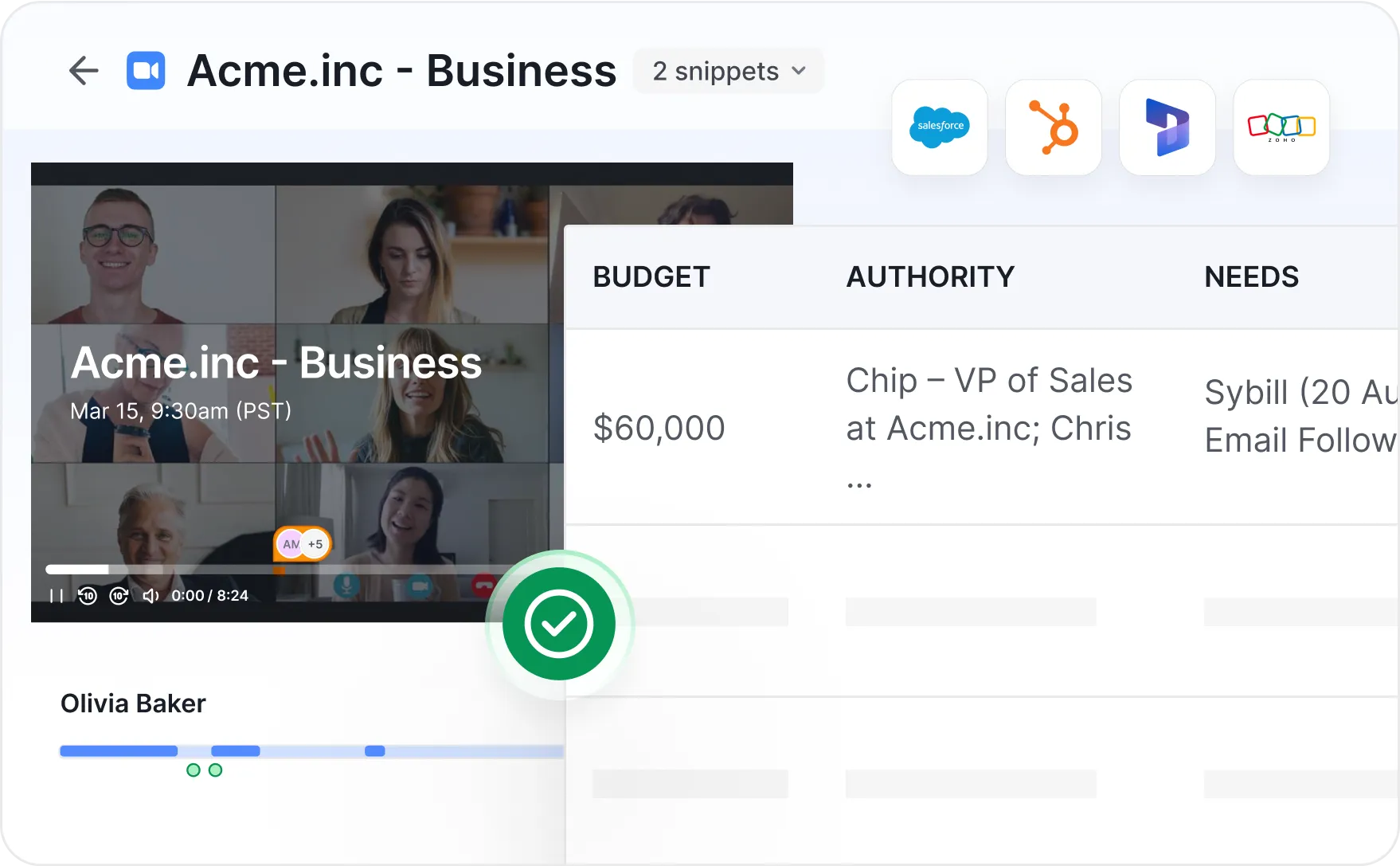
Sybill does. It records meetings without an intrusive bot, generates Magic Summaries that capture pain points, objections, and buying signals (including non-verbal cues), then writes personalized follow-up emails in the rep's own voice. CRM Autofill populates 30+ fields after every interaction with a 99% fill rate, covering MEDDPICC, BANT, SPICED, and custom frameworks. The Deal Workspace centralizes risks, stakeholders, and momentum for every opportunity. Ask Sybill lets anyone query the entire pipeline in plain language.
Key capabilities: Invisible meeting recording (no bot), Magic Summaries with multimodal analysis, one-click follow-up emails, CRM Autofill across 30+ fields, Deal Workspace for pipeline visibility, Ask Sybill for cross-deal intelligence, pre-call briefs, and native integrations with Salesforce, HubSpot, Slack, and all major meeting platforms.
Pricing: Free trial available. Paid plans start at $19 per user per month.
Where it fits: Sybill pairs with Outreach, Salesloft, Apollo, or any engagement tool. It is the intelligence and execution layer that turns activity into outcomes. Teams using both an engagement platform and Sybill get sequencing plus the post-call automation that actually moves deals forward.
Get started for free with Sybill.
.png)
Best for: Enterprise teams that want a mature cadence platform with strong workflow automation and embedded analytics.
G2 Rating: 4.5/5
Salesloft is the most frequently cited direct alternative to Outreach. The Conductor AI engine and Rhythm workflow prioritize daily tasks for reps, and the platform's cadence management across email, phone, and social channels matches Outreach's depth. Salesloft merged with Clari in 2025, adding forecasting and pipeline health capabilities to the core engagement platform.
Where Salesloft differs is in perceived ease of use. G2 reviewers consistently rate Salesloft higher for setup and administration compared to Outreach. The interface is more intuitive, and the learning curve is shorter, which matters for teams that cannot afford weeks of onboarding.
The limitation is the same as Outreach's: Salesloft manages the outbound motion but does not automate what happens after the conversation. CRM updates, follow-up writing, and deal intelligence still require manual effort or additional tools.
Pricing: Custom pricing (quote-based). Expect enterprise-level investment comparable to Outreach.
Best for teams that: Want to switch from Outreach to a direct competitor with comparable features and better usability.
Read the full comparison: Salesloft vs Outreach
Best for: SMB and mid-market teams that want a contact database and sequencing tool together at a fraction of Outreach's price.
G2 Rating: 4.7/5
Apollo combines a 275M+ verified contact database with email sequencing, a built-in dialer, LinkedIn connection requests, and CRM integration. For teams currently paying separately for ZoomInfo or Cognism alongside Outreach, Apollo consolidates data and execution into a single platform.
The free plan includes 1,200 email credits per year and two active sequences, which is enough for solo reps to evaluate the platform. Paid plans start at $49 per user per month with significantly more capacity.
The trade-off is engagement depth. Apollo's sequencing and conversation intelligence features are less mature than Outreach's. LinkedIn automation is limited to connection requests (no automated messages). For complex enterprise sales cycles, Apollo may not provide the workflow sophistication or pipeline visibility your team needs.
Pricing: Free plan available. Paid from $49/user/month (Basic) to $119/user/month (Organization).
Best for teams that: Need prospecting data and outreach in one affordable tool and sell primarily through email-first motions.
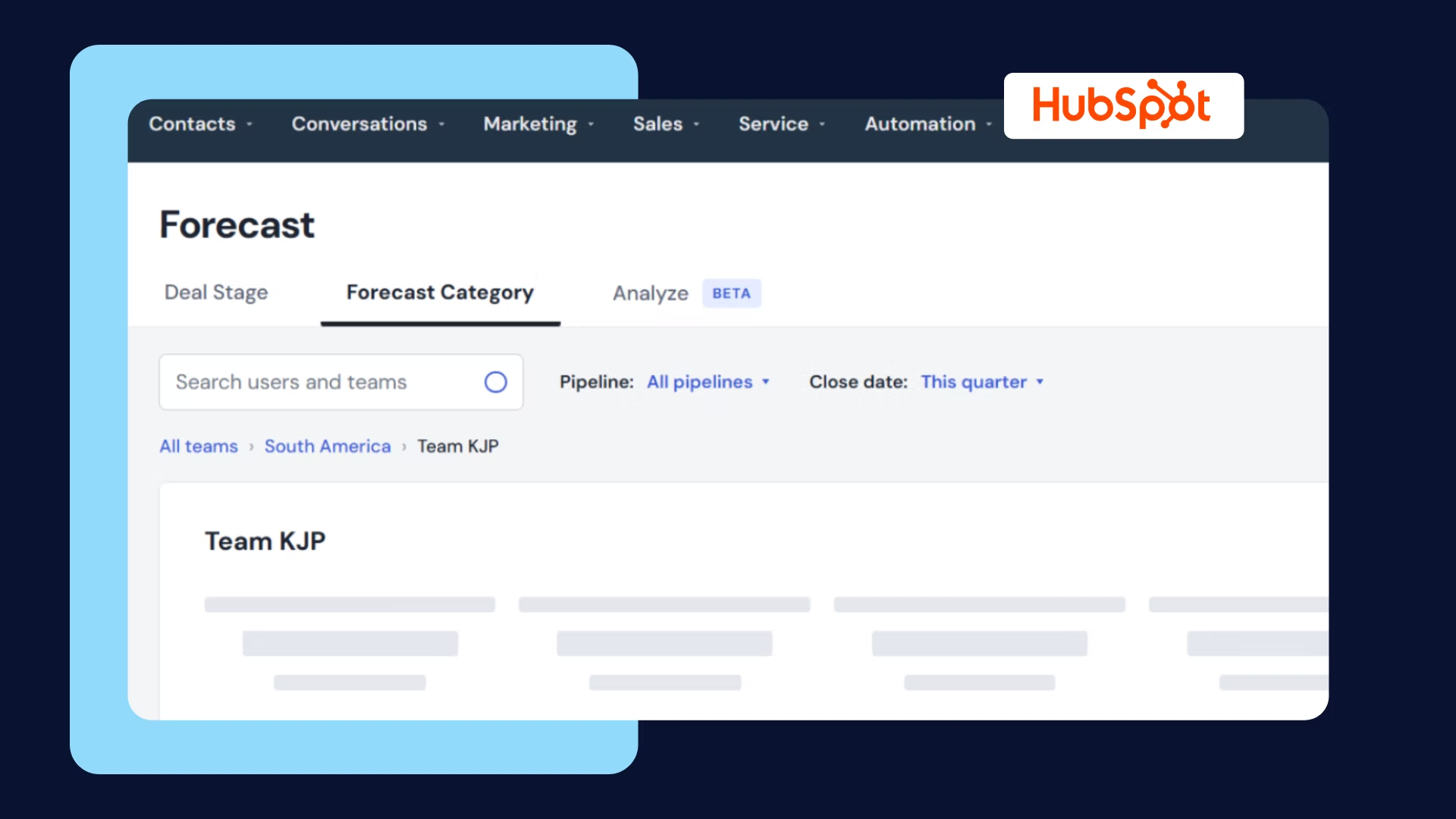
Best for: Teams already running HubSpot CRM that want engagement features without adding a separate vendor.
G2 Rating: 4.4/5
HubSpot Sales Hub brings email automation, sequences, meeting scheduling, and performance analytics into the HubSpot ecosystem. The tight alignment between marketing and sales data means cross-functional reporting happens natively, and lead scoring incorporates both marketing touches and sales activities.
The free CRM tier makes entry accessible. Paid Sales Hub plans scale progressively, offering predictive lead scoring, advanced sequences, and custom reporting as teams grow.
The ceiling appears at enterprise complexity. HubSpot's sequencing, calling, and analytics features are functional but less sophisticated than dedicated engagement platforms. Teams running multi-threaded enterprise deals with complex cadence logic may outgrow Sales Hub's capabilities.
Pricing: Free CRM tier. Paid Sales Hub from $15/user/month scaling to Enterprise.
Best for teams that: Already use HubSpot CRM and want engagement consolidated under one vendor without managing integrations.
Read more: Best HubSpot integrations
Best for: SMB sales teams and outbound marketers automating personalized email and LinkedIn sequences.
G2 Rating: 4.5/5
Reply.io uses AI to generate and optimize messaging for each contact across email, LinkedIn, and phone. The platform supports automated sequences, A/B testing, and lead scoring. Its modular pricing separates email-only, multi-channel, and agency packages so teams pay for what they use.
The AI writing assistant helps reps craft contextual messages without starting from scratch. LinkedIn automation manages connection requests, follow-ups, and direct messages within the platform.
The downside is that AI features are expensive and sold separately from the base packages. Analytics could also be deeper for teams wanting granular campaign insights.
Pricing: Email Volume from $49/month. Multichannel from $89/month. Agency from $166/month.
Best for teams that: Run email and LinkedIn outbound and want AI personalization without enterprise overhead.
Best for: Agencies and growth teams sending cold email at volume who need deliverability infrastructure without per-seat pricing.
G2 Rating: 4.7/5
Instantly disrupted sales engagement pricing by offering unlimited email accounts, built-in warmup, and inbox rotation at flat monthly rates. For teams where cold email is the primary channel, Instantly is dramatically cheaper than Outreach for pure email execution.
Deliverability monitoring, sender reputation management, and inbox health tools are built in. The setup is fast and the interface is simple, with minimal learning curve.
The trade-off is scope. Instantly does not offer calling, LinkedIn automation, conversation intelligence, deal management, or meaningful CRM integration. It is a cold email infrastructure tool, not a sales engagement platform.
Pricing: Growth from $30/month. Hypergrowth from $77.60/month. Lead database extra.
Best for teams that: Send high volumes of cold email and prioritize deliverability and cost over multi-channel orchestration.
Best for: Teams that want to stand out in crowded inboxes with video emails, image personalization, and creative outreach formats.
G2 Rating: 4.5/5
Lemlist enables sales teams to embed personalized videos and custom images into email campaigns, creating touchpoints that look and feel different from every other automated sequence. Email warmup is included on all paid plans, and the platform supports multi-channel sequences across email, LinkedIn, and phone.
The free plan provides basic access, and paid tiers scale from email-only ($32/month) to full multi-channel outreach ($129/month).
The limitation is integration breadth. Lemlist's CRM integrations are narrower than Outreach's, and the platform is more focused on top-of-funnel outreach than full-cycle sales management.
Pricing: Free plan. Email Starter from $32/month. Multichannel Expert from $79/month. Outreach Scale from $129/month.
Best for teams that: Want creative, attention-grabbing outreach formats and value deliverability infrastructure at accessible pricing.
Best for: Mid-market teams wanting structured, AI-driven outbound with intent detection and multi-channel execution.
G2 Rating: 4.6/5
Klenty's SDRx feature automates repetitive outbound tasks, from building prospect lists to sending follow-ups, using AI frameworks to prioritize outreach timing. Intent detection helps sellers reach prospects at the right moment, and the platform supports email, phone, LinkedIn, SMS, and WhatsApp.
The 14-day free trial with full feature access is generous compared to competitors. Deep CRM integrations with Salesforce, HubSpot, and Pipedrive ensure activity data flows back to your system of record.
Customization options are more limited than Outreach or Salesloft, and new users report a learning curve despite the AI-first design.
Pricing: Starter from $50/user/month. Growth from $70/user/month. Plus from $99/user/month.
Best for teams that: Want AI to automate prospecting and outreach execution across multiple channels at mid-market pricing.
Best for: SMBs wanting straightforward email automation with an integrated dialer at accessible pricing.
G2 Rating: 4.5/5
Mailshake keeps cold outreach simple. Dynamic email sequences, an integrated phone dialer, deliverability monitoring, and a Data Finder for basic lead prospecting are all included. The interface is clean and the setup is fast.
For smaller teams that do not need Outreach's complexity, Mailshake delivers the core cadence functionality at a fraction of the cost. The Starter plan at $25/month makes it one of the most accessible options on this list.
The limitation is scale. Mailshake's CRM features, analytics, and team collaboration tools are less robust than what mid-market or enterprise teams require.
Pricing: Starter from $25/month. Email Outreach from $45/month. Sales Engagement from $85/month.
Best for teams that: Want basic cold outreach with calling at budget-friendly pricing and minimal setup time.
Best for: Sales organizations that prioritize call recording, deal analytics, rep performance, and coaching over outbound automation.
G2 Rating: 4.8/5
Gong is not a cadence tool. It is a conversation intelligence and revenue intelligence platform that analyzes every customer interaction to surface coaching insights, deal risks, and competitive patterns.
Where Outreach focuses on what you send and when, Gong focuses on what happens during the conversation. Deal health scoring, forecasting, and performance benchmarking give revenue leaders visibility that no engagement platform provides.
Gong does not execute post-call work. It surfaces insights but reps still write follow-ups, update CRM, and act on recommendations manually. Pricing is enterprise-level.
Pricing: Custom pricing. Designed for mid-market and enterprise organizations.
Best for teams that: Need deep analytics on sales conversations and coaching at scale, and already have a separate engagement platform handling outbound.
Explore options: Gong alternatives
Best for: B2B SaaS companies with 3 to 20 salespeople who want lead generation, enrichment, and multi-channel outreach in a single platform.
G2 Rating: 4.8/5
Crono addresses the Franken-stack problem directly. Instead of juggling separate tools for lead generation, data enrichment, and engagement, Crono integrates all three. Its Waterfall enrichment approach queries 10+ data providers to maximize contact accuracy, and built-in LinkedIn automation handles connection requests and personalized messages.
The platform pulls leads directly from LinkedIn Sales Navigator, enriches them with one click, and launches multi-channel sequences combining email, calls, and LinkedIn, all within a single interface. Transparent pricing from €29 to €119 per user per month with no annual lock-in makes it accessible for growing teams.
The limitation is LinkedIn dependency. Teams not using Sales Navigator will not fully benefit from Crono's core workflow.
Pricing: Lite from €29/user/month. Pro from €69/user/month. Ultra from €119/user/month.
Best for teams that: Want prospecting, enrichment, and multi-channel engagement consolidated without enterprise complexity or pricing.
Best for: Growing sales teams wanting email, dialer, and LinkedIn automation in an intuitive platform with clean analytics.
G2 Rating: 4.5/5
Outplay offers a middle ground between Outreach's complexity and lighter tools like Mailshake. Multi-channel sequences across email, phone, and LinkedIn are unified in a single interface with strong analytics and CRM integration.
The platform automatically detects out-of-office replies and adjusts follow-up timing, which is a small but meaningful quality-of-life feature for SDR teams. The Starter plan at $39/month allows unlimited emails to active prospects.
Multi-channel outreach is only available on premium plans (Growth Plus and above), and analytics are less granular than Outreach's.
Pricing: Starter from $39/month. Growth from $89/user/month. Growth Plus from $139/user/month.
Best for teams that: Want multi-channel engagement without enterprise complexity or pricing, and value clean UX with fast adoption.
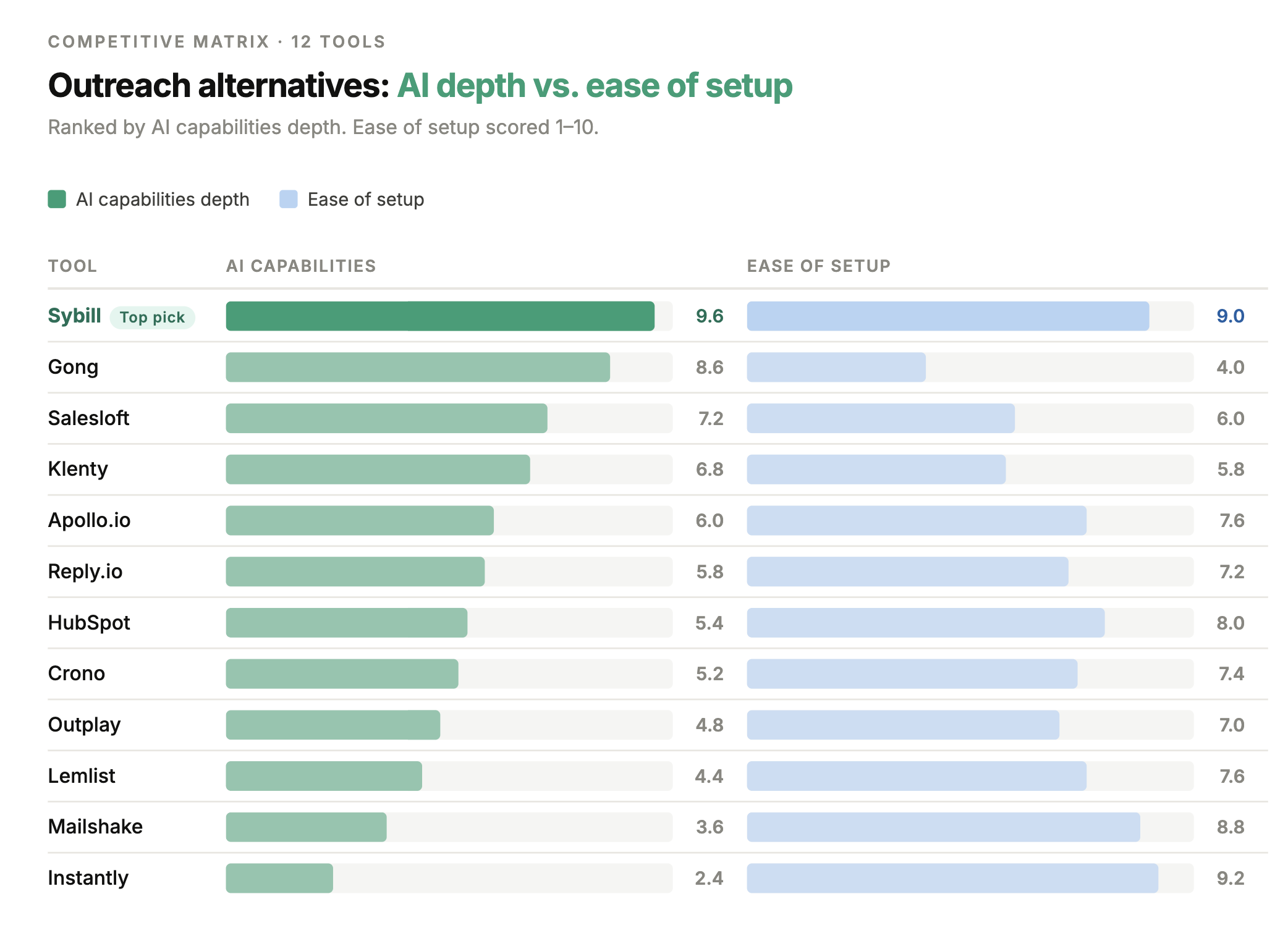
Picking a tool based on feature checklists is how teams end up switching again in 12 months. Instead, start with the problem you are solving.
If your problem is cost, Apollo, Instantly, Mailshake, and Crono offer the strongest value below $100 per user per month. Each makes trade-offs on feature depth, but they deliver real outbound capability at a fraction of Outreach's price.
If your problem is complexity, Lemlist, Outplay, and Klenty prioritize faster setup and shorter learning curves. They are built for teams that need reps productive in days, not weeks.
If your problem is the Franken-stack, Apollo and Crono consolidate data, enrichment, and engagement in single platforms. For teams currently paying for Outreach plus ZoomInfo plus an email verification tool, consolidation reduces both cost and workflow friction.
If your problem is CRM data quality, switching engagement platforms will not fix it. Engagement tools create activity but do not capture the intelligence from those activities. CRM automation tools like Sybill write structured data into your CRM after every interaction, solving the quality problem at its source.
If your problem is pipeline visibility and coaching, Gong provides the deepest conversation analytics in the market. Sybill provides similar intelligence with the added benefit of post-call execution: follow-ups, CRM updates, and deal workspace, making it a stronger fit for teams that want insights and action in one tool.
If your problem is what happens after the conversation, that is the execution gap. And it exists regardless of which engagement tool you use. Sybill was built to close it.
Here is what most Outreach alternatives articles will not tell you: the biggest productivity drain in your sales workflow is not which tool sends the email. It is what happens after the conversation ends.
Every engagement platform, Outreach included, focuses on the outbound motion: sequences, cadences, timing, templates. That is important. But it is only half the workflow.
After a discovery call, a demo, or a follow-up meeting, someone needs to update 15 to 30 CRM fields, write a contextual follow-up email, log action items and next steps, flag deal risks for the manager, and prep for the next interaction. Research shows reps waste five to six hours per week on these tasks. That is nearly a full selling day lost to admin every week.
Switching from Outreach to Salesloft does not fix this. Switching to Apollo does not fix it. Switching to any engagement platform does not fix it, because the problem is downstream of engagement.
This is the execution gap. And it is exactly where Sybill operates.
Sybill automates the entire post-conversation workflow. Magic Summaries capture what the buyer said, not just what the rep remembers. Follow-up emails draft themselves in the rep's voice using actual deal context. CRM Autofill writes structured data into every field your RevOps team needs. The Deal Workspace makes pipeline reviews evidence-based instead of opinion-based. And Ask Sybill lets anyone query across all conversations to surface patterns that manual review would never catch.
The teams producing the most revenue in 2026 are not switching engagement tools. They are building stacks where engagement handles the outbound motion and intelligence handles everything that follows.
The best Outreach alternative depends on what problem you are actually solving. If you need cheaper cadences, the market is full of options. If you need smarter cadences, the options narrow. And if you need the intelligence layer that turns every conversation into pipeline momentum, that is a different category entirely.
Get started for free with Sybill and see what happens when conversations stop being data points and start being deal drivers.
What is the best free alternative to Outreach?
Apollo.io offers the most capable free plan with access to its contact database, basic email sequencing, and CRM integration. HubSpot Sales Hub provides a free CRM tier with limited engagement features. Lemlist also offers a free plan with basic access. For AI-powered conversation intelligence and CRM automation, Sybill offers a free trial so teams can evaluate the platform before committing.
Is Outreach worth the price in 2026?
For enterprise teams with complex multi-channel cadences, dedicated RevOps support, and budgets exceeding $100,000 per year for engagement tooling, Outreach remains a strong choice. For mid-market teams, startups, or organizations where the total cost of ownership matters, alternatives like Apollo, Klenty, or Crono deliver 80 to 90% of the engagement capability at a fraction of the cost. The real question is whether engagement alone is enough, or whether your team also needs the intelligence and execution layer that tools like Sybill provide.
Can I use Sybill with Outreach?
Yes. Sybill integrates with any meeting platform and CRM, so it layers directly on top of an Outreach workflow. Outreach manages the outbound cadence. Sybill handles the post-conversation intelligence: meeting summaries, follow-up emails, CRM autofill, and deal insights. Teams using both get outbound automation plus the AI-driven execution that turns conversations into closed deals.
What should I look for when evaluating Outreach alternatives?
Focus on five dimensions: CRM integration depth (does it sync activities and context, or just log timestamps?), AI capabilities beyond basic automation, pricing transparency, time-to-productivity for new reps, and whether the tool addresses the full sales engagement workflow or just the outbound portion.
What is the difference between a sales engagement platform and conversation intelligence?
A sales engagement platform manages outbound communication: email sequences, call scheduling, social touches, and task management. Conversation intelligence analyzes what happens during buyer interactions: objections, sentiment, buying signals, and deal risks. Modern revenue teams increasingly use both. Engagement handles the "reach out" motion. Intelligence handles the "understand and act" motion. Sybill bridges both by turning conversation intelligence into automated post-call execution.
Who are Outreach's biggest competitors?
In the sales engagement space, Outreach's primary competitors are Salesloft, Apollo.io, HubSpot Sales Hub, and Klenty. In the broader revenue technology landscape, Gong competes on conversation intelligence, and platforms like Sybill compete on post-conversation execution. The competitive lines are blurring as the category evolves toward unified revenue orchestration.
Apollo.io offers the most capable free plan with access to its contact database, basic email sequencing, and CRM integration. HubSpot Sales Hub provides a free CRM tier with limited engagement features. Lemlist also offers a free plan with basic access. For AI-powered conversation intelligence and CRM automation, Sybill offers a free trial so teams can evaluate the platform before committing.
For enterprise teams with complex multi-channel cadences, dedicated RevOps support, and budgets exceeding $100,000 per year for engagement tooling, Outreach remains a strong choice. For mid-market teams, startups, or organizations where the total cost of ownership matters, alternatives like Apollo, Klenty, or Crono deliver 80 to 90% of the engagement capability at a fraction of the cost. The real question is whether engagement alone is enough, or whether your team also needs the intelligence and execution layer that tools like Sybill provide.
Yes. Sybill integrates with any meeting platform and CRM, so it layers directly on top of an Outreach workflow. Outreach manages the outbound cadence. Sybill handles the post-conversation intelligence: meeting summaries, follow-up emails, CRM autofill, and deal insights. Teams using both get outbound automation plus the AI-driven execution that turns conversations into closed deals.