Find us at booth #83, join us for a harbor side happy hour, or catch Gorish’s talk.

Sept, 16-18 > Learn more

%20(1).avif)
Mamta Tainwala

April 7, 2026
Most sales teams treat every deal, every customer, and every task as if they carry equal weight. They spread effort evenly across the pipeline, give the same attention to a $5,000 opportunity as a $150,000 one, and chase every lead with the same intensity regardless of likelihood to close.
This is exactly how you burn out a team while underperforming on quota.
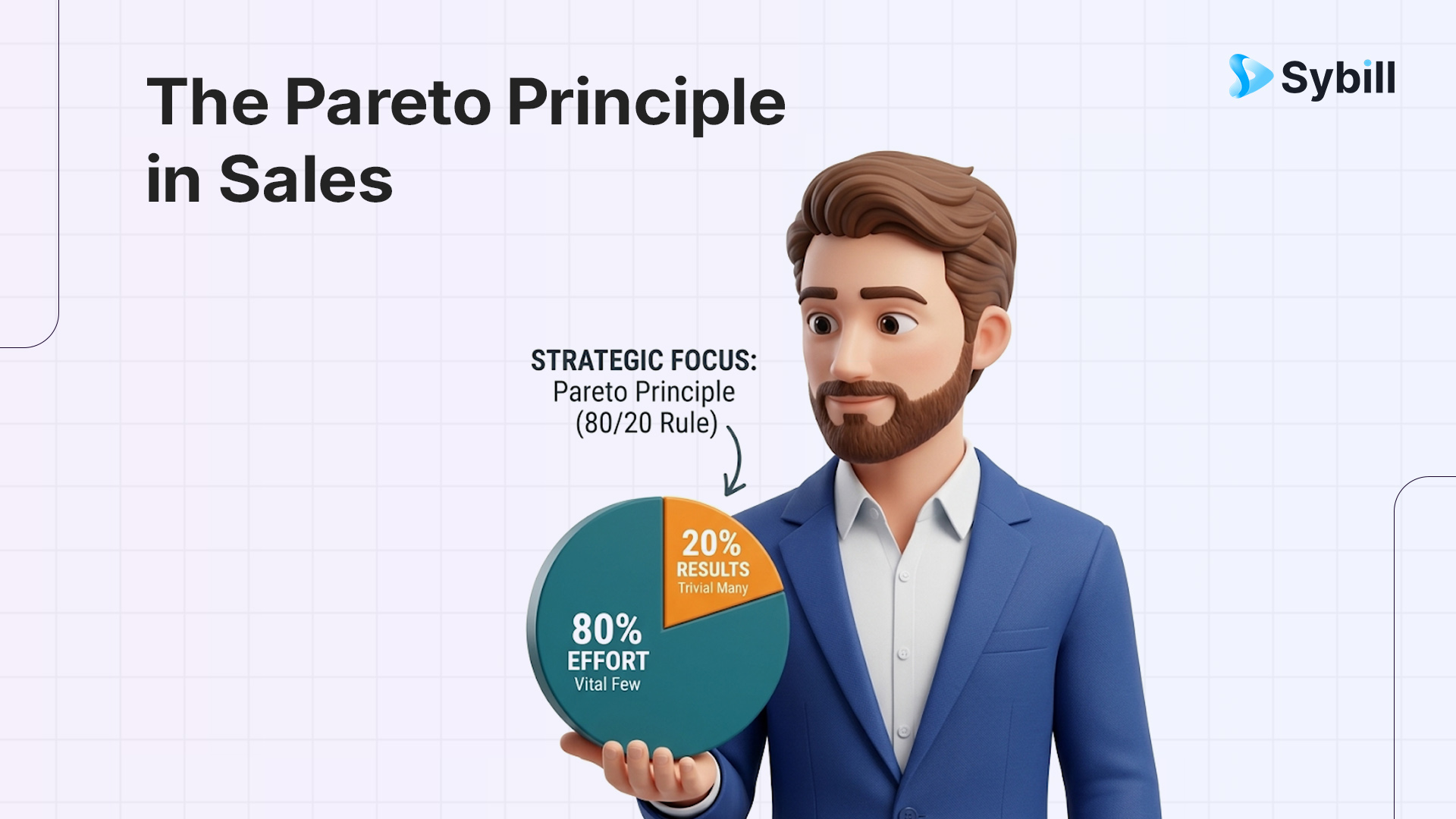
The Pareto Principle, also known as the 80/20 rule, offers a better framework. It states that roughly 80% of outcomes come from 20% of causes. In sales, this translates to a pattern that shows up with remarkable consistency: 80% of your revenue comes from 20% of your customers. 80% of your closed deals come from 20% of your pipeline. 80% of your team's quota attainment comes from 20% of your reps.
The numbers are rarely exactly 80/20. Sometimes it is 70/30 or 90/10. The exact ratio matters less than the underlying insight: a small fraction of your inputs generates a disproportionate share of your results. Once you internalize this, every decision about where to spend your time, your team's attention, and your resources changes.
This guide shows you how to apply the Pareto Principle across every dimension of B2B sales: pipeline prioritization, customer segmentation, rep performance, time management, and sales coaching. We will also cover how AI makes 80/20 analysis practical at scale, so you can identify your vital 20% without manually auditing every deal.
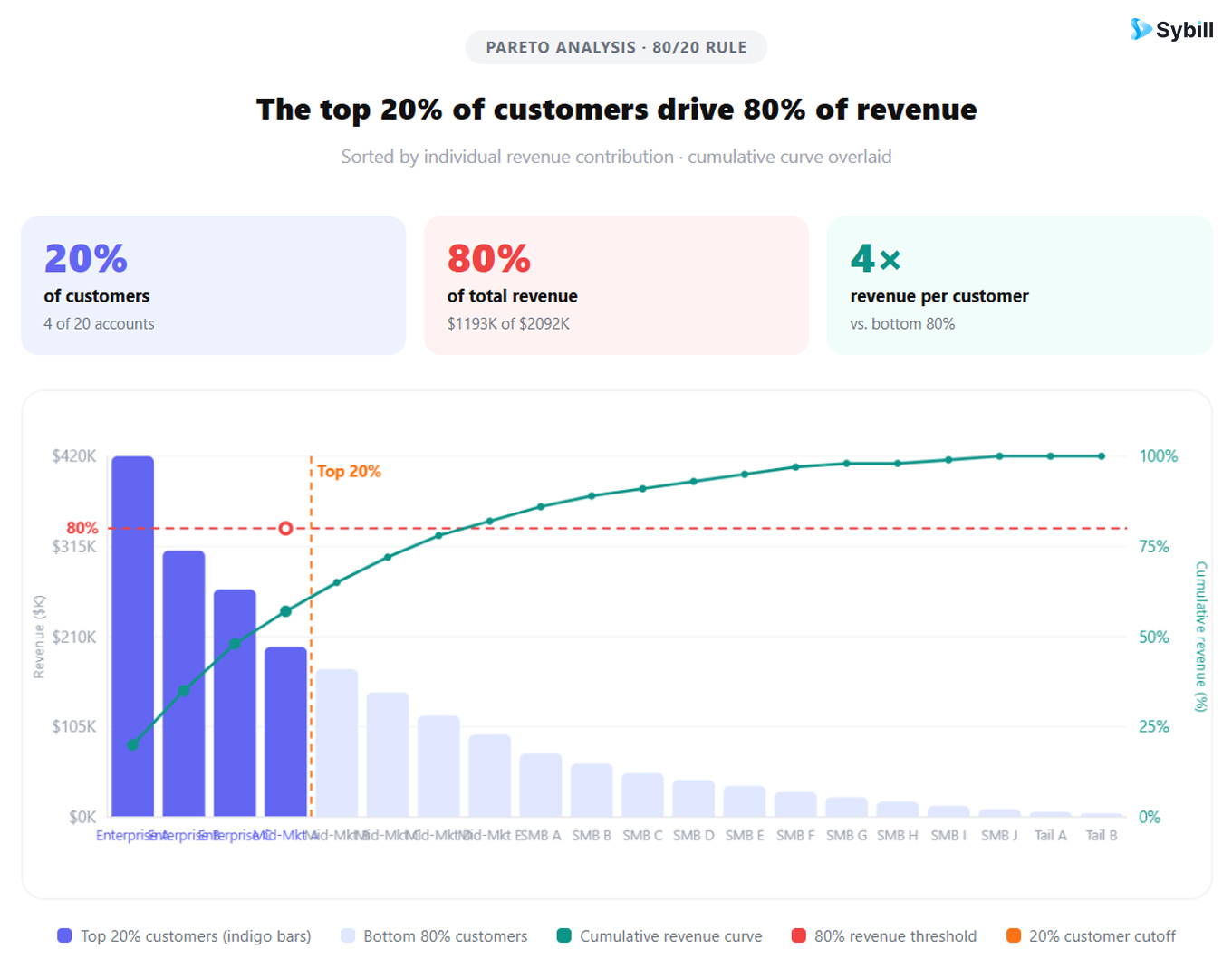
The Pareto Principle is named after Italian economist Vilfredo Pareto, who observed in 1896 that approximately 80% of Italy's land was owned by 20% of the population. He later noticed the same pattern in his garden: 20% of his pea plants produced 80% of the peas.
In 1941, management consultant Joseph Juran applied Pareto's observation to quality management, describing it as the separation between "the vital few and the useful many." The principle has since been validated across business, computer science, economics, and natural phenomena.
The 80/20 rule is not a mathematical law. It is an empirical observation about how inputs and outputs distribute unevenly in most systems. The specific percentages do not need to add up to 100 because they measure different things (20% of customers, 80% of revenue). What makes it useful is the insight that distribution is almost always lopsided, and that identifying the disproportionate contributors allows you to allocate resources far more effectively.
In B2B sales, the Pareto Principle shows up in nearly every metric you care about. Revenue concentration, deal conversion, rep productivity, customer lifetime value, product line profitability, and even objection frequency all tend to follow this pattern. The teams that outperform are not necessarily the ones working the hardest. They are the ones who have figured out which 20% deserves the most attention.
Pull up your pipeline right now. Look at the deals by expected value, stage, and likelihood to close. In almost every sales organization, a small number of opportunities represent the vast majority of potential revenue.
Yet most reps spread their preparation, follow-up, and deal strategy time roughly equally across all active opportunities. The $8,000 deal gets the same meeting prep as the $120,000 deal. The prospect who has gone silent for three weeks gets the same follow-up cadence as the one who asked for a proposal yesterday.
Applying the 80/20 rule to pipeline management means identifying the 20% of your deals that represent the most revenue potential and the highest probability of closing, then deliberately over-investing in those opportunities. This does not mean ignoring the rest. It means being honest about where the highest-leverage effort goes.
With tools like Sybill's Deal Workspace, managers can see every deal's health, engagement signals, and risk indicators in one view. Instead of reviewing 50 opportunities with equal scrutiny, you focus pipeline reviews on the vital few where coaching and attention will actually move the number.
In most B2B companies, a small group of customers generates the majority of revenue, referrals, and expansion opportunities. These are the accounts that renew without friction, expand into new products, and introduce you to their network.
Applying the 80/20 rule to customer segmentation means identifying who these top accounts are and building your retention, upsell, and service strategy around them. It also means accepting that the bottom 80% of accounts, while still worth serving, should not consume the same level of strategic attention.
This analysis often reveals uncomfortable truths. Some accounts that consume enormous support resources generate minimal revenue. Some of your largest accounts are actually less profitable than mid-tier ones when you factor in the cost to serve. The 80/20 lens forces you to look at the data rather than treating all customers as equally important.
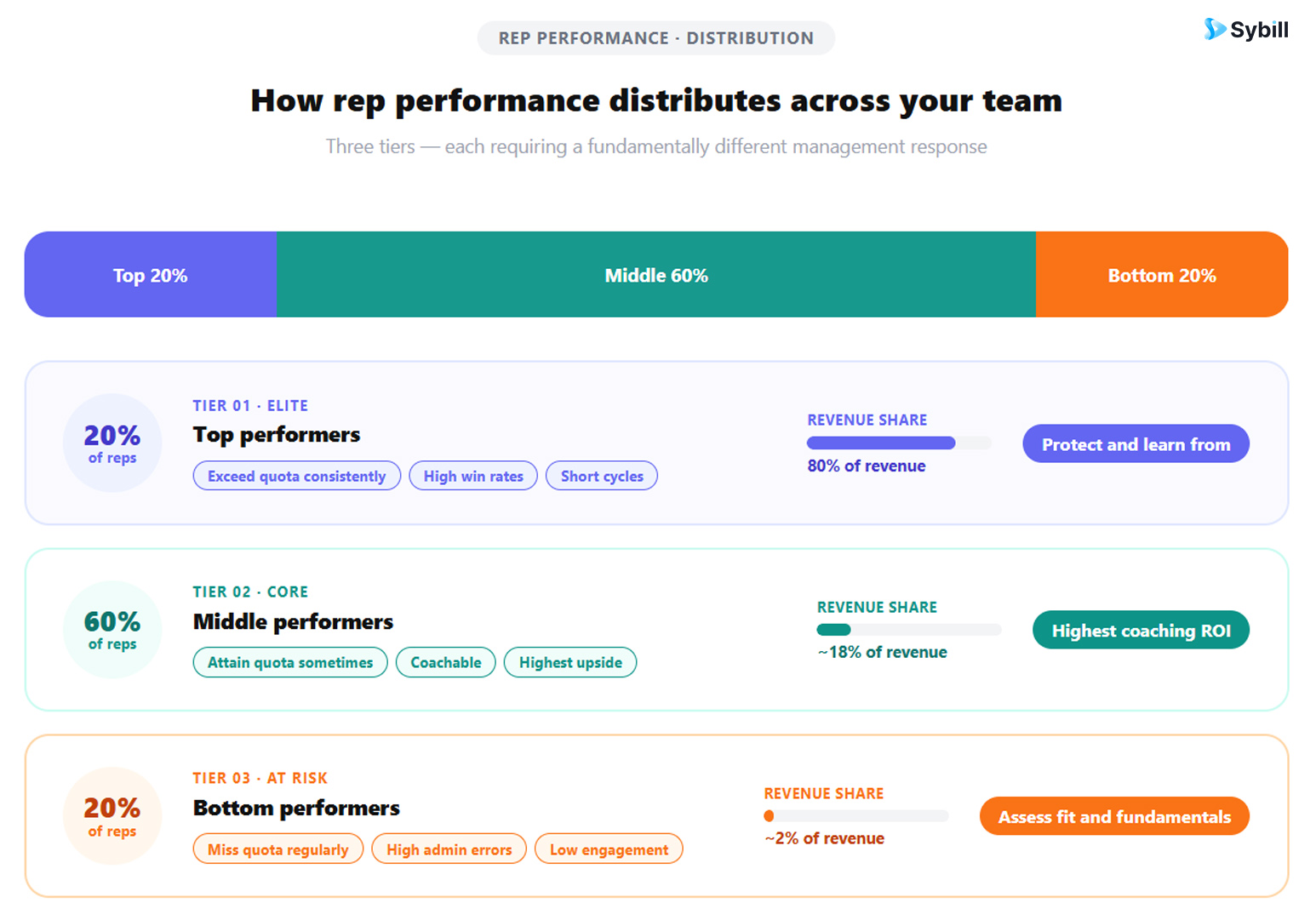
One of the most consistent applications of the Pareto Principle in sales is rep performance. In many organizations, 20% of the sales team generates 80% of the revenue. This is not a criticism of the bottom 80%. It is a recognition that performance distribution is uneven, and that the coaching, enablement, and management approach should reflect that reality.
The highest-leverage coaching investment is often in the middle 60% of performers. Your top 20% are already producing. Your bottom 20% may need fundamental changes. But your middle performers, with targeted coaching on specific skills like discovery depth or objection handling, can move meaningfully upward. This is where the 80/20 rule compounds: small improvements in the vital few skills that separate middle performers from top performers create disproportionate revenue impact.
Sales reps spend less than 30% of their time actively selling. The rest goes to CRM updates, meeting prep, email follow-ups, internal meetings, and administrative tasks. The 80/20 rule suggests that within that selling time, a small portion of activities generates most of the results.
For most reps, the highest-value activities are discovery conversations, proposal presentations, and negotiation calls with qualified buyers. Everything else, while necessary, produces less direct revenue impact. The question is not how to eliminate the other 80% of tasks (many are required) but how to reduce the time they consume so more hours flow to the vital 20%.
This is exactly what AI-powered automation solves. When Sybill handles CRM updates, follow-up emails, and meeting summaries automatically, reps reclaim 5 to 6 hours per week. That reclaimed time can be redirected to the selling activities that actually drive revenue, effectively shifting the balance from 30% selling time to 50% or more.
If you sell multiple products, SKUs, or service tiers, the 80/20 rule almost certainly applies to your revenue mix. A small number of products likely generate the majority of your revenue and profit. Understanding which products these are changes how you train reps, build sales decks, and allocate marketing spend.
This does not mean abandoning your full product line. It means leading with the 20% that resonates most, ensuring reps are deeply knowledgeable about the highest-value offers, and making the path to those products as frictionless as possible.
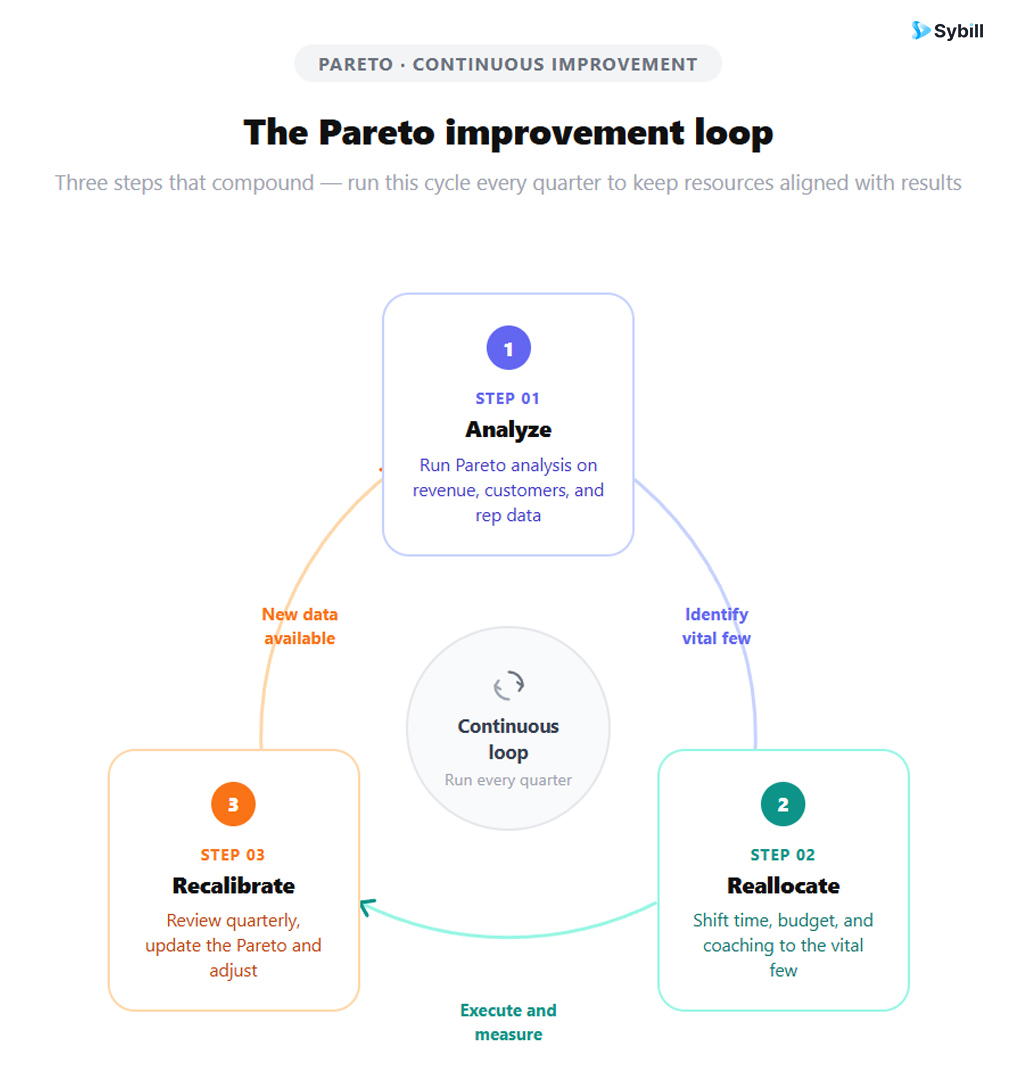
Knowing that the 80/20 rule exists is not useful. Applying it systematically is. Here is a practical framework.
Pull your CRM data and run Pareto analyses on the following:
Revenue by customer. Rank your customers by total revenue contribution. Identify the cutoff where 20% of accounts generate 80% of revenue. These are your strategic accounts.
Pipeline by deal value and win probability. Multiply deal value by win probability to create a weighted pipeline view. Identify the 20% of opportunities that represent 80% of your weighted pipeline. These are the deals that deserve disproportionate attention. Ask Sybill can surface these patterns instantly with questions like "Which deals represent the highest revenue risk this quarter?"
Revenue by rep. Rank reps by closed revenue. Identify your top 20% and study what they do differently. This analysis often reveals specific behaviors (better discovery, faster follow-up, stronger multi-threading) that can be coached to the broader team.
Time by activity. Have reps track their time for one week. Categorize activities as selling (discovery, demos, proposals, negotiations) versus non-selling (CRM, admin, internal meetings). Calculate what percentage of total time goes to the activities that directly produce revenue.
Once you know where the 80/20 split falls, make deliberate changes:
Pipeline reviews. Restructure weekly pipeline reviews to spend 80% of the time on the top 20% of deals by weighted value. Review the remaining deals briefly for updates, not deep strategy.
Account management. Assign your best reps and most experienced CSMs to the top 20% of accounts. These relationships are worth protecting with your strongest talent.
Coaching. Focus 1:1 coaching conversations on the one or two skills that would move each rep's performance the most, not a laundry list of ten improvements. The 80/20 rule applies here too: a small number of skill improvements create the largest performance gains.
Automation. Aggressively automate the tasks that fall in the non-vital 80% of time consumption. CRM data entry, call notes, follow-up email drafting, and meeting prep can all be handled by AI, freeing reps to spend more time on their vital 20%.
The 80/20 distribution is not static. Customers grow and shrink. New products emerge. Market conditions shift. The accounts that made up your top 20% last year may not be the same this year.
Build a quarterly cadence of Pareto analysis into your revenue operations rhythm. Review customer concentration, pipeline distribution, and rep performance. Adjust resource allocation as the data shifts. The best RevOps teams treat this as an ongoing practice, not a one-time exercise.
The Pareto Principle is powerful but not infallible. Here are the most common mistakes sales leaders make when applying it.
The 80/20 rule says to prioritize the vital few, not to abandon the useful many. Your smaller accounts still generate 20% of revenue, which is not trivial. Your less productive reps still contribute. The non-selling tasks still need to happen. The goal is disproportionate allocation, not total neglect.
The ratio is rarely exactly 80/20. It might be 70/30, 90/10, or 65/35 in your specific context. The exact numbers matter less than the principle of uneven distribution. Run the analysis on your own data rather than assuming the textbook ratio applies perfectly.
In SaaS, today's small customer can become next year's largest account. In sales forecasting, a deal that looks like part of the 80% today might be an early indicator of a new market segment. The 80/20 rule should inform prioritization, not eliminate exploration and optionality.
If 20% of your customers generate 80% of your revenue, you have a concentration risk. Losing one or two of those customers could devastate your numbers. Smart application of the Pareto Principle means both protecting your top 20% and deliberately building your pipeline so that no single customer represents too large a share. Revenue diversification matters alongside revenue prioritization.
Historically, applying the Pareto Principle to sales required manual data pulls, spreadsheet analysis, and periodic reviews that were always slightly out of date by the time you acted on them. AI changes this by making 80/20 analysis continuous and actionable.
Continuous deal prioritization. Sybill's deal inspection capabilities continuously assess deal health based on engagement signals, buyer behavior, and conversation patterns. Instead of manually ranking your pipeline, you get a real-time view of which deals are most likely to close and which need intervention. The vital 20% surfaces automatically.
Automated admin for the non-vital 80%. The biggest practical application of the 80/20 rule is automating the tasks that consume time but do not directly produce revenue. CRM Autofill, automated follow-ups, and Magic Summaries handle the admin work so reps can redirect that time to selling.
Pattern recognition across deals. Ask Sybill questions like "Which deals have the strongest buyer engagement this quarter?" or "Which rep behaviors correlate with our highest win rates?" and get instant answers. This is the equivalent of running a Pareto analysis across your entire pipeline in seconds rather than hours.
Coaching precision. Instead of coaching reps on everything at once, AI surfaces the specific skill gaps that would create the largest performance improvement. The coaching briefs Sybill generates for each rep identify the vital few development areas that will drive the most impact.
Microsoft famously discovered that 20% of the most-reported bugs caused 80% of system crashes. By prioritizing fixes for that vital 20%, they eliminated the majority of user-facing errors without addressing every single bug in the backlog. The lesson for sales teams: not every problem in your pipeline needs immediate attention. Fix the 20% of issues (stalled deals, missing stakeholders, unclear next steps) that cause 80% of your forecast misses.
Illinois Tool Works grew from $300 million to $18 billion in revenue by systematically applying the 80/20 rule across its business. They identified the 20% of customers, products, and operations that drove the most value and ruthlessly focused resources there. For sales organizations, this level of discipline in pipeline management and resource allocation is the difference between incremental and exponential growth.
Research consistently shows that top-performing sales organizations coach more frequently than average ones, sometimes 20% more. But the best teams do not just coach more. They coach on the specific 20% of skills that create the biggest performance gap. For most B2B sales teams, those skills are discovery depth, objection handling, and follow-up speed. Coaching these three skills with precision and evidence produces outsized improvements in win rates and deal velocity.
What is the Pareto Principle in sales?
The Pareto Principle, or 80/20 rule, states that roughly 80% of outcomes come from 20% of causes. In sales, this means 80% of revenue typically comes from 20% of customers, 80% of closed deals come from 20% of pipeline opportunities, and 80% of a team's quota attainment comes from 20% of reps. The principle is used to prioritize high-impact customers, deals, activities, and coaching efforts for maximum revenue impact.
How do you identify the top 20% of deals in your pipeline?
Rank your pipeline opportunities by weighted value (deal size multiplied by win probability). The top 20% of deals by weighted value typically represent 80% of your potential revenue. Supplement this quantitative analysis with qualitative signals like buyer engagement, stakeholder involvement, and next-step clarity. AI tools like Sybill can surface these insights automatically by analyzing conversation data, CRM activity, and deal health indicators across your entire pipeline.
Does the 80/20 rule mean you should ignore 80% of your customers?
No. The Pareto Principle is a prioritization framework, not an elimination strategy. Your top 20% of customers deserve disproportionate attention, investment, and protection. But the remaining 80% still contribute meaningful revenue and may include future top accounts. The goal is to allocate resources proportionally to impact, not to abandon the broader base.
How often should you run a Pareto analysis on your sales data?
Quarterly is the minimum recommended frequency. The best RevOps teams run Pareto analyses on customer revenue, pipeline distribution, and rep performance every quarter and adjust resource allocation accordingly. AI-powered tools make continuous 80/20 analysis possible by monitoring deal health and engagement patterns in real time.
What is the biggest mistake sales teams make when applying the 80/20 rule?
The biggest mistake is treating the 80/20 ratio as a rigid mathematical law rather than a directional principle. Every sales organization's actual distribution is different (it might be 70/30 or 90/10). The second most common mistake is over-concentrating on top customers without building pipeline diversification, which creates dangerous revenue dependency. The Pareto Principle should drive smarter allocation, not reckless concentration.
How does AI help apply the Pareto Principle to sales?
AI makes 80/20 analysis continuous and actionable. Instead of manual quarterly data pulls, tools like Sybill continuously assess deal health, surface the highest-value opportunities, and identify the specific rep skills where coaching will create the biggest performance gains. AI also applies the principle to time management by automating the non-vital 80% of admin tasks (CRM updates, call notes, email follow-ups), freeing reps to focus on the vital 20% of activities that produce revenue.
The Pareto Principle is not a hack. It is a lens for seeing where value concentrates and where effort gets wasted. In sales, where time is the most finite resource and attention is the most valuable asset, this lens changes how you lead, how you coach, and how you allocate every hour of your team's day.
The teams that consistently outperform do not work harder than everyone else. They work on the right things. They spend more time on their best deals, invest more coaching in their most improvable reps, protect their most valuable customer relationships, and ruthlessly automate the tasks that consume time without producing results.
Sybill makes this practical. It automates the 80% of admin work that drags down selling time, surfaces the 20% of deals and insights that matter most, and gives managers the evidence-based coaching tools to focus on the vital few improvements that create the biggest performance gains.
Get started for free with Sybill and start focusing on the 20% that actually moves your number.
The Pareto Principle, or 80/20 rule, states that roughly 80% of outcomes come from 20% of causes. In sales, this means 80% of revenue typically comes from 20% of customers, 80% of closed deals come from 20% of pipeline opportunities, and 80% of a team's quota attainment comes from 20% of reps. The principle is used to prioritize high-impact customers, deals, activities, and coaching efforts for maximum revenue impact.
Rank your pipeline opportunities by weighted value (deal size multiplied by win probability). The top 20% of deals by weighted value typically represent 80% of your potential revenue. Supplement this quantitative analysis with qualitative signals like buyer engagement, stakeholder involvement, and next-step clarity. AI tools like Sybill can surface these insights automatically by analyzing conversation data, CRM activity, and deal health indicators across your entire pipeline.
No. The Pareto Principle is a prioritization framework, not an elimination strategy. Your top 20% of customers deserve disproportionate attention, investment, and protection. But the remaining 80% still contribute meaningful revenue and may include future top accounts. The goal is to allocate resources proportionally to impact, not to abandon the broader base.