Find us at booth #83, join us for a harbor side happy hour, or catch Gorish’s talk.

Sept, 16-18 > Learn more

%20(1).avif)
Mamta Tainwala

April 5, 2026
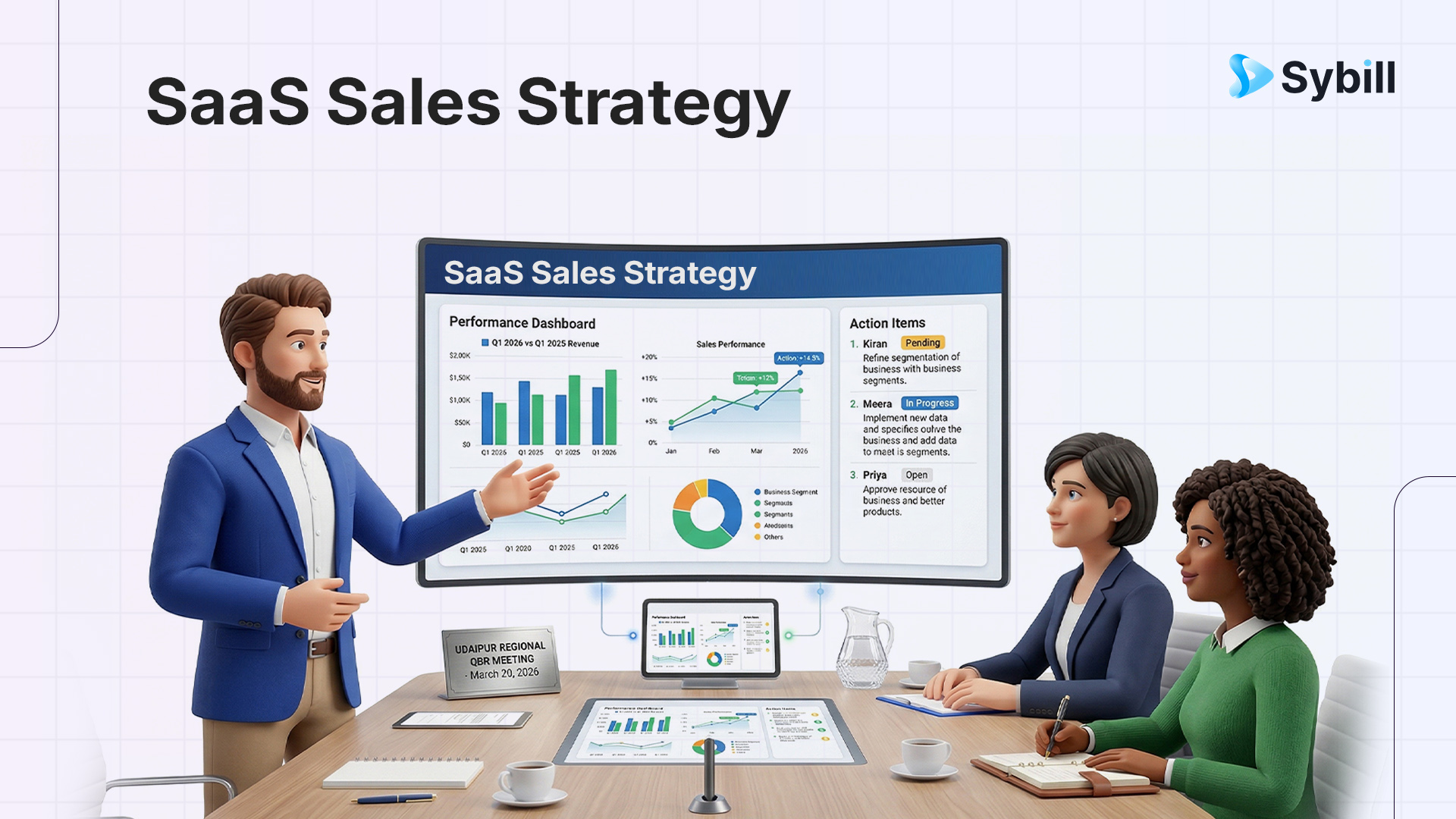
The SaaS sales landscape in 2026 has one clear pattern: the companies growing fastest are not the ones running the hardest. They are the ones running the right motion for their product, market, and stage.
Rigid, single-method sales strategies are dead. Buyers now complete roughly 70% of their evaluation before contacting a vendor. They expect frictionless product access, personalized engagement, and transparent pricing. One in three buyers would prefer a completely seller-free buying experience.
At the same time, the B2B SaaS market has become extraordinarily competitive, with over 17,000 SaaS companies in the US alone and customer acquisition costs climbing to $2 for every $1 of ARR at many growth-stage companies. The sales tactics that worked three years ago now earn a participation trophy at best.
This guide is not a listicle of generic tips. It is a strategic framework for building a SaaS sales strategy that matches your go-to-market motion, your buyer's decision process, and the economic realities of 2026. We will cover the three dominant motions (product-led growth, sales-led growth, and hybrid), when each one wins, how AI is reshaping execution across all three, and the specific metrics that tell you whether your strategy is working or burning cash.
Before choosing tactics, you need to choose a motion. Every SaaS sales strategy starts here.
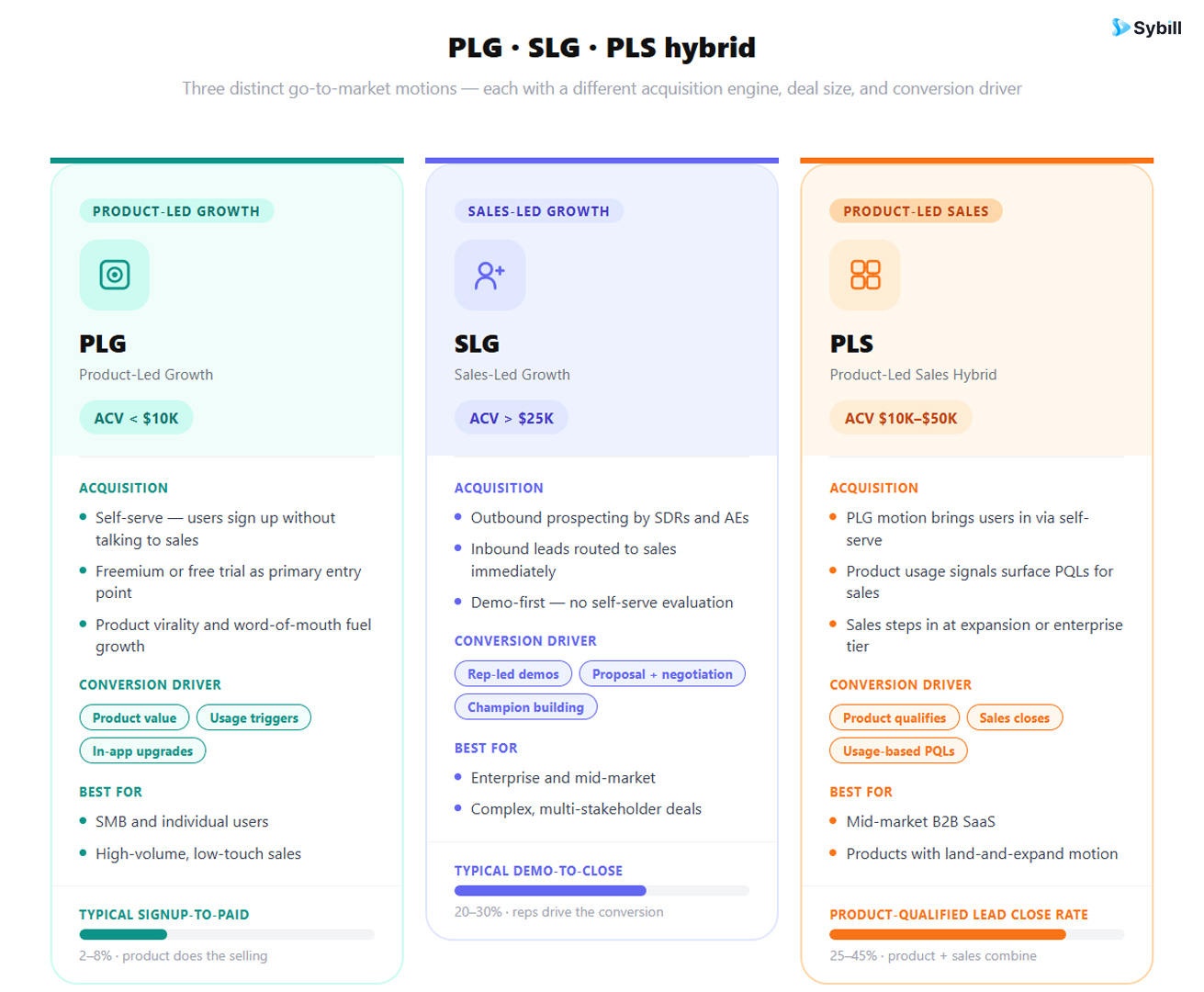
In a PLG motion, the product itself is the primary engine for acquisition, activation, and expansion. Users discover, try, and adopt the product before ever speaking to a salesperson. Revenue comes from self-serve conversions, usage-based upgrades, and expansion within accounts that started through the product experience.
PLG is the right fit when your product delivers clear value within minutes of signup, your ACV is under $10,000, individual users can adopt without organizational buy-in, and the product has natural viral or network-effect mechanics. Think Slack, Notion, Calendly, and Zoom.
PLG companies achieve 120%+ net revenue retention on average and significantly lower CAC than sales-led peers. The trade-off is that PLG requires substantial product and engineering investment in onboarding, activation, and self-serve upgrade flows. It also struggles with enterprise accounts where buying committees, procurement processes, and compliance requirements demand human-led engagement.
In a sales-led motion, a dedicated sales team drives growth through outbound prospecting, inbound qualification, demos, proposals, and negotiation. The salesperson guides the buyer through the entire purchase process.
SLG is the right fit when your product is complex and requires guided onboarding or customization, your ACV is above $25,000, the buying process involves multiple stakeholders and lengthy evaluation, and compliance, security, or integration requirements demand consultative conversations. Think Salesforce, Workday, and Snowflake.
Sales-led growth provides higher deal control, deeper customer relationships, and the ability to navigate complex buying committees. The trade-off is higher CAC, longer sales cycles (typically 90 to 180 days for mid-market, 180+ days for enterprise), and linear scaling that requires hiring more reps to grow revenue.
The hybrid model, increasingly called Product-Led Sales (PLS), combines PLG acquisition with sales-led expansion. Users enter through self-serve (free trial, freemium, or reverse trial), and sales teams engage when product usage signals indicate readiness for a larger deal.
PLS is the dominant motion for B2B SaaS in 2026. It works for ACV between $10,000 and $50,000, when your product serves both individual users and teams or departments, when self-serve adoption proves value but enterprise expansion requires human guidance, and when you want PLG efficiency for SMB segments with SLG depth for mid-market and enterprise. Think HubSpot, Figma, and Sybill.
The PLS model uses product-qualified leads (PQLs) rather than marketing-qualified leads (MQLs) to trigger sales engagement. A PQL is a user who has demonstrated meaningful product engagement: repeated logins, team invitations, feature depth usage, or hitting usage limits that signal upgrade readiness. This means sales teams focus on warm, informed buyers rather than cold prospects, which dramatically improves conversion rates and shortens sales cycles.
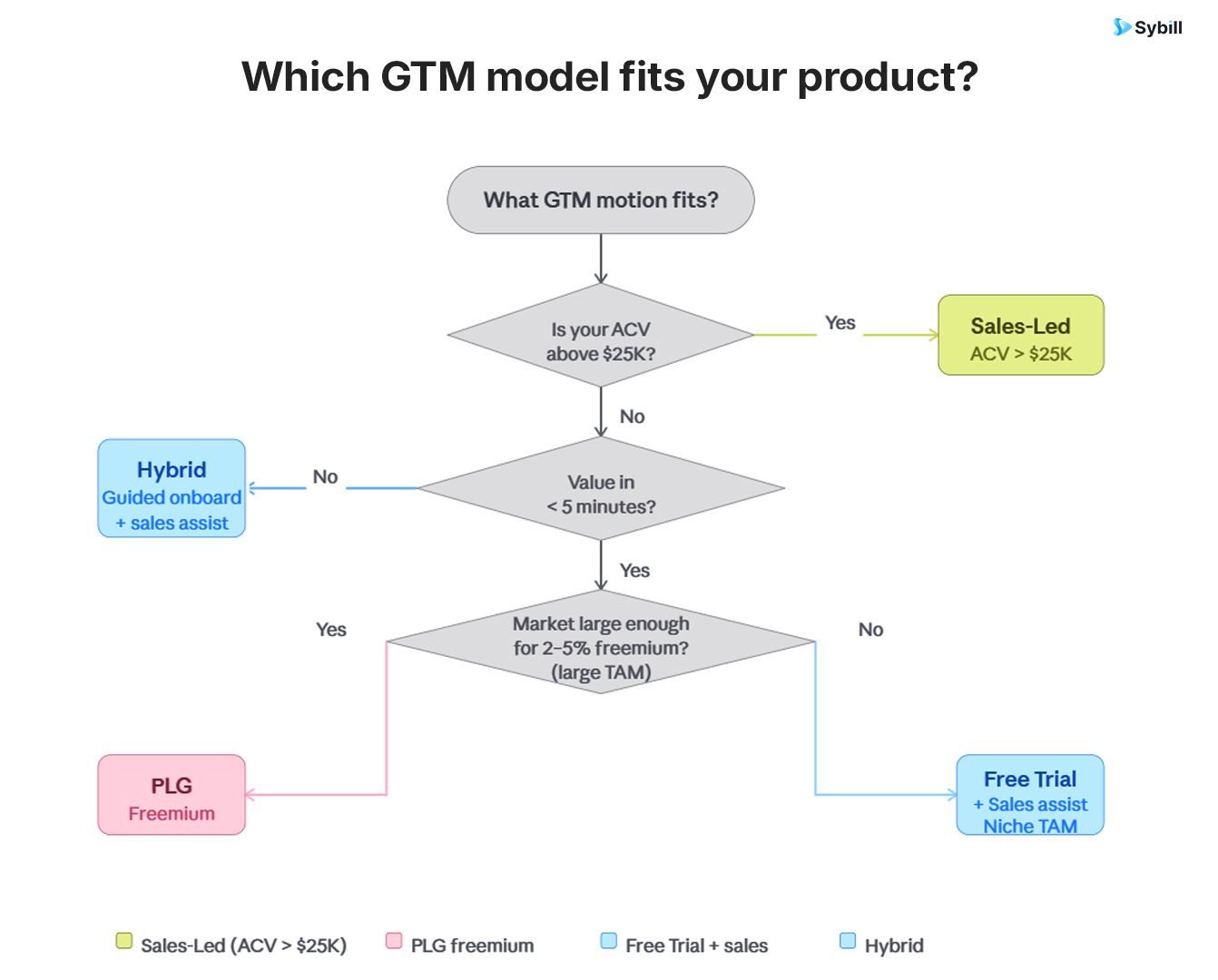
The choice between PLG, SLG, and hybrid is not philosophical. It is determined by four variables.
Average contract value. PLG for under $10K. Sales-led for above $25K. Hybrid for everything between. If your ACV does not justify a human-led sales cycle, you need PLG efficiency. If your ACV demands consultative engagement, you need a sales team. Most B2B SaaS companies fall in the middle.
Product complexity. Can a new user experience meaningful value within five minutes of signup? If yes, PLG is viable. If your product requires configuration, data integration, or role-based customization, sales assistance is needed. Products that have a simple core experience but complex advanced capabilities are natural fits for hybrid, where users self-serve into the core and sales assists the expansion.
Buyer profile. Individual users and small teams can self-serve. Buying committees with procurement processes, security reviews, and legal sign-off need sales guidance. If your product serves both audiences (individual contributors who adopt bottom-up and executives who buy top-down), hybrid captures both paths.
Go-to-market stage. Early-stage companies benefit from direct sales conversations that provide tight feedback loops for refining product-market fit. Once product-market fit is validated, layering in PLG extends reach without proportional headcount growth. Mature companies typically run both simultaneously with clear segmentation rules.
The entire PLG strategy revolves around one metric: time-to-value. How quickly can a new user experience the core benefit? Top-performing PLG companies get users to their first meaningful moment of value in under five minutes.
Onboarding is your sales team. Interactive walkthroughs, contextual tooltips, smart defaults, and progress indicators replace the AE's demo. Every friction point between signup and value realization is a conversion leak. Optimize relentlessly.
Activation triggers drive conversion. Identify the 2 to 3 in-product actions most correlated with paid conversion and design every onboarding flow to drive users toward them. For a conversation intelligence tool, the activation trigger might be recording the first call and seeing the AI-generated summary. For a CRM, it might be importing contacts and closing the first deal.
Usage signals replace lead scoring. Track product-qualified lead criteria: team size expansion, hitting feature limits, exploring premium-only capabilities, or exceeding usage thresholds. These behavioral signals are far more predictive than form fills and content downloads.
Viral mechanics compound growth. Collaboration features, sharing workflows, and team invitation flows turn each user into an acquisition channel. Slack grew because every team that adopted it invited other teams. Every product decision that makes sharing natural accelerates PLG.
Sales-led growth in 2026 is not about volume. It is about precision. The teams winning are not the ones sending the most emails. They are the ones who deeply understand their ICP, run highly targeted outreach, and execute flawlessly from discovery through close.
ICP clarity is non-negotiable. Define your ideal customer profile with firmographic, technographic, and behavioral specificity. "Mid-market SaaS companies" is not an ICP. "B2B SaaS companies with 50 to 200 employees, using Salesforce, with an SDR team of 5+, and annual revenue between $5M and $50M" is an ICP. Every dollar spent on outreach to non-ICP accounts is wasted.
Multi-threading wins enterprise deals. Single-threaded deals (one relationship with one contact) are the biggest risk in enterprise sales. Coach reps to build relationships with 3 to 5 stakeholders per opportunity: the champion, the economic buyer, the technical evaluator, and the end users. Sybill's deal workspace tracks stakeholder involvement across every deal, so managers can flag single-threaded risk before it becomes a lost deal.
Consultative selling outperforms feature pitching. Buyers in 2026 have already researched your product before the first call. They do not need a feature walkthrough. They need someone who understands their specific business context, asks sharp discovery questions, and positions the solution around their measurable pain. This approach builds trust and differentiates in a crowded market.
Follow-up speed is a competitive weapon. The window after a sales call is fragile. Momentum is real. Reps who send a personalized, context-rich follow-up within 30 minutes of a call close at significantly higher rates than those who follow up the next day (or never). Sybill automates this entirely: personalized follow-up emails are drafted in the rep's voice, referencing specific buyer concerns from the conversation, within minutes of the call ending.
The hybrid model only works when PLG and sales operate as a connected system, not two separate teams running parallel strategies.
Define clear handoff rules. At what point does a PLG user become a sales opportunity? Common triggers include exceeding a team size threshold, hitting a usage limit, requesting an enterprise feature, or engaging with premium pricing. Without clear rules, sales teams either cherry-pick easy conversions (undermining PLG) or ignore product-qualified leads (wasting the best pipeline source).
Sales-assist, not sales-replace. In a hybrid model, sales engagement should feel like a natural extension of the product experience, not a sudden gear shift into traditional selling. The rep who reaches out should reference the user's actual product behavior ("I noticed your team recorded 15 calls this week...") rather than running a cold discovery script.
Unified data is mandatory. Product usage data, CRM data, and conversation data must flow into a single view. If your sales team cannot see what a user did in the product before the first call, you have a data silo problem. This is where CRM automation and conversation intelligence bridge the gap.
AI is no longer a "nice to have" in SaaS sales strategy. It is the execution layer that makes every motion work better.
Post-call automation eliminates the admin tax. Sales reps spend less than 30% of their time selling. AI changes this ratio. After every call, Sybill automatically generates Magic Summaries, drafts personalized follow-up emails, updates 30+ CRM fields with structured deal data, and captures next steps and action items. Reps save 5 to 6 hours per week, which they can redirect to the selling activities that actually produce revenue.
Deal intelligence replaces guesswork. Ask Sybill gives managers instant answers to questions that previously required hours of manual pipeline review: "Which deals have no confirmed next steps?" "Where are competitors being mentioned?" "Which reps are struggling with pricing conversations?" This turns every pipeline review from an interrogation into a strategy session.
Coaching becomes data-driven and scalable. AI surfaces the specific coaching moments that matter most. Instead of reviewing random calls, managers can see cross-deal patterns: which reps skip discovery depth, who struggles with objection handling, where follow-ups are falling through. AI-powered coaching briefs make 1:1s more targeted and effective.
Forecasting reflects reality. When CRM data is automatically populated from actual conversations, forecasts stop being a fiction built on manual entries and start reflecting deal health based on real buyer engagement, sentiment, and commitment signals.
Generic metrics waste dashboards. Here are the ones that tell you whether your SaaS sales strategy is working.
LTV:CAC ratio. The single most important unit economics metric. Target 3:1 or higher. If your LTV:CAC is below 3:1, you are spending too much to acquire customers relative to their lifetime value, and your sales strategy needs structural changes, not tactical tweaks.
CAC payback period. How many months of revenue does it take to recover the cost of acquiring a customer? Target under 12 months. Companies with CAC payback over 18 months are typically scaling a broken motion.
Trial-to-paid conversion rate. For PLG and hybrid motions, this is the core efficiency metric. Opt-in trials should target 15 to 25%. Freemium should target 3 to 5% at minimum, with top performers reaching 6 to 8%. Sales-assisted freemium models can reach 10 to 15%.
Net revenue retention (NRR). The percentage of revenue retained from existing customers, including expansion and minus churn. Target 110%+ for healthy B2B SaaS, 120%+ for best-in-class. NRR above 100% means you grow even without acquiring new customers.
Sales cycle length. Track by segment. SMB should close in 30 to 45 days. Mid-market in 45 to 90 days. Enterprise in 90 to 180 days. If cycles are lengthening, your qualification, discovery, or follow-up process needs attention.
Pipeline coverage ratio. The ratio of total pipeline value to quota. Target 3x to 4x coverage. Below 3x coverage almost always results in a miss.
Win rate. Percentage of qualified opportunities that close. Track by source (inbound vs outbound vs PLG), by segment, and by rep. Declining win rates signal messaging, competitive, or qualification problems.
Scaling before proving the motion. Teams hire SDRs, buy outbound tools, and launch multi-channel campaigns before validating that their ICP is accurate, their messaging converts, and their unit economics are sustainable. Every dollar spent amplifies the problem when the motion is broken.
Choosing a motion based on competitors, not fundamentals. Your competitor's PLG success does not mean PLG is right for your product. Base the decision on your ACV, product complexity, and buyer profile.
Over-investing in acquisition, under-investing in retention. In SaaS, keeping and expanding existing customers is almost always more profitable than acquiring new ones. If your churn rate is above 5% annually, fixing retention is higher leverage than doubling your SDR team.
Misaligning sales and product. In PLG and hybrid motions, product and sales must share the same data, the same definitions of qualified leads, and the same handoff protocols. Misalignment is the number one cause of GTM failure.
Ignoring post-call execution. The best discovery call in the world is wasted if the follow-up is late, the CRM is not updated, and the next meeting is not scheduled. AI tools like Sybill exist specifically to close this execution gap so no deal loses momentum to admin overhead.
What is the best SaaS sales strategy in 2026?
The best SaaS sales strategy depends on your product, market, and stage. Product-led growth (PLG) works for simple products with ACV under $10K and fast time-to-value. Sales-led growth works for complex products with ACV above $25K and multi-stakeholder buying committees. Most B2B SaaS companies in 2026 use a hybrid model (product-led sales) that combines PLG acquisition for lower-ACV segments with sales-led expansion for larger accounts.
What is the difference between PLG and sales-led growth?
PLG uses the product as the primary acquisition and conversion engine. Users self-serve through free trials or freemium, and the product experience drives paid conversion. Sales-led growth uses a dedicated sales team to drive outreach, qualification, demos, and closing. PLG reduces CAC but requires significant product and engineering investment. Sales-led offers higher deal control but scales linearly with headcount.
What is product-led sales (PLS)?
Product-led sales is a hybrid model where users enter through self-serve (free trial or freemium), and sales teams engage when product usage signals indicate readiness for a larger deal. Sales engagement is triggered by product-qualified leads (PQLs) rather than marketing-qualified leads, which means reps engage warm, informed buyers rather than cold prospects. PLS is the dominant B2B SaaS motion in 2026 for companies with ACV between $10K and $50K.
How does AI improve SaaS sales execution?
AI eliminates the administrative burden that prevents reps from selling. Tools like Sybill automate post-call CRM updates, follow-up emails, meeting summaries, and deal documentation. AI also provides deal intelligence (which deals are at risk, where coaching is needed), forecasting accuracy, and personalized coaching insights at scale. The net effect is that reps spend more time on revenue-producing activities and less time on admin.
What metrics should I track for my SaaS sales strategy?
The most important metrics are LTV:CAC ratio (target 3:1+), CAC payback period (under 12 months), trial-to-paid conversion rate (15 to 25% for opt-in trials), net revenue retention (110%+), sales cycle length (by segment), pipeline coverage (3 to 4x), and win rate (by source). These metrics tell you whether your GTM motion is working or needs structural changes.
When should a SaaS company add a sales team to PLG?
Add sales when you see signals that self-serve conversion is leaving money on the table: larger teams signing up but not upgrading, enterprise-sized companies using the free tier, users requesting features only available on paid plans, or individual adoption growing but organizational purchasing not following. These signals indicate that a sales-assist layer can capture expansion revenue that PLG alone cannot convert.
The SaaS sales strategies winning in 2026 share three traits. They match the motion to the market (not to what a competitor does). They obsess over time-to-value (the fastest path from signup to "I need this"). And they use AI to close the execution gap between strategy and daily selling.
Whether you run PLG, sales-led, or hybrid, the execution fundamentals are the same. Reps need to spend more time selling and less time on admin. Pipeline data needs to reflect reality. Follow-ups need to be fast, personalized, and context-rich. Coaching needs to be specific and evidence-based.
Sybill handles all of this. It automates the admin work that eats selling time, keeps CRM data accurate without manual entry, drafts follow-ups grounded in actual conversations, and gives managers the intelligence to coach precisely and forecast confidently.
Get started for free with Sybill and build a SaaS sales strategy that compounds.
The best SaaS sales strategy depends on your product, market, and stage. Product-led growth (PLG) works for simple products with ACV under $10K and fast time-to-value. Sales-led growth works for complex products with ACV above $25K and multi-stakeholder buying committees. Most B2B SaaS companies in 2026 use a hybrid model (product-led sales) that combines PLG acquisition for lower-ACV segments with sales-led expansion for larger accounts.
PLG uses the product as the primary acquisition and conversion engine. Users self-serve through free trials or freemium, and the product experience drives paid conversion. Sales-led growth uses a dedicated sales team to drive outreach, qualification, demos, and closing. PLG reduces CAC but requires significant product and engineering investment. Sales-led offers higher deal control but scales linearly with headcount.
Product-led sales is a hybrid model where users enter through self-serve (free trial or freemium), and sales teams engage when product usage signals indicate readiness for a larger deal. Sales engagement is triggered by product-qualified leads (PQLs) rather than marketing-qualified leads, which means reps engage warm, informed buyers rather than cold prospects. PLS is the dominant B2B SaaS motion in 2026 for companies with ACV between $10K and $50K.