Find us at booth #83, join us for a harbor side happy hour, or catch Gorish’s talk.

Sept, 16-18 > Learn more

%20(1).avif)
Mamta Tainwala

March 26, 2026
Salesforce controls 23.8% of the global CRM market and is used by more than 80% of Fortune 500 companies. By almost every conventional measure, it is the market leader, and it has been for over two decades.
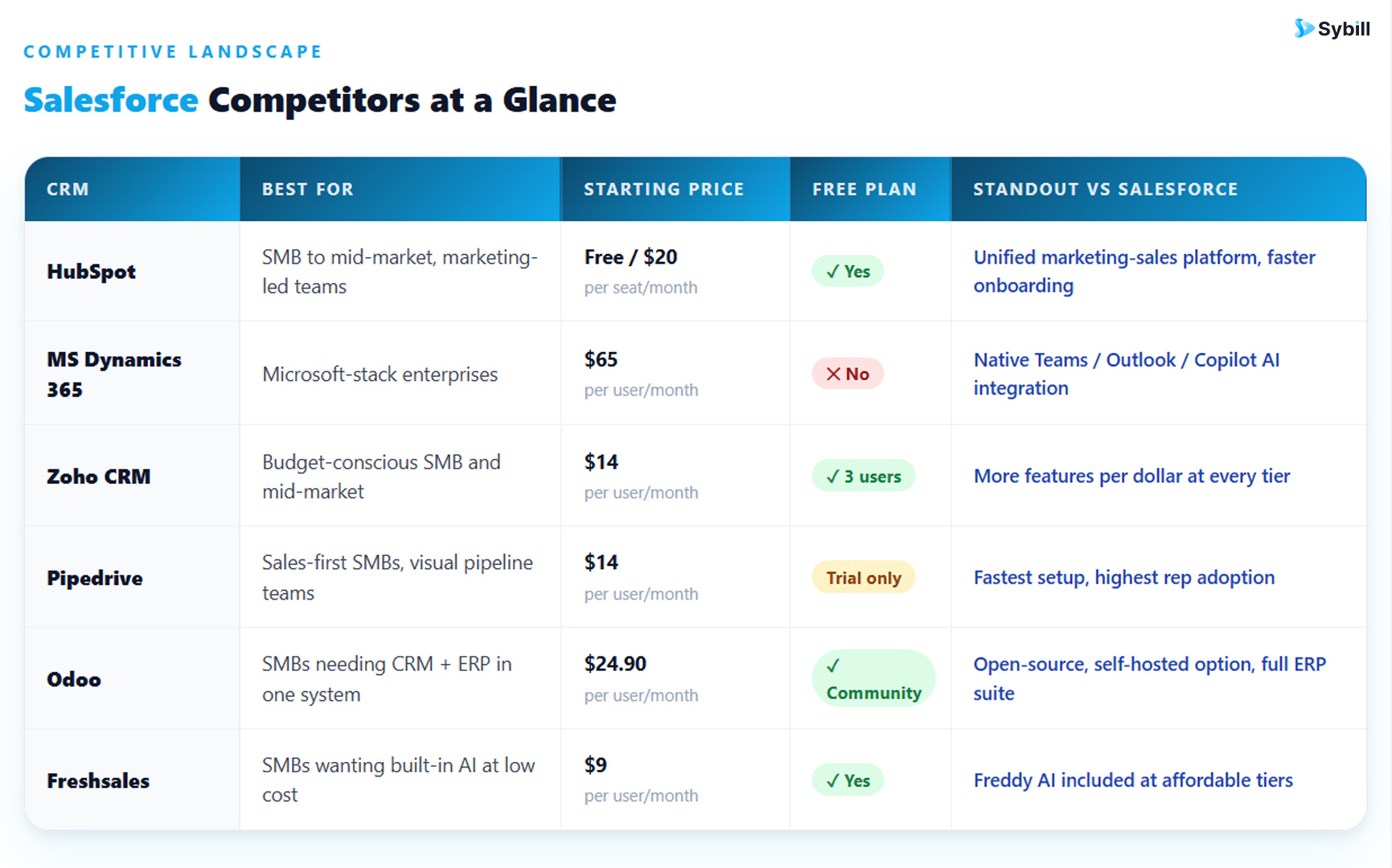
The six strongest Salesforce competitors for B2B sales teams in 2026 are HubSpot (best for marketing-led sales teams), Microsoft Dynamics 365 (best for Microsoft-stack enterprises), Zoho CRM (best for feature-rich affordability), Pipedrive (best for sales-first simplicity), Odoo (best for teams that need CRM plus operations), and Freshsales (best for AI-driven SMBs on a budget). Each addresses a specific gap in the Salesforce experience — whether that is cost, implementation speed, ease of use, or ecosystem fit.
And yet, every year, thousands of companies actively search for Salesforce competitors. Some are evaluating for the first time and want to know if the market leader is actually the right choice for their team. Others are mid-contract and already frustrated. Some are growing fast and wondering if they are paying for complexity they do not need. Others are specifically looking for platforms that integrate better with their existing Microsoft stack, cost less at their team size, or give their reps a better daily experience.
The honest answer is that Salesforce has serious, capable competitors in 2026. Several of them have closed the feature gap significantly, and for many companies, the right CRM is not Salesforce.
This guide covers the six strongest Salesforce competitors, what each one does better, where each one falls short, and how to decide which platform is actually right for your team.
Not every CRM is a Salesforce competitor in the meaningful sense. A Salesforce competitor has to be able to handle the full weight of a B2B sales operation: pipeline management, contact and account management, sales automation, reporting, AI features, integrations with the rest of your stack, and enough customization to fit your specific process rather than forcing your process to fit the tool.
The six platforms in this guide meet that bar. They are not lightweight alternatives. They are genuine options that sales leaders, RevOps teams, and buyers evaluate alongside Salesforce every day.
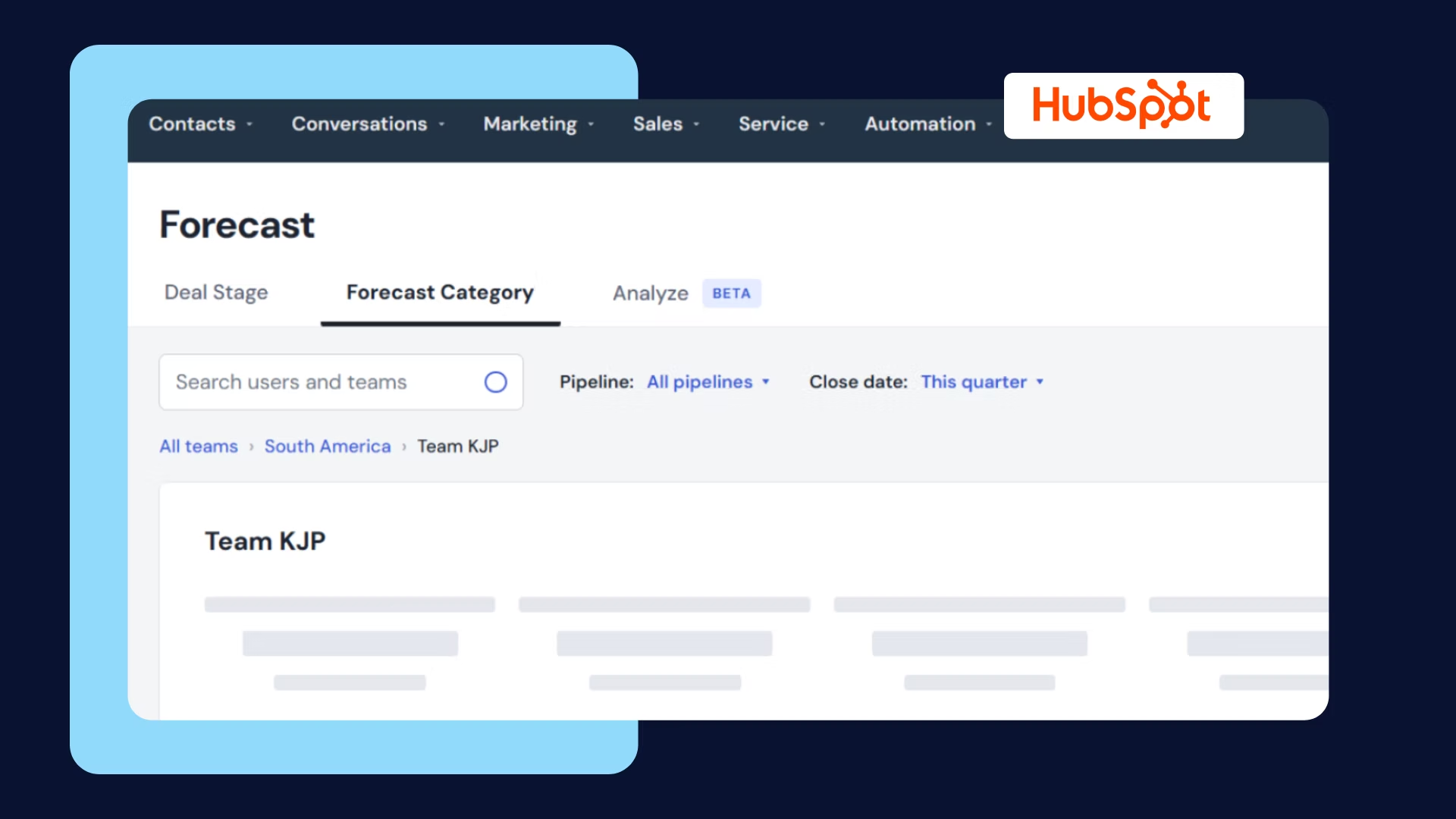
Why companies choose it over Salesforce: HubSpot was built on the premise that marketing and sales should operate from the same data in the same interface. Every contact interaction, from the first form fill to the closed deal, lives in a single record that both teams can see and act on. Salesforce can achieve the same outcome, but it requires purchasing Pardot or Marketing Cloud as separate products, building integrations, and maintaining data sync across multiple objects.
For growth-stage B2B companies where inbound marketing drives a meaningful share of pipeline, HubSpot eliminates an entire category of operational complexity. Its interface is also the most accessible of any CRM in this comparison, with guided onboarding and a learning curve that gets most reps productive in a day or two without dedicated training.
HubSpot's key advantages over Salesforce:
Where HubSpot falls short of Salesforce:
Bottom line: HubSpot is the strongest Salesforce competitor for companies where marketing and sales alignment, fast deployment, and accessible pricing matter more than maximum customization. For the best CRM fit for your business size and motion, HubSpot is typically the first alternative to evaluate seriously.
Why companies choose it over Salesforce: For organizations already running Microsoft 365, Teams, Azure, SharePoint, and LinkedIn, Microsoft Dynamics 365 Sales offers something Salesforce structurally cannot: a CRM that is native to the productivity suite your reps already live in every day.
Copilot for Sales runs directly inside Outlook. When a rep opens an email thread, Copilot surfaces the related opportunity, contact history, and CRM data alongside it. After a Teams meeting, Copilot generates a meeting summary, identifies action items, and updates the opportunity record automatically. Reps can ask natural-language questions about pipeline health without opening Dynamics at all. For organizations whose primary Salesforce complaint is that reps do not update it consistently, Dynamics 365 addresses the structural cause of that problem rather than adding more training.
Dynamics 365's key advantages over Salesforce:
Where Dynamics 365 falls short of Salesforce:
Bottom line: Dynamics 365 is the strongest Salesforce competitor for enterprises already committed to the Microsoft ecosystem. If your team lives in Teams and Outlook, Dynamics 365 removes the CRM friction that makes Salesforce adoption a persistent RevOps problem. Read the full Microsoft Dynamics 365 vs Salesforce comparison for a complete breakdown.
Why companies choose it over Salesforce: Zoho CRM consistently delivers more included features per dollar than any CRM in this comparison. The Enterprise plan at $40/user/month includes Zia AI, advanced automation through Blueprint and CommandCenter, Canvas interface customization, territory management, custom modules, and a feature set that legitimately rivals Salesforce Professional at less than a quarter of the price.
Zoho's AI assistant Zia adds lead scoring, deal closure predictions, email sentiment analysis, best-time-to-contact recommendations, and anomaly detection that flags when pipeline progression deviates from historical patterns. These are not premium add-ons. They are included in the Enterprise plan.
Zoho CRM's key advantages over Salesforce:
Where Zoho CRM falls short of Salesforce:
Bottom line: Zoho CRM is the strongest Salesforce competitor on value. For SMBs and mid-market teams that are paying for Salesforce features they do not fully use, Zoho delivers a comparable functional experience at a fraction of the cost. See the full Zoho CRM vs Salesforce comparison for a tier-by-tier breakdown.
Why companies choose it over Salesforce: Pipedrive was founded in 2010 by salespeople who were frustrated with CRMs built for managers and organizations rather than the reps who actually use them daily. That origin story is still visible in the product. Pipedrive is organized around a visual Kanban pipeline. Every deal is a card. Every stage is a column. The interface is built for the way salespeople actually think about their pipeline rather than the way their CRM system prefers to organize data.
Pipedrive sets up in two to three days. Reps get productive without training. And its pricing is the most transparent in this comparison, with most capabilities included in base plans without the add-on sprawl that inflates Salesforce's real cost.
Pipedrive's key advantages over Salesforce:
Where Pipedrive falls short of Salesforce:
Bottom line: Pipedrive is the strongest Salesforce competitor for lean, sales-driven teams that want maximum pipeline visibility, fast onboarding, and predictable pricing without enterprise-level complexity. For teams evaluating the full picture on Salesforce vs Pipedrive, the total cost of ownership comparison alone is often decisive.
Why companies choose it over Salesforce: Odoo is a different kind of Salesforce competitor. Where every other platform in this guide competes on CRM-specific features, Odoo competes on breadth. Its CRM module is genuinely capable, with a visual pipeline, AI-powered lead scoring, automated follow-up workflows, and integrated email marketing. But the reason companies choose Odoo over Salesforce is that it comes with 50-plus additional business applications: accounting, HR, inventory, manufacturing, project management, e-commerce, and more, all sharing the same data model and the same interface.
For companies that currently manage their CRM in Salesforce, their accounting in QuickBooks or NetSuite, their HR in a separate HRIS, and their project management in yet another tool, Odoo is a compelling case for consolidation. A won CRM deal can automatically trigger a sales order, an invoice, a delivery, and a project without any integration work.
Odoo is also the only platform in this comparison with a true self-hosted option. Organizations with strict data residency requirements or on-premises mandates can deploy Odoo on their own VPS, dedicated server, or Kubernetes cluster with full infrastructure control. Salesforce does not offer this.
Odoo's key advantages over Salesforce:
Where Odoo falls short of Salesforce:
Bottom line: Odoo is the strongest Salesforce competitor for companies that want CRM and operations in a single, affordable, unified system. For a complete feature-by-feature breakdown, see the Odoo vs Salesforce comparison.
Why companies choose it over Salesforce: Freshsales is gaining traction specifically because it makes enterprise-grade AI accessible at SMB pricing. Its Freddy AI assistant handles lead scoring, deal scoring, next-best-action suggestions, and contact enrichment starting at tiers where Salesforce's AI features are still locked behind multiple upgrade barriers.
Freshsales is built by Freshworks, which also makes Freshdesk for customer support and Freshmarketer for marketing automation. Teams that want a lightweight CRM ecosystem without Salesforce's implementation complexity or HubSpot's marketing-centric architecture often find Freshsales hits a practical sweet spot.
Freshsales' key advantages over Salesforce:
Where Freshsales falls short of Salesforce:
Bottom line: Freshsales is the strongest Salesforce competitor for SMBs that want Freddy AI-powered intelligence without paying for Salesforce's full platform. It is particularly compelling for teams that want built-in calling and email alongside their CRM without adding another tool.
Yes. HubSpot and Salesforce are direct competitors in the CRM market, and the HubSpot vs Salesforce decision is among the most common evaluation choices in B2B sales technology. The key distinction is positioning: Salesforce is primarily a CRM-first platform that has expanded into marketing, service, and analytics. HubSpot is primarily a marketing-first platform that has expanded into CRM and sales. Both now cover comparable feature territory. HubSpot typically wins on accessibility, unified marketing-sales data, and pricing transparency. Salesforce wins on customization depth, enterprise analytics, and AppExchange breadth. Read the full Salesforce vs HubSpot comparison for a complete side-by-side breakdown.
Yes. Microsoft Dynamics 365 and Salesforce are the two dominant enterprise CRM platforms globally and directly compete for the same large-enterprise buyer. The key distinction is ecosystem: Dynamics 365 is native to the Microsoft 365 environment and offers the strongest CRM-Copilot-Teams-Outlook integration available. Salesforce offers deeper CRM-specific customization and a broader third-party integration marketplace. For enterprises already running the Microsoft stack, Dynamics 365 is a more coherent long-term choice. For enterprises that need CRM-vendor independence and maximum AppExchange ecosystem coverage, Salesforce remains the benchmark.
Yes. Oracle offers Oracle CX (Customer Experience) Cloud, which competes with Salesforce at the enterprise level, particularly in industries where Oracle's ERP ecosystem is already in use, including manufacturing, financial services, and utilities. Oracle CX is less commonly evaluated by mid-market sales teams and is primarily relevant in procurement decisions where Oracle's broader enterprise software footprint creates a natural bundling advantage.
Partially. ServiceNow and Salesforce overlap primarily in customer service and IT service management use cases rather than pure sales CRM. Salesforce Service Cloud competes with ServiceNow's Customer Service Management module for organizations building omnichannel support operations. For sales CRM specifically, ServiceNow is not a direct Salesforce competitor. For enterprise customer service platform decisions, they compete directly.
Here is the thing that no CRM vendor, Salesforce or otherwise, puts in their marketing: all of these platforms are recording systems. Every single one. They store what your reps choose to enter. And in most organizations, what reps choose to enter is an abbreviated, end-of-day summary written from memory that captures maybe half of what actually happened on the call.
The budget signal mentioned once but phrased in a specific way that would have shaped the entire follow-up strategy. The procurement stakeholder referenced offhand. The competitor name that came up twice. The genuine implementation concern that the rep noted mentally but did not log because the next call was starting in three minutes.
None of that makes it into HubSpot, Dynamics 365, Zoho, Pipedrive, Odoo, Freshsales, or Salesforce automatically. Not one of them. Because not one of them was on the call when it happened.
This shared limitation is the root cause of the CRM data quality and hygiene problem that costs companies an estimated 12% of annual revenue in wasted time, bad forecasts, and missed follow-ups. It is why RevOps teams cite incomplete pipeline data as their top challenge regardless of which platform they are running. And it is why AI CRM use cases that capture conversation signals at the source, rather than depending on memory and manual entry, are where measurable pipeline accuracy improvements are actually being built in 2026.
Get started for free with Sybill and see what your pipeline data looks like when it reflects what actually happened in your deals rather than what was typed in at the end of the week.
Sybill integrates natively with Salesforce, HubSpot, Zoho CRM, and Microsoft Dynamics 365, and connects with Pipedrive and Odoo via Zapier. It works on top of whichever platform you choose, without migration or rearchitecting. It is not a CRM replacement. It is the conversation intelligence and automation layer that closes the data gap every CRM leaves open.
After every call and email, Sybill extracts what actually happened and writes it directly into your CRM. Pain points, objections, budget signals, decision-maker identity, MEDDPICC and BANT criteria, agreed next steps, and competitor mentions: all populated automatically, field by field, in human-sounding language, without the rep touching the CRM.
CRM Autofill eliminates post-call admin across every platform in this guide. Sybill auto-discovers your CRM fields, including custom ones, and populates them from the actual conversation. AEs on Sybill report saving four to six hours per week on CRM updates alone.
Magic Summary delivers a structured call debrief within minutes of every call ending. Outcome, buyer pain points, objections raised, next steps, and engagement signals: all structured and delivered to the rep's inbox before they have written their first word. Sales call transcripts stop being recordings nobody reviews and become action plans that drive the next step.
Ask Sybill is a natural-language querying interface across all your deals, calls, emails, and CRM data. Ask which accounts have gone quiet after the demo. Ask which deals have raised a pricing objection in the last 30 days. Ask which reps are most consistent at multi-stakeholder discovery. Answers in seconds, not after a report build. This is conversation intelligence software turning every sales meeting into searchable, structured deal intelligence.
Non-Verbal AI Analysis tracks body language and engagement signals on video calls, identifying which stakeholders in a buying committee are genuinely bought in and which are passive resistors. For complex B2B deals with multiple decision-makers, this capability shapes the entire follow-up and multithreading strategy.
Pre-Meeting Briefs are auto-generated before every call, pulling from full deal history, previous call summaries, and CRM context. Reps walk in prepared without 20 minutes of pre-call tab navigation.
AI Follow-Up Emails are one-click drafts in the rep's own voice, written specifically from what was discussed on the call. Not templates. Contextual emails that reference the actual conversation, delivered in seconds.
For sales managers and revenue leaders, Sybill generates rep-level coaching briefs, deal health snapshots, and automated pipeline reviews that give AI agents for sales managers the structured data they need to coach effectively rather than spending pipeline reviews chasing field completeness. For teams running MEDDPICC, BANT, or SPICED inside any of these platforms, Sybill enforces completeness at the source rather than at the end-of-week reminder.
This directly addresses the top challenges RevOps teams report across every platform in this guide: incomplete CRM data, unreliable forecasts, and excessive administrative burden. Sybill solves all three simultaneously, for any CRM, because the problem lives in the conversation layer that every CRM leaves manual.
For teams evaluating the best AI sales tools to layer on top of their CRM investment, Sybill delivers the post-call execution that makes whichever platform you choose actually work the way it was designed to.
Get started for free with Sybill and connect it to any CRM in this guide today.
Who are the main Salesforce competitors?
The six strongest Salesforce competitors in 2026 are HubSpot, Microsoft Dynamics 365, Zoho CRM, Pipedrive, Odoo, and Freshsales. HubSpot is the strongest alternative for marketing-led teams that want sales and marketing unified in one platform. Microsoft Dynamics 365 is the strongest alternative for organizations already running the Microsoft 365 ecosystem. Zoho CRM delivers the most features per dollar at every pricing tier. Pipedrive offers the fastest setup and highest rep adoption for sales-first teams. Odoo provides CRM plus full ERP in a single open-source platform. Freshsales brings AI-powered lead intelligence at SMB-friendly pricing.
What are the most popular Salesforce CRM competitors?
By market adoption and evaluation volume, the most commonly compared Salesforce CRM competitors are HubSpot and Microsoft Dynamics 365. HubSpot is evaluated most often by SMBs and growth-stage B2B companies. Dynamics 365 is evaluated most often by enterprises already running Microsoft 365. Zoho CRM is the most commonly chosen alternative among budget-conscious mid-market teams. Pipedrive is the most popular among lean, sales-driven teams prioritizing simplicity over feature depth.
Is HubSpot a Salesforce competitor?
Yes. HubSpot and Salesforce are direct CRM competitors and among the most frequently compared platforms in B2B sales technology. HubSpot started as a marketing automation company and added CRM in 2014. Salesforce started as CRM and expanded into marketing. Today both platforms cover comparable feature territory: pipeline management, sales automation, AI features, and multi-hub go-to-market functionality. HubSpot wins on accessibility, marketing-sales alignment, and pricing transparency. Salesforce wins on customization depth, enterprise analytics, and AppExchange ecosystem breadth. For the full comparison, see Salesforce vs HubSpot.
Are Oracle and Salesforce competitors?
Yes, at the enterprise level. Oracle CX Cloud competes with Salesforce Sales Cloud for large enterprise accounts, particularly in industries where Oracle's ERP ecosystem is already deployed. For mid-market B2B sales teams evaluating CRM, Oracle CX is not typically on the shortlist. The evaluation criteria at that scale differ significantly from the platforms compared in this guide.
Are Salesforce and ServiceNow competitors?
Partially. Salesforce and ServiceNow overlap in customer service and IT service management, where Salesforce Service Cloud competes with ServiceNow Customer Service Management. For sales CRM specifically, ServiceNow is not a direct Salesforce competitor. For enterprise customer service platform decisions, they compete directly. Organizations evaluating both are typically looking at customer-facing service automation rather than sales pipeline management.
What CRM is better than Salesforce for small businesses?
For most small businesses, HubSpot, Zoho CRM, or Pipedrive deliver a better value proposition than Salesforce. HubSpot's free CRM tier is genuinely useful and scales sensibly into paid plans. Zoho CRM's free plan and $14/user/month Standard tier include more features than Salesforce's $25/user/month entry plan. Pipedrive's visual pipeline and fast setup make it the most rep-friendly choice for small sales teams. Salesforce's complexity and implementation cost create overhead that most small businesses cannot capitalize on. The best CRM for small businesses is almost never Salesforce at the five to fifteen person stage.
What is the cheapest Salesforce alternative?
Zoho CRM offers the lowest paid pricing of any serious Salesforce competitor at $14/user/month for the Standard plan. Freshsales starts at $9/user/month. Both HubSpot and Zoho offer free plans for small teams. Odoo's Community edition is free and self-hosted. Pipedrive's Essential plan starts at $14/user/month. For teams where budget is the primary driver, Zoho CRM consistently delivers the strongest feature set at the lowest price point. However, the cheapest platform and the right platform are often different decisions. Total cost of ownership including implementation, training, and the cost of incomplete CRM data should factor into any platform decision.
Does Sybill work with Salesforce competitors?
Yes. Sybill integrates natively with Salesforce, HubSpot, Zoho CRM, and Microsoft Dynamics 365, and connects with Pipedrive and Odoo via Zapier. After every sales call and email, Sybill automatically populates CRM fields in any of these platforms with structured deal intelligence, including deal stage, next steps, qualification criteria, stakeholder identification, and objections, without manual data entry. Reps save four to six hours per week on CRM admin regardless of which platform they use. Read more about the best AI sales tools that work alongside CRM platforms to improve pipeline accuracy.
The six strongest Salesforce competitors in 2026 are HubSpot, Microsoft Dynamics 365, Zoho CRM, Pipedrive, Odoo, and Freshsales. HubSpot is the strongest alternative for marketing-led teams that want sales and marketing unified in one platform. Microsoft Dynamics 365 is the strongest alternative for organizations already running the Microsoft 365 ecosystem. Zoho CRM delivers the most features per dollar at every pricing tier. Pipedrive offers the fastest setup and highest rep adoption for sales-first teams. Odoo provides CRM plus full ERP in a single open-source platform. Freshsales brings AI-powered lead intelligence at SMB-friendly pricing.
By market adoption and evaluation volume, the most commonly compared Salesforce CRM competitors are HubSpot and Microsoft Dynamics 365. HubSpot is evaluated most often by SMBs and growth-stage B2B companies. Dynamics 365 is evaluated most often by enterprises already running Microsoft 365. Zoho CRM is the most commonly chosen alternative among budget-conscious mid-market teams. Pipedrive is the most popular among lean, sales-driven teams prioritizing simplicity over feature depth.
Yes. HubSpot and Salesforce are direct CRM competitors and among the most frequently compared platforms in B2B sales technology. HubSpot started as a marketing automation company and added CRM in 2014. Salesforce started as CRM and expanded into marketing. Today both platforms cover comparable feature territory: pipeline management, sales automation, AI features, and multi-hub go-to-market functionality. HubSpot wins on accessibility, marketing-sales alignment, and pricing transparency. Salesforce wins on customization depth, enterprise analytics, and AppExchange ecosystem breadth. For the full comparison, see Salesforce vs HubSpot.