Find us at booth #83, join us for a harbor side happy hour, or catch Gorish’s talk.

Sept, 16-18 > Learn more

%20(1).avif)
Mamta Tainwala

February 7, 2026
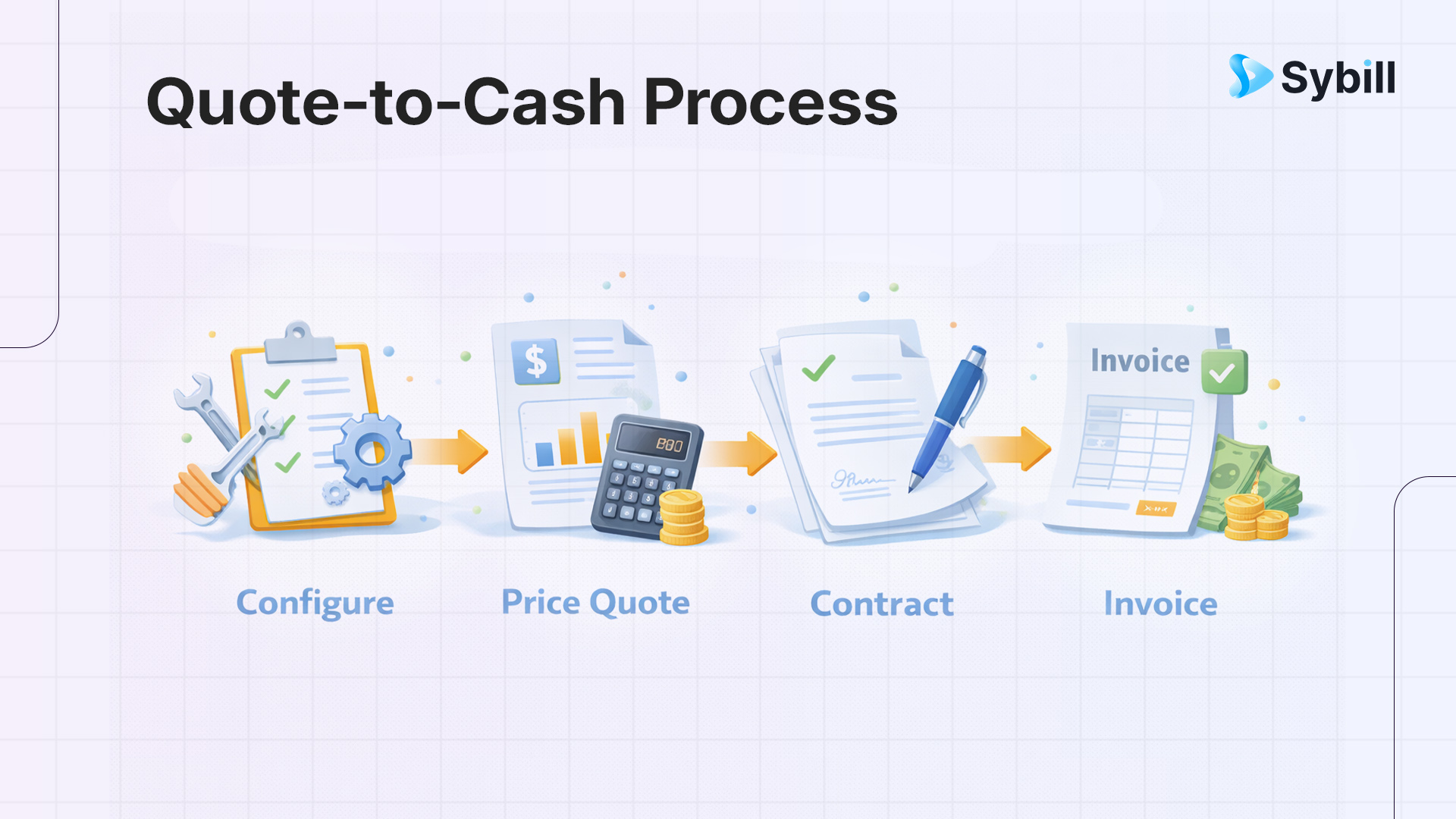
TL;DR: The quote-to-cash (Q2C) process covers everything from the moment a sales rep configures a product and sends a quote to the moment payment hits the bank. It includes CPQ (configure, price, quote), contract management, order fulfillment, invoicing, and revenue recognition. Most sales teams lose deals and leak revenue not because they lack a process, but because their Q2C stages are disconnected, manual, and riddled with handoff errors. This guide breaks down each stage of the quote-to-cash flow, highlights where revenue leakage happens, explains CPQ vs Q2C differences, and shows how to fix bottlenecks with smarter automation and AI-powered deal execution.
Everyone in a sales organization knows the goal is to close deals and collect revenue, but the actual process from "yes, I want a quote" to "yes, we received your payment" is often treated like a mystery nobody wants to diagram on a whiteboard.
That mystery has a name. It is called the quote-to-cash process. And if your sales team does not have a clear, repeatable, and well-automated version of it, you are probably leaving money, time, and sanity on the table.
The quote-to-cash cycle (sometimes abbreviated Q2C or QTC) is the end-to-end business process that connects a buyer's intent to purchase with a company's realization of revenue. It spans everything from product configuration and pricing to contract negotiation, order fulfillment, billing, payment collection, and renewal management. Within this broader lifecycle, CPQ (Configure, Price, Quote) handles the critical early stages where deals are shaped, priced, and presented to buyers.
Here is the thing: most content about quote-to-cash reads like a software brochure. It lists features, drops a few acronyms, and tells you to "streamline" things. This guide is different. I have broken down the entire Q2C process from a sales team's perspective, identified where things actually break down and cause revenue leakage, and included practical ways to make every stage faster and less painful.
Quote-to-cash is the sequence of steps that turns a prospect's buying interest into collected revenue. It sounds straightforward, but in practice, Q2C involves multiple teams (sales, finance, legal, operations), multiple systems (CRM, CPQ, ERP, billing), and multiple handoffs where things can go sideways.
The Q2C process matters to sales teams for a few specific reasons.
It directly impacts how fast you get paid. Delays in quoting, contract approvals, or invoicing mean delayed revenue. Every extra day in your Q2C cycle is a day your cash flow sits in limbo.
It determines quote accuracy. Pricing errors, misconfigured products, and unapproved discounts are not just embarrassing. They cause rework, erode margins, and damage buyer trust. Research shows CPQ software reduces the time required for product configuration by 28%, and teams using CPQ generate quotes up to 10x faster than manual methods.
It prevents revenue leakage. Revenue leakage happens when unbilled usage, missed renewals, pricing discrepancies, or manual errors cause your company to collect less than what was agreed upon. A tight Q2C process plugs these leaks.
It shapes the buyer experience. A clunky quoting process or a slow contract turnaround signals to your prospect that working with your company might always feel this painful. A tight Q2C process makes your organization look sharp and professional.
For sales reps, the Q2C process is personal. It is the difference between a deal that closes smoothly and one that dies in legal review because someone used an outdated pricing sheet. If you have ever lost a deal because approval took too long or a quote had errors, you have felt the pain of a broken quote-to-cash cycle firsthand.
The Q2C process has distinct stages, and understanding each one helps sales teams pinpoint where friction lives. Here is the complete flow.
Configuration is where a salesperson begins building a quote by selecting the products, features, bundles, and options that match the buyer's needs. For companies selling complex or customizable offerings, this step can be tricky. Without CPQ software, reps often dig through spreadsheets, outdated price lists, and product databases to piece together what they need.
CPQ tools like Salesforce CPQ, DealHub, and Oracle CPQ solve this by embedding product rules and constraints directly into the configuration engine. Guided selling features walk reps through a structured workflow, helping them ask the right questions and select the right products without requiring deep technical knowledge. This means reps cannot accidentally create invalid combinations, and they can build quotes in minutes instead of hours.
This stage matters for deal velocity. The faster a rep can configure an accurate solution, the faster the quote reaches the buyer. Research shows that custom quotations generated in minutes increase the likelihood of qualifying a lead by 21 times compared to slower manual processes.
If your reps are spending more time building quotes than having conversations with buyers, that is a configuration problem. Tools like Sybill's AI-powered CRM autofill ensure that data from discovery calls feeds directly into the systems reps use for configuration, reducing the manual research required before a quote even starts.
Once the product or service is configured, the next step is pricing. This involves applying the correct price lists, discount structures, volume tiers, promotional rates, and any negotiated terms specific to the deal.
Pricing is where revenue leakage often begins. When reps rely on outdated price sheets or apply discounts inconsistently, the margin impact adds up fast. CPQ software centralizes all pricing rules, discount approval workflows, and promotional logic in one place, ensuring every quote reflects current and accurate pricing.
For sales teams, accurate pricing also builds trust. Nobody wants to send a quote, have the buyer accept it, and then discover that the pricing was wrong.
With configuration and pricing locked in, the CPQ system generates a professional, customer-facing quote document. This typically includes product details, specifications, pricing breakdowns, terms and conditions, and any relevant visualizations or technical specs.
The quality of this document matters. A polished, detailed quote signals competence and attention to detail. CPQ tools automate quote generation, ensuring consistency and accuracy across every document your team sends out.
Pro tip: The insights captured during discovery calls feed directly into how effective your quotes are. If you are using tools like Sybill that generate magic summaries from every conversation, your quoting process can reference actual buyer priorities and pain points, not just generic product descriptions.
After the buyer reviews the quote, the deal moves into contract negotiation. This is where legal teams, procurement, and sometimes multiple stakeholders weigh in on terms, conditions, SLAs, and payment schedules.
Contract management is notorious for slowing down deals. Approvals get stuck in someone's inbox. Redlines go back and forth. Legal has questions about a clause from three revisions ago.
Automated approval workflows help by routing contracts to the right people at the right time, with full visibility into where things stand. Integration between CPQ and contract management systems ensures that whatever was quoted carries through accurately, eliminating the manual re-entry that introduces errors.
This is also where having a clear record of everything discussed during the sales cycle becomes invaluable. When legal asks "did the customer agree to these terms verbally?", having detailed call summaries and deal context can save days of back-and-forth.
Once the contract is signed, the order needs to be processed. This involves transferring all deal details from the sales system (CRM/CPQ) to the order management and fulfillment teams. Product specs, pricing, delivery requirements, and special instructions all need to flow cleanly from one system to another.
When this handoff is manual, errors multiply. Wrong quantities, incorrect configurations, missed delivery instructions. These problems create downstream issues that affect customer satisfaction and your team's credibility.
Integration between CPQ, CRM, and ERP systems (like NetSuite or SAP) is what makes this stage work. When data flows automatically, what was quoted is what gets ordered, produced, and delivered.
After the order is fulfilled, invoices are generated. Accurate billing depends on the integrity of every upstream stage. If the quote had the wrong pricing, or the contract terms were not properly captured, the invoice will reflect those errors.
Automated billing systems that integrate with platforms like Stripe, Chargebee, or NetSuite pull directly from the Q2C data chain, eliminating guesswork. Discounts, billing timeframes, payment terms, and product details all transfer automatically.
For SaaS companies with recurring revenue models, billing complexity increases with subscription tiers, usage-based pricing, and renewal cycles. A well-integrated Q2C system handles all of this without requiring your finance team to manually reconcile every invoice.
The final stage is collecting payment, recognizing revenue accurately, and managing renewals. Revenue recognition has real compliance implications (think ASC 606). When contract terms, pricing, and delivery schedules are accessible and accurate throughout the Q2C process, your accounting team can recognize revenue correctly and on time.
For subscription and SaaS businesses, this stage also includes renewal management. Tracking contract end dates, triggering renewal workflows, and identifying upsell opportunities are all part of a mature Q2C process. Missed renewals are one of the most common sources of revenue leakage in recurring revenue businesses.
Automated payment reminders and collection workflows improve cash flow and reduce the administrative burden on your finance team.
A common question is: what is the difference between CPQ and quote-to-cash? Here is the simplest way to think about it.
CPQ is a component of the quote-to-cash process. CPQ handles the front end, specifically the configuration, pricing, and quoting stages. Quote-to-cash is the entire lifecycle from that initial quote all the way through to payment collection, revenue recognition, and renewals.
Think of it like ordering at a restaurant. CPQ is writing the order and handing it to the kitchen. Q2C is everything: cooking the food, serving it, collecting the check, and making sure the customer comes back next week with a loyalty discount.
There is also a related term worth knowing: order-to-cash. This narrower process picks up after the quote is accepted and the contract is signed. It covers fulfillment, invoicing, and payment. So the hierarchy looks like this: CPQ sits within Q2C, and order-to-cash overlaps with the later stages of Q2C.
For sales teams, the key takeaway is this: optimizing CPQ alone is not enough. If your contracts take three weeks to get approved, or your invoices go out with wrong amounts, a faster quoting tool will not save your revenue cycle.
Choosing between CPQ and a full Q2C solution depends on where your biggest pain points live. Here are a few diagnostic questions to ask:
When to combine CPQ and Q2C: High-performing teams that deal with significant quote volume and complex deal structures typically use both. A common architecture looks like this: your CRM (Salesforce, HubSpot) feeds into a CPQ tool (Salesforce CPQ, DealHub), which pushes deal details into a billing and ERP system (Stripe, NetSuite, Chargebee). The Q2C layer connects all of these into a single workflow so handoffs do not require manual intervention.
The mistake most teams make is optimizing just one piece. They invest in a great CPQ tool but leave the contract-to-billing handoff completely manual. Or they automate billing but the quotes feeding into the system are full of errors because there is no CPQ discipline upstream. The whole chain matters.
And before any of these systems can work well, the data flowing into them needs to be accurate. This is where the quality of your sales interactions matters. If a rep runs a strong discovery call and captures every buyer detail, tools like Sybill that automatically update over 30 CRM fields after every interaction ensure that the data feeding your CPQ and Q2C systems is clean from the start.
Let us get honest about where most Q2C processes fall apart. The problems are predictable, and the fixes are achievable.
Sales uses the CRM. Finance uses the ERP. Legal uses a contract management tool. Operations has its own order system. None of these talk to each other natively, so data gets re-entered, copied, and pasted across platforms. Every manual touchpoint is an opportunity for errors and revenue leakage.
The fix: Invest in integrations that create a continuous data flow from CPQ through contract management, order fulfillment, and billing. The data entered at the configuration stage should carry through the entire process without anyone retyping it.
Maintaining clean CRM data from the very first interaction pays dividends here. When your CRM is accurate and complete from day one, every downstream system inherits that accuracy.
Deals die in approval queues. Discount approvals, legal reviews, and executive sign-offs can add days or weeks to your sales cycle. The culprit is usually a lack of automated workflows and unclear escalation paths.
The fix: Build automated approval workflows with clear rules. For example: discounts under 15% are auto-approved, discounts between 15-25% require a manager, and anything above 25% goes to the VP. CPQ tools can enforce these rules automatically, routing approvals and tracking where things stand in real time.
A quote is sent. Then silence. The buyer has questions, but the rep is juggling 30 other deals and does not follow up for a week. By then, the buyer has talked to a competitor.
The fix: This is not a CPQ problem. It is a deal execution problem. Sales teams need systems that automatically track follow-ups and next steps after every buyer interaction. Sybill's AI-generated follow-up emails address this directly by drafting personalized follow-ups immediately after every call, so the gap between "we sent the quote" and "we checked in on the quote" shrinks dramatically.
Get started with Sybill for free and see how AI can keep your deals moving through every stage of the revenue cycle.
When a deal moves from sales to fulfillment, critical context often gets lost. The specific things a buyer requested during discovery, the nuances of pricing discussions, delivery preferences mentioned in passing. None of this makes it into the order management system because it lives in a rep's head or scattered meeting notes.
The fix: Capture deal context automatically throughout the sales process. When every call, email, and interaction is summarized and stored in a structured way, handoffs become seamless. Sybill's deal workspace centralizes all deal activity, giving every team a single source of truth.
A rep offers a discount that was never approved. A product is priced using last quarter's rate card. A bundle discount is applied incorrectly. A renewal is missed entirely. These errors are more common than anyone in sales leadership wants to admit, and they are one of the biggest sources of revenue leakage.
The fix: CPQ software with enforced pricing guardrails. When discount limits, approval thresholds, and current pricing are built into the system, reps literally cannot send out a quote with unauthorized pricing. For renewals, automated tracking and alerts ensure no contract expires without a conversation.
For teams that think visually, here is the standard Q2C process laid out in 10 steps:
Each of these steps involves different teams, systems, and potential friction points. The organizations that execute Q2C well treat it as a single connected workflow rather than ten separate activities managed by ten separate departments.
The traditional Q2C process relies heavily on human diligence. Reps need to remember to follow up. Managers need to manually approve discounts. Finance needs to cross-check invoices against contracts. The problem with relying on human diligence at scale is that humans get busy, distracted, and overwhelmed.
AI is changing this in tangible ways across the Q2C lifecycle.
The quality of a quote depends entirely on the quality of the discovery that precedes it. If a rep does not fully understand the buyer's needs, the configuration will be off, the pricing will miss the mark, and the deal will stall.
AI tools that analyze sales conversations surface buyer needs, pain points, and priorities automatically. Instead of relying on a rep's memory to populate a quote, teams can pull insights directly from call transcripts and deal summaries. Sybill's pre-call briefs and meeting summaries ensure reps walk into every interaction prepared and that insights from every conversation feed directly into the quoting process.
A broken Q2C process often traces back to bad CRM data. When reps do not log deal details, update stages, or record buyer requirements, every downstream system suffers. The configuration is guesswork. The contract misses key terms. The invoice does not match what was discussed.
AI-powered CRM automation eliminates this. Sybill automatically updates CRM fields after every call and email, capturing details like budget, timeline, decision-makers, next steps, and competitive landscape. The data feeding your CPQ and contract systems stays current and accurate without reps doing manual entry.
When a deal is stuck in the approval process, the question is usually "what is the context?" Why is the discount needed? What is the competitive situation? What is the buyer's timeline?
AI tools that provide deal-level insights give approvers the context they need to make fast decisions. Instead of pinging the rep on Slack and waiting for a response, an approver can review the AI-generated deal summary and approve (or push back) in minutes.
The Q2C process feeds directly into revenue forecasting and cash flow planning. When your Q2C data is clean and your pipeline reflects reality, sales forecasting becomes dramatically more accurate.
AI-driven forecasting tools analyze not just deal stages, but buyer behavior, engagement patterns, and historical win/loss data to predict outcomes with greater precision. This means finance teams can plan cash flow more effectively, and leadership can make better strategic decisions.
You cannot improve what you do not measure. Here are the metrics that matter most across the Q2C cycle.
Quote volume: How many quotes does your team generate per period? Trends here indicate rep productivity and demand.
Quote-to-close conversion rate: What percentage of quotes turn into closed deals? Low conversion suggests pricing issues, poor qualification, or competitive weakness. Running a thorough win/loss analysis can help identify root causes.
Sales cycle length: How many days from quote creation to deal closure? This is one of the most important Q2C efficiency metrics.
Average deal size: Are deals getting larger or smaller? This indicates whether your pricing and configuration approach is optimizing for value.
Quote error rate: How often do quotes need revision due to configuration or pricing mistakes?
Contract turnaround time: How long from quote acceptance to signed contract?
Days sales outstanding (DSO): How quickly are you collecting payment after invoicing?
Renewal rate: What percentage of contracts renew on time? Low renewal rates point to revenue leakage in the final Q2C stage.
If your current Q2C process feels messy, here is a practical framework for improvement.
Step 1: Map your current process. Document how deals actually flow from quote to cash today. Not how they are supposed to flow, but how they actually flow. Interview reps, managers, operations, and finance. You will find the gaps quickly.
Step 2: Identify the biggest bottleneck. Is it quoting speed? Approval delays? CRM data quality? Contract negotiations? Pick the one that causes the most friction and focus there first.
Step 3: Automate the repetitive stuff. CRM data entry, follow-up emails, quote generation, approval routing. These are tasks that should not require manual effort in 2026. Tools that handle personalized email follow-ups and sales task automation free reps to focus on selling.
Step 4: Connect your systems. Your CRM, CPQ, contract management, ERP, and billing platforms should share data seamlessly. If they do not, you will always have accuracy problems downstream.
Step 5: Measure and iterate. Set up dashboards tracking the KPIs listed above. Review them monthly. The sales pipeline management discipline that keeps deals moving also applies to process improvement.
Here is something that most Q2C content overlooks: the quality of your quote-to-cash process depends on the quality of your sales execution. You can have the best CPQ software on the planet, but if your reps are not running strong discovery calls, if follow-ups are inconsistent, if deal context gets lost between interactions, then your Q2C process will underperform.
This is why tools focused on sales coaching and deal execution are just as important to Q2C success as the CPQ and billing tools that handle the transactional stages.
Think about it this way: if a rep runs a strong discovery call and captures every detail (buyer's specific needs, budget parameters, timeline, decision-making structure), then the quote can be configured precisely, priced correctly, and delivered quickly. If the rep runs a mediocre call and logs nothing, the entire Q2C process starts on shaky ground.
Sybill exists at this intersection. It is not a CPQ tool or a billing platform. It is an AI sales assistant that ensures every interaction produces actionable intelligence that flows into your CRM, your deal strategy, and your quote-to-cash process. From BANT and MEDDPICC qualification data captured automatically to deal risk detection that helps managers intervene before a deal goes sideways, Sybill addresses the upstream execution that makes downstream Q2C stages work.
The difference between average and excellent Q2C execution comes down to a few key practices.
They treat Q2C as a revenue team problem, not a sales problem. The best organizations have sales, finance, legal, and operations aligned around shared Q2C metrics and workflows. Revenue operations alignment is not a buzzword here. It is the operating model.
They invest in buyer experience, not just internal efficiency. A fast quoting process means nothing if the quote itself does not speak to the buyer's specific needs. Best-in-class teams use insights from every conversation to personalize every document, proposal, and follow-up.
They close the feedback loop. When a deal is won or lost, they analyze why and feed those insights back into the Q2C process. Was the pricing competitive? Did the contract terms cause friction? This kind of continuous win/loss analysis separates elite revenue cycle management from the "we have a process on paper" crowd.
They use AI to eliminate the mundane. Manual CRM updates, generic follow-ups, context-free handoffs. These are the silent killers of Q2C efficiency. Research suggests that sales reps spend only 28% of their week actually selling. AI tools like Sybill help reclaim that time by automating the other 72%.
Get started with Sybill for free and turn every sales interaction into fuel for a faster, cleaner quote-to-cash process.
CPQ (Configure, Price, Quote) handles the quoting stage. Quote-to-cash (Q2C) covers the entire lifecycle from quoting through revenue collection. CPQ focuses on product configuration, pricing rules, and quote generation. Q2C extends beyond that to include contract management, order fulfillment, billing, payment collection, revenue recognition, and renewals. CPQ is a critical component within the broader Q2C workflow.
Bottlenecks at any Q2C stage add days or weeks to your sales cycle. Teams using CPQ software take up to 73% less time generating quotes compared to manual processes. But quoting is just one piece. Automated contract workflows, integrated order management, and AI-driven follow-ups each contribute to shortening the total time from first quote to collected payment.
Yes. Much of Q2C friction lives in the handoffs and execution gaps between stages, not just in quoting. AI tools like Sybill improve Q2C by automating CRM data entry, generating instant follow-up emails, providing deal intelligence for faster approvals, and surfacing buyer insights that improve quote accuracy from the start.
CPQ (Configure, Price, Quote) handles the quoting stage. Quote-to-cash (Q2C) covers the entire lifecycle from quoting through revenue collection. CPQ focuses on product configuration, pricing rules, and quote generation. Q2C extends beyond that to include contract management, order fulfillment, billing, payment collection, revenue recognition, and renewals. CPQ is a critical component within the broader Q2C workflow.
Bottlenecks at any Q2C stage add days or weeks to your sales cycle. Teams using CPQ software take up to 73% less time generating quotes compared to manual processes. But quoting is just one piece. Automated contract workflows, integrated order management, and AI-driven follow-ups each contribute to shortening the total time from first quote to collected payment.
Yes. Much of Q2C friction lives in the handoffs and execution gaps between stages, not just in quoting. AI tools like Sybill improve Q2C by automating CRM data entry, generating instant follow-up emails, providing deal intelligence for faster approvals, and surfacing buyer insights that improve quote accuracy from the start.