
Find us at booth #83, join us for a harbor side happy hour, or catch Gorish’s talk.

Sept, 16-18 > Learn more


Tamanna Mishra

March 20, 2026
Every B2B company runs QBRs.
But ask ten sales leaders what a QBR actually is, and you will probably hear ten different answers.
For some teams, the quarterly business review is simply a slide deck full of metrics.
For others, it is a quick customer check-in call.
And for a few unfortunate teams, it is the awkward meeting everyone survives before the renewal discussion begins.
High-performing companies see QBRs very differently.
They treat the QBR as the moment where you:
Those conversations matter more than ever today.
Because modern SaaS growth does not only happen during the sale. It happens in the conversations that follow.
And the quarterly business review is the most important conversation of the quarter.
In this guide, we will break down:
Also read:
Let us start with the basics.
A QBR, or quarterly business review, is a strategic meeting held every three months between a company and its customer to evaluate progress, measure value delivered, and align on priorities for the next quarter.
These meetings are typically led by account managers, customer success leaders, or revenue teams. The goal is not just to present performance metrics. It is to connect those metrics to business outcomes.
In simple terms, a QBR answers three critical questions:
A strong quarterly business review helps organizations:
The most important thing to understand is that a QBR is not a reporting meeting.
It is a strategic alignment conversation.
When run well, it keeps both sides focused on business outcomes instead of product features.
Understanding the definition of a QBR is easy. Running a great one is where most teams struggle.
The importance of the quarterly business review has increased dramatically over the last decade.
Modern SaaS and B2B revenue models depend heavily on:
In many companies, most revenue growth now comes from existing customers rather than new ones.
Reports suggest that most B2B buying decisions involve 6–10 stakeholders across different departments.
That complexity creates a challenge.
Without regular strategic conversations, it becomes easy for stakeholders to lose alignment.
Customers forget the value they originally expected.
Product adoption slows.
Priorities shift without discussion.
The quarterly business review prevents that drift.
It gives both teams a structured moment to step back, review progress, and ensure the partnership is still moving in the right direction.
Done well, QBRs transform customer relationships from transactional to strategic.
Even though QBRs are widely used, many organizations run them poorly.
Here are the most common mistakes.
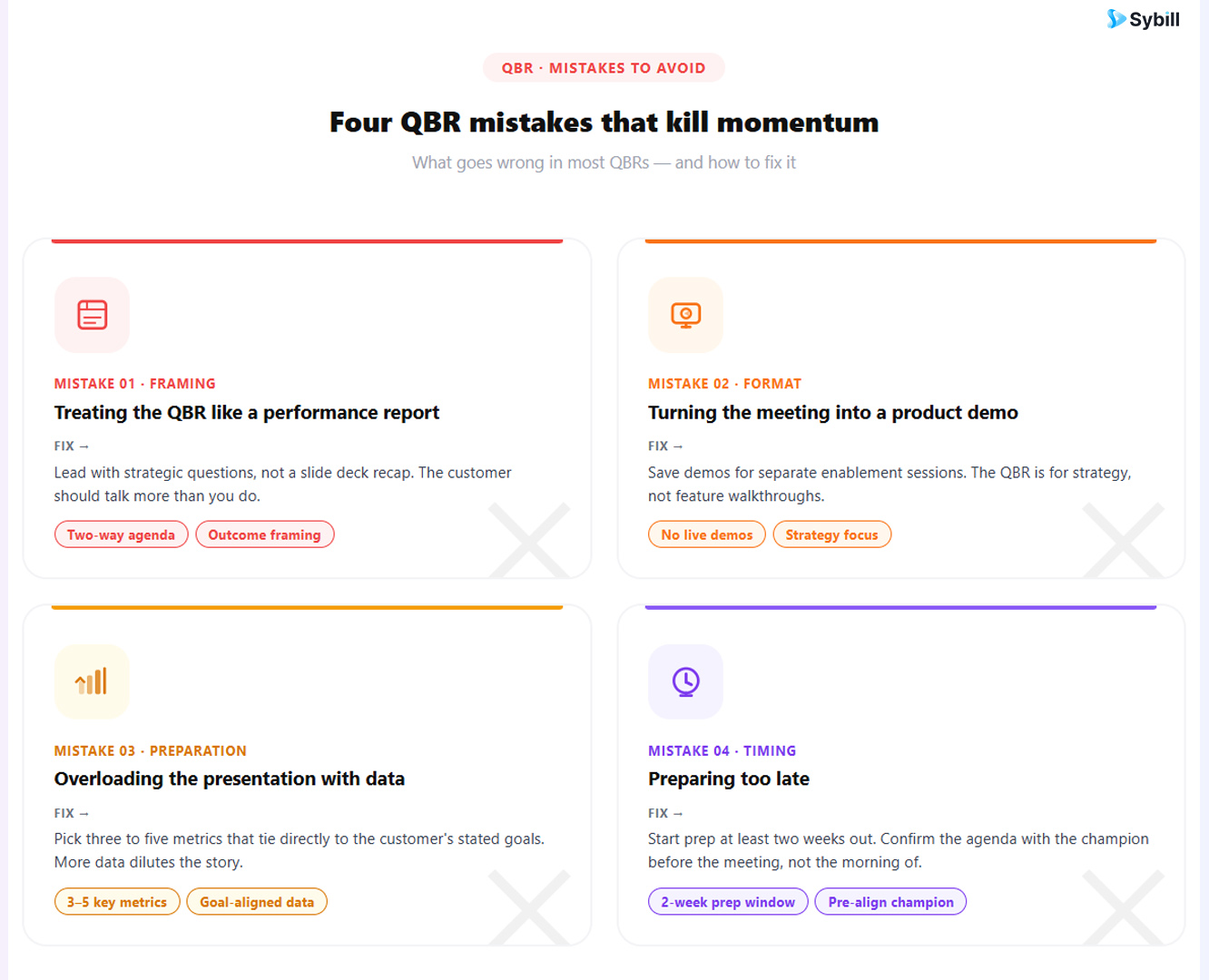
Many teams approach the QBR as a presentation of metrics.
They walk through dashboards, charts, and usage reports.
But customers rarely care about raw numbers.
They care about outcomes.
Another common mistake is focusing heavily on product features.
While product updates can be useful, the core question in a QBR should always be:
How is this helping the customer achieve their business goals?
Executives do not want to analyze dozens of charts.
They want insights.
A good quarterly business review translates data into meaning.
Without proper preparation, QBRs become reactive conversations.
Teams scramble to assemble slides at the last minute and miss key insights that could have shaped the discussion.
Avoiding these mistakes requires structure.
That is where a clear QBR framework becomes essential.
Running a strong quarterly business review does not require a complicated playbook. It requires a clear process.
Here is a simple framework that many high-performing teams follow.

Start by revisiting the customer’s strategic objectives.
Have their priorities changed?
Are the original goals still relevant?
Alignment at the beginning of the meeting ensures the rest of the discussion stays focused.
Next, evaluate what happened during the past quarter.
This includes:
The focus should always remain on business impact rather than product usage alone.
Product adoption often reveals the real story behind account health.
Review:
This helps identify both opportunities and potential risks.
Every partnership encounters obstacles.
A good QBR openly addresses:
Early visibility allows teams to resolve issues before they escalate.
The meeting should always end with a clear plan.
Both teams should leave with:
A strong quarterly business review always answers one final question:
What happens next?
While every company structures QBRs differently, most successful meetings follow a similar flow.
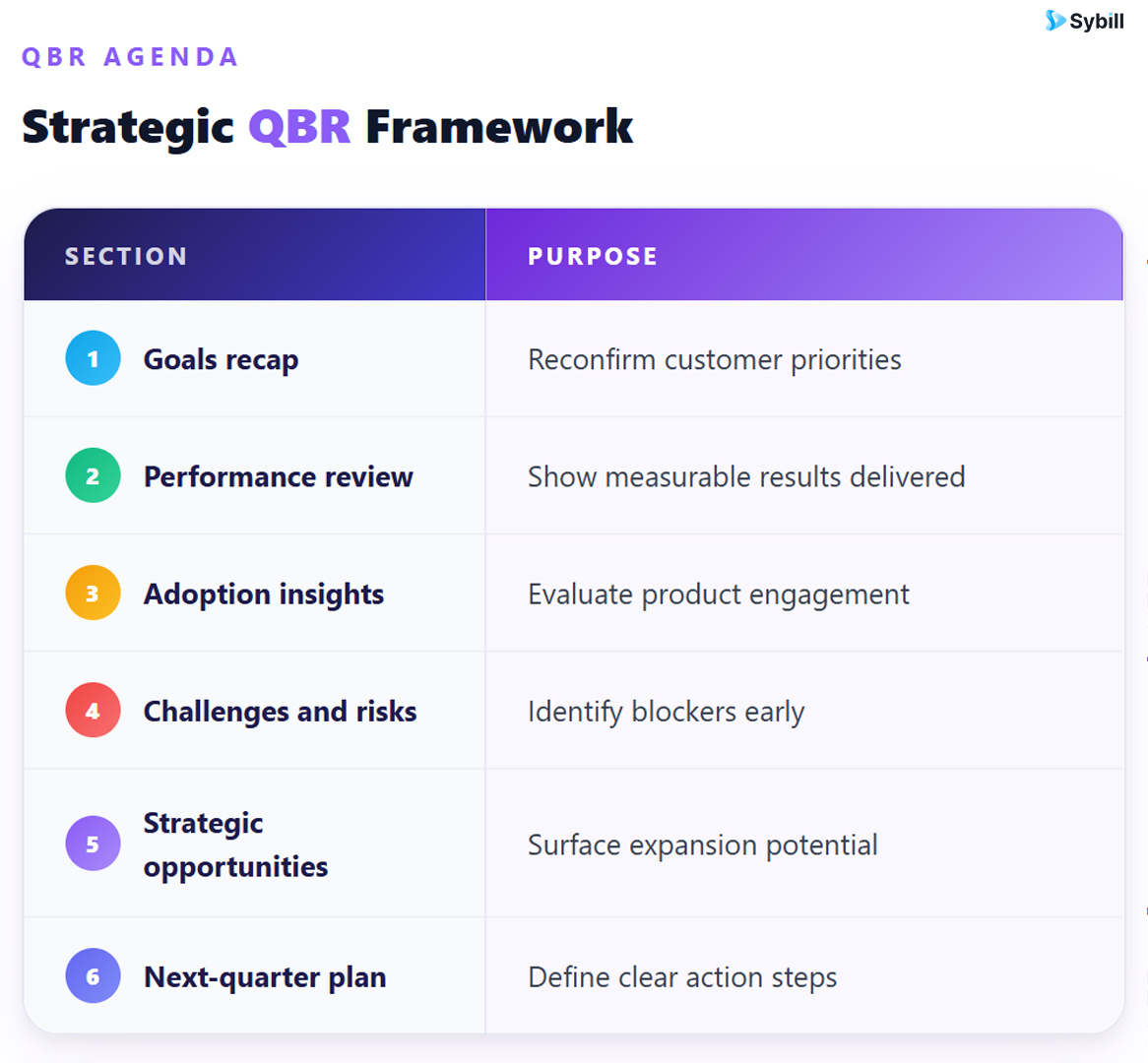
This structure helps the meeting flow logically instead of becoming a collection of disconnected updates.
The most effective QBRs follow a clear narrative:
Goal → progress → insights → next steps
When stakeholders understand that story, the conversation becomes far more productive.
Preparing for a quarterly business review has traditionally been time-consuming.
Teams often pull information from multiple sources, including:
Assembling all that context into a coherent narrative can take hours.
Conversation intelligence and AI are now changing that process.
Modern platforms can analyze customer conversations automatically and surface the insights that matter most.
These systems can identify:
This allows revenue teams to walk into QBR meetings already understanding what the customer cares about most.
Tools like Sybill help revenue teams prepare for quarterly business reviews more efficiently.
For example:
Instead of spending hours assembling slides, teams can focus on the strategic conversation itself.
That shift changes the role of the QBR from a reporting exercise into a real growth discussion.

The most effective revenue teams approach the quarterly business review differently.
They focus on outcomes instead of features.
They use data storytelling instead of dashboards.
They encourage collaboration rather than running one-sided presentations.
And most importantly, they end every QBR with a clear action plan.
The result is a meeting that strengthens relationships and reveals new opportunities.
Over time, these conversations become one of the most powerful drivers of retention and expansion.
The quarterly business review is no longer just a status meeting.
It has become one of the most important strategic conversations between companies and their customers.
It is where teams:
As AI and conversation intelligence continue to evolve, QBR preparation will become faster and more insight-driven.
Instead of building slides, teams will walk into meetings already understanding the customer narrative.
And that shift will make the QBR one of the most powerful tools for long-term growth.
A QBR (quarterly business review) is a strategic meeting held every three months between a company and its customer to review performance, measure value delivered, and align on priorities for the next quarter.
The purpose of a quarterly business review is to demonstrate business value, strengthen relationships with stakeholders, identify risks, and uncover opportunities for growth or expansion.
Most organizations conduct QBRs every three months. Some companies also hold executive business reviews annually to discuss longer-term strategy and partnerships.
A typical QBR agenda follows a structured flow that connects past performance to future strategy. It usually includes:
The goal is to move beyond reporting and create a clear path forward.
A QBR (quarterly business review) is a strategic meeting held every three months between a company and its customer to review performance, measure value delivered, and align on priorities for the next quarter.
The purpose of a quarterly business review is to demonstrate business value, strengthen relationships with stakeholders, identify risks, and uncover opportunities for growth or expansion.
Most organizations conduct QBRs every three months. Some companies also hold executive business reviews annually to discuss longer-term strategy and partnerships.








