Find us at booth #83, join us for a harbor side happy hour, or catch Gorish’s talk.

Sept, 16-18 > Learn more

%20(1).avif)
Mamta Tainwala

March 17, 2026
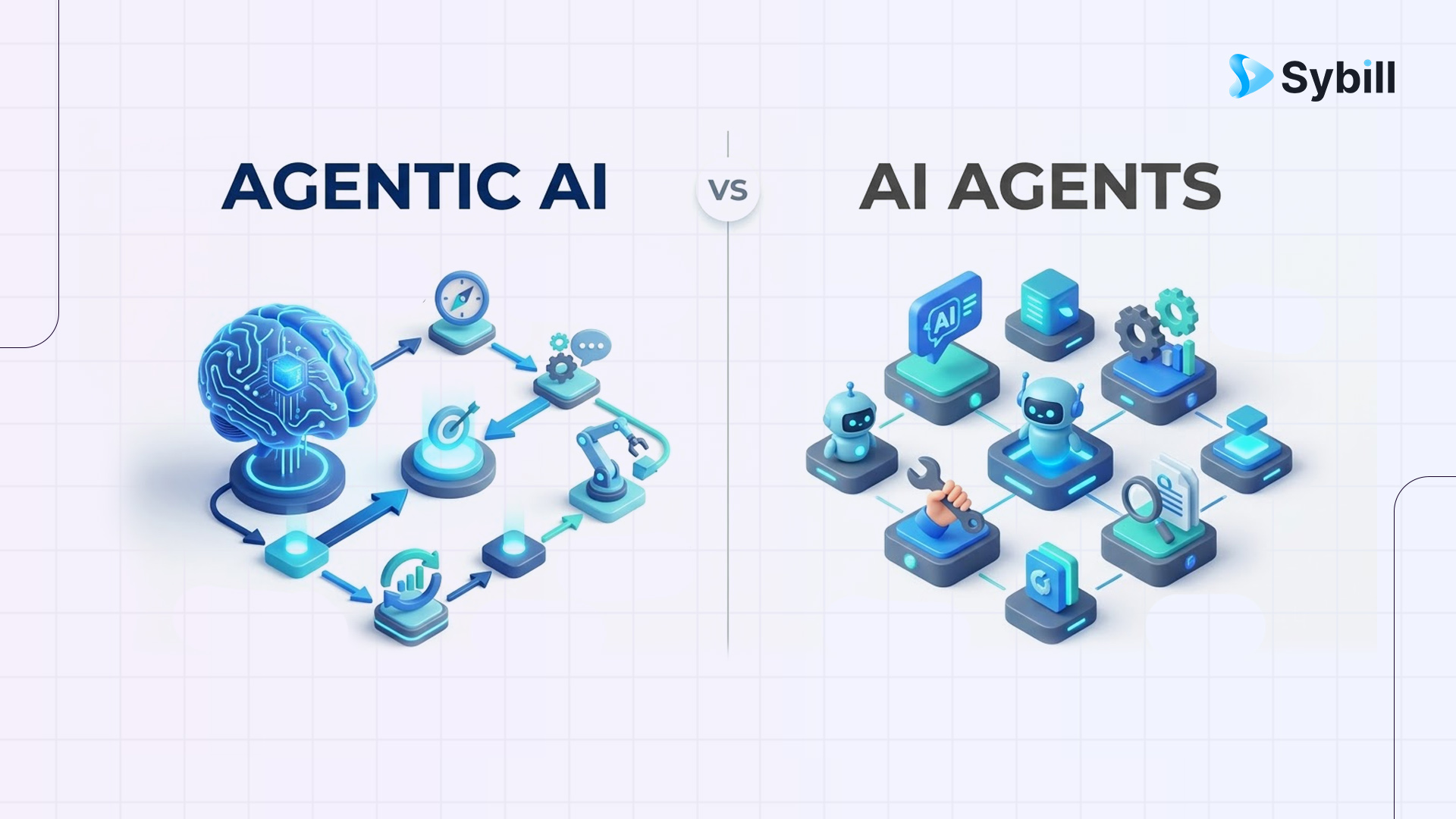
The AI agents market is projected to hit $47 billion by 2030, growing at 44% annually. Every sales tool vendor is now slapping "agentic AI" on their homepage. The problem is that most of them are describing something significantly more modest: a bot that fires a Slack notification when a deal stage changes.
Understanding the actual difference between agentic AI and AI agents is not a trivia exercise. For sales leaders evaluating where to invest and why, it is the question that determines whether a tool will handle the admin that slows your team down, or whether it will actually adapt, plan, and act on your behalf the way a skilled coordinator would.
This guide defines both terms precisely, explains how they differ in practice, and shows what each looks like inside a real sales workflow.
An AI agent is software that can perceive its environment, make decisions based on defined logic, and take actions to complete a specific task, without needing a human to supervise every step.
The key word is "defined." An AI agent operates within parameters set by a human. It follows instructions, executes a workflow, and produces a result. It does not improvise. It does not reprioritize on its own. It does not decide to approach a task differently because something in the context changed.
In sales, an AI agent might look like this: when a call ends, it transcribes the recording, populates a set of CRM fields, and sends a draft follow-up email to the rep's inbox. Every time. Reliably. Without being asked. That is genuinely useful. It is also a predefined task executed by a rule-following system, not a thinking one.
What AI agents are good at:
What they are not good at:
For a practical look at the tools currently built around this model, Sybill's breakdown of AI agent builders covers the full landscape from no-code options to developer frameworks.
Agentic AI is an AI system that does not just execute a task; it reasons about how to approach a goal, plans the steps required, adapts when circumstances change, and makes decisions across multiple actions to get there.
Where an AI agent asks "what is my next instruction?", agentic AI asks "what is the goal, and what is the best path to it given what I know right now?"
The term comes from the concept of agency: the capacity to act intentionally in pursuit of a goal. In practice, agentic AI systems exhibit three behaviors that traditional agents do not:
Goal decomposition. Agentic systems break a high-level objective into sub-tasks and sequence them intelligently. If the objective is "prepare this rep for tomorrow's renewal call," an agentic system pulls deal history, surfaces recent email sentiment, flags the open objection from three calls ago, and assembles a pre-call brief, not because someone wrote a workflow for each of those steps, but because it reasoned through what "prepared" means in this context.
Adaptive replanning. If a step fails or produces unexpected output, agentic AI does not halt. It reconsiders the approach, tries an alternative path, or escalates with context. A rigid agent that cannot find a CRM field simply errors out. An agentic system either infers the value, flags the ambiguity, or routes the decision to a human with the relevant context already assembled.
Cross-task coherence. Agentic systems maintain context and memory across multiple tasks and sessions. They know that this follow-up email relates to the objection raised in last week's call, which was itself flagged in the account health review from the previous month. That thread of context is what allows genuinely helpful, non-generic output.
It is worth being direct about one thing: pure autonomous goal-setting, where a system invents its own objectives, remains a research frontier. The practical definition of agentic AI for sales teams today is a system that operates with structured autonomy: goals are set by humans, but the planning, sequencing, and adaptation to get there happen within the system.
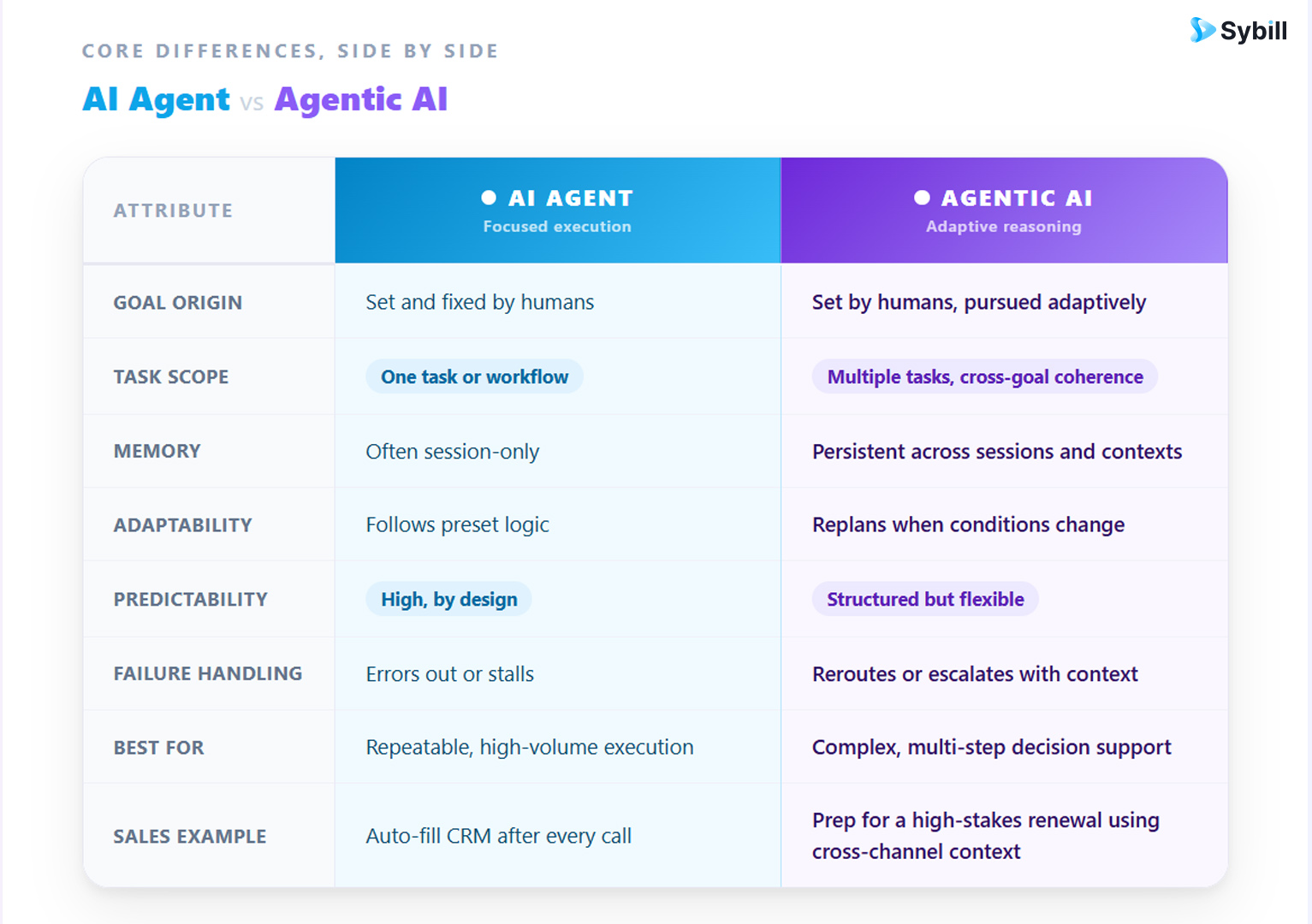
The distinction is not about which is better. It is about which is right for the task at hand. You want an AI agent handling your CRM hygiene. You want agentic AI reasoning through why a deal went quiet and what to do about it.
Sales is not a collection of discrete tasks. It is an interconnected sequence of context-dependent decisions, where missing a signal in week two can cost you the deal in week eight. The tools a revenue team chooses reflect a theory about where AI can create value.
The case for AI agents in sales. Most of the time a sales rep spends on non-selling activity involves structured, repeatable tasks: logging call notes, updating deal stages, writing follow-up emails, scheduling next meetings. These are exactly the jobs AI agents handle reliably. Sales workflow automation at this level does not require a thinking system. It requires a fast, accurate, always-on one. Getting this right frees 10 to 14 hours per week per rep. That is not a small number.
The case for agentic AI in sales. The tasks that actually determine whether a deal closes are not structured. They require judgment: reading a buyer who says they are interested but whose email cadence has slowed, deciding which of seven stalled deals deserves attention before Friday's forecast call, knowing that the objection raised in this week's call is a variation of the one that killed three similar deals last quarter. Machine learning for sales can surface patterns at this scale. Agentic AI can act on them.
The sales teams winning right now are not choosing between these two models. They are using both: agents handling the execution layer, agentic systems handling the intelligence and planning layer.
This is where the definition becomes concrete.
Scenario 1: Pre-call preparation. A rep has a renewal call in 90 minutes. An AI agent would surface last quarter's call transcript if the rep remembered to ask for it. An agentic system would proactively compile a brief: deal health across the account, recent email sentiment from the champion, open action items from the last call, pricing objections raised across every conversation with this account, and a suggested talking track, without being prompted. It reasoned that pre-call prep is what the situation requires and assembled the inputs accordingly.
Sybill's pre-meeting briefs do exactly this: pulling deal history, attendee context, and outstanding next steps automatically before each call.
Scenario 2: Pipeline review. A manager needs to run a weekly pipeline review for a team of twelve reps with 200 open opportunities. An AI agent can pull a CRM report and display current stage data. An agentic system queries across calls, emails, and CRM fields simultaneously, identifies which deals in commit have declining engagement, flags which reps have stale opportunities that have not been touched in fourteen days, and generates a prioritized risk summary with supporting evidence from actual conversations, ready before the manager opens their laptop Friday morning.
This is the shift Sybill's AI agents for sales managers are designed around: from manual pipeline inspection to continuous, context-aware deal surveillance.
Scenario 3: A deal that just went quiet. A $180K opportunity has not had buyer activity in eleven days. An AI agent flags the inactivity threshold. An agentic system does more: it surfaces that the last call ended with an unresolved pricing objection, that the champion's email response time has doubled over the past three weeks, and that two similar deals in the same vertical were lost at this exact stage last quarter. It drafts a re-engagement message referencing the specific concern raised, and proposes a multi-step recovery sequence for the rep to review and approve.
The AE AI Agent built around Sybill works this way: it does not just notice that a deal is quiet. It connects the silence to deal context and gives the rep something to act on.
Every sales AI vendor is using the word "agentic" right now. Most of them are not describing the same thing. Here is how to cut through the positioning.
Ask: does the system maintain memory across sessions? A true agentic system knows that the discount discussion from three weeks ago is relevant to the objection being raised today. A session-based agent processes each interaction in isolation and cannot make that connection. AI sales assistants vary enormously on this dimension.
Ask: does it adapt when the workflow breaks? Put an unexpected input into the system and watch what happens. Does it error out? Does it default to a generic output? Or does it reason through the ambiguity and either handle it gracefully or escalate with context? The answer tells you whether you are looking at a rigid rule engine or something more genuinely adaptive.
Ask: can it operate across multiple goals simultaneously? An AI agent handles one task at a time within a defined scope. An agentic system can manage pre-call prep for five meetings, monitor seven at-risk deals, track outstanding action items across a rep's book, and surface the most urgent of these without being asked which to prioritize first.
Ask: does it integrate at depth or just at surface level? A system that connects to your CRM but only reads data is not meaningfully agentic. A system that reads data from calls, emails, Slack, and CRM, reasons across all of it, and writes back to update fields, send messages, and log activity is operating at the level where genuine workflow transformation happens. Sybill's CRM autofill and Magic Summaries are built on this principle: the system observes what happened in the call and takes action across multiple downstream systems automatically.
Whether you are evaluating a dedicated agent platform or choosing an AI sales tool, the same questions apply.
What is the task scope? If the job is executing a repeatable workflow, an AI agent built for that workflow is the right call. It will be faster, more predictable, and easier to audit than a general-purpose agentic system applied to a narrow task. The generative AI tools built for sales that handle specific jobs like email personalization and sequence generation tend to outperform broader platforms on those specific tasks.
Where does your team lose the most time to cognitive load? Agentic AI creates the most value when it replaces judgment-heavy tasks that currently require a manager's attention: pipeline reviews, deal health assessment, coaching prioritization, forecast calls. Sales coaching AI powered by agentic systems surfaces the right coaching opportunity at the right time for each rep, rather than waiting for a monthly one-on-one.
How clean is your data? Agentic AI is only as good as the signals it can access. A system reasoning across call data, email sentiment, and CRM fields requires all three to be populated and accurate. If your CRM hygiene is the problem, fix that first. CRM automation tools that auto-fill from call data are the fastest path to the data quality that makes agentic reasoning possible.
How much human oversight do you need? Structured autonomy, where humans set the goal and AI plans and executes, works well for most revenue workflows. Fully autonomous goal-setting, where AI decides what to pursue without human input, is not where most sales teams want to be, and not where the technology is today. The ideal system surfaces recommendations and drafts for human review rather than acting unilaterally. The AI-automated sales funnel that performs best in practice is one where AI handles execution and humans handle final judgment.
Get started for free with Sybill and see what an agentic sales system looks like when it is embedded directly into your deal workflow, not sitting in a separate tool no one opens.
The current generation of agentic sales AI operates with what might be called "supervised autonomy." The system plans, executes, and adapts, but within guardrails that humans define and with outputs that humans review before they become actions.
The next generation will extend this in two directions. First, personalization at buyer-level depth will move beyond role-based messaging to communication style matching: understanding how this specific buyer prefers to receive information, which arguments resonate with their personality, and adapting every touchpoint accordingly. Some of this exists today in early form. The next iteration will be significantly more sophisticated.
Second, proactive pipeline intervention will become the norm rather than the exception. Instead of surfacing that a deal is at risk, an agentic system will draft the intervention, schedule the outreach, prepare the rep, and track execution across the team, all coordinated through a single intelligence layer that connects every deal in the portfolio. The rep's job becomes approving and personalizing, not building and chasing.
The frame that makes most sense for revenue teams thinking about this transition is not "AI versus humans." It is what Sybill has always called intelligence amplification: AI handling the scale, memory, and pattern recognition that humans cannot sustain, so humans can focus on the relationship, judgment, and creativity that AI cannot replicate.
The AI agents market is growing fast. The vocabulary is outpacing the reality. Most tools claiming "agentic" capabilities are describing something closer to a well-configured Zapier workflow, useful, but not what the word implies.
The gap between a tool that fires a canned sequence and one that reasons about what your pipeline actually needs right now is significant. Knowing the difference is what lets you invest in the right layer.
Get started for free with Sybill and see what agentic sales AI looks like when it is built around how deals actually work.
AI agents follow predefined instructions to complete specific tasks within a fixed scope. They are reliable, predictable, and excellent at repetitive execution. Agentic AI systems pursue goals with a degree of autonomous planning: they break objectives into steps, adapt when conditions change, maintain context across sessions, and coordinate multiple actions simultaneously. The distinction is not better versus worse. It is narrow execution versus adaptive reasoning.
Agentic AI is an AI system that can figure out how to accomplish a goal, not just follow instructions to complete a task. Given an objective, it plans the necessary steps, executes them in sequence, adjusts when something goes wrong, and maintains the context it needs to keep the goal in sight across multiple interactions.
No. Every agentic AI system uses agents as its execution components, but not every AI agent is agentic. An AI agent is a task-executor. Agentic AI is a goal-pursuer. The difference is whether the system can plan, adapt, and coordinate across tasks, or whether it simply runs a workflow that was designed for it in advance.
A rep finishes a demo call. An agentic AI system pulls the transcript, identifies the three objections raised, cross-references them against similar deals in the pipeline, generates a follow-up email addressing each objection with specific proof points, updates the relevant CRM fields, schedules a suggested next step on the rep's calendar, and flags the deal as a coaching opportunity for the manager because one of the objections is a pattern the rep consistently struggles with. The rep reviews the outputs, approves what looks right, and moves on to the next call. No workflow was explicitly defined for that sequence. The system reasoned through what the situation required.
Evaluate whether the system maintains memory across sessions, whether it adapts when workflows break rather than erroring out, whether it integrates at depth with your CRM and communication tools rather than surface-level read access, and whether it can operate across multiple goals simultaneously. The best AI sales tools guide covers how to evaluate the broader stack these systems sit within.
Sybill operates as an agentic AI platform built specifically for sales workflows. It reasons across calls, emails, CRM data, and Slack to surface deal intelligence, plan and execute post-call actions, draft contextual follow-ups, and populate CRM fields automatically. It maintains context across sessions and deals, adapts its outputs to each deal's specific situation, and supports both individual reps and sales managers with proactive, goal-oriented intelligence. It does not just execute tasks you set up in advance. It thinks about what the deal needs.
The main risks are data quality dependency and the temptation to over-automate. Agentic systems reason from the data available to them. If your CRM is inconsistent or your call data is incomplete, the system's outputs will reflect that. The second risk is removing human judgment from decisions that still benefit from it: complex negotiations, sensitive account situations, and moments where relationship nuance matters more than pattern matching. The best implementations keep humans in the review loop for high-stakes outputs and use AI for the planning and drafting work that precedes those decisions.
AI agents follow predefined instructions to complete specific tasks within a fixed scope. They are reliable, predictable, and excellent at repetitive execution. Agentic AI systems pursue goals with a degree of autonomous planning: they break objectives into steps, adapt when conditions change, maintain context across sessions, and coordinate multiple actions simultaneously. The distinction is not better versus worse. It is narrow execution versus adaptive reasoning.
Agentic AI is an AI system that can figure out how to accomplish a goal, not just follow instructions to complete a task. Given an objective, it plans the necessary steps, executes them in sequence, adjusts when something goes wrong, and maintains the context it needs to keep the goal in sight across multiple interactions.
No. Every agentic AI system uses agents as its execution components, but not every AI agent is agentic. An AI agent is a task-executor. Agentic AI is a goal-pursuer. The difference is whether the system can plan, adapt, and coordinate across tasks, or whether it simply runs a workflow that was designed for it in advance.