Find us at booth #83, join us for a harbor side happy hour, or catch Gorish’s talk.

Sept, 16-18 > Learn more


Mamta Tainwala

September 7, 2026
CloudTalk and Zoom Phone answer the same question, "what should our team's phone be?", from opposite philosophies. CloudTalk treats calling as the product: dialer modes including the category's rare parallel option, unlimited outbound to 160-plus destinations on its top plan, and call flows an ops lead edits visually, at $19 to $49 per user per month plus a menu. Zoom Phone treats calling as a checkbox on the platform your team already meets in: from $10.50 per user per month, AI notes included, zero new apps, and no sales dialer in its plans at all.
One is bought by teams whose phone is the job; the other by teams whose phone is a utility.
Which philosophy your call logs support is the whole decision, mapped from the usual seat: Sybill integrates with both, sees both platforms' calls daily, and tilts for neither.
Same shelf, different intentions:
Zoom Phone publishes the lightest entry in business telephony:
CloudTalk publishes four tiers (its pricing page renders in euros; US guides carry dollar figures):
The configured math: a list-working CloudTalk seat runs $44 to $68 (or Expert's $49 flat), against Zoom Phone's $15-ish Unlimited seat that cannot be configured into a list-working machine at any price on its plans. That is not a 3x price gap; it is a phone bill next to a calling platform, and the AI packaging inverts the usual story: Zoom includes its notes in the cheap seat, while CloudTalk's cost $9 on top.
CloudTalk, structurally, wherever lists are worked:
Zoom Phone's honest wins are real for the right team: the zero-adoption path (calls land where meetings already live), the included AI that lets teams drop separate note tools, mobile experience field teams rate highly, and a price that funds other stack decisions. Calendar-driven teams whose calls come from bookings and inboxes may never feel the dialer gap, and for them the checkbox is the correct purchase, with the craft (timing, openers, lists) mattering more than either platform.
Zoom: 4.5 out of 5 across more than 56,000 G2 reviews (platform-wide), with the split worth reporting honestly:
CloudTalk: 4.4 out of 5 on G2 across roughly 1,700 reviews, small-business skew, 2026 High Performer:
Choose CloudTalk if:
Choose Zoom Phone if:
One trap and one non-pattern before the tiebreaker:
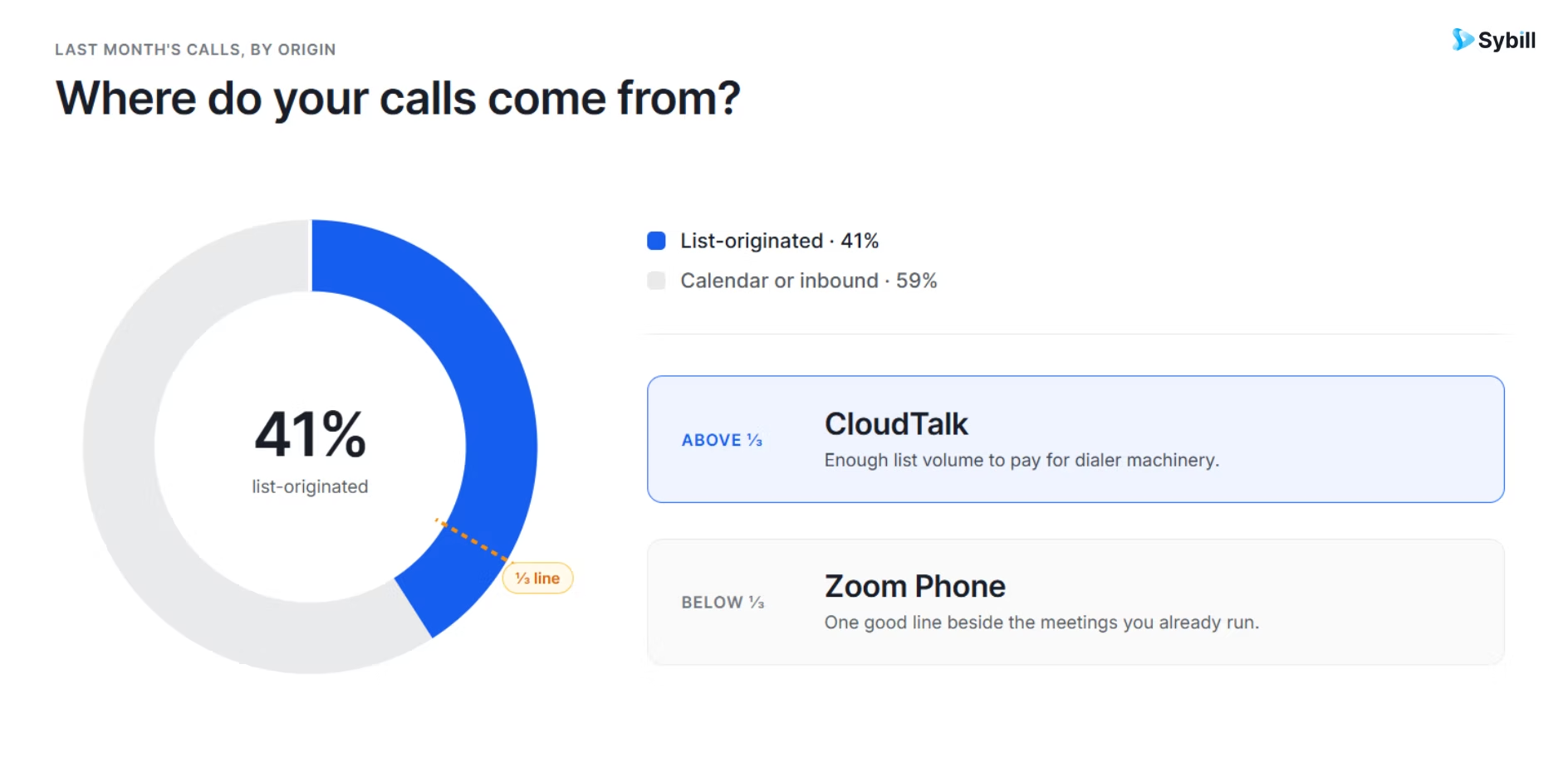
The tiebreaker is the count this series keeps landing on: the share of last month's calls that originated from a worked list. Above roughly a third, the platform pays for itself in eliminated hand-dialing; below it, the checkbox is the rational buy and the savings fund the stack. Near the line, CloudTalk's two-week trial at your real configuration settles it with your own connect rates, an experiment Zoom Phone's no-trial policy cannot match.
Platform or checkbox, the conversations are the asset. Sybill captures every CloudTalk and Zoom Phone call, and your Zoom meetings besides, turning all of it into summaries, CRM updates, follow-ups, and deal intelligence, automatically. Get started for free with Sybill.
Both philosophies stop at the call. Zoom's included notes cover the conversation that just ended; CloudTalk's add-on intelligence does the same on the other side; and the signals deals turn on live across conversations:
Sybill has analyzed around 33 million sales conversations across the dialer and meeting platforms it connects to, and it sits identically beneath both phones here, including Sybill's native CloudTalk integration, with the bonus specific to this pairing: on the Zoom side it captures the meetings themselves, where most B2B deals actually advance. Every call and meeting becomes a summary, CRM fields that fill themselves, a follow-up in the rep's voice, captured commitments, and account-level intelligence (risk flags, queryable history, coaching signals) that compounds whichever philosophy carries the call. The full integration list covers both vendors, and recording consent configures once, wherever capture happens.
With the memory layer independent, teams can even take the honest path this pairing invites: start on the checkbox, and graduate to the platform when the list share crosses the line, without losing a conversation of history.
For teams whose phone is the job, CloudTalk wins decisively: the dialer menu, the international economics, and ops-editable workflows are what a calling platform is for, and Zoom Phone cannot be configured into one at any price on its plans. For calendar-driven, Zoom-native teams, Zoom Phone is the quietly correct and dramatically cheaper answer, AI notes included, and buying a calling platform for a motion that never works a list is machinery as decoration. The line between the two is a number already sitting in your call logs.
One closing note for the graduation path, because it is the most common real-world sequence: teams that start on Zoom Phone should still set up call capture and CRM logging discipline from day one, not at the migration. The habits and the history are what make the eventual platform move a weekend project instead of a quarter, and both are free to start now regardless of which seat you are paying for.
Count the list share. The philosophy follows.
Get started for free with Sybill or book a demo and make every call count on either one.
For teams that work call lists, CloudTalk: power and smart dialers bundle into its $49 Expert plan, a parallel add-on exists for blitz volume, and unlimited calling covers 160-plus destinations. For calendar-driven teams already living in Zoom, Zoom Phone's $10.50 to $24.50 seats with AI notes included are the rational lighter buy; its plans carry no sales dialer.
No, Zoom Phone's plans include no sales dialer at any tier: working an outbound list means manually initiating each call, with advanced dialing living in Zoom's separate contact-center products. List-working teams should evaluate dedicated calling platforms or dialers alongside it.
CloudTalk publishes $19 (Lite) to $49 (Expert) per user monthly on annual billing, with a list-working seat realistically $44 to $68 after add-ons, and a two-week trial. Zoom Phone publishes $10.50 (metered) to $24.50 (Business Plus) per user monthly with AI Companion included and no trial on Phone plans.
The packaging inverts the price story: Zoom Phone includes AI Companion notes and real-time transcription in its cheap seats, while CloudTalk sells conversation intelligence as a $9 add-on. Both are call-level intelligence; account-level signals across conversations are neither product's job.
Yes, Sybill integrates natively with both, including its CloudTalk integration, and with Zoom meetings besides, capturing every conversation and turning it into summaries, CRM updates, follow-ups, and cross-deal intelligence automatically. Teams can graduate from one phone to the other without losing a conversation of history.
For teams that work call lists, CloudTalk: power and smart dialers bundle into its $49 Expert plan, a parallel add-on exists for blitz volume, and unlimited calling covers 160-plus destinations. For calendar-driven teams already living in Zoom, Zoom Phone's $10.50 to $24.50 seats with AI notes included are the rational lighter buy; its plans carry no sales dialer.
No, Zoom Phone's plans include no sales dialer at any tier: working an outbound list means manually initiating each call, with advanced dialing living in Zoom's separate contact-center products. List-working teams should evaluate dedicated calling platforms or dialers alongside it.
CloudTalk publishes $19 (Lite) to $49 (Expert) per user monthly on annual billing, with a list-working seat realistically $44 to $68 after add-ons, and a two-week trial. Zoom Phone publishes $10.50 (metered) to $24.50 (Business Plus) per user monthly with AI Companion included and no trial on Phone plans.