Find us at booth #83, join us for a harbor side happy hour, or catch Gorish’s talk.

Sept, 16-18 > Learn more

%20(1).avif)
Mamta Tainwala

July 21, 2026
%20(46).png)
Demand forecasting predicts total market appetite for your product: what customers will want, in what quantity, and when, regardless of your capacity to deliver it. Sales forecasting predicts the revenue your team will actually close in a period, based on pipeline, deal stages, and historical conversion. Demand looks outward at the market; sales looks inward at your pipeline. Growing companies need both, talking to each other.
That is the two-sentence version. The longer version matters because confusing these two forecasts produces very expensive, very specific mistakes, and we will name them.
Demand forecasting estimates future customer demand for a product or service: how much the market will want, when, and in which segments. It is unconstrained by your inventory, capacity, or sales headcount, and it feeds decisions in supply chain, capacity planning, hiring, budgeting, and product strategy. Inputs include historical demand, seasonality, market trends, and leading indicators like search volume and pipeline creation.
The key word is unconstrained. Demand forecasting asks "what does the market want?" without regard for whether you can serve it. A SaaS company forecasting demand looks at trial sign-up trends, category search growth, competitive dynamics, and the health of its ideal customer profile segments. A hardware company adds inventory, lead times, and seasonality.
Who uses it: finance for budgets, operations for capacity, product for roadmap bets, and sales leadership for one critical decision most teams get wrong: how much pipeline to build. Demand is the ceiling. Everything downstream lives under it.
Sales forecasting predicts the revenue your team will close in a defined period, built from the pipeline that exists today: deal values, stages, close dates, and historical stage-to-stage conversion. It is constrained by your actual capacity, coverage, and deal quality, and it drives quota setting, resource allocation, and the number your CFO reports upward.
Where demand forecasting is a market question, sales forecasting is an execution question: of the opportunities we have, what will actually sign? It runs on internal data (CRM records, pipeline views, rep judgment) and its accuracy lives or dies on whether that internal data reflects reality, a point we will return to, because it is where most forecasts quietly rot.
Method-wise, teams range from simple stage-weighted models to regression and AI scoring. We covered the options in our guide to sales forecasting methods and the tools that run them, so this post stays on the comparison.
The core differences: demand forecasting is market-facing, unconstrained, longer-horizon (quarters to years), and owned by finance or ops; sales forecasting is pipeline-facing, capacity-constrained, shorter-horizon (weeks to quarters), and owned by sales leadership. Demand answers "how big is the opportunity"; sales answers "how much of it will we capture this quarter."
The side-by-side:
Question answered. Demand: what will the market want? Sales: what will our team close?
Constraint. Demand is unconstrained by your capacity. Sales is entirely constrained by it: pipeline, headcount, cycle length.
Horizon. Demand runs quarters to years, feeding annual plans. Sales runs weeks to quarters, feeding the number on Friday's call.
Primary inputs. Demand: market data, seasonality, trends, top-of-funnel signals. Sales: CRM pipeline, stage conversion history, rep judgment, and increasingly conversation-level deal evidence.
Owner. Demand: finance, ops, or a planning function. Sales: the CRO and sales leaders, with RevOps running the machinery.
Failure mode. A bad demand forecast wastes capital: overhiring, overbuilding, overbuying. A bad sales forecast wastes credibility: missed guidance, panicked quarter-ends, boards that stop trusting the number.
Now picture this: a company treats its sales forecast as its demand forecast. Pipeline looks thin, so leadership concludes the market is soft and cuts marketing spend. But the market was fine. The pipeline was thin because two reps left and pipeline generation stalled for a quarter. They diagnosed a demand problem from an execution symptom, and the cut made both worse. That confusion, in both directions, is the whole reason this comparison deserves a post.
Yes, and it is the most dangerous forecasting failure. A pessimistic sales forecast triggers cost cuts and reduced customer outreach, which causes the poor results the forecast predicted, which validates the forecast and deepens the cuts. Breaking the loop requires separating the two questions: is demand actually falling, or is our execution slipping?
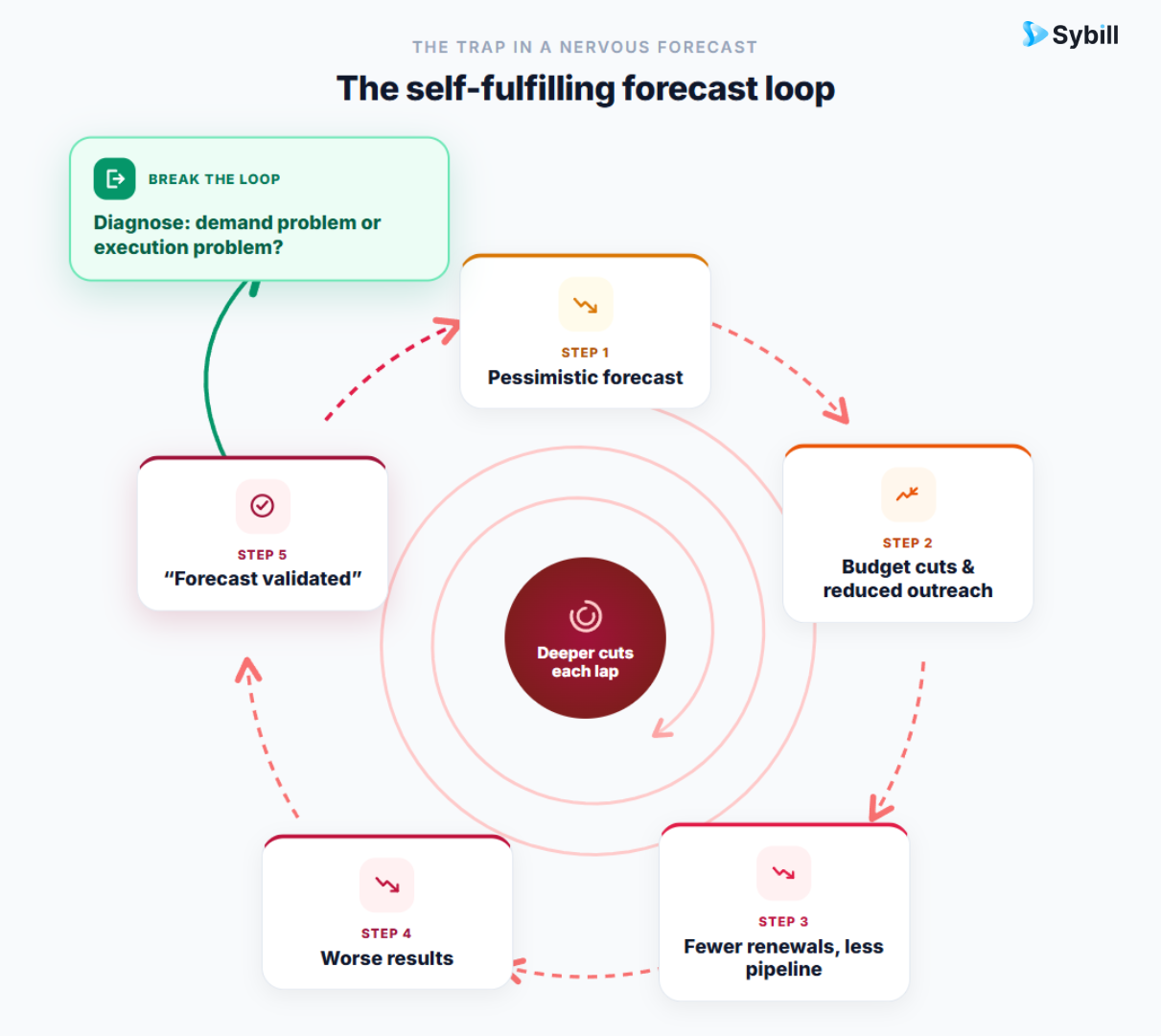
This was the one genuinely good idea in the previous version of this post, so it survives the rebuild, minus the horror-movie framing.
The mechanics: sales forecasts are built from historical pipeline data. When the forecast dips, businesses react by trimming: fewer check-ins, less nurture, smaller campaigns. Those cuts reduce future pipeline and renewals, the next forecast dips further, and everyone congratulates the model on its accuracy. The forecast did not predict the decline. It caused it.
The escape is diagnostic discipline, and it maps exactly onto the two-forecast distinction:
Check demand independently. Are trials, inbound volume, category search, and win rates against competitors holding? If yes, the market is fine and your problem is internal. If no, it is a real demand shift and belongs in the demand forecast.
Check execution evidence. What are customers actually saying? A renewal dip caused by a competitor's discounting sounds different on calls than one caused by onboarding gaps. Buyer intelligence across your conversations answers the "why" that pipeline numbers cannot, and churn analysis turns the answer into a fix.
Never cut the diagnosis budget. Whatever gets trimmed in a downturn, it should not be the listening: the call reviews, the customer conversations, the win-loss work. Cutting those is how a company goes blind precisely when it most needs eyes.
Your sales forecast is only as honest as your CRM. Sybill updates deal records from what buyers actually said, flags at-risk deals, and gives your forecast a foundation of evidence instead of optimism. Start for free.
They form a two-way correction loop: the demand forecast sets pipeline targets (if demand supports $10M and win rates say 25%, you need $40M of pipeline), while sales forecast misses diagnose whether the problem is market demand or sales execution. Reviewed together quarterly, each forecast catches the other's blind spots.
The practical integration, without the philosophy:
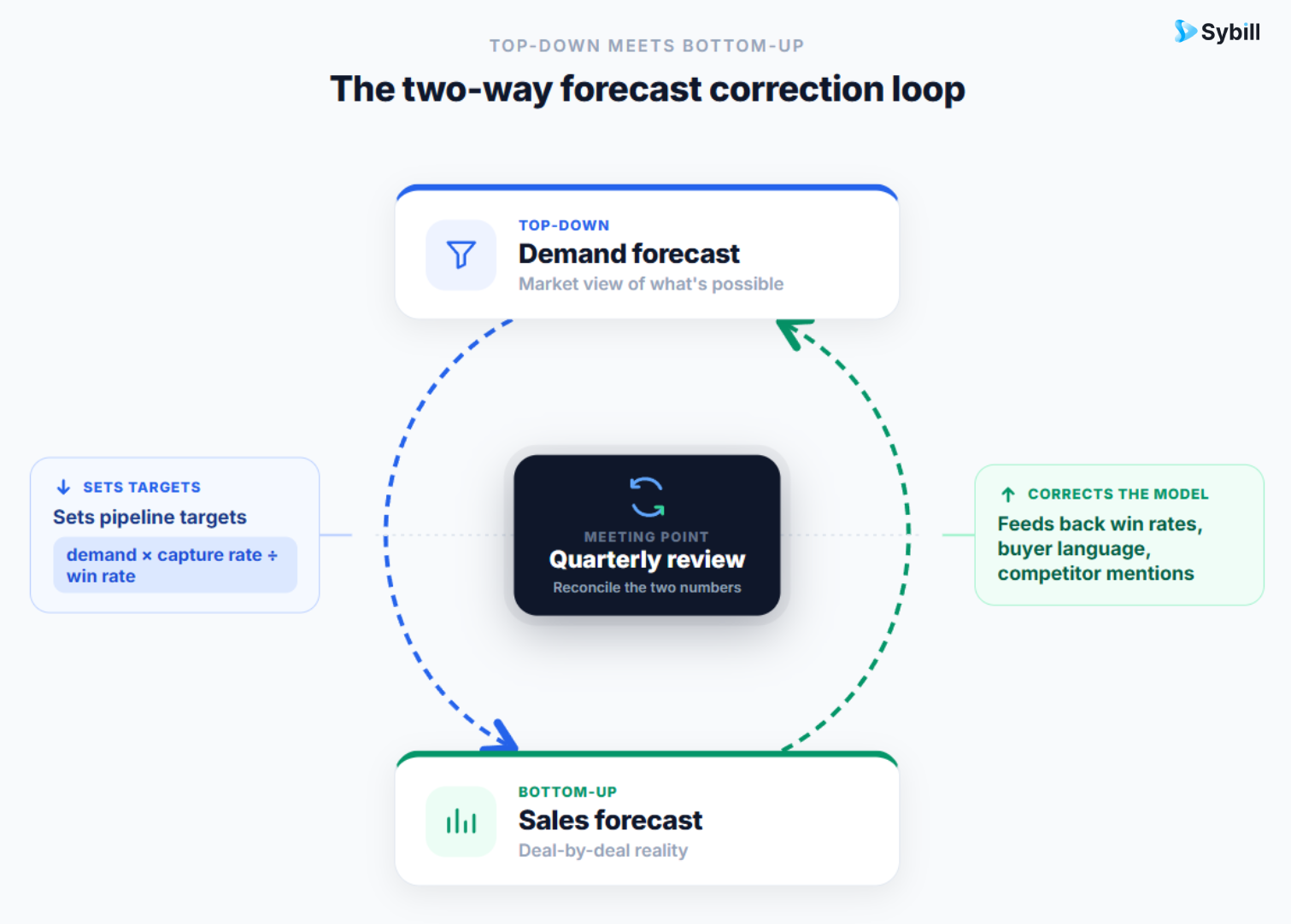
Demand sets the pipeline target. Market demand estimate × expected capture rate = revenue goal. Revenue goal ÷ win rate = required pipeline. This chain is how the annual plan connects to the Monday pipeline meeting, and when the chain is explicit, a coverage gap triggers the right response (generate more pipeline) instead of the wrong one (lower the demand assumption).
Sales evidence corrects the demand model. Your reps hear demand shifts quarters before they show in market data: new competitor mentions rising, budget language tightening, a use case suddenly appearing in every discovery call. Competitor intelligence and conversation trends are leading indicators the demand forecast should consume. Sybill has analyzed millions of sales conversations, and shifts in what buyers ask about consistently precede shifts in what they buy.
One review, both forecasts. The quarterly business review should put the demand view and the sales view on the same table and interrogate the gap. Demand strong but sales forecast weak: execution problem, fix pipeline and process. Sales forecast fine but demand indicators softening: enjoy the quarter, fix the year.
Shared data plumbing. Both forecasts run on the same upstream records, which is why CRM hygiene is not an admin nicety but forecast infrastructure, and why keeping every deal's story in one place keeps the two forecasts from arguing about facts instead of interpretations.
AI improves demand forecasting through better pattern detection across market signals, and sales forecasting through deal-level evidence: scoring deals on what buyers actually said rather than which stage a rep picked. The larger shift is that conversation data now feeds both: buyer language is a leading indicator for demand and a truth serum for pipeline.
On the demand side, machine learning models digest more signals than any spreadsheet: seasonality, macro indicators, search trends, cohort behavior. That work belongs to dedicated planning tools, and honesty compels a lane marker here: Sybill is not a demand planning platform, and if your primary problem is inventory or capacity planning, that is a different software category.
The sales side is where conversation intelligence changes the game, because the classic failure of sales forecasting is not the model. It is the inputs. Stage fields set by optimism, close dates set by hope, risks that live in a rep's head. Predictive analytics built on conversation evidence fixes the inputs: deals scored on whether the economic buyer actually showed up, whether next steps were actually confirmed, whether pricing pushback actually got resolved. Then forecast calls prepared from that evidence stop being negotiation theater and start being math.
Your team has targets, not vibes. The forecast should be built from the same material.
Here is the takeaway worth taping to the wall. Demand forecasting tells you how big the game is. Sales forecasting tells you the score of the match you are playing. Confuse them and you will cut marketing during an execution slump, or hire aggressively into a softening market, and both mistakes come with a very sincere-looking spreadsheet attached.
Keep them separate in method, joined in review, and fed by the richest data source you own: what your buyers actually say, in their own words, on every call.
That last part is where Sybill lives. Every conversation captured, every deal's evidence organized, every forecast input grounded in what happened instead of what got typed into the CRM at 5:55 PM on Friday.
Try Sybill free or book a demo and give your forecast a memory.
No. Demand forecasting predicts total market appetite for your product, unconstrained by your capacity, and feeds planning decisions like budgets, hiring, and inventory. Sales forecasting predicts the revenue your team will close from existing pipeline in a specific period. One measures the opportunity; the other measures your capture of it.
Demand forecasting, in planning sequence. The demand estimate sets revenue goals, which set pipeline targets, which the sales forecast then tracks against. In practice both run continuously, and sales evidence (win rates, buyer conversations, competitive mentions) should flow back to correct the demand model each quarter.
Demand forecasting typically sits with finance, operations, or a dedicated planning function, with input from marketing and product. Sales forecasting is owned by sales leadership, usually the CRO, with RevOps running the process and data. Companies that never put the two in the same review meeting eventually pay for it.
Yes, though it looks different from manufacturing. SaaS demand forecasting tracks trial and sign-up trends, category search growth, market sizing by segment, and expansion appetite in the installed base. It drives hiring plans, marketing budgets, and pipeline coverage targets rather than inventory decisions.
Deal-level evidence beats stage labels. Forecasts improve fastest when inputs reflect what actually happened in deals: whether economic buyers are engaged, next steps are confirmed, and objections are resolved, all verifiable from conversation records. Clean CRM data, honest stage definitions, and conversation intelligence are the three highest-leverage upgrades.
No. Demand forecasting predicts total market appetite for your product, unconstrained by your capacity, and feeds planning decisions like budgets, hiring, and inventory. Sales forecasting predicts the revenue your team will close from existing pipeline in a specific period. One measures the opportunity; the other measures your capture of it.
Demand forecasting, in planning sequence. The demand estimate sets revenue goals, which set pipeline targets, which the sales forecast then tracks against. In practice both run continuously, and sales evidence (win rates, buyer conversations, competitive mentions) should flow back to correct the demand model each quarter.
Demand forecasting typically sits with finance, operations, or a dedicated planning function, with input from marketing and product. Sales forecasting is owned by sales leadership, usually the CRO, with RevOps running the process and data. Companies that never put the two in the same review meeting eventually pay for it.