Find us at booth #83, join us for a harbor side happy hour, or catch Gorish’s talk.

Sept, 16-18 > Learn more

%20(1).avif)
Mamta Tainwala

May 25, 2026
.png)
The best revenue intelligence platform for startups in 2026 is one that delivers conversation intelligence, automatic CRM updates, follow-up automation, and deal insights at a price that does not require board approval or a six-figure annual commitment. Gong remains the category leader for enterprise sales organizations purely because of how long it’s been in the market, but its pricing structure, which includes $5,000 to $50,000 in annual platform fees plus $1,200 to $1,600 per user per year, makes it financially impractical for startups operating with lean sales teams and tighter budgets. Sybill delivers the full revenue intelligence workflow at $79 per user per month with no minimum seats, no annual contract, and same-day deployment.
That is the direct answer. The rest of this guide explains what "revenue intelligence" actually means for a startup (versus what enterprise vendors tell you it means), which capabilities drive real ROI at the startup stage, where each platform falls on the price-to-capability spectrum, and how to evaluate whether you need a revenue intelligence platform at all versus a simpler tool that covers 80% of the value.
Enterprise vendors define revenue intelligence broadly: pipeline analytics, AI-powered forecasting, deal health scoring, buyer engagement tracking, activity capture across CRM, email, calendar, and calls. That is accurate for organizations with 50-plus reps, multiple segments, and a CRO who needs to commit quarterly numbers to a board.
For a startup, revenue intelligence needs to be defined by what actually drives revenue at your stage, not by what looks impressive on an analyst quadrant.
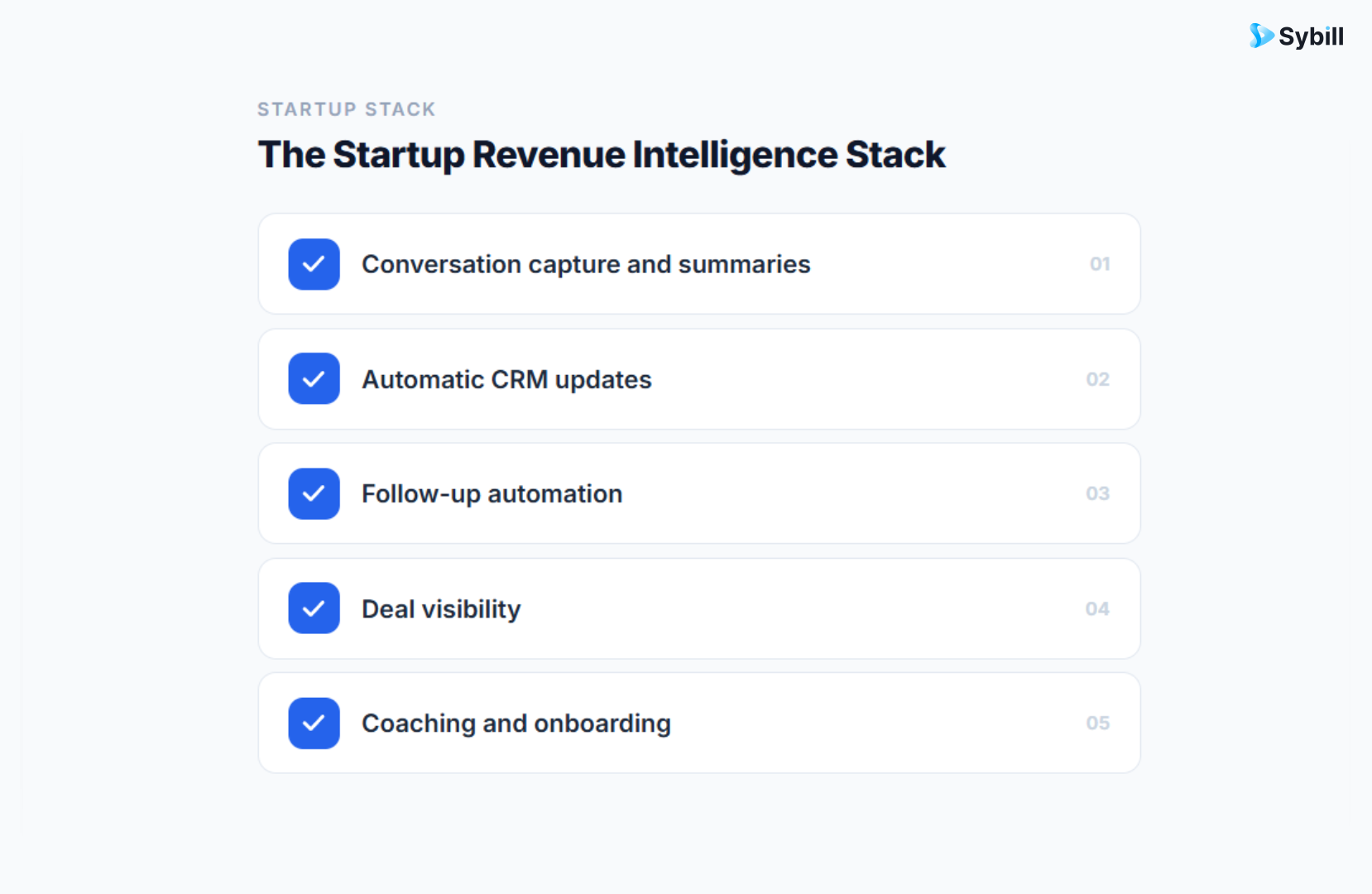
A startup with 5 to 20 reps needs five things from a revenue intelligence platform. Everything else is noise until you hit scale.
Every deal starts with a conversation. If those conversations are not captured, transcribed, and structured into usable intelligence, everything downstream falls apart. You need reliable call recording across Zoom, Teams, Google Meet, and phone, plus summaries that extract outcomes, pain points, next steps, and buyer signals rather than dumping a raw transcript that no one reads.
CRM data quality is the single biggest infrastructure problem for startup sales teams. When reps do not update Salesforce or HubSpot after calls, your pipeline is fiction. But telling reps to "be more disciplined about CRM updates" does not work, it has never worked, and it will never work. The only reliable solution is AI that writes structured CRM entries from actual conversations automatically.
The gap between a call ending and a follow-up email landing in the buyer's inbox is where startup deals die. Your reps have three more calls that afternoon. The follow-up gets pushed to tomorrow. The details blur. The email is generic. The buyer's enthusiasm cools. You need a tool that drafts follow-up emails in the rep's voice, referencing specific conversation details, within minutes of the call ending.
You do not need an enterprise forecasting engine at the startup stage. You need to know which deals are progressing, which have gone quiet, and where your reps need help. Basic deal health based on conversation evidence and activity patterns is sufficient. Sophisticated Monte Carlo forecasting models are overkill.
New hires at startups ramp without the structured onboarding programs that enterprise orgs provide. A library of real winning calls, combined with AI that identifies coaching opportunities on every conversation, replaces the sales training program your startup cannot afford to build.
If a platform delivers these five capabilities at a price that does not require CFO approval for a seed-stage company, it is a legitimate revenue intelligence platform for startups. If it requires $30,000 in annual commitment and three months of implementation to get there, it is an enterprise product wearing a startup marketing hat.
This is not a Gong-bashing exercise. Gong could be a genuinely powerful product. Its conversation analytics are trained on billions of sales interactions. Its coaching libraries, pattern detection, and enterprise reporting are popular. For a 200-rep organization with a dedicated RevOps team and a six-figure conversation intelligence budget, Gong might be able to deliver some value.
The problem is structural, not qualitative. Gong's pricing model was designed for enterprise procurement cycles, not startup velocity.
Beyond pricing, there are three structural mismatches between Gong and the startup use case.
First, startup sales teams do not have dedicated RevOps. Gong's power comes from deep configuration.
Second, startups need execution, not analytics. The primary pain for a 5 to 15 person sales team is not "we lack insights into our pipeline." It is "our reps spend half their day on admin instead of selling, our CRM is empty, and follow-ups happen too late."
Third, the contract structure is misaligned with startup reality. Annual contracts with automatic renewal increases of 5 to 15% lock startups into commitments. Month-to-month flexibility is not a nice-to-have for startups. It is a requirement.
Here is how the main options stack up across the capabilities that actually matter for startup sales teams. Each platform is evaluated on what it delivers at its startup-accessible price tier, not on enterprise features that require higher plans.
Sybill is an AI-driven revenue intelligence platform that was built from the ground up around a different assumption than Gong or Clari: the most valuable output of a sales intelligence platform is not an insight or a dashboard. It is an action that moves a deal forward.
What it does for startups: Sybill records and transcribes calls across Zoom, Teams, Google Meet, and phone. Magic Summary generates structured outputs covering outcomes, pain points, next steps, buyer signals, objections, and competitive mentions within minutes of each call. CRM Autofill writes updates into 30 or more fields in Salesforce, HubSpot, Zoho, or Dynamics 365 after every call and email, including MEDDPICC qualification criteria, custom fields, and stakeholder information. AI follow-up emails draft in the rep's own tone, referencing specific details from the conversation. Pre-meeting briefs pull context from CRM and past interactions so reps walk into every call prepared. Ask Sybill enables natural language querying across all deals. The deal workspace provides visibility into pipeline health based on actual conversation evidence.
Sybill also captures in-person meetings through its native mobile app, delivering the same structured summaries and CRM updates for field sales conversations that would otherwise be invisible.
Pricing: Essentials at $19 per user per month. Business (includes CRM Autofill, AI follow-ups, pre-meeting briefs, Ask Sybill, deal workspace) at $79 per user per month. No minimum seats. No annual contract. No implementation fees. Month-to-month billing available.
Startup-specific strengths: Deploys in a single day (connect calendar, record first call, get first summary before the next meeting). No RevOps or admin required. CRM accuracy improves automatically as a byproduct of reps having conversations. The execution layer (follow-ups, CRM writes, pre-meeting briefs) delivers measurable time savings from day one, which matters more for a startup rep juggling 30 accounts than a dashboard they will check once a week.
Where it trades off versus Gong: Gong has deeper enterprise analytics, more sophisticated cross-organizational benchmarking, and more advanced forecasting modules. If your startup has 100 or more reps and a dedicated RevOps team, Gong's analytics depth justifies the premium. For startups under 50 reps, the analytics gap matters less than the execution gap that Sybill fills.
10-rep team annual cost: $9,480 (Business plan).
Fathom is a free AI meeting assistant that records, transcribes, and summarizes calls. It is the lightest entry point into conversation capture for startups with near-zero budget for sales tools.
What it does for startups: Fathom joins calls automatically, generates transcripts, and produces meeting summaries with highlights and action items. It integrates with major CRMs for basic note sync.
Pricing: Free plan available. Pro at $29 per user per month. Enterprise pricing available.
Startup-specific strengths: Zero cost to start. Fast to deploy. Does the basic job of capturing conversations well.
Where it falls short for revenue intelligence: Fathom is an AI notetaker, not a revenue intelligence platform. It does not write structured CRM field updates. It does not draft follow-up emails. It does not provide deal health scoring, cross-deal querying, or coaching insights. It does not support in-person meeting capture. If your only need is "I want my calls transcribed for free," Fathom is excellent. If you need the admin layer automated and your pipeline data to reflect reality, you will outgrow Fathom quickly.
10-rep team annual cost: Free (basic) to $3,480 (Pro).
Fireflies is an AI meeting assistant that offers transcription, searchable meeting notes, and basic conversation analytics at an affordable price point.
What it does for startups: Records and transcribes meetings. Generates AI summaries and action items. Offers basic analytics like talk-to-listen ratios and topic tracking. Integrates with CRMs and project management tools.
Pricing: Free plan available. Pro at $10 per user per month. Business at $19 per user per month.
Startup-specific strengths: Very affordable. Broad integration ecosystem. Easy to deploy.
Where it falls short for revenue intelligence: Fireflies' strength is meeting transcription, not sales execution. CRM integration is basic (note syncing rather than structured field updates). No automatic CRM Autofill across qualification frameworks. No AI follow-up email drafting. No deal intelligence or pipeline health assessment. Limited sales-specific coaching features. Fireflies is a general-purpose meeting tool that happens to be useful for sales teams, not a revenue intelligence platform built for sales workflows.
10-rep team annual cost: $1,200 (Pro) to $2,280 (Business).
Avoma is an AI meeting intelligence platform that combines meeting assistance, conversation intelligence, and revenue intelligence features in a single tool. It positions itself as a Gong alternative for mid-market teams.
What it does for startups: Records and transcribes meetings. Generates AI summaries and notes. Provides conversation analytics including talk ratios, topic tracking, and coaching insights. Offers deal intelligence and CRM integration with automated field updates on higher plans. Revenue intelligence features include pipeline views and forecasting signals.
Pricing: Starter at $19 per user per month. Plus at $49 per user per month. Business at $79 per user per month. Enterprise at $129 per user per month.
Startup-specific strengths: Transparent, published pricing. Good feature-to-price ratio at the Business tier. Meeting scheduling included, which eliminates a separate tool.
Where it trades off versus Sybill: Avoma's conversation analytics are solid but its CRM automation is not as deep. Sybill writes 30 or more structured CRM fields automatically; Avoma's CRM sync covers fewer fields with less granularity, particularly around custom fields and complex qualification frameworks. Avoma does not draft follow-up emails in the rep's voice. Avoma does not support in-person meeting capture through a native mobile app. The meeting scheduling feature is a genuine differentiator if you need it, but most startups already use Calendly or HubSpot scheduling.
10-rep team annual cost: $9,480 (Business).
Clari is a revenue intelligence platform built primarily for CROs and RevOps teams who need pipeline forecasting, deal inspection, and revenue management. It acquired conversation intelligence capabilities through Clari Copilot.
What it does for startups: Pipeline management and forecasting. Deal inspection and risk scoring. Conversation intelligence through Copilot (recording, transcription, coaching). Activity capture and CRM data enrichment.
Pricing: Custom enterprise pricing. Industry estimates range from $68 to $175 per user per month depending on modules. Minimum seat requirements and annual contracts typical.
Startup-specific strengths: If your primary pain is forecast accuracy and you have a VP of Sales who needs board-ready pipeline data, Clari's forecasting capabilities are best-in-class.
Where it falls short for startups: Clari is designed for the CRO looking down at the organization, not the rep trying to close the next deal. It does not automate follow-up emails. CRM enrichment is activity-based rather than conversation-content-based. Implementation is heavier than startup-friendly tools. Pricing is opaque and typically requires a sales conversation. For a startup that needs reps to be more productive, not just a more accurate forecast, Clari solves the wrong problem first.
10-rep team annual cost: Estimated $8,160 to $21,000 depending on modules.
Chorus is a conversation intelligence platform now embedded within the ZoomInfo ecosystem. It records calls, provides coaching insights, and connects to ZoomInfo's contact and intent data.
What it does for startups: Call recording and transcription. AI-driven coaching insights (talk ratios, competitor mentions, objection handling). Integration with ZoomInfo's B2B data for account and contact enrichment.
Pricing: Enterprise-level, comparable to Gong. Requires a demo for a quote. Typically bundled with ZoomInfo subscriptions.
Startup-specific strengths: If your startup already pays for ZoomInfo for prospecting data, adding Chorus provides conversation intelligence that maps directly to the account data you already have.
Where it falls short for startups: Chorus is increasingly tied to ZoomInfo's enterprise sales motion. Pricing is not transparent. It does not automate post-call execution (follow-ups, CRM writes). It is optimized for post-call analysis, not rep productivity. For startups not already in the ZoomInfo ecosystem, there is no reason to start here.
10-rep team annual cost: Not publicly available. Typically comparable to or higher than Gong when bundled with ZoomInfo.

The evaluation criteria for a startup are fundamentally different from enterprise procurement. Enterprise buyers evaluate feature completeness, analyst coverage, reference customers, and security certifications. Startups should evaluate on four questions that determine whether the tool actually generates ROI at your scale.
If the platform requires a multi-week implementation project, dedicated admin time, or a professional services engagement to configure, it is not startup-ready. Revenue intelligence should work the moment you connect your calendar and take your first call.
Sybill deploys in a single day. Fathom and Fireflies deploy in minutes. Avoma takes one to two days. Clari and Gong typically require weeks to months.
This is the most important filter. Many revenue intelligence platforms create more work for reps: another dashboard to check, another system to log into, another set of fields to manually update. The platform should eliminate work, not redistribute it.
Track the specific admin tasks your reps do today and ask which ones the platform automates. CRM field updates after calls (Sybill automates this completely). Follow-up email drafting (Sybill automates this). Meeting prep and context gathering (Sybill automates this through pre-meeting briefs). Note-taking during calls (all platforms in this list handle this). Call summary creation (all platforms handle this to varying depths).
If the platform automates only note-taking and call summaries but leaves CRM updates, follow-ups, and meeting prep manual, it is a meeting tool, not a revenue intelligence platform.
Startups grow unevenly. You might have 3 reps today and 15 in six months. Platforms with minimum seat requirements, annual contracts, and enterprise pricing tiers force you to over-commit before you know what you need.
Look for month-to-month billing, no minimum seats, and pricing that scales linearly with team size. Sybill and Fireflies meet all three criteria. Avoma and Fathom offer flexible entry points. Clari, Gong, and Chorus require enterprise-style commitments.
The opposite risk of over-committing is under-investing. A tool that works for 5 reps but cannot support 30 reps with deal intelligence, cross-team coaching, and pipeline analytics means you will migrate platforms during a critical growth phase.
Sybill scales from a single user to enterprise teams without changing platforms. The Essentials plan captures conversations. The Business plan adds CRM Autofill, deal intelligence, Ask Sybill cross-deal querying, and coaching. You can start lean and add capabilities as the team grows.
Not every startup needs a revenue intelligence platform on day one. Here is the honest assessment of when you should wait.
If you have fewer than 3 reps and fewer than 20 active deals: The overhead of any platform may exceed the value. A free notetaker (Fathom) plus disciplined manual CRM updates may be sufficient until your pipeline complexity justifies a more sophisticated tool.
If your sales motion is entirely inbound and transactional: If deals close in one or two calls with minimal follow-up, the execution automation that revenue intelligence provides (CRM writes, follow-up emails, deal tracking) matters less. A simple recording tool may cover your needs.
If you have not validated your sales process yet: If you are still iterating on pricing, ICP, messaging, and sales motion, the conversation capture aspect of CI is valuable (record everything, learn from it) but the deal intelligence and pipeline features are premature. Start with Sybill Essentials or a free tool to capture conversations while you iterate, then upgrade when your process stabilizes.
When you absolutely need it, even early: If your reps are spending more than 30 minutes per day on CRM updates, follow-up emails, and meeting prep. If your CRM is chronically inaccurate and pipeline reviews are based on guesswork. If you are hiring reps faster than you can train them and need scalable onboarding. If you are losing deals to slow follow-ups or dropped next steps. Any of these signals means the ROI of conversation intelligence is already justified, even at the earliest stage.
The most common pattern in the market is not startups choosing between Gong and alternatives from scratch. It is startups that tried Gong (or inherited it from a previous role) and switched because the value-to-cost ratio stopped making sense.
The recurring themes from G2 reviews, Reddit discussions, and buyer conversations are consistent across sources. Teams report that Gong's analytics are excellent but most reps only use call recordings and summaries, which means they are paying $1,500 per user per year for a fraction of the platform's capabilities. Implementation timelines of 2 to 6 months feel misaligned with startup speed. The mandatory annual contract is a dealbreaker for pre-revenue or early-revenue companies. And the features that justify Gong's premium (enterprise forecasting, complex coaching programs, multi-team benchmarking) are irrelevant for teams under 30 reps.
The honest caveat: if your startup is already on Gong, has invested in configuring it, and is genuinely using the enterprise analytics, switching carries migration costs and learning curve friction. Sybill can ingest historical Gong recordings and layer on top of existing conversation data, so the transition does not require a hard cutover. Some teams run both platforms during a transition period, using Gong for leadership dashboards while Sybill handles rep-facing execution.
The fastest way to know whether Sybill is the right revenue intelligence platform for your startup is to use it on your next 5 sales calls. No implementation project. No sales conversation. No credit card required for the trial.
Connect your calendar. Take your next call. See a structured summary, auto-populated CRM fields, and a follow-up email draft before your next meeting starts.
Start free with Sybill and get the revenue intelligence stack your startup needs without the enterprise price tag.
Sybill is the best revenue intelligence platform for startups in 2026. It delivers the full revenue intelligence workflow, including conversation intelligence, automatic CRM updates across 30 or more fields, AI follow-up emails, pre-meeting briefs, deal intelligence, and cross-deal querying, at $79 per user per month with no minimum seats, no annual contract, and same-day deployment. Other platforms serve specific slices of the problem (Fathom for free transcription, Fireflies for budget-friendly meeting capture, Avoma for meeting-centric intelligence), but Sybill is the only platform that covers the full startup revenue intelligence stack at a price point that works for early-stage companies.
Gong costs $1,200 to $1,600 per user per year plus a mandatory annual platform fee of $5,000 to $50,000. For a 10-rep startup, total Year 1 cost is typically $17,000 to $40,000 or more before implementation costs. Gong requires annual contracts with no monthly billing option and automatic renewal increases of 5 to 15% per year. For most startups, this pricing structure is prohibitively expensive relative to alternatives that deliver comparable core capabilities at 60 to 80% lower total cost.
Yes. Revenue intelligence is a capability set, not a product. Startups need five specific capabilities: conversation capture and structured summaries, automatic CRM field updates, follow-up automation, basic deal visibility, and coaching tools. Sybill delivers all five at $79 per user per month. Fathom and Fireflies deliver conversation capture at lower price points but lack CRM automation, follow-up drafting, and deal intelligence. The gap between Gong's analytics and modern alternatives like Sybill has narrowed significantly, while the pricing gap remains wide.
It depends on your pain point. If your only need is "capture what was said on calls," a meeting recorder (Otter) is sufficient. If your reps are losing time on CRM updates, sending late or generic follow-ups, working from inaccurate pipeline data, or ramping slowly without structured coaching, you need revenue intelligence. The differentiator is whether the tool stops at capturing conversations or continues through to executing on what was discussed, including CRM updates, follow-ups, deal tracking, and coaching.
Deployment time ranges from minutes to months depending on the platform. Sybill, Fathom, and Fireflies deploy in less than a day with self-serve setup. Avoma deploys in one to two days. Clari and Gong typically require weeks to months of implementation with dedicated admin resources. For startups, deployment speed is not a convenience factor. It is a capability filter. If the tool cannot deliver value in week one, the startup will not adopt it.
For startups under 50 reps, Sybill delivers better ROI than Gong because it provides comparable conversation intelligence plus execution capabilities (CRM Autofill, AI follow-ups, pre-meeting briefs) that Gong does not offer, at roughly one-third the total cost. Gong's advantages, including deeper enterprise analytics, cross-organizational benchmarking, and sophisticated forecasting modules, are valuable for organizations with 100-plus reps and dedicated RevOps teams. For most startups, those capabilities are not needed and the cost is not justified.
Yes. Sybill can ingest historical Gong recordings and sync bidirectionally with your CRM. Teams can layer Sybill on top of existing Gong data, run both platforms during a transition period, and consolidate when ready. There is no forced rip-and-replace. Some teams keep Gong for leadership dashboards and forecasting while using Sybill for rep-facing execution, CRM automation, and follow-up drafting.
Sybill is the best revenue intelligence platform for startups in 2026. It delivers the full revenue intelligence workflow, including conversation intelligence, automatic CRM updates across 30 or more fields, AI follow-up emails, pre-meeting briefs, deal intelligence, and cross-deal querying, at $79 per user per month with no minimum seats, no annual contract, and same-day deployment. Other platforms serve specific slices of the problem (Fathom for free transcription, Fireflies for budget-friendly meeting capture, Avoma for meeting-centric intelligence), but Sybill is the only platform that covers the full startup revenue intelligence stack at a price point that works for early-stage companies.
Gong costs $1,200 to $1,600 per user per year plus a mandatory annual platform fee of $5,000 to $50,000. For a 10-rep startup, total Year 1 cost is typically $17,000 to $40,000 or more before implementation costs. Gong requires annual contracts with no monthly billing option and automatic renewal increases of 5 to 15% per year. For most startups, this pricing structure is prohibitively expensive relative to alternatives that deliver comparable core capabilities at 60 to 80% lower total cost.
Yes. Revenue intelligence is a capability set, not a product. Startups need five specific capabilities: conversation capture and structured summaries, automatic CRM field updates, follow-up automation, basic deal visibility, and coaching tools. Sybill delivers all five at $79 per user per month. Fathom and Fireflies deliver conversation capture at lower price points but lack CRM automation, follow-up drafting, and deal intelligence. The gap between Gong's analytics and modern alternatives like Sybill has narrowed significantly, while the pricing gap remains wide.