Find us at booth #83, join us for a harbor side happy hour, or catch Gorish’s talk.

Sept, 16-18 > Learn more

%20(1).avif)
Mamta Tainwala

May 3, 2026
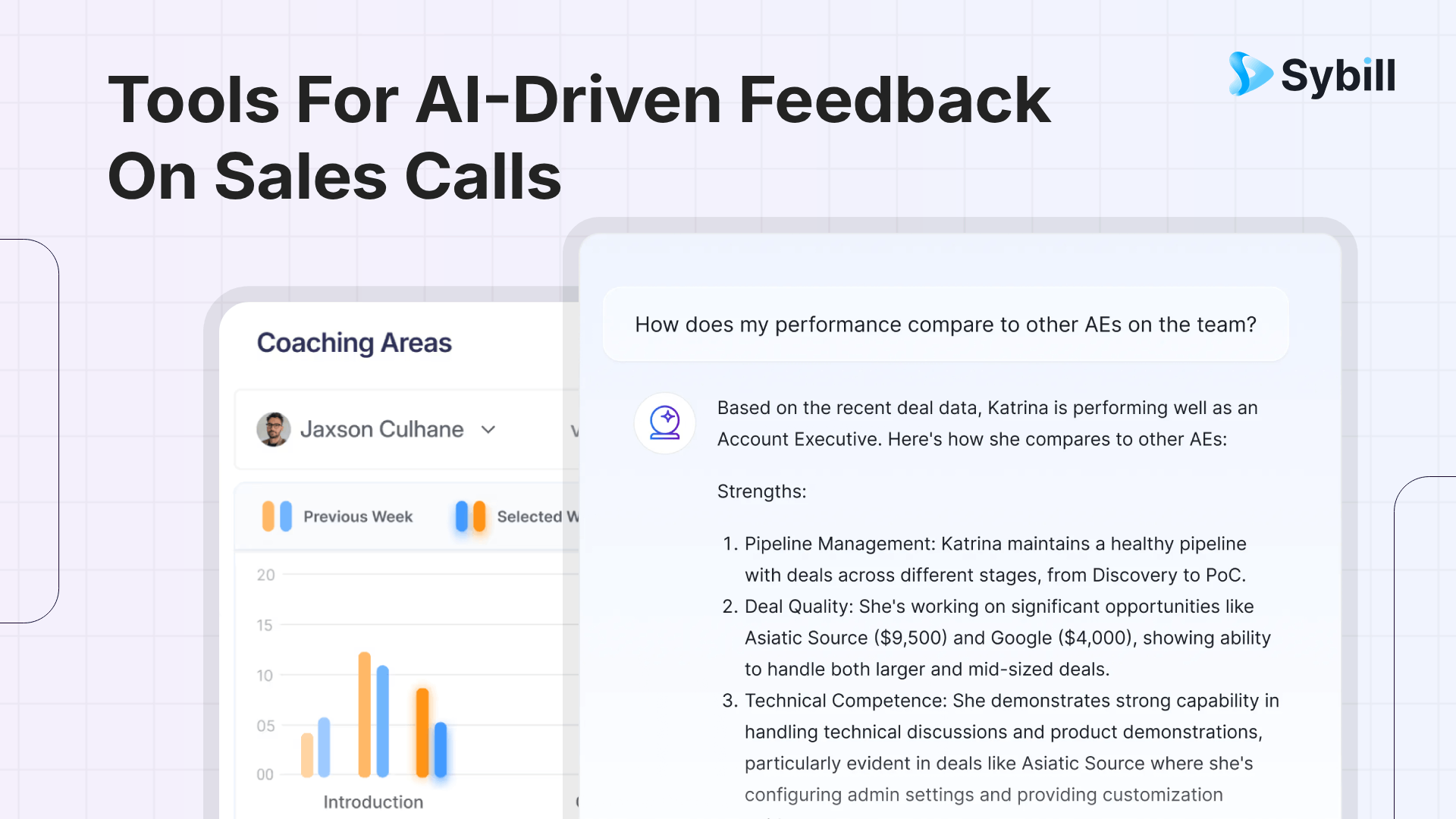
Several AI tools now give sales reps automatic, personalized feedback on their calls without waiting for a manager. Sybill leads the category by delivering structured feedback through Ask Sybill (on-demand natural language coaching), scheduled self-coaching prompts that push insights automatically, win/loss pattern analysis, and framework compliance tracking, all on top of the revenue workflow it already automates. Other tools with genuine AI-driven feedback include Salesken (real-time in-call coaching alerts), Balto (live compliance and performance prompts), Dialpad Sell (pacing and sentiment feedback during calls), and Cirrus Insight (morning coaching digests from Salesforce data). Here is what each delivers and where the tradeoffs are.
Here is the core problem. According to the State of Sales Coaching 2026 Report, 73% of sales managers spend less than 5% of their time coaching. Managers typically review only 1% to 2% of their team's calls. That means 98% of sales conversations get zero feedback.
It is not that managers do not care. It is that the average frontline manager now oversees 12 reps, each running dozens of active deals. The math does not allow for reviewing every call, even the important ones. So coaching ends up reactive. A deal stalls. The manager listens to the recording. They give feedback three days after the conversation happened. By then, the moment is gone.
What reps actually need is feedback that arrives while the insight is still actionable:
Immediately after the call: "You asked two discovery questions versus your team average of five. Here is what your top performer asks." The next morning: "Across your calls yesterday, you consistently missed confirming next steps with a specific date. Here is the pattern." Weekly: "Your MEDDIC qualification has improved on Decision Criteria but is declining on Identify Pain. Here is evidence from your last five calls."
That kind of feedback used to require a full-time coach. In 2026, AI delivers it automatically.
.png)
Not every tool that says "coaching" actually pushes feedback to reps. Many conversation intelligence platforms have coaching dashboards designed for managers, not reps. True AI-driven feedback for reps has three characteristics:
It is automatic. The rep does not have to open a dashboard, run a query, or schedule a review. The feedback comes to them, via email, Slack, or in-app notification.
It is specific. "Be more consultative" is not feedback. "In your last call, you spent 4 minutes presenting before asking a single question. Your top-performing teammate asks the first discovery question within 90 seconds" is feedback a rep can act on.
It is continuous. One piece of feedback after one call is a nice-to-have. Feedback after every call, with pattern recognition across calls, is what drives behavior change.
Best for: Reps who want always-on, deal-aware feedback that covers every call
Sybill delivers AI-driven feedback through multiple channels, and it is the only tool where feedback is informed by the full deal context, not just isolated call metrics.
After every call: Sybill's Magic Summary is itself a form of feedback. It structures the conversation around what happened (outcome, pain points, objections, next steps) and implicitly shows the rep what they captured and what they missed. If the summary's "Next Steps" section is vague, the rep knows they did not nail the close. If "Pain Points" is thin, they know discovery was weak.
On-demand via Ask Sybill: Reps query their own performance in plain English. "How did I handle objections this week?" "Where did I lose buyer engagement on the Acme demo?" "What do my won deals have in common that my lost deals do not?" Each answer pulls from actual call data, not generic advice.
Scheduled coaching prompts: This is where the "push" happens. Reps set Ask Sybill questions to run automatically. Every Monday morning: "What were my most coachable moments last week?" Every Friday: "Which deals need attention before next week?" The insights arrive in Slack or email without the rep lifting a finger.
Framework compliance tracking: Sybill's CRM autofill shows reps exactly how well they are qualifying deals against MEDDIC, BANT, or custom frameworks. If Decision Criteria is consistently empty across your deals, that is feedback on your discovery process.
Win/loss patterns: Ask Sybill to compare behaviors across won and lost deals. "What did I do differently in deals that closed versus deals that stalled?" The answers are evidence-backed and specific to your conversations.
Clip libraries for self-review: Save your best and worst moments. Review them before similar calls. Build a personal improvement library over time.
Critically, Sybill's feedback is not just about how you talked. It is about how the deal is progressing. Because Sybill already handles call summaries, CRM updates, follow-up emails, pre-meeting briefs, and deal intelligence, the feedback is grounded in the full picture of your deal, not just an audio recording.
Pricing: Free tier available. Essentials at $19/user/month. Business at $79/user/month.
.png)
Get started for free with Sybill and get AI-driven feedback that knows your deals, your patterns, and your team's winning behaviors.
Best for: Teams that want real-time coaching during live calls
Salesken takes a different approach: it delivers feedback during the call, not after. The platform monitors live conversations and surfaces real-time alerts for talk-to-listen ratio, filler words, talk speed, engagement signals, and objection detection. When a prospect raises a pricing concern, Salesken pops up a suggested response. When a rep monologues too long, it nudges them to ask a question.
The platform also generates post-call scorecards and performance analytics that reps can review independently. Managers get leaderboards and conversion funnel tracking.
Where it falls short: Real-time alerts can be distracting. Some reps find in-call prompts break their concentration rather than helping it. Post-call analytics are less deep than dedicated conversation intelligence platforms. No cross-deal querying. No CRM autofill at the depth Sybill offers. No follow-up email generation. No pre-meeting briefs. Pricing typically requires 10+ seat minimums and annual contracts in the $50 to $100/user/month range.
Best for: SDR and call center teams needing live compliance and performance prompts
Balto provides real-time coaching focused on compliance and talk track adherence. It listens to live calls and delivers instant prompts: compliance reminders, empathy cues, objection-handling suggestions, and script adherence alerts. The platform is particularly strong for regulated industries where getting the language right on every call is not optional.
Where it falls short: Balto is built for high-volume, structured call environments (SDR teams, call centers), not complex B2B deal cycles. Post-call feedback is limited compared to platforms built for AEs. No CRM autofill, no follow-up generation, no deal intelligence. The real-time focus means the tool is less useful for strategic coaching on longer, consultative sales calls. Pricing is enterprise-only.
Best for: Teams on Dialpad that want native pacing and sentiment feedback
Dialpad Sell integrates AI coaching directly into its calling platform. During live calls, it provides feedback on pacing, filler words, and listening behavior. AI Live Coach Cards display objection handling tips and product details triggered by specific phrases. Post-call, the platform generates scorecards and tracks AI Playbook adherence.
Where it falls short: Requires Dialpad as your calling infrastructure. Limited to voice calls (not Zoom/Teams/Meet video meetings). Post-call analytics are lighter than dedicated conversation intelligence platforms. No cross-deal querying, no follow-up email generation, no pre-meeting briefs. Strongest for outbound calling teams already on Dialpad.
Best for: Salesforce-first teams wanting AI-powered morning coaching digests
Cirrus Insight offers "AI Sales Coaching" that reviews your latest calls, meetings, and follow-ups each morning and delivers personalized insights to your inbox. The feedback is tied to your Salesforce data, so it connects coaching recommendations to deal context. The Live Meeting Coach also provides in-call suggestions.
Where it falls short: Deeply tied to the Salesforce ecosystem. Teams on HubSpot, Zoho, or Dynamics miss out. The coaching feedback is more dashboard-driven than conversational. No natural language querying across your full call history. Post-call coaching depth is limited compared to platforms like Sybill. Pricing is enterprise-focused.
This is a genuine debate in the sales coaching space, and the honest answer is: it depends on the sales motion.
Real-time feedback (Salesken, Balto, Dialpad) works best for high-volume, structured calls where reps follow scripts or playbooks. SDR qualification calls. Cold outreach. Compliance-heavy conversations. The prompts help reps stay on track in the moment.
Post-call feedback (Sybill, Cirrus Insight) works best for complex B2B sales cycles where the conversation is consultative, the deal spans months, and improvement comes from pattern recognition across many calls. AEs running enterprise deal cycles benefit more from knowing "you consistently miss asking about the decision timeline" than from an in-call alert about talk ratio.
The best approach is both. Real-time for in-the-moment course correction. Post-call for strategic improvement. But if you have to choose one, post-call feedback with pattern recognition drives more durable behavior change for B2B sales teams.
Having feedback available is not the same as using it. Here is how top performers actually build the habit:
Review your Magic Summary after every call. It takes 60 seconds. Look at the pain points section. Was it rich or thin? Look at next steps. Were they specific? The summary is a mirror for your call quality.
Set one scheduled coaching prompt per week. Start simple. "What is my most coachable moment from last week?" Read it Monday morning. Pick one thing to improve. That is it.
Compare yourself to what works. Ask Sybill how top performers on your team handle the same scenarios you struggle with. Self-improvement without a benchmark is self-reflection. The benchmark makes it development.
Bring AI feedback to your 1:1. The reps who get the most out of manager coaching show up with specific questions. "I noticed I keep losing engagement during pricing. Can we roleplay that?" is a 10x more productive coaching conversation than "How am I doing?"
Track improvement over time. Run the same coaching query monthly. Are your discovery calls getting richer? Are your objection-handling moments improving? Pattern recognition across months is where real growth compounds.
AI-driven feedback uses conversation intelligence to automatically analyze sales calls and deliver specific, personalized coaching insights to reps. This can happen in real time during the call (alerts, battlecards, pacing prompts) or after the call (structured summaries, performance patterns, framework compliance tracking). The goal is to close the feedback gap between the 1% to 2% of calls managers can review and the 100% of calls AI can analyze.
Sybill offers the deepest AI-driven feedback through Ask Sybill (natural language querying), scheduled coaching prompts (automatic weekly insights), win/loss analysis, framework compliance tracking, and structured Magic Summaries that function as implicit call quality feedback. For real-time in-call feedback, Salesken and Balto are the strongest options. Sybill's advantage is that its feedback is informed by the full deal context, not just call audio metrics.
No, and it should not. AI-driven feedback fills the gap between manager coaching sessions. It gives reps a daily practice layer and makes scheduled 1:1s more productive because both parties arrive with data-backed talking points. The combination of AI feedback and human coaching is where real performance gains happen.
It varies. Sybill delivers structured summaries within minutes of the call ending. Scheduled coaching prompts arrive at the configured time (daily, weekly). Real-time tools like Salesken and Balto deliver feedback during the live call. The fastest useful feedback is Sybill's Magic Summary, which serves as both a call record and implicit feedback on discovery quality, objection handling, and deal progression.
Yes, but different tools suit different roles. SDRs running high-volume, structured calls benefit from real-time prompts (Salesken, Balto). AEs running complex B2B deal cycles benefit more from post-call pattern recognition and cross-deal analysis (Sybill). The best approach matches the feedback tool to the sales motion.
Waiting for your manager to review your call is like waiting for your dentist to tell you to floss. By the time the feedback arrives, the moment has passed. AI-driven feedback changes the equation: every call gets analyzed, every pattern gets surfaced, and every rep gets personalized coaching at the speed of their pipeline.
Get started for free with Sybill and turn every sales call into a coaching moment with AI feedback that knows your deals, your patterns, and what winning looks like on your team.
AI-driven feedback uses conversation intelligence to automatically analyze sales calls and deliver specific, personalized coaching insights to reps. This can happen in real time during the call (alerts, battlecards, pacing prompts) or after the call (structured summaries, performance patterns, framework compliance tracking). The goal is to close the feedback gap between the 1% to 2% of calls managers can review and the 100% of calls AI can analyze.
Sybill offers the deepest AI-driven feedback through Ask Sybill (natural language querying), scheduled coaching prompts (automatic weekly insights), win/loss analysis, framework compliance tracking, and structured Magic Summaries that function as implicit call quality feedback. For real-time in-call feedback, Salesken and Balto are the strongest options. Sybill's advantage is that its feedback is informed by the full deal context, not just call audio metrics.
No, and it should not. AI-driven feedback fills the gap between manager coaching sessions. It gives reps a daily practice layer and makes scheduled 1:1s more productive because both parties arrive with data-backed talking points. The combination of AI feedback and human coaching is where real performance gains happen.