Find us at booth #83, join us for a harbor side happy hour, or catch Gorish’s talk.

Sept, 16-18 > Learn more


Tamanna Mishra

July 9, 2026
%20(30).png)
Your B2B sales cycle is long because modern buying is messy. There are more stakeholders, more tools, more approvals, more risk checks, and more internal “let’s circle back next week” energy than ever.
According to Forrester’s 2026 State of Business Buying report, the typical B2B buying decision now includes 13 internal stakeholders and nine external influencers. That number rises for more complex or strategic purchases. Translation: your buyer is not just buying software. They are trying to survive a committee meeting.
At the same time, sales reps are still buried in work that does not look like selling. Salesforce reports that sales reps spend 60% of their time on non-selling tasks. CRM updates. Follow-up emails. Searching for the right deck. Reconstructing call notes from memory. All the glamorous stuff nobody put on the job description.
That is why B2B sales cycle optimization cannot be reduced to “follow up faster” or “create urgency.” Cute advice. Deeply insufficient.
The real goal is not to rush buyers. The goal is to remove avoidable drag from the buying process. Better qualification. Cleaner discovery. Stronger stakeholder alignment. Faster follow-through. More accurate CRM data. Earlier deal risk detection. Less admin theatre.
And yes, AI can help. Not the “paste a transcript into ChatGPT and pray” kind of AI. The useful kind that understands your sales calls, CRM data, emails, deal history, next steps, and buyer signals.
That is where Sybill comes in. Sybill helps sales teams shorten the dead space between meetings by turning conversations into summaries, CRM updates, follow-ups, deal insights, and next actions. Magic Summaries capture what happened in customer calls. CRM Autofill updates deal fields automatically. Pre-meeting Briefs help reps walk into calls with context. Ask Sybill lets teams ask questions across calls, emails, CRM, Slack, and sales data instead of digging through everything manually.
In plain English: Sybill helps revenue teams see why deals are moving, why they are stuck, and what needs to happen next.
B2B sales cycle optimization is the process of improving how deals move from first touch to closed won. It is not only about making the sales cycle shorter. It is about making the buying process clearer, faster, more predictable, and less dependent on heroic rep memory.
A good sales cycle tells your team what usually happens between prospecting and close. A good sales process tells reps how to move buyers through those stages. Sales cycle optimization asks the harder question:
Where are deals getting stuck, and what can we fix?
That could mean improving qualification so bad-fit opportunities do not clog the pipeline. It could mean helping reps identify stakeholders before the demo. It could mean creating stronger business cases, sending better follow-ups, updating CRM fields accurately, or spotting deal risk before the forecast call turns into a crime scene investigation.
For a deeper breakdown of the full sales cycle structure, read Sybill’s guide on sales cycle stages, examples, and management.
Some long sales cycles are normal. Enterprise deals often need procurement, security, legal, finance, IT, implementation planning, and executive approval. Nobody is buying a six-figure platform the way they buy socks at midnight.
But many sales cycles become longer than they need to be because of fixable execution gaps.
The most common culprits are:
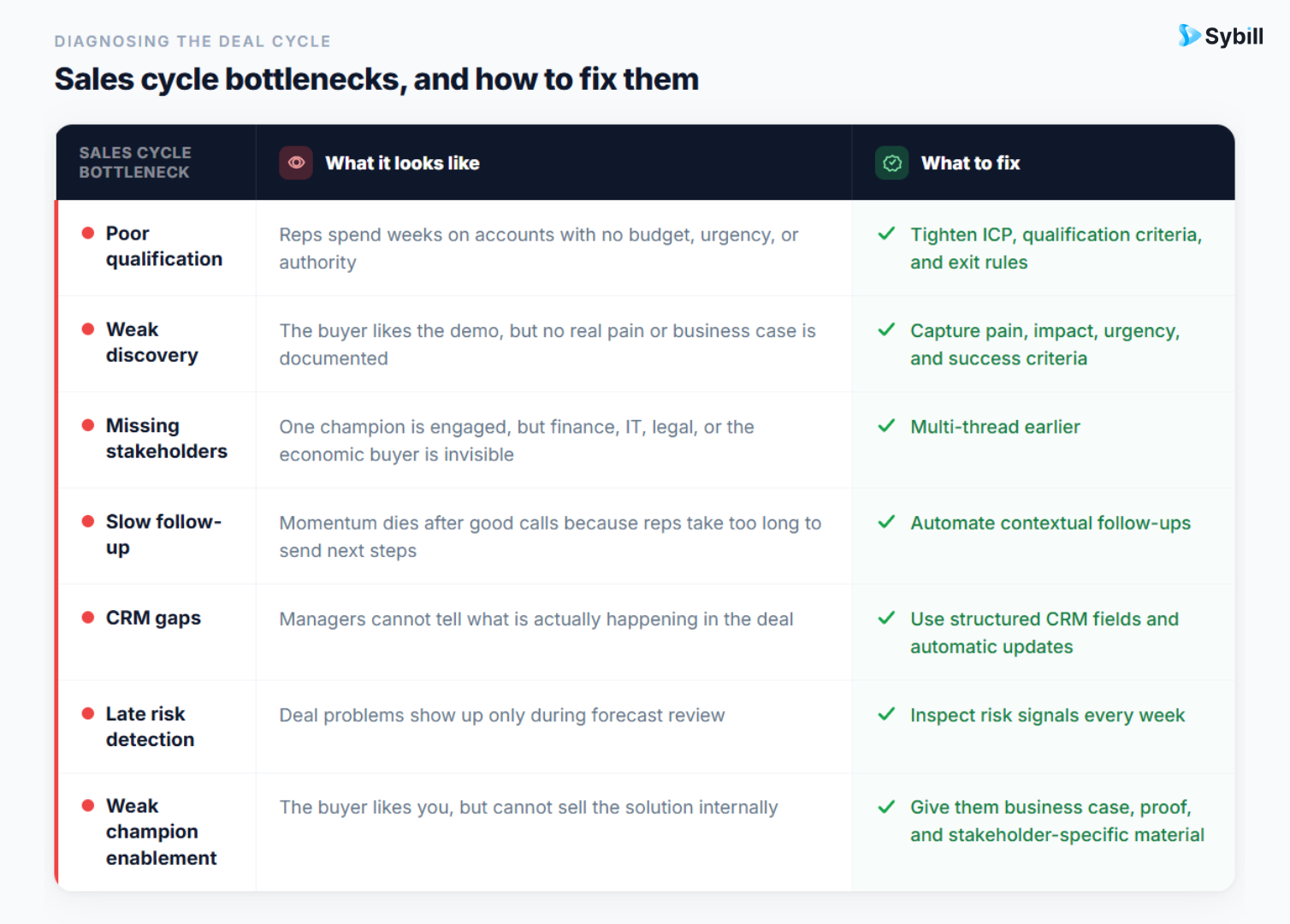
The annoying part is that many of these risks are visible before the deal slips. They show up in buyer language, meeting notes, stakeholder participation, pricing questions, competitor mentions, and vague next steps. The problem is that those signals are usually scattered across calls, emails, Slack threads, and half-updated CRM records.
That is not a sales cycle. That is a group project with worse documentation.
The classic B2B sales cycle usually includes prospecting, qualification, research, pitching, objection handling, closing, and nurturing. That is a decent starting point, and the existing version of this blog already covers those basics.
But modern B2B sales needs a more realistic version. Today’s cycle is not a neat relay race. It is more like a season of Succession, except everyone is forwarding pricing decks instead of betraying their siblings.
Here is a more useful version of the B2B sales cycle:
Before you worry about closing faster, worry about entering the right deals. Poor-fit accounts make every downstream metric look worse. If the buyer does not have the problem, urgency, budget, authority, or operating pain your product solves, the sales cycle will stretch because there is nothing real pulling the deal forward.
Qualification should answer four questions: Is there a real problem? Is it important now? Can this account buy? Are we speaking to someone who can influence the decision?
This is where teams need discipline. “They took a call” is not qualification. That just means your calendar worked.
Discovery is where sales cycles are either shortened or quietly doomed. Great discovery captures business pain, current process, cost of inaction, stakeholder priorities, decision criteria, timeline, and risks.
Weak discovery creates “good demo, no movement” deals. The buyer nods. The rep gets excited. The CRM says “next step pending.” Everybody loses.
This is where the pitch or demo should connect directly to what the buyer cares about. Not every feature deserves airtime. Your demo is not a museum tour.
The goal is to show how your product solves the buyer’s specific problem, supports their internal priorities, and creates a clear business case for change.
This is now one of the most important stages in B2B sales. If your deal depends on one champion, your deal is wearing flip-flops to a marathon.
Sales teams need to identify economic buyers, technical evaluators, finance approvers, legal reviewers, end users, blockers, and hidden influencers. For a practical workflow, read Sybill’s guide on how to research multiple stakeholders before a demo.
The buyer needs to justify the decision internally. That means your champion needs proof, numbers, use cases, implementation clarity, security answers, and stakeholder-specific messaging.
This is where deals often slow down because reps mistake interest for internal readiness.
This stage is rarely glamorous, but it is where many deals die of “process.” If procurement, legal, finance, or security enter late, your close date becomes fan fiction.
Good sales cycle management means identifying these steps early and building them into the mutual action plan.
Closed won is not the finish line. It is the handoff point. A messy handoff creates churn risk, poor adoption, and a bad customer experience. Sales cycle optimization should include customer success context, not just contract signature energy.
The best sales cycles do not end at acquisition. They create better expansion, renewal, and referral opportunities because the team understands the customer’s goals, stakeholders, and success criteria from day one.
Here is where AI becomes genuinely useful. Not because it magically makes buyers approve budgets faster. Sadly, even AI cannot make finance thrilling.
AI helps when it removes the busywork and visibility gaps that slow deals down.
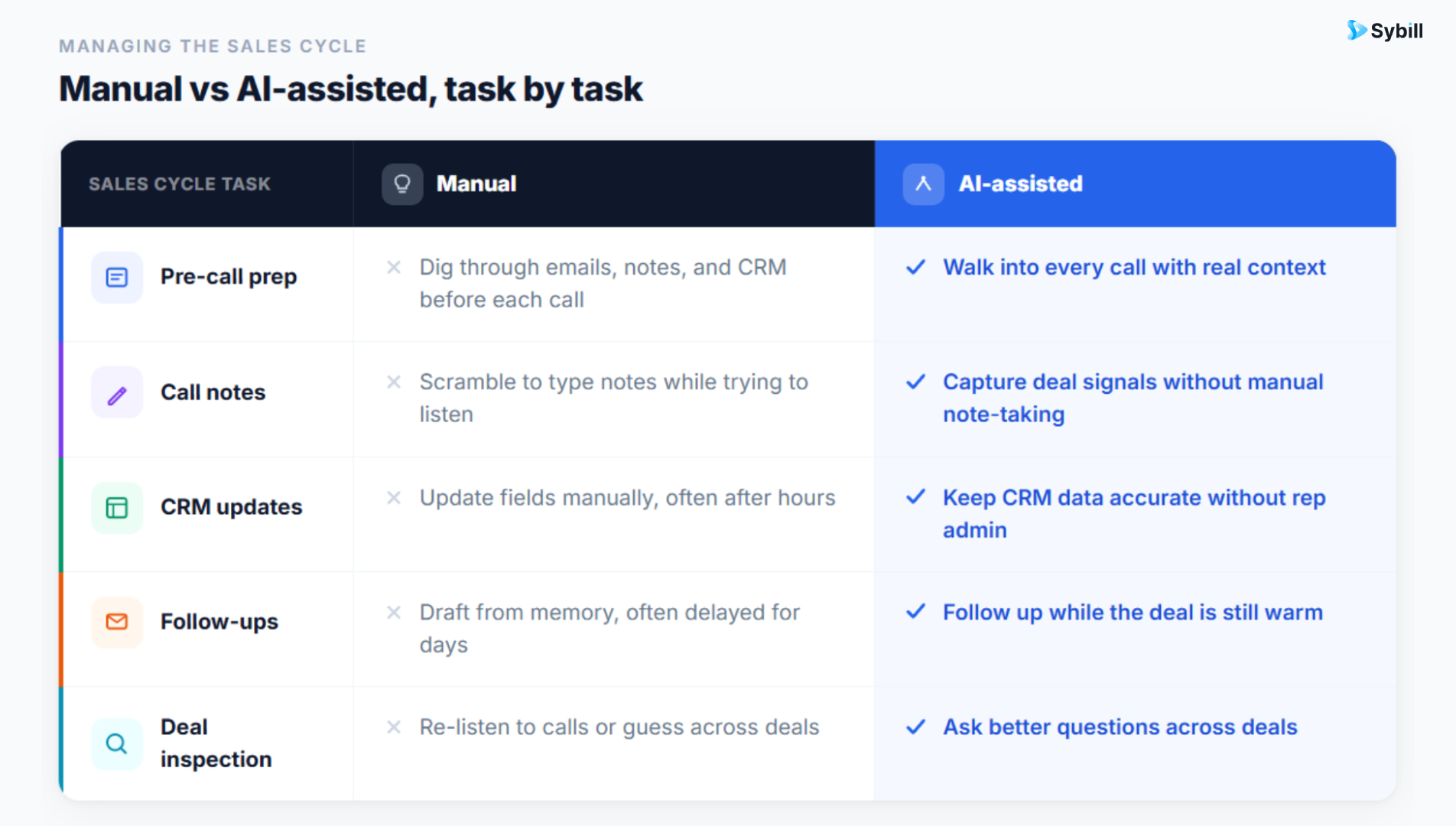
A rep should not enter a discovery call by speed-reading CRM notes like they are cramming for an exam. Sybill’s Pre-meeting Briefs scan calendar, calls, email, CRM, and other sources to help reps prepare before meetings.
That matters because better prep leads to sharper discovery. Sharper discovery leads to better demos. Better demos lead to clearer next steps. No one needs another “just checking in” email floating through the void.
Sales calls are full of signals: pain points, objections, buying intent, competitor mentions, decision criteria, budget concerns, stakeholder references, and next steps.
The problem is that reps cannot fully listen, sell, think strategically, and capture perfect notes at the same time. They are sellers, not court stenographers.
Magic Summaries help capture what happened in customer conversations so teams can see the deal story without digging through transcripts.
For more on this category, read Sybill’s guide on what conversation intelligence is.
Sales cycle optimization collapses when CRM data is stale. A deal can show the right stage, amount, and close date while the actual buyer conversation is screaming, “this is not closing this month.”
Sybill’s CRM Autofill captures important details from meetings and emails and updates CRM fields automatically. It can capture next steps, competitors, qualification fields, methodologies like MEDDPICC or BANT, and deal signals after calls and emails. (Sybill)
That gives managers cleaner pipeline visibility without forcing reps to spend their best selling hours doing data entry.
The gap between a good call and a good follow-up is where deal momentum often goes to die.
A strong follow-up should recap the actual conversation, confirm priorities, document open questions, share promised resources, and lock the next step. A weak follow-up says “great chatting” and then wanders off into irrelevance.
Sybill helps reps create contextual follow-ups from real call data. For more tactical advice, read Sybill’s guide to sales follow-up emails that get quick responses.
Managers should not have to wait until forecast review to learn that five deals have no economic buyer, three are stuck in procurement, and two have unresolved competitor concerns.
Ask Sybill lets teams ask plain-language questions across CRM, email, Slack, calls, and historical sales context. That makes it easier to inspect patterns like:
This is the difference between managing deals from evidence and managing deals from vibes. Vibes are for playlists. Not pipeline.
Now let’s get practical. Here is how to make the sales cycle faster, cleaner, and less chaotic.
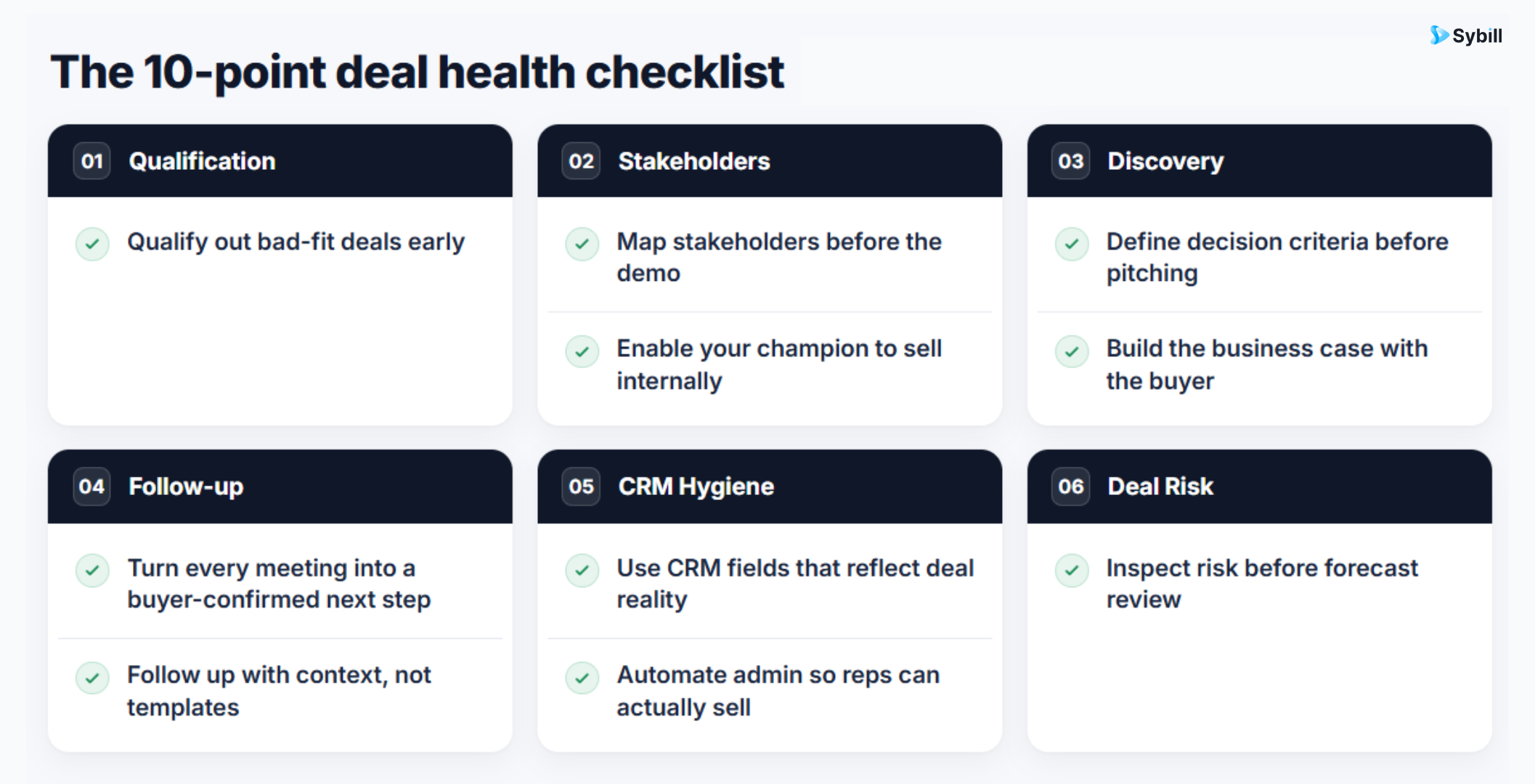
The fastest way to shorten your average sales cycle is to stop dragging dead deals through the pipeline like they owe you money.
Qualification should not be a polite formality. It should identify whether the account has a real problem, a clear owner, business urgency, buying power, and a reason to act now.
Ask:
If the answers are vague, the deal is not necessarily dead. But it is not forecast-ready either.
A single-threaded deal can look healthy until your champion goes silent, changes jobs, loses influence, or gets outvoted by someone you never met.
Modern B2B sales requires multi-threading. That means identifying everyone who can influence, approve, block, use, fund, evaluate, or delay the purchase.
Use the first discovery call to ask about the buying process. Then use every meeting to expand the map.
Useful questions:
Also read: Multi-threading best practices for sales reps.
Do not demo first and discover later that the buyer’s real priority was security, migration effort, executive reporting, or integration with a very specific tool someone forgot to mention.
Decision criteria should be clear before the pitch.
Ask:
Once you know the criteria, your pitch gets tighter. You stop showing everything and start proving the right things.
Buyers do not only need to like your product. They need to justify it.
That means your champion may need to explain the problem, cost of inaction, expected business impact, implementation effort, risks, and return to people who were not on the call.
Help them.
Give your champion clear business case material. Translate features into outcomes. Turn pain points into measurable impact. Document what the current process costs in time, revenue leakage, manual work, poor visibility, missed follow-ups, or forecast risk.
This is especially important when your buyer has to persuade finance. Finance does not care that the dashboard is “beautiful.” Finance wants to know what breaks if the company does not buy.
A next step is not “we will reconnect soon.”
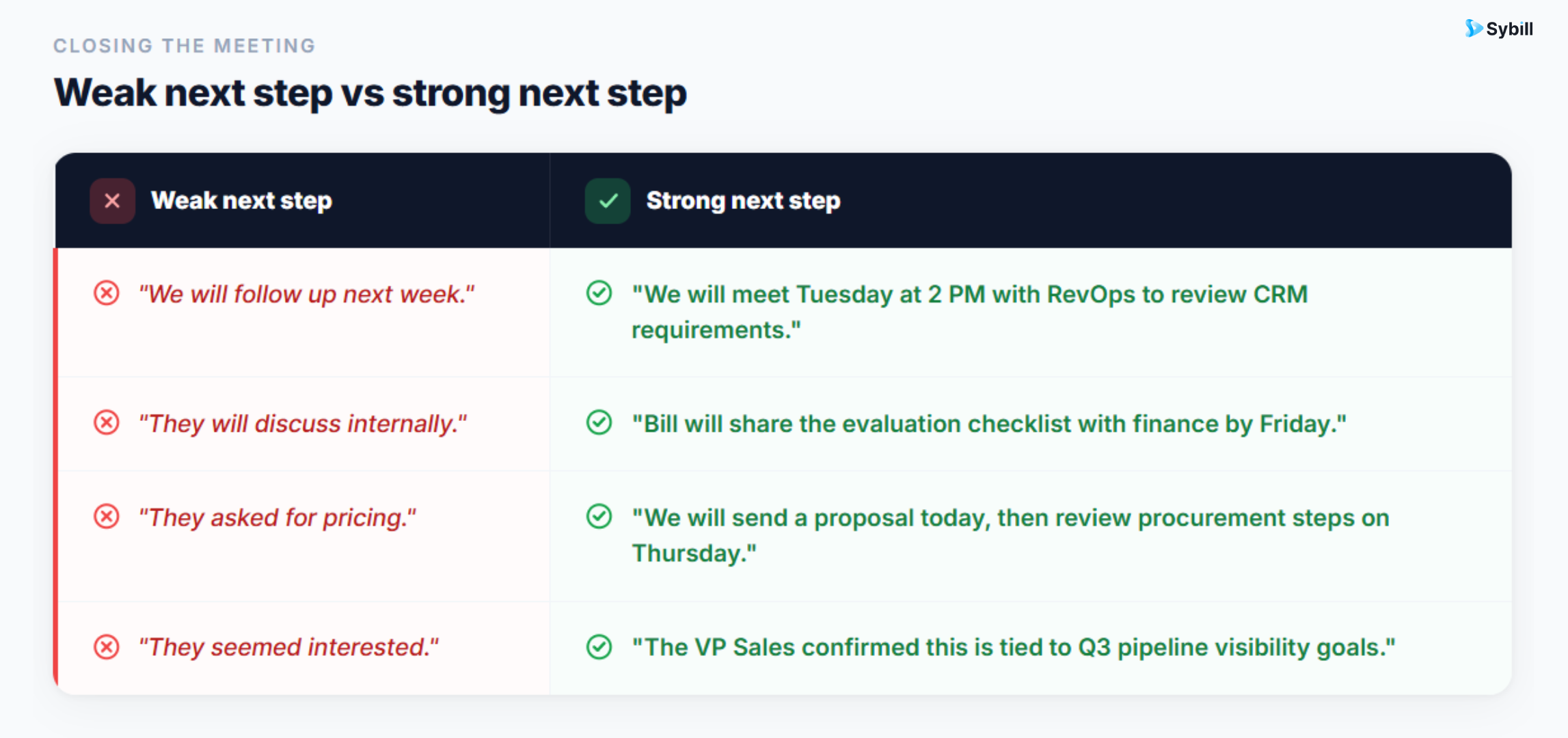
If the buyer has not agreed to a specific action, owner, and timeline, the deal has not moved. It has only smiled politely.
For a deeper risk lens, read Sybill’s guide on how to spot deal risk before forecast review.
Templates are fine. Template energy is not.
A good follow-up should prove you listened. It should summarize the buyer’s priorities, clarify open items, share relevant resources, and confirm the next action. It should feel like the natural continuation of the meeting, not a mail merge wearing a blazer.
With AI follow-ups, the difference comes from context. Generic AI can write a decent email if you feed it enough information. But a sales-native AI assistant like Sybill can draft follow-ups using actual meeting context, buyer pain points, objections, CRM data, and next steps.
That saves time, but more importantly, it preserves momentum.
A CRM filled with vague fields is not a revenue system. It is a spreadsheet with ambition.
To optimize your sales cycle, your CRM should capture the signals that actually affect deal movement:
This is where CRM Autofill becomes commercially powerful. It reduces manual updates while improving the quality of deal data managers rely on.
Forecast review should not be the first time a manager realizes a deal is held together with optimism and one enthusiastic champion.
Deal risk appears early. It shows up in vague timelines, missing stakeholders, pricing hesitation, sudden silence, competitor mentions, weak business cases, and next steps that are not buyer-confirmed.
Managers should inspect active deals weekly and ask:
For a practical meeting structure, read Sybill’s guide on how to run a sales pipeline review meeting.
Your champion may like you. Wonderful. Unfortunately, your champion also has a job, a boss, a budget process, and a room full of people asking annoying but valid questions.
Help them sell internally.
Give them:
The goal is to make your champion look smart in the rooms you are not invited to.
You cannot optimize a sales cycle while reps are buried in notes, CRM updates, follow-ups, call reviews, task tracking, and “where did I save that deck?” scavenger hunts.
Automation matters because every delay has a compounding effect. Late notes lead to weak CRM data. Weak CRM data leads to bad pipeline reviews. Bad pipeline reviews lead to late risk detection. Late risk detection leads to slipped deals.
Sybill helps automate the execution layer: meeting summaries, CRM updates, email follow-ups, task capture, deal context, and pipeline questions. That gives reps more time to sell and managers a clearer view of what is actually happening.
Also read: How to use AI to shorten your sales cycle.
You cannot optimize what you only discuss emotionally in forecast calls. Track these metrics:
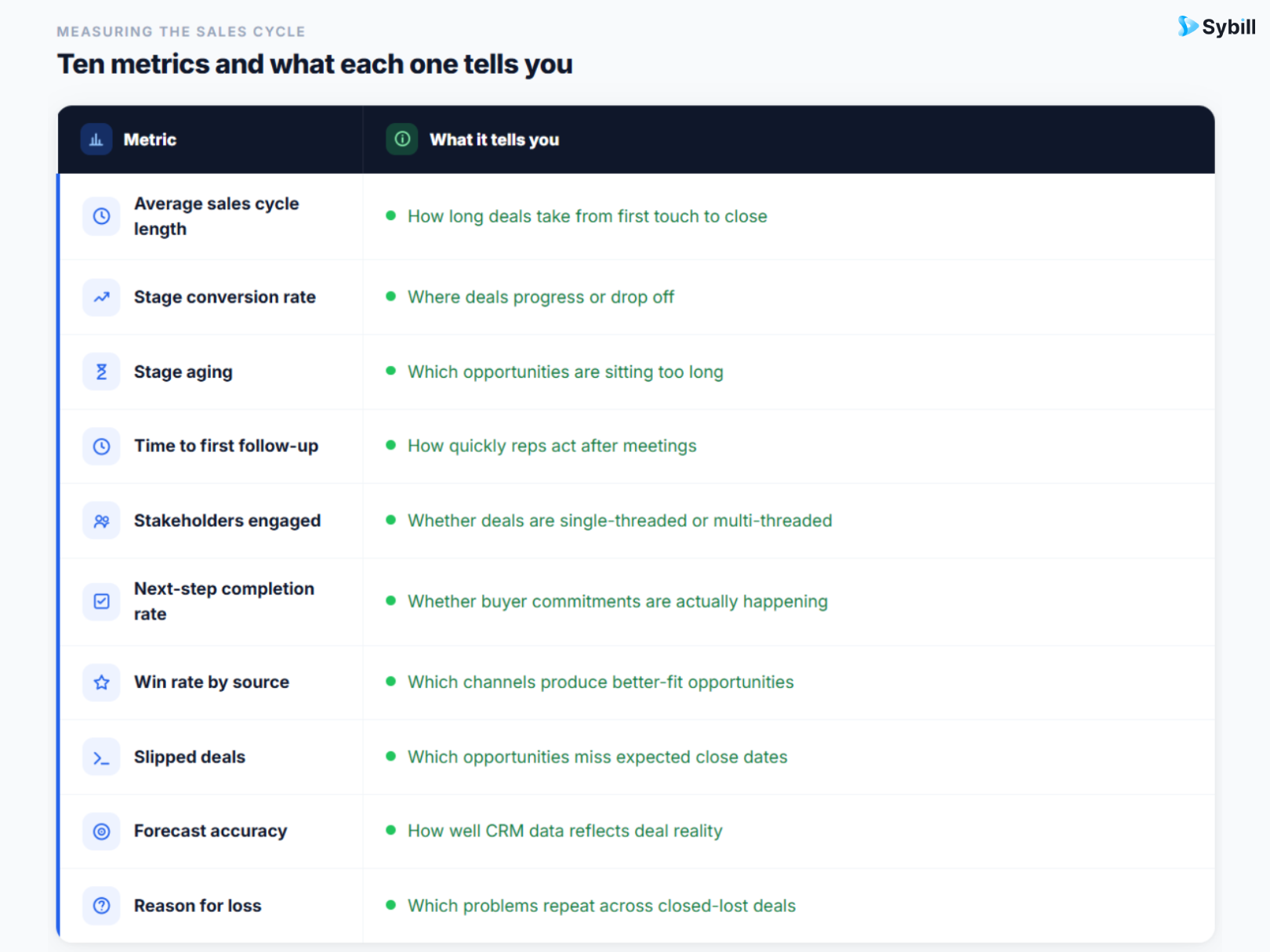
Sales teams have enough dashboards to open a small museum. The important part is connecting metrics to action.
If stage aging is high, inspect next steps. If win rate is low, inspect qualification and discovery. If forecast accuracy is weak, inspect CRM hygiene and deal risk. If follow-up time is slow, automate the follow-up workflow.
Not every long sales cycle is bad.
Some deals need time because the purchase is complex, strategic, expensive, or risky. Enterprise buyers may need legal review, procurement negotiation, security approval, implementation planning, finance sign-off, and multiple stakeholder conversations.
Trying to artificially rush that process can backfire. You may create pressure, but you will not create trust.
The right goal is to shorten friction, not due diligence.
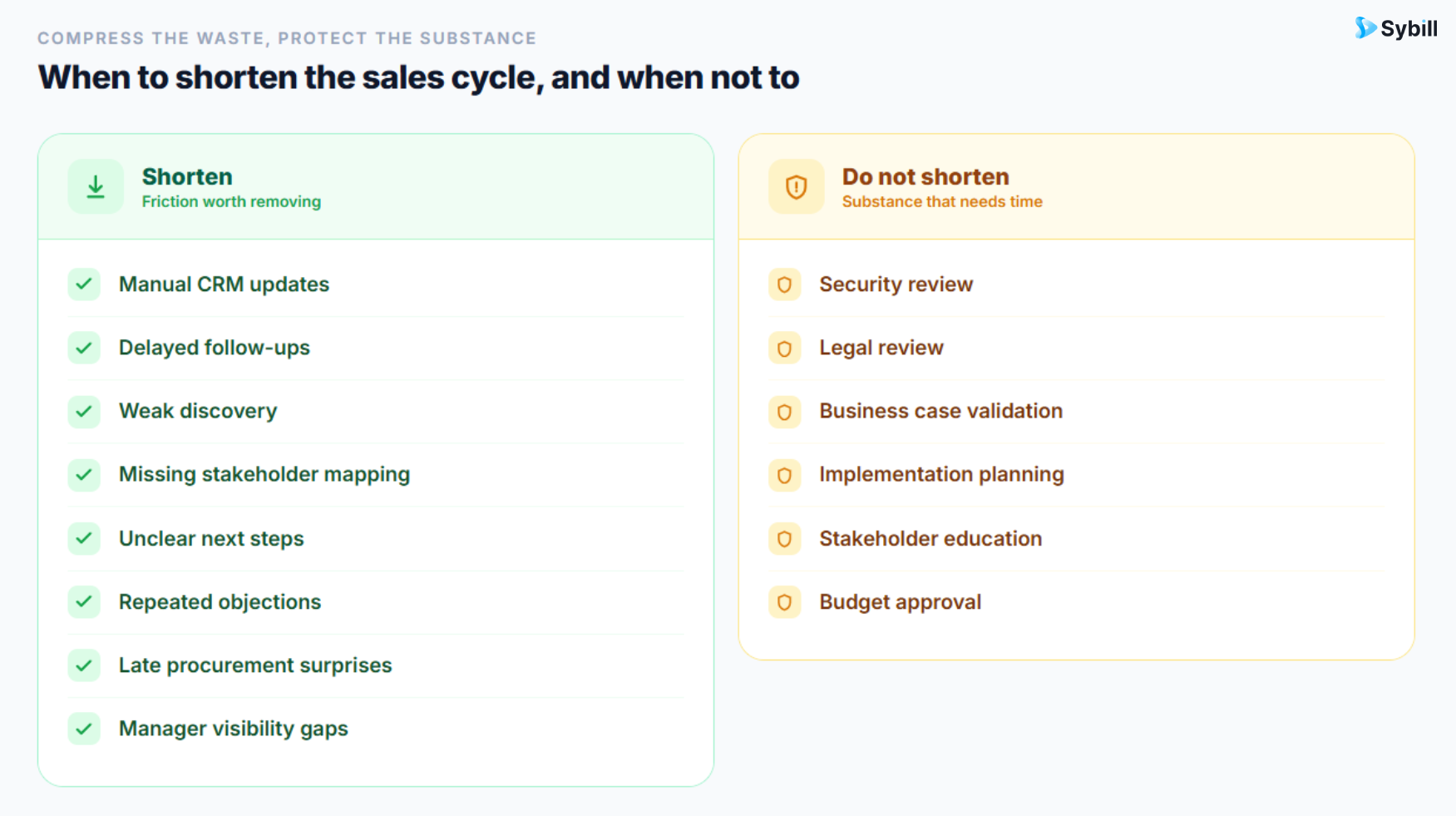
The best sales teams do not bully buyers into moving faster. They make it easier for buyers to move.
You will know your sales cycle optimization work is paying off when:
The big sign? Your team stops arguing about whether a deal “feels good” and starts inspecting buyer evidence. That is the difference between a pipeline and a wish list.
B2B sales cycle optimization is not about pushing buyers through your process faster. It is about removing the friction that makes buying harder than it needs to be.
The modern buyer is surrounded by stakeholders, external influencers, internal politics, competing priorities, budget pressure, legal checks, and risk concerns. If your team is also adding slow follow-ups, stale CRM data, weak discovery, and unclear next steps, congratulations. You have become part of the problem.
The fix is not another motivational Slack message.
The fix is better sales execution.
Sybill helps revenue teams capture deal context, update CRM fields, automate follow-ups, inspect risks, prepare for meetings, and ask smarter questions across the pipeline. That means reps can spend less time reconstructing what happened and more time moving deals forward.
Want to see where your deals are slowing down and what your team should do next? Try Sybill for free.
B2B sales cycle optimization is the process of improving how deals move from prospecting to close. It focuses on reducing bottlenecks, improving qualification, aligning stakeholders, strengthening follow-ups, improving CRM accuracy, and identifying deal risk earlier.
You can shorten a B2B sales cycle by qualifying bad-fit deals earlier, mapping stakeholders before the demo, clarifying decision criteria, building a strong business case, sending faster follow-ups, keeping CRM data accurate, and inspecting risk before forecast review.
Long B2B sales cycles are usually caused by poor qualification, unclear business value, missing decision-makers, slow follow-up, budget uncertainty, legal or procurement delays, competitor evaluation, security review, and weak internal buyer alignment.
AI can help optimize the sales cycle by summarizing customer calls, identifying buyer signals, drafting follow-ups, updating CRM fields, preparing reps before meetings, capturing next steps, and helping managers inspect deal risk across the pipeline.
B2B teams should track average sales cycle length, stage aging, stage conversion rate, time to follow-up, number of stakeholders engaged, next-step completion rate, win rate, slipped deals, forecast accuracy, and reasons for closed-lost opportunities.
No. A shorter sales cycle is only better when it removes unnecessary friction. Strategic enterprise deals may need longer timelines for legal, security, procurement, budget, and implementation review. The goal is to shorten avoidable delays, not rush necessary due diligence.
B2B sales cycle optimization is the process of improving how deals move from prospecting to close. It focuses on reducing bottlenecks, improving qualification, aligning stakeholders, strengthening follow-ups, improving CRM accuracy, and identifying deal risk earlier.
You can shorten a B2B sales cycle by qualifying bad-fit deals earlier, mapping stakeholders before the demo, clarifying decision criteria, building a strong business case, sending faster follow-ups, keeping CRM data accurate, and inspecting risk before forecast review.
Long B2B sales cycles are usually caused by poor qualification, unclear business value, missing decision-makers, slow follow-up, budget uncertainty, legal or procurement delays, competitor evaluation, security review, and weak internal buyer alignment.