Find us at booth #83, join us for a harbor side happy hour, or catch Gorish’s talk.

Sept, 16-18 > Learn more

%20(1).avif)
Mamta Tainwala

April 3, 2026

Every revenue leader eventually faces the same question: should we sell directly to customers, or should we sell through partners?
The answer shapes everything downstream. Your hiring plan. Your margin structure. Your customer relationships. Your sales tech stack. Your ability to scale into new markets without burning through the runway.
Direct sales and channel sales are not interchangeable approaches. They operate on fundamentally different principles, require different organizational muscles, and produce different economic outcomes. Choosing wrong does not just slow you down. It can actively undermine your go-to-market strategy at the exact moment you need it to work.
This guide breaks down both models with the clarity that sales leaders, founders, and RevOps professionals need to make this decision well. We will cover what each model is, how they differ, when each one wins, how to run a hybrid approach, and how AI tools like Sybill amplify the effectiveness of whichever model you choose.
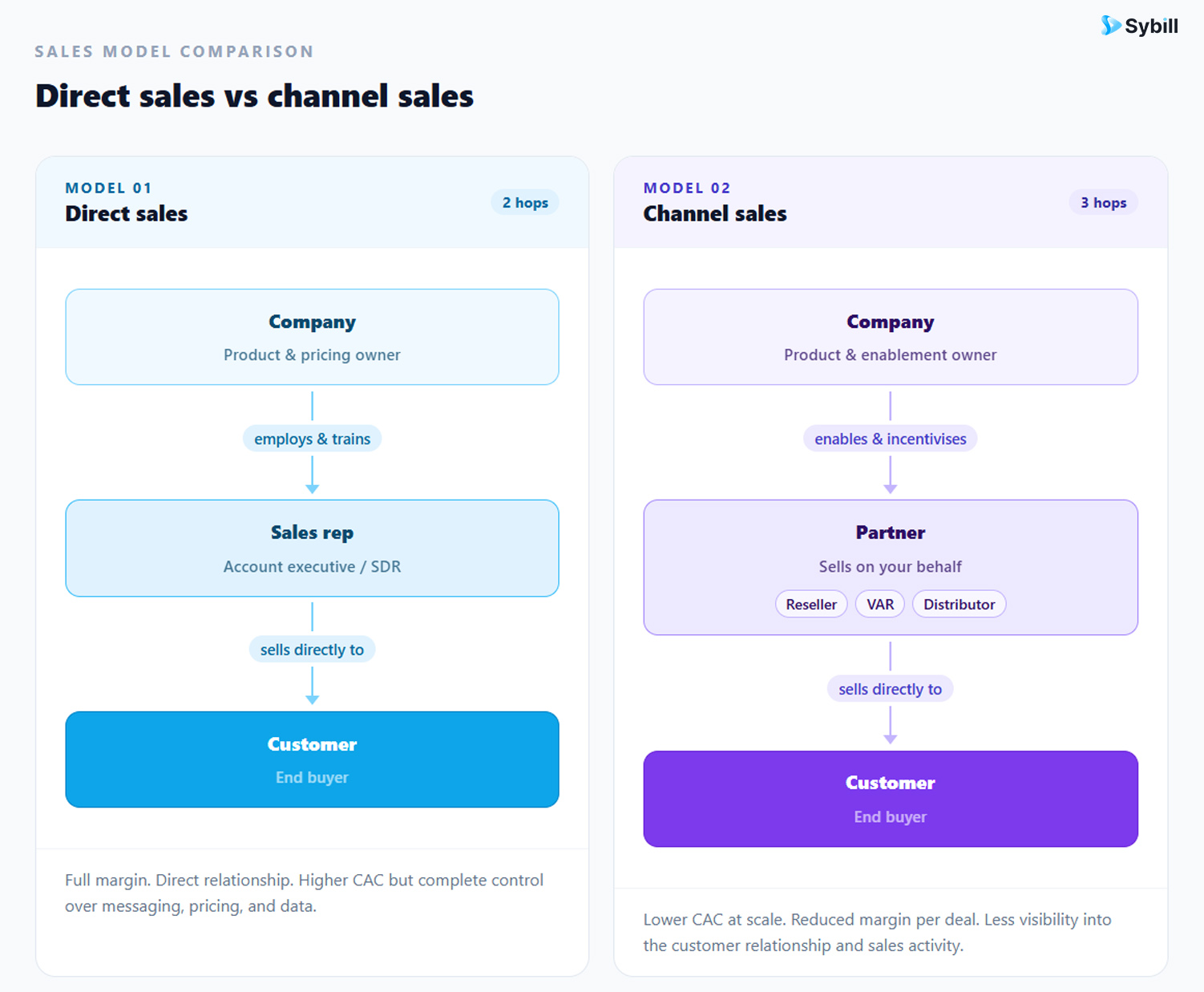
Direct sales is a model where a company sells its product or service directly to the end customer through its own team. No intermediaries, no resellers, no partners in the transaction chain.
The company controls the entire sales process from first touch to signed contract: prospecting, discovery calls, demos, negotiations, closing, and post-sale relationship management. The sales team is in-house, reports to the company, and operates under the company's playbook.
Direct sales is common in B2B SaaS, healthcare technology, enterprise software, and high-value consumer products. Think of companies like Tesla selling directly through their own stores and website, or a SaaS company whose account executives run the full cycle from outbound prospecting to closed-won.
The defining characteristic of direct sales is ownership. You own the customer relationship, you own the data, you own the brand experience, and you own the margin.
Channel sales is a model where a company sells its product or service through third-party partners rather than (or in addition to) its own sales team. These partners can include resellers, distributors, value-added resellers (VARs), managed service providers (MSPs), system integrators, affiliate partners, or marketplace platforms.
The company does not interact with the end customer directly during the sales process. Instead, the partner identifies the opportunity, runs the sales cycle, and closes the deal. The company provides the product, pricing, marketing collateral, and partner enablement, then shares a portion of the revenue with the partner.
Channel sales is the backbone of companies like Microsoft, Cisco, and HubSpot, all of which generate a significant percentage of their revenue through partner ecosystems. In B2B SaaS specifically, research from Iconiq Capital's State of GTM report shows that surveyed companies derived 20% or more of their revenue from channel sales between 2023 and 2025, and nearly half of small and medium businesses involve channel partners in their technology buying decisions.
The defining characteristic of channel sales is leverage. You trade margin and control for reach and scale.
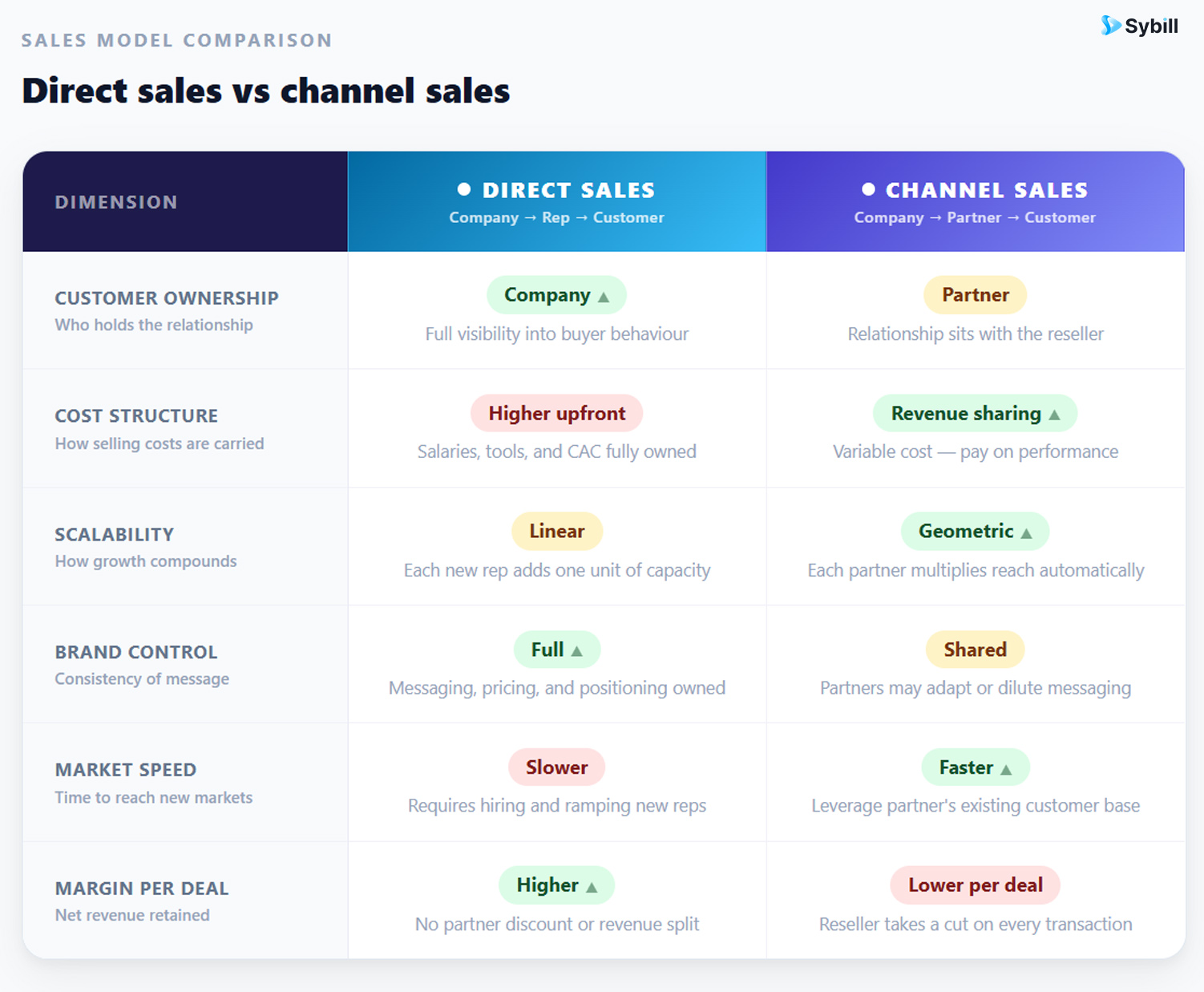
Understanding the structural differences between these models helps you align your sales strategy with your actual business goals.
In direct sales, your team owns every interaction. Reps build personal relationships with buyers, understand their pain points firsthand, and control the narrative from first contact through renewal. This creates a tight feedback loop between what customers need and what your product team builds.
In channel sales, the partner owns the customer relationship. Your company sits one step removed from the buyer, which means you depend on partners to represent your brand accurately, communicate your value proposition effectively, and surface customer feedback. Some companies mitigate this by maintaining a partner success team that maintains indirect relationships, but the fundamental dynamic is different.
Direct sales requires higher upfront investment. You are hiring, training, managing, and compensating an in-house sales team. Salaries, commissions, benefits, sales tools, and management overhead all add up. The cost of a single enterprise AE (fully loaded) can easily exceed $150,000 to $250,000 annually before they close their first deal.
Channel sales shifts much of that cost to the partner. You do not hire the salespeople who sell your product. Instead, you share revenue through commissions, margins, or referral fees. Your costs are concentrated in partner recruitment, enablement, co-marketing, and a partner management team. Per-deal costs are often lower, but margin per deal is also lower because the partner takes a cut.
Direct sales scales linearly. More revenue requires more reps. Each new rep takes time to hire, onboard, and ramp. In a competitive talent market, this can be a significant bottleneck. Pipeline management complexity also grows with team size.
Channel sales can scale geometrically. Each new partner brings their own customer base, market presence, and sales capacity. Adding 10 partners who each close 5 deals per quarter is equivalent to adding 50 deals without hiring a single rep. The trade-off is that partner performance is variable and harder to control.
Direct sales gives you complete control over how your brand is represented. Every email, call, demo, and proposal reflects your messaging, your positioning, and your values.
Channel sales requires trust. Partners will represent your product alongside (or against) other products they sell. They may emphasize features differently, discount differently, or position your solution in ways you did not intend. Strong partner enablement reduces this risk but never eliminates it entirely.
Channel sales wins on speed to new markets. If you need to enter a geography, vertical, or customer segment where you have no presence, a partner who already has relationships there can open doors in weeks that would take your direct team months to crack.
Direct sales is slower but more controlled. You build presence methodically, usually starting with a beachhead market and expanding outward as you learn and iterate.
Full margin retention. No revenue sharing with partners means higher profit per deal. For high-ACV products, this margin advantage compounds significantly.
Deeper customer relationships. Direct interaction with buyers creates stronger relationships, better retention, and more upsell opportunities. Your team hears firsthand what customers need, which feeds directly into product development and expansion plays.
Tighter feedback loops. When your own reps are on every call, insights about market shifts, competitive positioning, and buyer objections flow directly back to leadership. Tools like Sybill's conversation intelligence make this even more powerful by automatically capturing and structuring these insights across every deal.
Brand consistency. You control the message. Every touchpoint reflects your positioning, tone, and value proposition exactly as intended.
Better forecasting. With direct ownership of the pipeline, sales forecasting is more reliable because you have visibility into every deal's activity, engagement, and health.
Expensive to scale. Every new market, segment, or growth target requires more headcount. Hiring good reps is competitive and time-consuming.
Slower market penetration. Entering new geographies or verticals without existing relationships requires building from scratch.
Management complexity. Larger direct teams require more managers, more coaching infrastructure, and more operational overhead. Effective sales coaching at scale becomes a significant challenge.
Resource ceiling. There is a practical limit to how many deals your team can manage simultaneously, which creates a growth bottleneck during high-demand periods.

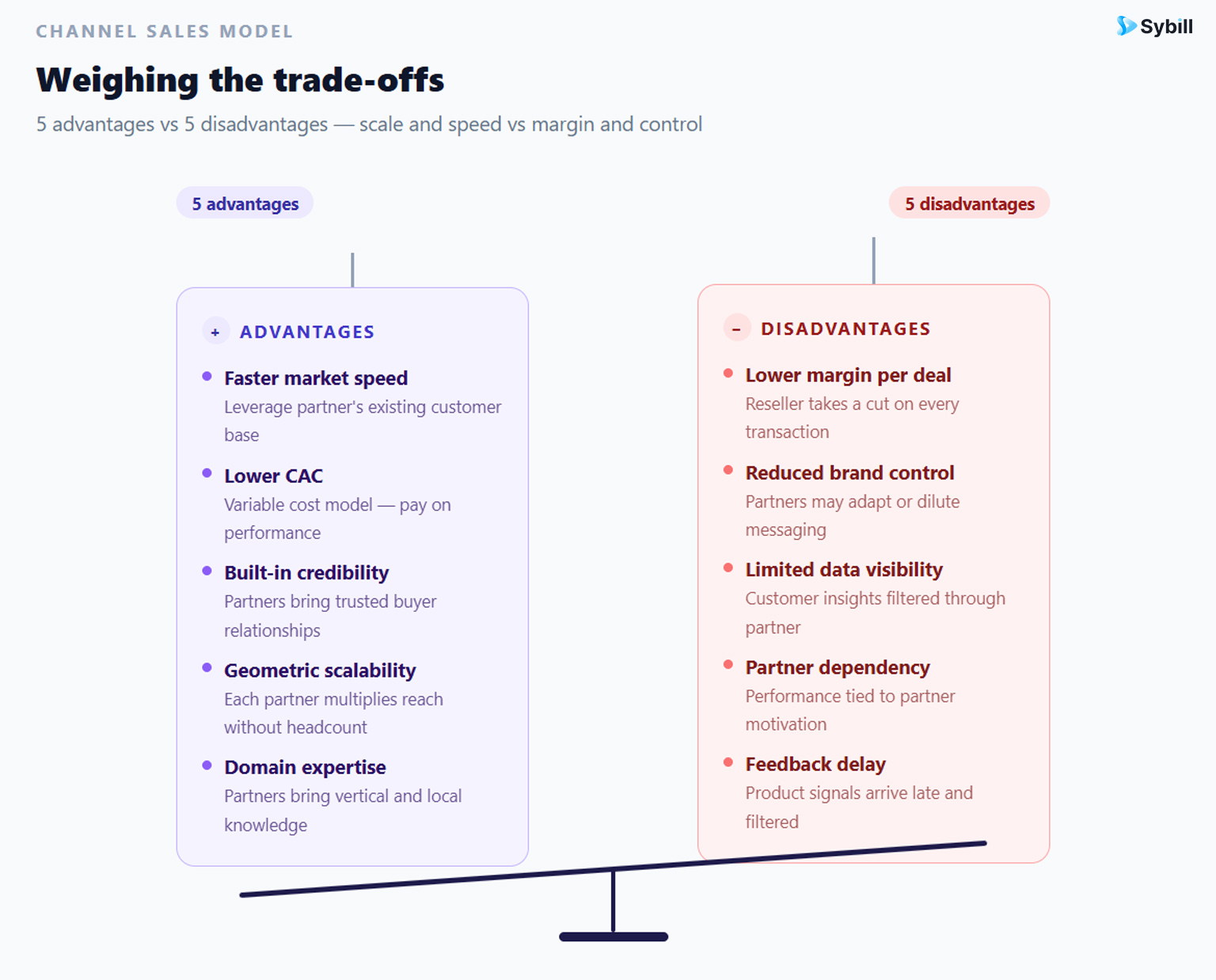
Rapid market expansion. Partners provide instant access to markets, verticals, and customer segments you could not reach on your own timeline or budget.
Lower cost per acquisition. You avoid the full cost of hiring and maintaining an in-house team for every new market. Partner commissions are variable costs tied to actual revenue, which is more capital-efficient.
Built-in credibility. When a trusted local partner recommends your product, it carries weight that a cold outbound email from an unknown vendor never will. This warm introduction dynamic is increasingly valuable as customer acquisition costs rise.
Scalability without linear headcount. You can grow revenue significantly without proportionally growing your sales organization. This is particularly attractive for companies approaching or beyond product-market fit who want to accelerate without dilutive hiring.
Complementary expertise. Partners often bring domain expertise, implementation services, or customer success capabilities that complement your product, creating a more complete solution for buyers.
Reduced margin per deal. Revenue sharing with partners means lower profit per transaction. Depending on the partner model, this can range from 10% to 40% of the deal value.
Less control over the sales experience. You are trusting someone outside your organization to represent your product accurately and sell it effectively. Partner quality varies, and poor partner experiences reflect on your brand.
Weaker customer data. When a partner owns the relationship, you may receive limited data about the buyer's needs, objections, and decision process. This creates blind spots for product development and account management.
Partner dependency risk. If a key partner underperforms, changes strategic direction, or starts promoting a competitor, the revenue impact can be sudden and significant.
Longer feedback cycles. Customer insights are filtered through the partner before reaching you, which slows your ability to adapt messaging, objection handling, and product positioning.
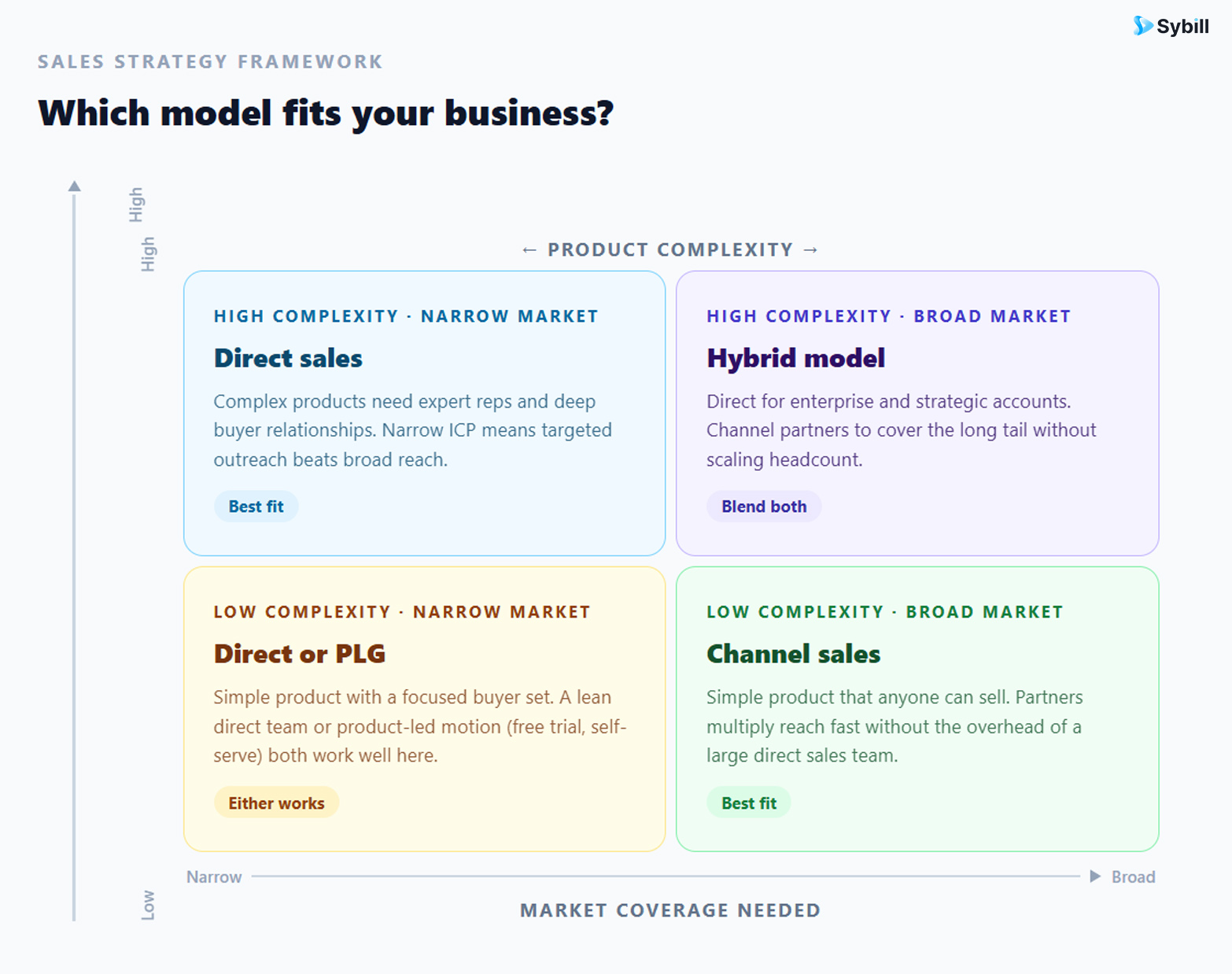
Direct sales is typically the better fit when:
Your product is complex and requires consultative selling. Enterprise software, solutions with long implementation cycles, and products that require deep discovery to position correctly all benefit from the control and expertise of an in-house team. The ability to run thorough discovery calls and tailor the pitch to each buyer's specific situation is hard to replicate through partners.
Your ACV is high enough to support the cost structure. If your average deal size is $50,000 or above, the margin to support a direct sales team is there. Below that threshold, the economics often favor more efficient channels.
You are in the early stages of go-to-market. Before you have product-market fit nailed down, direct sales gives you the tight feedback loops you need. Your reps are hearing objections, surfacing feature requests, and testing messaging in real time. This intelligence is invaluable for refining your positioning, and tools like Sybill's buyer intent analysis can capture it automatically.
Customer retention and expansion are critical revenue drivers. If your business model depends on renewals, upsells, and expansion revenue, owning the customer relationship from day one sets you up for long-term success.
Brand experience is a competitive advantage. If how you sell is as important as what you sell (think premium positioning, white-glove onboarding, or differentiated customer success), direct sales lets you control every touchpoint.
Channel sales is typically the better fit when:
You need to scale into new markets quickly. If you are expanding internationally, entering new verticals, or reaching customer segments where you have no existing presence, partners with established relationships can accelerate your timeline dramatically.
Your product is relatively standardized. Products that can be sold with a consistent pitch, do not require heavy customization, and have straightforward implementation are easier for partners to sell effectively.
Customer acquisition cost needs to come down. As CAC rises across B2B, many companies are leaning into partnerships as a more efficient acquisition channel. The warm introduction from a trusted partner converts at higher rates than cold outbound in many markets.
You want to complement, not replace, your direct team. Channel sales does not have to be an either/or decision. Many companies use partners to cover market segments or geographies that their direct team cannot reach, while keeping strategic accounts in-house.
Your product fits into a larger ecosystem. If your solution is typically purchased alongside other products (think integrations, tech stacks, bundled offerings), partners who sell those adjacent products are natural distribution channels.
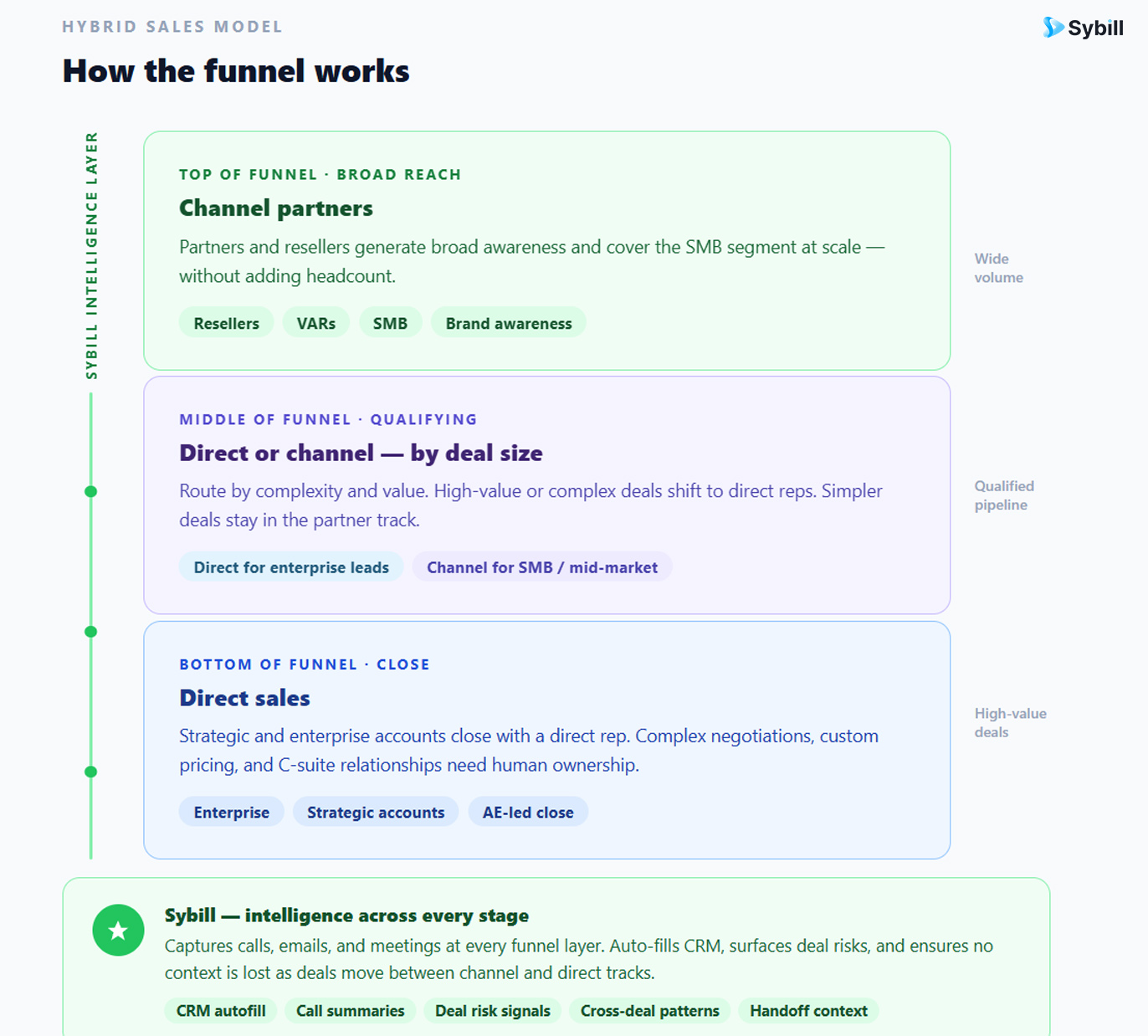
The direct sales vs channel sales debate often presents a false binary. In practice, the most successful B2B companies use both models simultaneously, allocating them to different segments, geographies, or deal types.
A common hybrid structure looks like this:
Direct sales for enterprise and strategic accounts. High-ACV deals with complex buying committees stay with the in-house team, where the company can invest in deep discovery, multi-threaded relationships, and customized proposals.
Channel sales for SMB and mid-market. Smaller deals that cannot justify the fully loaded cost of an enterprise AE are routed through partners who can sell at scale with lower overhead.
Channel sales for geographic expansion. International markets where the company lacks local presence, language capabilities, or regulatory knowledge are served through regional partners.
Direct sales for product-led upgrades. Users who self-serve into a free or low-cost tier and signal upgrade intent are handled by an in-house team that can maximize conversion and deal size.
The hybrid model requires clear rules of engagement to avoid channel conflict. Your direct team and your partners should not be competing for the same accounts. Territory mapping, deal registration systems, and partner tiering all help prevent friction.
Regardless of whether you sell directly or through partners, AI is changing the economics and effectiveness of both models. Here is how.
The biggest bottleneck in direct sales is the admin burden that steals time from selling. Reps spend roughly 70% of their time on non-selling activities: CRM updates, follow-up emails, meeting prep, and deal documentation. AI-powered tools like Sybill reclaim that time.
After every call, Sybill automatically captures the conversation, generates Magic Summaries, drafts personalized follow-up emails in the rep's voice, and updates 30+ CRM fields with structured data including deal stage, next steps, objections, and MEDDPICC qualification criteria. The result is that direct sales reps spend more time selling and less time typing, which directly improves quota attainment and pipeline velocity.
For sales managers, Ask Sybill provides instant, cross-deal intelligence. Questions like "Which deals have no confirmed next steps?" or "Where is this rep struggling with objection handling?" return data-backed answers in seconds, making coaching more targeted and efficient.
AI also improves channel sales, though the applications differ. For the company managing partners, AI helps with:
Partner performance analysis. Understanding which partners are performing, which are stalling, and where enablement gaps exist. When partner-sourced deals flow through your CRM, Sybill's pipeline visibility tools help you track health and momentum across all channels.
Enablement content creation. AI tools can generate sales collateral, battle cards, and objection-handling guides that help partners sell more effectively on your behalf.
Customer intelligence capture. Even in channel deals, some interactions may flow through your team (pre-sales calls, technical evaluations, onboarding). Capturing insights from these touchpoints with conversation intelligence ensures you are not flying blind on partner-sourced accounts.
Tesla bypassed the traditional dealership model entirely, selling directly through company-owned stores and its website. This gives Tesla complete control over pricing (no dealer markup), the customer experience (consistent from test drive to delivery), and the customer relationship (enabling direct upsells for features and services). The trade-off is the capital intensity of maintaining a retail footprint, but for Tesla, the brand consistency and customer data ownership justify the investment.
Microsoft built one of the most successful channel ecosystems in technology history, starting in the 1980s. Through VARs, distributors, cloud solution providers, and marketplace partnerships, Microsoft reaches millions of businesses globally without maintaining a proportional direct salesforce. The trade-off is reduced per-deal margin and reliance on partner quality, but the scale and market penetration are unmatched.
HubSpot runs one of the most effective hybrid models in SaaS. Its direct sales team handles enterprise accounts and product-led upgrade conversions, while its Solutions Partner Program drives a significant portion of mid-market and SMB revenue through agencies and consultants who implement HubSpot for their clients. This hybrid approach lets HubSpot maintain deep customer relationships at the top of the market while scaling efficiently through partners everywhere else.
What is the difference between direct sales and channel sales?
Direct sales is when a company sells its product directly to the end customer through its own sales team, with no intermediaries. Channel sales is when a company sells through third-party partners like resellers, distributors, or VARs. The key differences are in customer relationship ownership, cost structure, scalability, and brand control. Direct sales offers higher margins and tighter customer relationships. Channel sales offers faster market expansion and lower cost per acquisition.
Which is better for B2B SaaS: direct sales or channel sales?
It depends on your product complexity, ACV, and go-to-market stage. Early-stage SaaS companies typically benefit from direct sales because it provides tight feedback loops for refining product-market fit. Established companies with standardized products often layer in channel sales to reach new markets efficiently. Most successful B2B SaaS companies eventually use a hybrid of both, with direct sales for strategic accounts and channel partners for broader market coverage.
What is a hybrid sales model?
A hybrid sales model uses both direct and channel sales simultaneously, allocating each to different customer segments, geographies, or deal types. For example, a company might use its in-house team for enterprise deals above $50,000 ACV and channel partners for SMB deals below that threshold. The hybrid model requires clear rules of engagement to prevent channel conflict, including territory mapping and deal registration systems.
How does AI improve direct sales performance?
AI eliminates the administrative burden that consumes most of a direct sales rep's time. Tools like Sybill automatically capture call insights, update CRM fields, draft personalized follow-up emails, and generate coaching briefs after every conversation. This lets reps spend more time selling and gives managers better data for pipeline reviews and coaching. AI also improves forecasting accuracy by ensuring CRM data reflects reality rather than guesswork.
What are the biggest risks of channel sales?
The primary risks are reduced margin per deal, less control over the brand experience, weaker customer data and feedback loops, and dependency on partner performance. Partners may also prioritize other products in their portfolio, especially if incentives are not well-aligned. Strong partner enablement, clear communication, and performance tracking mitigate these risks but never eliminate them entirely.
How do you choose between direct and channel sales?
Evaluate four factors: product complexity (complex products favor direct), market coverage needed (broad coverage favors channel), ACV (high ACV supports direct economics), and go-to-market maturity (early stage favors direct for feedback loops). If your answers point in different directions, a hybrid model is likely the right approach.
The direct sales vs channel sales decision is not about which model is universally better. It is about which model fits your product, your market, your stage, and your economics right now.
Most B2B companies will use both models at some point. The question is which to lead with and when to layer in the other. Get the sequencing right, and you build a revenue engine that scales efficiently. Get it wrong, and you either burn cash on a direct team that cannot cover enough market or depend on partners who cannot represent your product well enough to win.
Whatever model you choose, the quality of your sales execution determines the outcome. Reps who show up prepared, follow up fast, keep their CRM accurate, and learn from every conversation outperform those who do not, regardless of whether they work for you directly or sell through a partner. And this is exactly where AI tools like Sybill make the difference: by automating the grunt work so every seller, direct or partner-enabled, can focus on what actually closes deals.
Get started for free with Sybill and give your sales team the AI-powered edge that makes both direct and channel sales more effective.
Direct sales is when a company sells its product directly to the end customer through its own sales team, with no intermediaries. Channel sales is when a company sells through third-party partners like resellers, distributors, or VARs. The key differences are in customer relationship ownership, cost structure, scalability, and brand control. Direct sales offers higher margins and tighter customer relationships. Channel sales offers faster market expansion and lower cost per acquisition.
It depends on your product complexity, ACV, and go-to-market stage. Early-stage SaaS companies typically benefit from direct sales because it provides tight feedback loops for refining product-market fit. Established companies with standardized products often layer in channel sales to reach new markets efficiently. Most successful B2B SaaS companies eventually use a hybrid of both, with direct sales for strategic accounts and channel partners for broader market coverage.
A hybrid sales model uses both direct and channel sales simultaneously, allocating each to different customer segments, geographies, or deal types. For example, a company might use its in-house team for enterprise deals above $50,000 ACV and channel partners for SMB deals below that threshold. The hybrid model requires clear rules of engagement to prevent channel conflict, including territory mapping and deal registration systems.