Find us at booth #83, join us for a harbor side happy hour, or catch Gorish’s talk.

Sept, 16-18 > Learn more


Tamanna Mishra

May 22, 2026
.png)
The Dunning-Kruger effect in sales happens when reps overestimate their skill because they do not yet know what great selling actually looks like. It shows up in weak discovery, optimistic forecasts, missed objections, and deals that looked “committed” until they ghosted. The fix is not less confidence. It is better calibration through evidence-based coaching, call reviews, buyer signals, and AI-powered feedback loops.
The Dunning-Kruger effect is a cognitive bias where people with limited knowledge or skill in a specific area overestimate their competence. Not because they are arrogant monsters. Because they do not yet know enough to see what they are missing.
In sales, that can get expensive fast.
A rep may think they ran a great discovery call because the buyer nodded along. They may think they handled an objection because the buyer stopped pushing back. They may think a deal is healthy because the champion said, “This looks interesting.”
But polite interest is not qualification. Silence is not agreement. And “they loved the demo” is not a forecast category, no matter how emotionally convincing it sounds in the Monday pipeline review.
The Dunning-Kruger effect in sales is not just about overconfidence. It is about the gap between how well a rep thinks they sold and what actually happened in the buyer conversation.
That gap affects coaching, forecasting, deal strategy, CRM hygiene, follow-ups, and revenue predictability.
Also read: How to avoid the happy ears syndrome in sales
Sales is built on confidence. Reps need it to cold call strangers, handle rejection, ask hard questions, negotiate pricing, and come back after a deal dies for reasons nobody can fully explain.
So no, confidence is not the villain.
The problem starts when confidence outruns competence.
Sales teams are especially vulnerable because many sales signals are easy to misread. A full calendar can look like momentum. A friendly buyer can look like intent. A polished demo can look like a strong sales process. A big pipeline can look like future revenue until someone asks, “How many of these opportunities have confirmed budget?”
Awkward silence.
The job rewards optimism, but the revenue system needs proof. That tension creates the perfect Dunning-Kruger trap.
A rep gets one good month and assumes the process is working. A manager sees activity and assumes quality. A leader hears “strong interest” and assumes forecast confidence. Meanwhile, the buyer has not confirmed urgency, the economic buyer is missing, procurement is a black hole, and the “champion” is actually just a nice person with no internal influence.
This is why strong teams do not coach only on outcomes. They coach on behaviors, evidence, and patterns.
For a deeper tactical view of how to structure that coaching rhythm, Sybill’s guide on sales coaching tips and tricks is a useful read.
Confidence is the belief that you can do the job. Competence is the repeated ability to do it well.
Sales teams need both. A rep with competence but no confidence may avoid bold questions. A rep with confidence but weak competence may bulldoze through calls, miss buyer signals, and still walk away saying, “Great meeting.”
That second one is where deals go to die wearing cologne.
Here is how the difference shows up in real sales work:
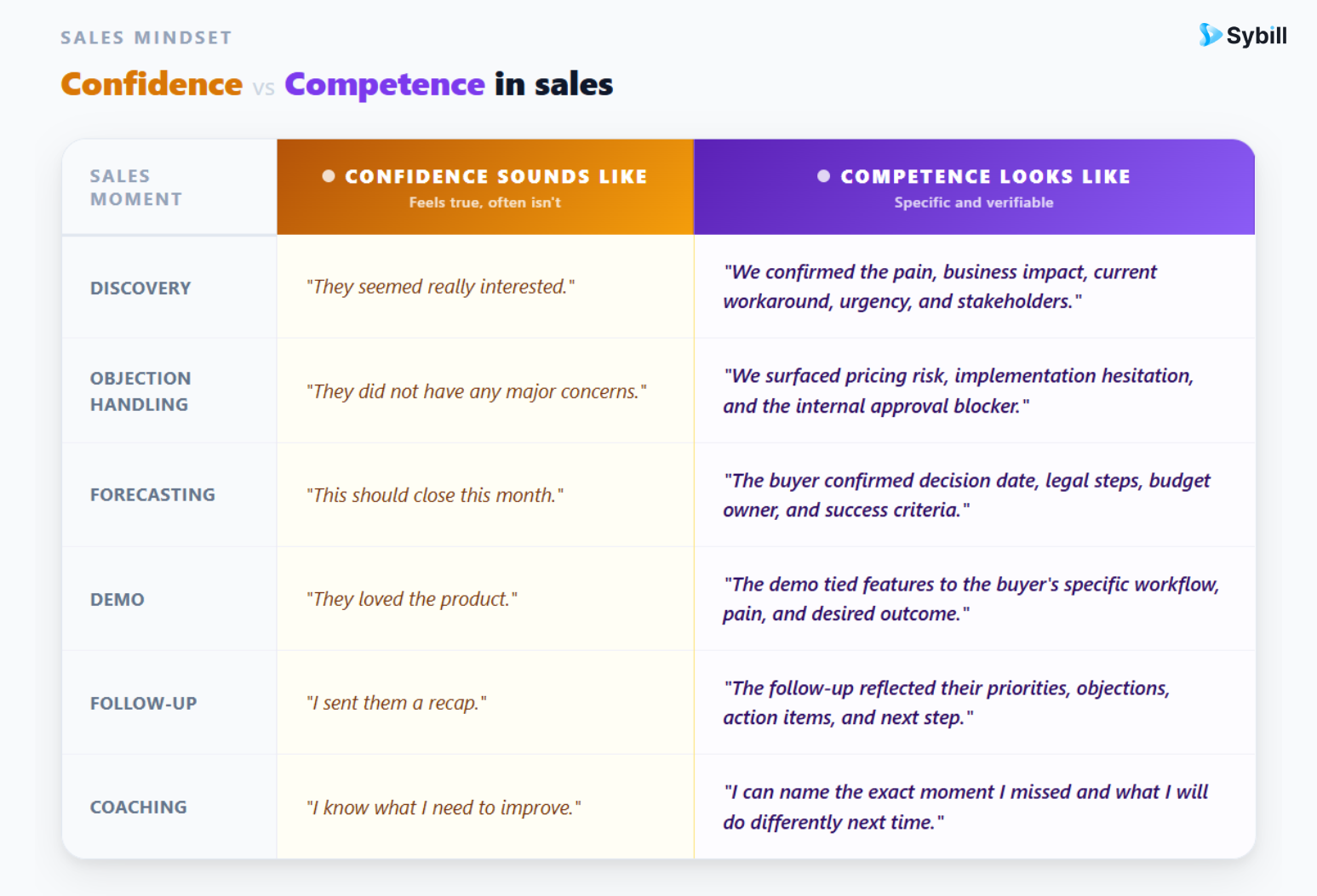
The goal is not to make reps doubt themselves. The goal is to help them calibrate.
Great reps are not less confident. They are more accurate.
The Dunning-Kruger effect rarely announces itself dramatically. It shows up in small moments that sound harmless until you inspect the deal.
They had five calls, sent three emails, updated CRM, and scheduled a demo.
Looks productive.
But when the manager asks what changed in the buyer’s decision process, the answer gets foggy. There is no economic buyer. No timeline. No confirmed internal pain. No next step with mutual commitment.
Activity is not progress. Sometimes it is just motion wearing a blazer.
Weak discovery often sounds professional on the surface.
“What are your pain points?”
“What are your goals?”
“What is your budget?”
“What solution are you using today?”
Fine questions. Not enough.
Strong discovery goes deeper. It uncovers the current state, the cost of inaction, the internal politics, the decision criteria, the buying committee, and what happens if nothing changes.
If your team is working on discovery depth, this Sybill blog on sales call planning is a good read because it covers how reps can prepare better questions before the call.
This one is classic.
The buyer did not push back. The rep assumes the deal is clean.
But buyers do not always voice objections. Sometimes they avoid confrontation. Sometimes they are confused. Sometimes they already know the product is too expensive but do not want to say it on the call. Sometimes they are mentally forwarding the deck to a CFO who is about to vaporize the deal.
No objection does not mean no concern. It often means the rep has not earned the truth yet.
A buyer who likes you is not automatically a champion.
A real champion has influence, credibility, urgency, access to power, and a reason to push the deal internally. A friendly contact may attend every call, say nice things, and still be unable to move the deal one inch.
This is one of the most dangerous confidence traps in B2B sales. Reps feel supported because the relationship is warm. But warmth does not equal authority.
“This one feels good.”
Lovely. So does ordering dessert after saying you are full.
Forecasting needs evidence. Confirmed timeline. Budget clarity. Decision owner. Legal path. Procurement process. Technical validation. Mutual next step. Internal business case.
Without those, the forecast is not a forecast. It is fan fiction.
Some reps know the product inside out. They can explain every feature, workflow, integration, and dashboard.
Then they lose deals because they never connect that product knowledge to buyer urgency.
Product expertise matters. But sales skill is about diagnosis, relevance, timing, stakeholder alignment, and change management. A rep who can explain everything may still fail to make the buyer care.
For reps working on broader sales execution, Sybill’s guide to best sales techniques can be a useful next read.
Plot twist: it is not always the rep.
Managers can also overestimate their coaching quality. They may think they are coaching when they are actually reviewing pipeline. They may think they know what happened on a call because the rep summarized it. They may mistake one top performer’s style for a repeatable sales playbook.
Good sales management requires the same humility expected from reps: inspect the evidence, identify the gap, and coach the behavior.
Our blog on sales coaching templates is a good read because templates help managers make coaching more repeatable instead of relying on memory, mood, or whoever shouted loudest in the pipeline meeting.
The Dunning-Kruger effect is not just a personality quirk. It creates real revenue damage.
First, it weakens forecasting. When reps overestimate deal quality, managers inherit an inflated pipeline. Leadership plans around revenue that may never arrive. Finance gets optimistic numbers. Everyone claps in QBR. Then the quarter ends and the CRM looks like a crime scene.
Second, it hurts qualification. Reps who believe they are better than they are may skip hard questions. They avoid asking about budget, competition, decision criteria, or internal blockers because the deal “feels good.” That feeling usually expires right around procurement.
Third, it slows coaching. If reps cannot see the gap, they resist feedback. Every critique becomes an exception. Every lost deal becomes “bad timing.” Every missed next step becomes “the buyer went quiet.”
Fourth, it damages follow-up quality. Reps who misread the call send generic recaps instead of buyer-specific follow-ups. They write, “Great speaking with you,” when they should be reinforcing the business problem, clarifying the objection, and confirming the next step.
For practical follow-up improvement, read our guides on follow-up emails or the more template-focused follow-up email templates.
Finally, it creates inconsistent customer handoffs. If the rep misunderstood the buyer’s pain during the sales cycle, customer success inherits a messy version of reality. That is how “smooth handoff” becomes “surprise expectations management.”
You do not need to wait for a deal to slip before spotting the warning signs.
Overconfidence usually shows up in language.
Watch for vague phrases like:
None of these are bad on their own. But they are not evidence.
A rep may be overestimating the deal if they cannot clearly answer:
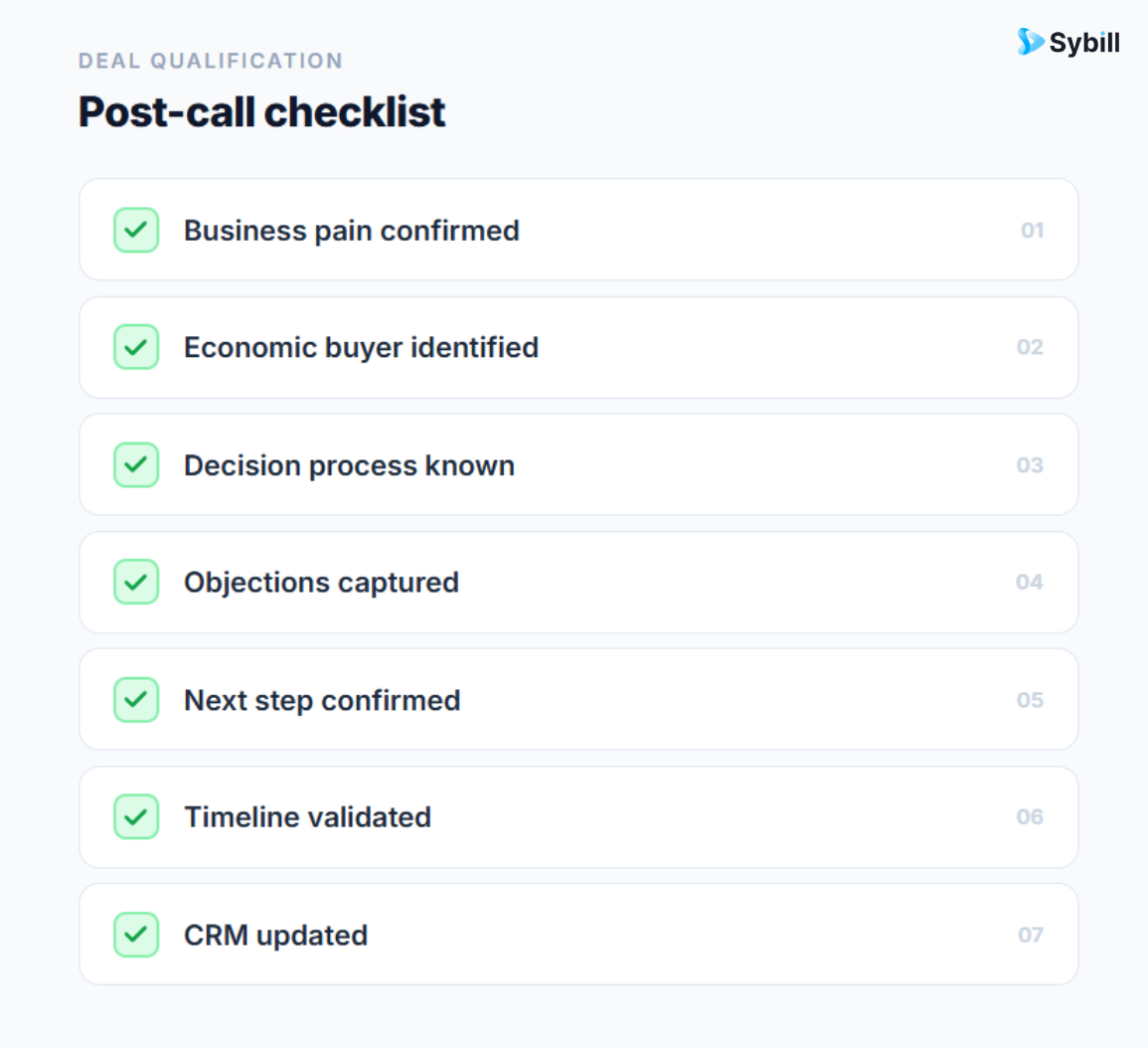
The shift is simple: stop asking, “How do you feel about the deal?” Start asking, “What evidence do we have?” That one change can turn a pipeline review from theater into strategy.
The worst way to handle overconfidence is to embarrass the rep.
That creates defensiveness, not growth. The goal is not to humble people for sport. This is not a prestige drama where everyone needs a devastating monologue. The goal is to help reps compare their perception with reality and improve without losing momentum.
Instead of saying, “Your discovery was weak,” point to the call.
Try this:
“At minute 14, the buyer mentioned implementation risk. We moved to pricing right after that. What could we have asked before changing topics?”
That kind of coaching is harder to argue with because it is specific. It moves the conversation from personal critique to observable behavior.
Ask the rep to self-assess first.
“How do you think the call went?”
“What made you feel that way?”
“What did the buyer actually confirm?”
“What did we assume?”
“What evidence would make this deal stronger?”
“What would you do differently next time?”
This helps reps build self-awareness instead of waiting for the manager to diagnose everything.
If call review only happens when something goes wrong, reps will treat it like punishment.
Make it normal. Review winning calls, messy calls, average calls, discovery calls, pricing calls, and renewal calls. The best sales teams do not use call reviews to catch people failing. They use them to understand what good looks like.
For stage-specific coaching, Sybill’s deal coaching guide is an interesting read because it shows how managers can coach differently across the sales cycle.
A rep should never walk away thinking, “I am bad at sales.”
They should walk away thinking, “I missed a stakeholder question in discovery, and I know how to fix it next time.”
That distinction matters.
Good coaching protects confidence while improving competence.
Calibration should not depend on one heroic manager listening to random calls at 11 pm.
Create rituals:
And keep the standard simple: what did the buyer say, what did the buyer do, and what do we know for sure?
Sales coaching used to depend heavily on memory.
The rep remembered the call one way. The manager heard the summary secondhand. CRM had three cryptic notes and a next step called “follow up.” Everyone made decisions from partial reality.
That is how confidence gaps survive.
AI changes the feedback loop by making sales conversations easier to inspect, summarize, and coach.
Sybill helps teams move from “the rep said the call went well” to “here is what actually happened.”
With Magic Summary, reps and managers get a clear recap of the conversation, including buyer priorities, pain points, objections, and next steps.
With CRM Autofill, Sybill updates key CRM fields with real context from the call, so the pipeline does not depend on a rep remembering every detail after six meetings and too much coffee.
With Ask Sybill, managers can ask deal questions directly. What risks came up? What objections were raised? What did the buyer care about? What next steps were agreed on?
With Personal Coach, reps can get targeted coaching insights from real conversations instead of generic “be more consultative” advice, which is basically the sales version of “just be yourself.”
With AI Tasks, commitments become trackable actions. If the rep promised to send a business case, loop in security, or schedule a technical call, the task does not disappear into the swamp.
And with Deal Pipeline and Deal Workspace, leaders get a clearer view of deal health, risk, and execution across opportunities.
If you are comparing broader tools in this category, Sybill’s guide to the best AI sales tools is a good next step.
Use the C.A.L.M. framework.
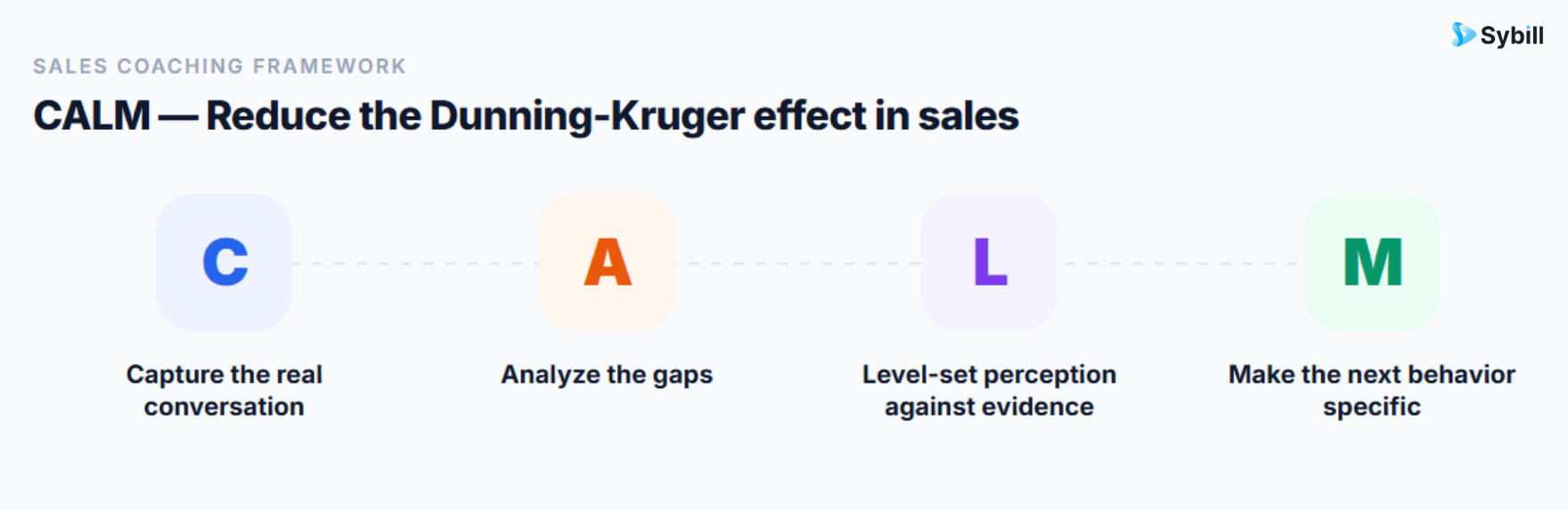
Do not rely only on rep memory. Capture calls, summaries, objections, next steps, buyer priorities, and deal context.
Look for what was missed. Was the business pain clear? Was the decision process confirmed? Were objections handled or avoided? Did the buyer commit to a next step?
Ask reps to compare what they thought happened with what the conversation actually shows.
This is where growth happens. Not in vague motivation. Not in another “crush quota” kickoff slide. In the exact gap between perception and reality.
Do not end coaching with “do better discovery.”
End with:
“On the next call, ask what happens if they do nothing this quarter.”
“Confirm who signs off before sending pricing.”
“Pause after pricing and ask what concerns they expect internally.”
“Before forecasting commit, verify legal, budget, and decision date.”
Specific behavior beats motivational fog every time.
Sales does not need less confidence. It needs better-calibrated confidence.
The best reps are not the ones who leave every call convinced they crushed it. They are the ones who can look at the evidence, spot what they missed, and improve fast.
That is the real antidote to the Dunning-Kruger effect in sales: not ego demolition, but better feedback loops.
Sybill helps sales teams build those loops by capturing call context, surfacing buyer signals, generating Magic Summary, updating CRM, drafting buyer-specific follow-ups, and helping managers coach from real conversations. So if your team is still forecasting from optimism, coaching from memory, or trusting CRM notes that read like fortune cookies, it may be time to give them something better.

The Dunning-Kruger effect in sales happens when reps overestimate their selling ability because they do not yet have the skill or experience to recognize what they are missing. It can show up in weak discovery, optimistic forecasting, poor objection handling, and overconfidence after calls that were actually underqualified.
A common example is a rep who thinks a deal is highly likely to close because the buyer liked the demo. But the rep has not confirmed budget, decision criteria, legal process, economic buyer, or urgency. The rep feels confident, but the deal lacks evidence. That gap between confidence and actual qualification is the Dunning-Kruger effect in action.
Fix overconfidence by using evidence-based coaching. Review call recordings, inspect buyer signals, ask reps to self-assess, compare forecast confidence against deal evidence, and coach specific behaviors. Managers should avoid vague feedback like “ask better questions” and instead point to exact missed moments in discovery, objection handling, or closing.
Confidence is a rep’s belief that they can sell effectively. Competence is their demonstrated ability to diagnose buyer needs, run strong discovery, handle objections, create urgency, manage stakeholders, and close deals repeatedly. High-performing reps need both, but confidence without competence can create missed risks and unreliable forecasts.
Yes. AI can help sales coaching by capturing call context, summarizing buyer needs
, identifying objections, tracking next steps, and surfacing coaching moments. AI does not replace the sales manager. It gives managers better evidence, so coaching becomes more specific, timely, and grounded in what actually happened.
The Dunning-Kruger effect in sales happens when reps overestimate their selling ability because they do not yet have the skill or experience to recognize what they are missing. It can show up in weak discovery, optimistic forecasting, poor objection handling, and overconfidence after calls that were actually underqualified.
A common example is a rep who thinks a deal is highly likely to close because the buyer liked the demo. But the rep has not confirmed budget, decision criteria, legal process, economic buyer, or urgency. The rep feels confident, but the deal lacks evidence. That gap between confidence and actual qualification is the Dunning-Kruger effect in action.
Fix overconfidence by using evidence-based coaching. Review call recordings, inspect buyer signals, ask reps to self-assess, compare forecast confidence against deal evidence, and coach specific behaviors. Managers should avoid vague feedback like “ask better questions” and instead point to exact missed moments in discovery, objection handling, or closing.