Find us at booth #83, join us for a harbor side happy hour, or catch Gorish’s talk.

Sept, 16-18 > Learn more


Mamta Tainwala

April 23, 2026
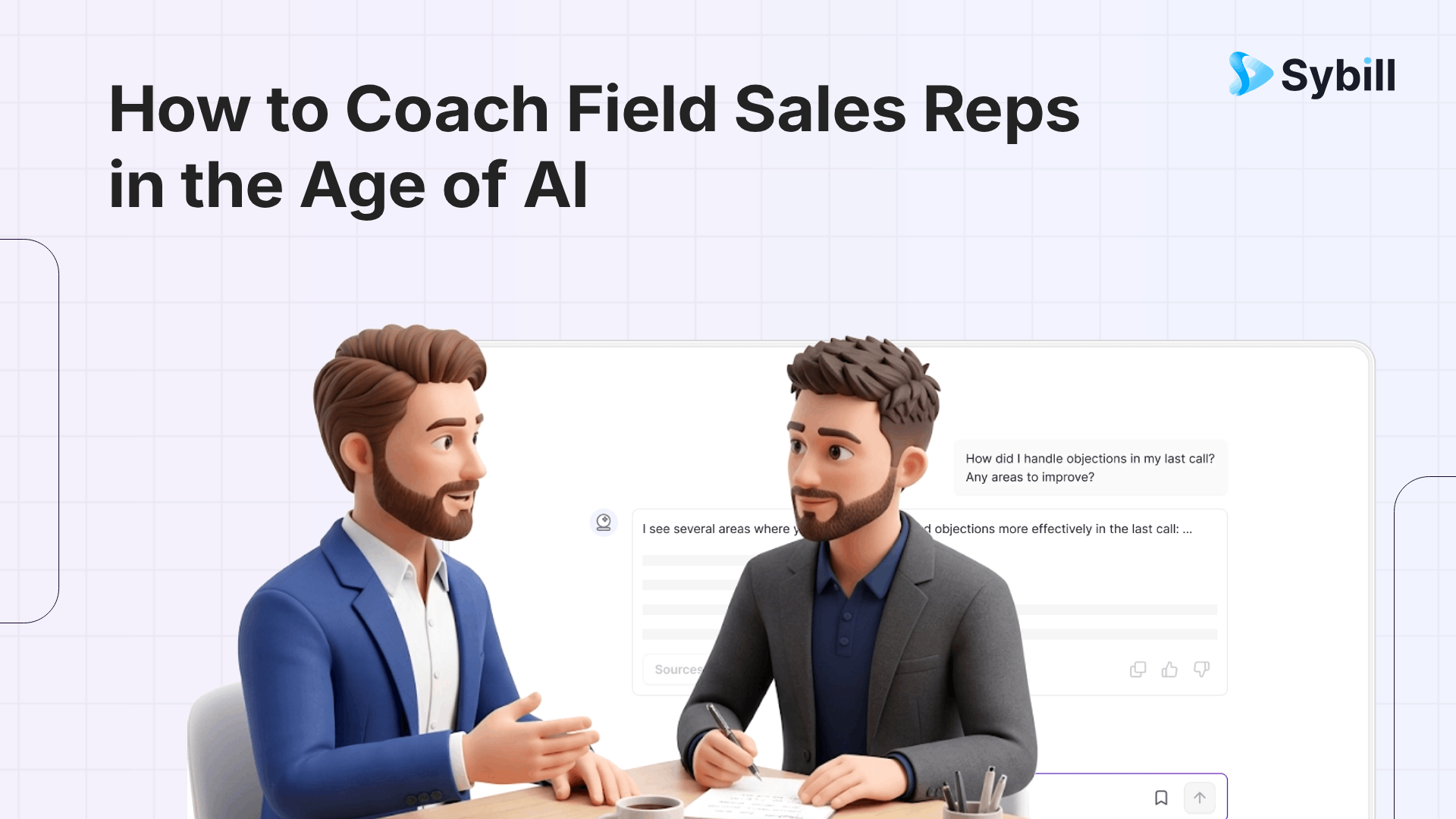
Coaching inside sales reps is straightforward, at least in theory. Pull up the call recording. Listen to how the rep handled the discovery questions. Note where they missed the pricing objection. Bring the evidence to the 1:1. Discuss.
Coaching field sales reps has never worked that way. The manager was not in the room. There is no recording. There is no transcript. There is no data. The coaching conversation starts with "So, how did the meeting go?" and the rep says "Really well, I think they're interested." That is not coaching. That is storytelling.
For decades, the only way to actually observe a field rep in action was the ride-along: a manager physically accompanies the rep on client visits, watches the meeting unfold, and provides feedback afterward. Ride-alongs are effective coaching tools. They are also brutally inefficient. A manager who spends an entire day with one rep can observe two, maybe three meetings. That means the other seven reps on the team go uncoached that week. Multiply that across a quarter, and most field reps receive meaningful observation-based coaching a handful of times per year.
AI has changed this math entirely. Conversation intelligence for field sales now lets managers review structured summaries of in-person meetings, analyze rep behavior patterns across dozens of conversations, and deliver specific, evidence-based coaching without ever getting in the car. The question is no longer whether you can coach field reps with the same rigor as inside reps. It is how to build a coaching system that takes advantage of these new capabilities.
This guide breaks down the practical framework for coaching field sales reps in 2026, combining AI-powered visibility with the human judgment that only a great manager can provide.
Before diving into the framework, it helps to understand the specific challenges that make field sales coaching structurally different from inside sales coaching. These are not problems of effort or intent. They are problems of physics and logistics.
Inside sales managers can listen to any call, any time, from anywhere. They can review five calls before a 1:1 and come prepared with specific, timestamped feedback. Field sales managers cannot observe what they cannot see. Unless they are physically present, the meeting is invisible. This means coaching has historically been based on the rep's self-reported version of events, which is always filtered through optimism, selective memory, and sometimes deliberate spin.
A typical inside sales manager can review 20 to 30 call recordings per week if they are disciplined about it. AI summaries can compress that further, allowing a manager to scan 50 or more calls in the same time. A field sales manager doing physical ride-alongs can observe 6 to 10 meetings per week at best, and that is if they do nothing else. The observation-to-coaching ratio is fundamentally broken for field teams.
When coaching is based on subjective recollection rather than observable data, it tends to be inconsistent. One rep gets coached on discovery depth because the manager happened to be present for a weak discovery meeting. Another rep makes the same mistake every week but never gets flagged because the manager has never observed it. AI eliminates this randomness by providing consistent visibility across all reps.
The best coaching happens as close to the event as possible. For inside sales, a manager can review a call recording the same day and provide feedback within hours. For field sales, ride-along coaching might happen weeks after the behaviors it is meant to correct were established. By then, the rep has reinforced the bad habit across a dozen more meetings.
Inside sales coaching is increasingly data-driven. Managers can compare talk-to-listen ratios, question frequency, objection handling patterns, and meeting length across their entire team. They can identify that their top performer asks three times more open-ended questions than the bottom performer. For field sales, this data simply has not existed. You cannot analyze patterns in conversations you never captured.
Effective field sales coaching in 2026 combines AI-generated insights with human judgment. AI provides the visibility, the data, and the consistency. The manager provides the context, the relationship, and the strategic direction. Neither works well alone. Here is the framework.
The foundation of any coaching system is data. For field sales, that means recording in-person meetings and processing them through conversation intelligence.
Sybill lets field reps capture in-person conversations by uploading voice memos or audio recordings from their phone. The audio is transcribed, analyzed, and turned into a structured summary that includes discussion points, buyer pain points, objections, next steps, and engagement signals. This happens automatically after every meeting.
The key cultural shift is getting reps to record consistently. The fastest path to adoption is positioning recording as a benefit for the rep, not a surveillance tool for the manager. When reps see that recording eliminates manual CRM updates, generates their follow-up emails, and saves them an hour of admin per day, adoption becomes self-reinforcing.
Rilla and Siro are two other platforms built specifically for in-person sales coaching. Rilla's data from millions of field conversations shows that top performers talk 45% to 65% of the time and ask five times more open-ended questions per hour than average performers. These patterns only emerge when you capture conversations at scale.
Having data is not the same as coaching. The manager's job is to review meeting summaries and conversation patterns with a specific coaching objective in mind. Reviewing without a lens is just surveillance. Reviewing with a lens is coaching.
Here are the review lenses that matter most for field sales:
Discovery quality. Is the rep asking enough open-ended questions? Are they uncovering the buyer's real pain points, or accepting surface-level answers? In field settings, where the rep can observe the buyer's environment and body language, discovery should be richer than on a video call. If it is not, that is a coaching opportunity.
Objection handling. How does the rep respond when the buyer pushes back on pricing, timeline, or competitive alternatives? Do they get defensive, deflect, or engage? AI can flag objection moments across multiple meetings and surface patterns. A rep who consistently folds on pricing objections needs different coaching than one who handles pricing well but struggles with competitive displacement.
Talk-to-listen ratio. The best field reps spend more time listening than talking, especially in discovery and early-stage meetings. If a rep is dominating the conversation in every meeting, they are likely pitching when they should be diagnosing.
Next step clarity. Does every meeting end with a clear, specific next step? Or does the rep leave with vague commitments like "We'll circle back next quarter"? This is one of the highest-leverage coaching areas because it directly affects pipeline velocity.
Playbook adherence. If your team has a defined sales methodology (MEDDPICC, SPIN, Challenger, or a custom framework), AI can score how well each rep follows it across their field meetings. Deal coaching becomes far more targeted when you can see exactly where in the methodology reps are deviating.
The 1:1 meeting is where coaching actually happens. AI provides the raw material. The manager brings the judgment, the context, and the relationship.
A strong AI-powered coaching 1:1 for field reps follows a simple structure:
One highlight. Start with something specific the rep did well in a recent field meeting. Not generic praise ("Great job this week"), but evidence-based recognition ("In your meeting with Acme on Tuesday, you handled the pricing objection by reframing the conversation around implementation speed. That was exactly right."). This builds trust and shows the rep that you are actually reviewing their work.
One coaching focus. Pick one behavior to improve. Not three. Not five. One. The rep who needs to improve discovery, objection handling, and closing is not going to fix all three in one coaching cycle. Focus the conversation on the single highest-leverage behavior and discuss specific examples from recent meetings.
One action. Define a concrete behavior the rep will practice in their next set of meetings. "In your next three discovery meetings, I want you to ask at least five open-ended questions before you start talking about our product." Specific, measurable, observable.
This structure keeps 1:1s focused and productive. Managers spend less time preparing because AI surfaces the data. Reps trust the feedback because it is grounded in real meetings, not recollection. And the coaching compounds because each week builds on the previous one.
The most scalable form of coaching is self-coaching: the rep reviews their own performance, identifies patterns, and adjusts their approach without waiting for a manager to flag the issue.
AI makes self-coaching practical for field reps in a way it never was before. After every meeting, the rep receives a structured summary that shows what they discussed, what questions they asked, what objections came up, and what next steps were established. Over time, a rep who reads their own summaries starts to notice patterns: "I keep losing control of the conversation when pricing comes up" or "I'm not asking enough about the decision-making process."
Sybill's Ask Sybill feature takes self-coaching further by letting reps query their own conversation history. A rep can ask, "What objections came up in my last ten meetings?" or "How much time am I spending on discovery versus product demos?" and get instant, data-backed answers. This turns reflection from a subjective exercise into a data-driven one.
AI roleplay tools like Hyperbound, SalesEcho, and Salesforce's Agentforce add another dimension by letting reps practice specific scenarios (objection handling, discovery, negotiation) with AI-powered buyer personas before walking into live meetings. The combination of post-meeting reflection and pre-meeting practice creates a continuous improvement loop that does not depend on manager availability.
The final layer is measurement. Without tracking, coaching is an activity. With tracking, coaching is a system.
The metrics that matter for field sales coaching include:
Coaching frequency. How often is each rep receiving observation-based coaching? With AI, this should be weekly, not quarterly.
Behavior change. Is the coached behavior actually changing? If you coached a rep on asking more open-ended questions, are they asking more open-ended questions two weeks later? AI makes this measurable.
Outcome correlation. Are the coached behaviors correlating with better outcomes? If reps who improve their discovery quality also see higher win rates, you have validation that the coaching focus is correct.
Ramp time. For new field reps, how quickly are they reaching the performance benchmarks of tenured reps? AI coaching should meaningfully compress this timeline by giving new reps immediate access to feedback and conversation examples from top performers.

Not every field rep needs the same coaching. The framework above applies universally, but the coaching focus shifts depending on where the rep is in their development.
New field reps need to learn the product, the sales methodology, the territory, and how to run an in-person meeting. AI accelerates this by giving new hires immediate access to a library of recorded field conversations from top performers. Instead of abstractly describing what a great discovery meeting looks like, you can show them one.
During onboarding, coaching should focus on methodology adherence: Is the new rep following the defined sales process? Are they hitting the key milestones in every meeting? AI-scored playbook compliance gives managers a fast, objective read on whether the new rep is internalizing the framework or winging it.
AI-powered sales training tools can supplement manager-led coaching with AI roleplay scenarios that let new reps practice before their first live meetings. Research suggests that reps who practice daily with AI simulations reach full quota capacity significantly faster than those who rely solely on traditional onboarding.
Once a rep knows the basics, coaching shifts from methodology adherence to execution quality. This is where the nuanced coaching on discovery depth, objection handling, multi-threading, and deal progression becomes critical.
At this stage, the manager should be reviewing multiple meeting summaries per week for each developing rep, looking for patterns rather than isolated incidents. A rep who struggles with pricing objections in one meeting might just have had a tough buyer. A rep who struggles with pricing objections in six out of ten meetings has a coaching need.
Cross-deal intelligence becomes valuable here. Sybill's Ask Sybill lets managers query across a rep's meetings: "What competitor mentions came up in Sarah's meetings this month?" or "How does Sarah's talk-to-listen ratio compare to the team average?" These queries surface coaching opportunities that would be invisible without data.
Experienced field reps need different coaching than developing ones. They are not learning the methodology. They are refining their craft and working on the subtle skills that separate good from great: reading a room, navigating complex buying committees, creating urgency without being pushy, and adapting their approach to different buyer personas.
At this level, coaching is more peer-oriented. AI enables this by identifying what top performers do differently and making those patterns visible to the broader team. If your highest-performing field rep asks a specific type of question in discovery that correlates with larger deal sizes, AI can surface that pattern and turn it into a coaching talking point for the rest of the team.
The manager's role at this stage is less about correcting behavior and more about pushing strategic thinking: "You've been crushing mid-market accounts. Let's talk about how you'd adjust your approach for the enterprise deals we're moving upmarket into."
AI does not replace the field sales manager. It replaces the parts of the manager's job that were always bottlenecked by physical limitations. The manager no longer needs to be in the room to know what happened. They no longer need to spend hours reviewing raw recordings to find coaching moments. They no longer need to choose between coaching one rep deeply or skimming across the team.
What AI cannot replace is the manager's judgment about which coaching priorities will have the biggest impact on a specific rep's development. AI cannot navigate the interpersonal dynamics of delivering tough feedback to a tenured rep. AI cannot understand that a rep's recent performance dip might be related to a personal situation that requires empathy, not more data.
The best field sales managers in the age of AI are architects. They design the coaching system: which behaviors to track, which patterns to flag, how to structure 1:1s, and how to create a culture where recording and reviewing are seen as development tools, not surveillance mechanisms. Then they use AI to run the system at a scale that was physically impossible before.
This shift matters because the field sales coaching gap is not closing through incremental improvement. It is closing through a fundamentally different operating model. Inside sales managers have been architects of data-driven coaching systems for years. Field sales managers are just getting access to the same building materials.

Adopting AI for field sales coaching is not just a technology decision. It is a cultural and operational one. Here are the mistakes that derail the transition.
If reps feel like recording is about catching them doing something wrong, adoption will stall. The framing matters enormously. Recording should be positioned as a tool that benefits the rep: automatic CRM updates, AI-drafted follow-up emails, and pre-meeting briefs. The coaching visibility is a byproduct of a system designed to make their lives easier, not harder.
AI provides a lot of data. Talk-to-listen ratios, question counts, meeting duration, topic coverage. It is tempting to optimize for metrics rather than outcomes. A rep with a "perfect" talk-to-listen ratio who never closes anything is not performing well. Use metrics as diagnostic signals, not targets. The target is always revenue and pipeline progression.
AI surfaces a lot of coaching opportunities. A single meeting summary might reveal weak discovery, missed objections, vague next steps, and a competitor mention that was not addressed. The temptation is to address everything in one 1:1. Do not. Pick the one behavior that will have the biggest impact and focus there. The rest will get its turn.
AI summaries are not coaching. They are raw material for coaching. A manager who sends a rep an AI-generated summary with a note that says "see areas for improvement" is not coaching. They are delegating feedback to a machine. The 1:1 conversation, the human judgment about what matters and why, the relationship that makes tough feedback land without damaging trust: these are irreplaceable.
Coaching without follow-through is motivational speaking. If you coach a rep on discovery quality in week one, you need to check whether discovery quality has improved in week three. AI makes this easy by tracking the coached behavior across subsequent meetings. The loop must close, or the coaching will not stick.
Here is the competitive reality. Sales teams that coach 20% more than average teams see disproportionately better results. The coaching gap between inside and field sales has persisted for years because the tools did not exist to coach field reps with the same rigor. Now they do.
Organizations that implement AI-powered field sales coaching will see their reps improve faster, their new hires ramp sooner, their CRM data get cleaner, their forecasts get more accurate, and their deal execution get more consistent. And because coaching compounds (each improvement builds on the last), teams that start now will be measurably ahead of teams that wait.
The best AI sales coaching tools are not replacing managers. They are giving managers superpowers: the ability to observe every meeting, coach every rep, and track every behavior change without burning out or being limited by geography. That is not incremental. That is transformational.
Get started for free with Sybill and give your field sales managers the visibility and coaching intelligence they have been missing.
AI-powered conversation intelligence now lets managers review structured summaries of in-person field meetings without being physically present. Field reps record conversations on their smartphone, and the AI transcribes and analyzes the meeting to produce summaries, coaching signals, and behavioral data. This enables virtual ride-alongs where managers can review 10 to 20 meeting summaries in the time it would take to physically shadow one rep.
A virtual ride-along is when a sales manager reviews an AI-generated summary and analysis of a field rep's in-person meeting rather than physically accompanying them on the visit. It provides visibility into what happened in the meeting, including talk-to-listen ratios, objections raised, questions asked, and next steps agreed on, without requiring the manager to travel with the rep.
Field reps should receive observation-based coaching weekly, not quarterly. With AI-powered meeting analysis, managers can review enough meeting data to provide specific, evidence-based feedback every week. The most effective coaching cadence combines weekly AI-informed 1:1s, monthly skill-focused deep dives, and quarterly strategic development conversations.
No. AI provides the data, visibility, and pattern recognition that make coaching scalable. But the human judgment about which coaching priority matters most, the interpersonal skill to deliver feedback effectively, and the strategic thinking about each rep's development path are irreplaceable. The best model is AI as the diagnostic tool and the manager as the coach.
Key coaching metrics include coaching frequency (how often each rep receives observation-based feedback), behavior change rate (whether coached behaviors are actually improving), outcome correlation (whether improved behaviors lead to better win rates), and ramp time for new hires. AI makes all of these measurable for field sales in a way that was not possible before.
Position recording as a benefit for the rep, not a surveillance tool. When reps see that recording their meetings automatically generates CRM updates, drafts follow-up emails, and saves them an hour of admin work per day, adoption becomes self-reinforcing. Lead with the productivity benefit, and the coaching visibility follows naturally.
An effective AI-powered 1:1 follows a simple structure: one specific highlight from a recent meeting (evidence-based, not generic praise), one coaching focus (the single highest-leverage behavior to improve), and one action (a concrete behavior to practice in the next set of meetings). This keeps the conversation focused and ensures the coaching is specific, measurable, and actionable.
Deal coaching focuses on specific, active opportunities: "How do we advance this particular deal? What are the risks? Who are we missing in the buying committee?" Skill coaching focuses on the rep's broader capabilities: "How can you improve your discovery questions across all your meetings?" Both are important. AI supports deal coaching through deal health analysis and supports skill coaching through behavioral pattern analysis across many meetings.
AI-powered conversation intelligence now lets managers review structured summaries of in-person field meetings without being physically present. Field reps record conversations on their smartphone, and the AI transcribes and analyzes the meeting to produce summaries, coaching signals, and behavioral data. This enables virtual ride-alongs where managers can review 10 to 20 meeting summaries in the time it would take to physically shadow one rep.
A virtual ride-along is when a sales manager reviews an AI-generated summary and analysis of a field rep's in-person meeting rather than physically accompanying them on the visit. It provides visibility into what happened in the meeting, including talk-to-listen ratios, objections raised, questions asked, and next steps agreed on, without requiring the manager to travel with the rep.
Field reps should receive observation-based coaching weekly, not quarterly. With AI-powered meeting analysis, managers can review enough meeting data to provide specific, evidence-based feedback every week. The most effective coaching cadence combines weekly AI-informed 1:1s, monthly skill-focused deep dives, and quarterly strategic development conversations.