Find us at booth #83, join us for a harbor side happy hour, or catch Gorish’s talk.

Sept, 16-18 > Learn more


Tamanna Mishra

May 28, 2026
.png)
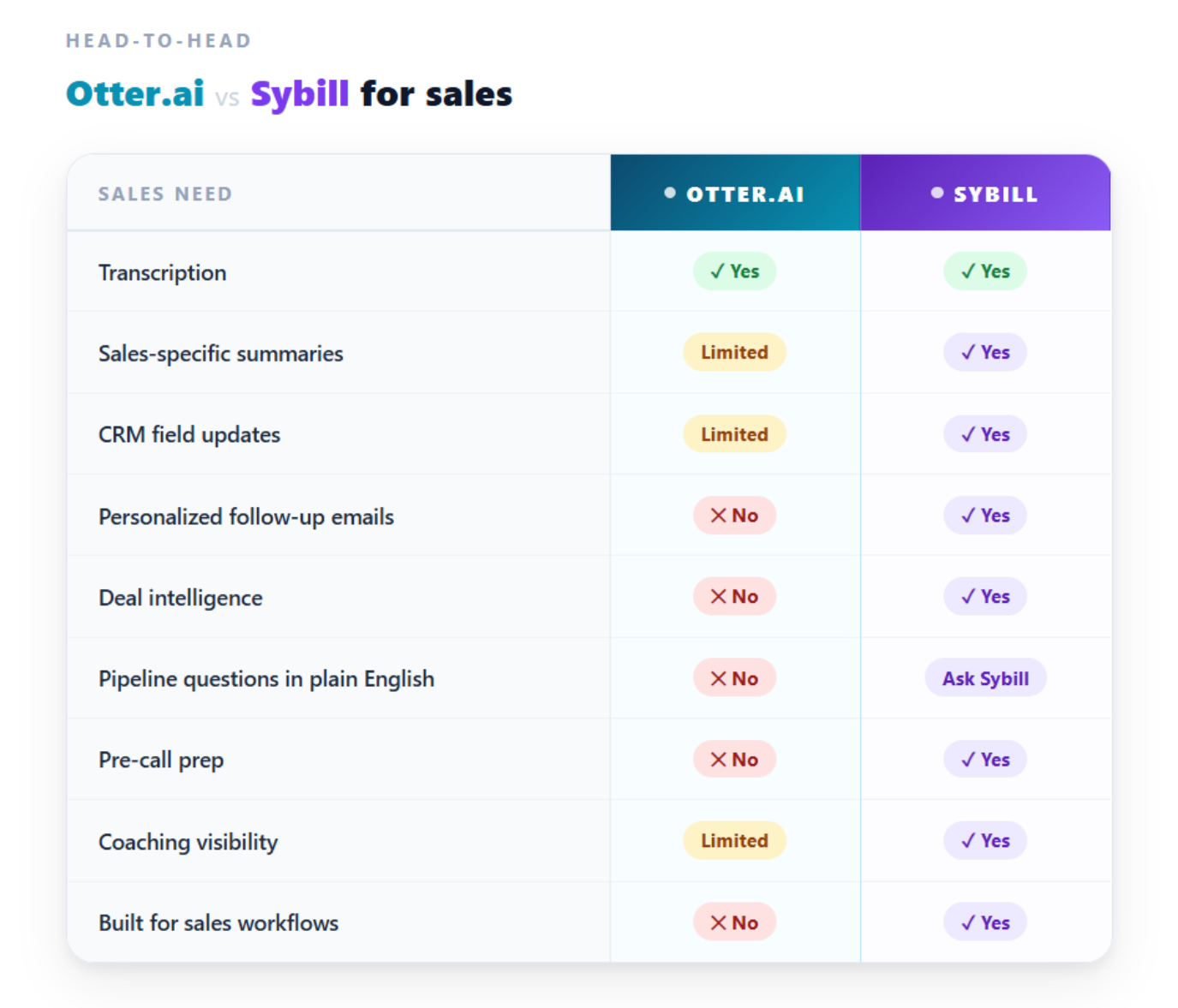
Otter.ai is a solid transcription tool. But if you are in sales, a transcript is about as useful as a gym membership you never use. Nice to have. Zero impact unless something happens after.
Sales teams need more than meeting notes. They need AI tools that can summarize calls, update CRM fields, draft follow-up emails, capture next steps, surface deal risks, and help managers coach reps without watching every call like it is a prestige TV crime doc.
If you are looking for the best Otter.ai alternatives for sales, start with Sybill. It is built for revenue teams that want every sales call to turn into action: CRM Autofill, Magic Summary, Personalized Emails, Ask Sybill, AI Tasks, Pre-Meeting Briefs, and coaching visibility.
Otter.ai became popular because it solved a real problem: people hated taking meeting notes. Fair. Nobody joins sales to become a court stenographer with a quota.
But sales calls are not ordinary meetings.
A discovery call is not a product standup. A late-stage pricing call is not a weekly sync. A renewal conversation is not a casual internal brainstorm. Every sales conversation has deal signals hiding inside it: pain points, objections, buying intent, timeline, competitors, stakeholders, budget signals, next steps, and the occasional “just checking internally” that definitely needs decoding.
Otter.ai can help you remember what was said. That is useful. But remembering is not the same as selling.
If you want a deeper breakdown of how Otter compares with Sybill, read Otter vs Sybill: Which AI Meeting Assistant Wins for Sales?.
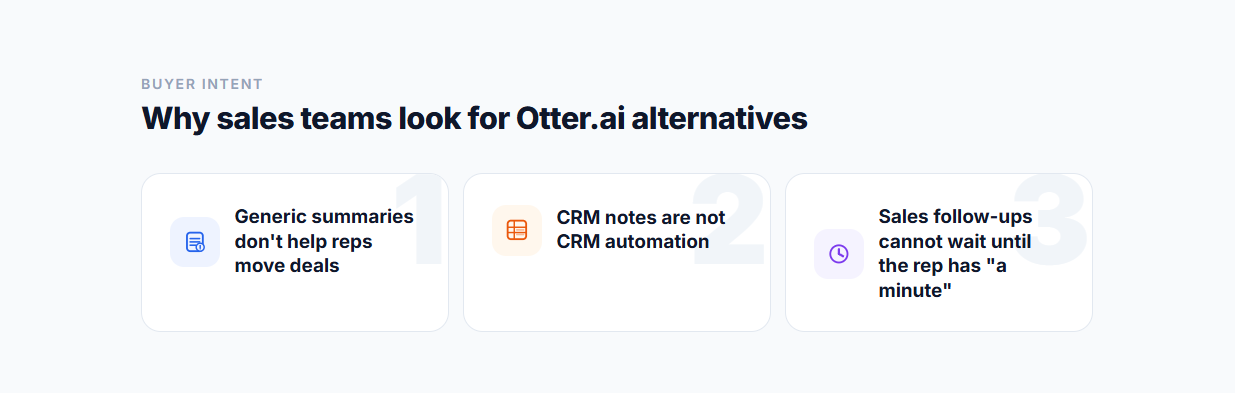
Sales reps do not need a chronological recap that says:
“First, the participants introduced themselves. Then they discussed challenges. Then they talked about pricing.”
A sales team needs the call broken down by what matters to the deal:
A generic AI meeting assistant usually captures the conversation. A sales-focused AI assistant interprets it through the lens of pipeline movement.
One of the biggest traps in the Otter.ai alternatives category is the phrase “CRM integration.”
A tool can say it integrates with Salesforce or HubSpot because it attaches meeting notes to a record. That does not mean it updates your CRM in a way RevOps or managers can trust.
For sales teams, CRM automation should mean the tool can extract structured data from sales calls and emails, then update the right fields. Think MEDDIC, BANT, next steps, competitors, buying committee, deal stage, close blockers, pain points, and use case.
If the rep still has to read the summary, copy the details, update fields, clean up the opportunity, and write the follow-up manually, congratulations. You bought a prettier clipboard.
For more on this exact workflow, read Which AI Tool Automatically Writes CRM Notes After Sales Calls?.
The faster the follow-up, the cleaner the momentum.
But sales reps are often stacked with back-to-back calls. The follow-up email gets pushed to the end of the day, then tomorrow, then somewhere between “I will get to it” and “this deal is now cold.”
A strong Otter.ai alternative for sales should turn the conversation into a personalized follow-up email. Not a lifeless template. Not “Great chatting today.” A real recap with the buyer’s priorities, specific pain points, agreed next steps, and the rep’s tone.
Because nobody needs another AI email that sounds like it was written by a toaster wearing a blazer.
For a dedicated comparison of tools in this category, read AI Tools That Write Personalized Follow-Up Emails After Sales Calls.
Before comparing tools, separate the nice-to-have features from the revenue-impacting ones.
A clean transcript is table stakes. The real question is: what does the tool do after the call ends?
Look for summaries that understand the difference between a discovery call, demo, negotiation, renewal, and handoff.
A good AI sales call summary should include:
This is where many generic Otter alternatives fall flat. They summarize meetings. Sales teams need summaries that map to deal movement.
To go deeper into this distinction, read AI Call Summary: From Manual Notes to Sales Intelligence.
If your sales team lives in Salesforce, HubSpot, Zoho, or Dynamics 365, the AI tool should not merely attach a transcript and walk away like it did something heroic.
It should update CRM fields with structured data from calls and emails.
That is the difference between “we have notes” and “our pipeline reflects reality.”
The best AI meeting assistant for sales should draft follow-up emails from the actual conversation.
That includes:
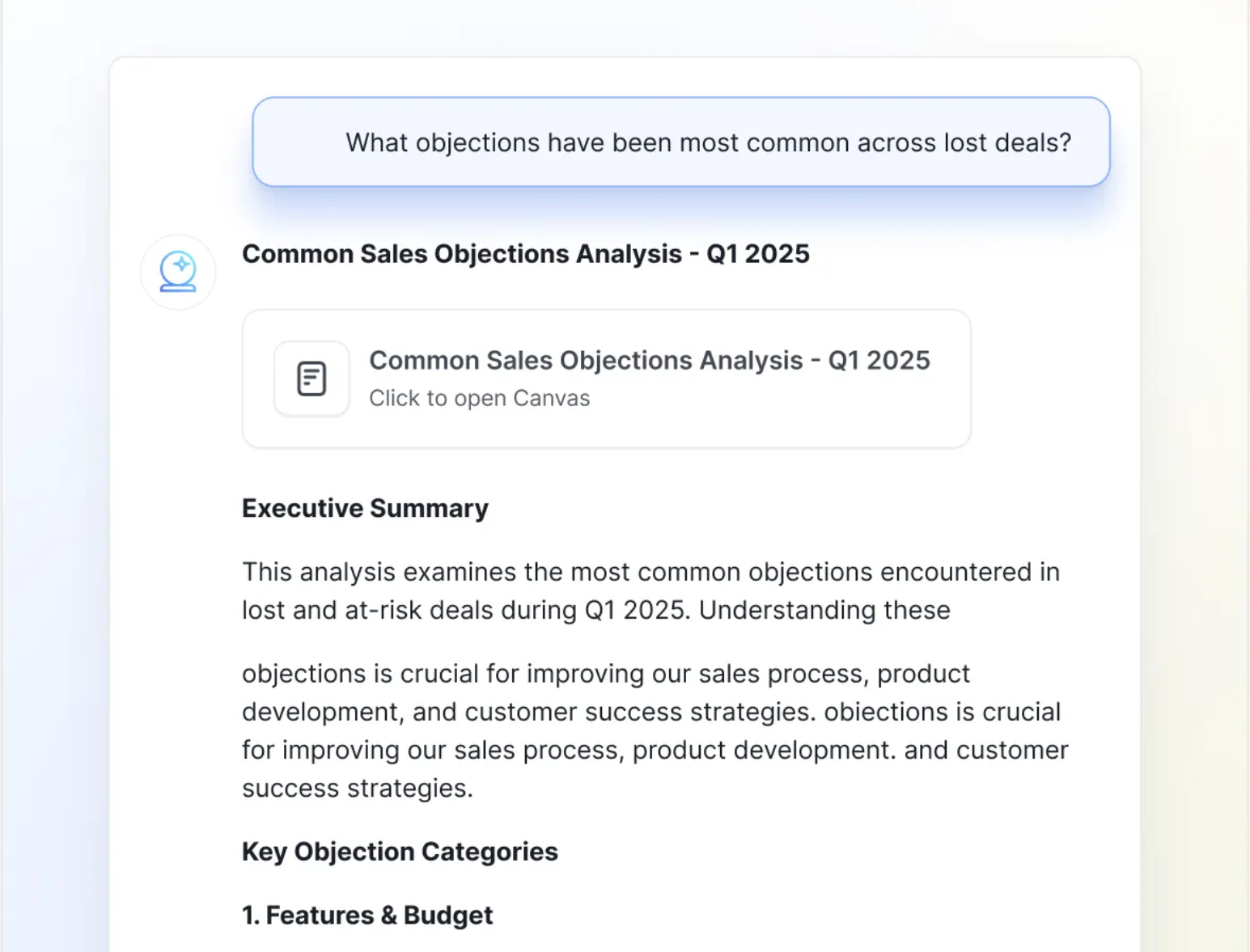
Sales teams should be able to ask questions across calls, emails, CRM records, and deal history.
For example:
That is where sales AI becomes more than a meeting recorder. It becomes a revenue assistant.
For a broader breakdown of tools in this space, check out Best AI Sales Tools in 2026.
Managers do not need another dashboard they will ignore after two weeks. They need coaching signals that make 1:1s better.
The right Otter.ai alternative should help managers spot:
For more on rep-level feedback, read What Tools Give Reps AI-Driven Feedback on Their Sales Calls?.
Sybill is not just an AI note-taker. It is an AI sales assistant built for the full sales workflow before, during, and after the call.
Where Otter captures conversations, Sybill helps sales teams act on them.
That distinction matters because sales teams do not need more data lying around. They need less admin, faster follow-ups, cleaner CRM, better coaching, and sharper deal execution.
Sybill is best for:
Sybill’s Magic Summary does not simply recap what happened. It organizes the conversation around sales outcomes: buyer priorities, pain points, objections, competitors, next steps, stakeholders, and deal risks.
That means reps do not need to dig through a transcript to figure out what matters. Managers do not need to watch a full recording to understand deal health. RevOps does not need to pray that reps remembered to update CRM.
The summary is built for the way sales teams actually work.
The real villain in sales productivity is not “too many meetings.” It is the swamp of admin that follows every meeting.
Sybill’s CRM Autofill extracts deal details from calls and emails, then updates CRM fields automatically. That includes key qualification details, next steps, stakeholder information, buyer pain points, competitors, and deal notes.
This is where Sybill clearly separates itself from generic Otter.ai alternatives.
Otter can help you document a meeting. Sybill helps your CRM reflect reality.
Sales follow-up is where good calls either turn into progress or quietly rot.
Sybill drafts personalized follow-up emails based on the actual conversation. The email reflects what the buyer said, what the rep promised, what was agreed, and what should happen next.
No generic “great chatting” filler. No copy-paste archaeology. No waiting until 8 PM because the rep had five calls and a pipeline review.
This is exactly why Sybill is one of the strongest AI tools that summarize sales calls better than Otter.
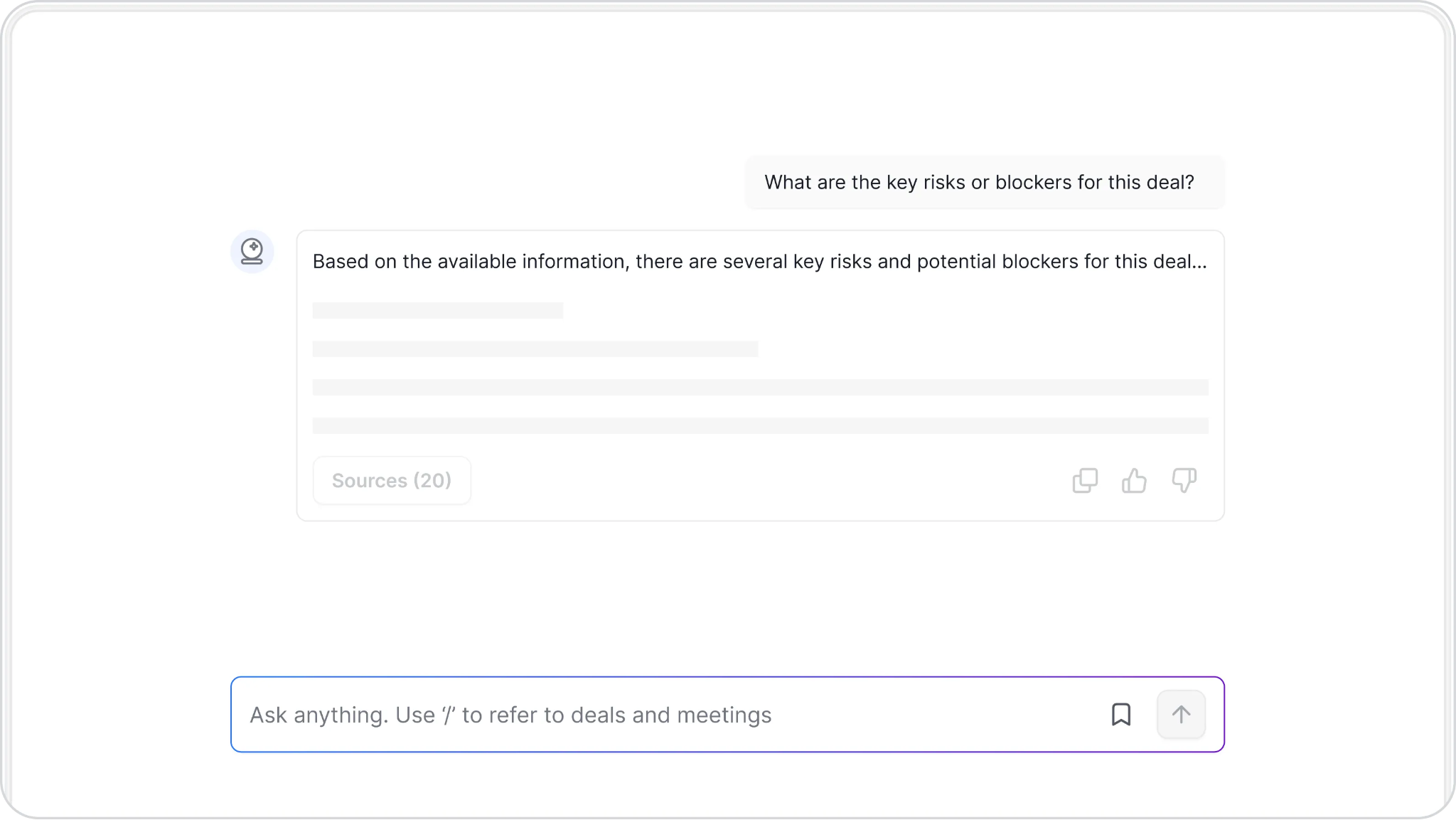
Ask Sybill lets reps and managers ask questions across calls, emails, CRM records, and deal activity.
Examples:
This matters because revenue teams do not need more places to search. They need answers.
Before a sales call, Sybill’s Pre Meeting Brief pulls together key context: attendee details, company information, previous interactions, open tasks, deal history, and suggested talking points.
That means reps do not have to spelunk through CRM, inboxes, and old notes before every meeting. They show up prepared, which buyers notice immediately.
Every sales call creates tiny commitments. Send the deck. Loop in security. Confirm pricing. Book next steps. Share a case study. Update the champion.
Sybill’s AI Tasks helps capture those commitments and keep deals moving.
That is the real difference between a note-taker and a sales execution platform.
Bottom line: Choose Sybill if you want every sales call to become a clean summary, updated CRM record, personalized follow-up, coaching signal, and deal insight.

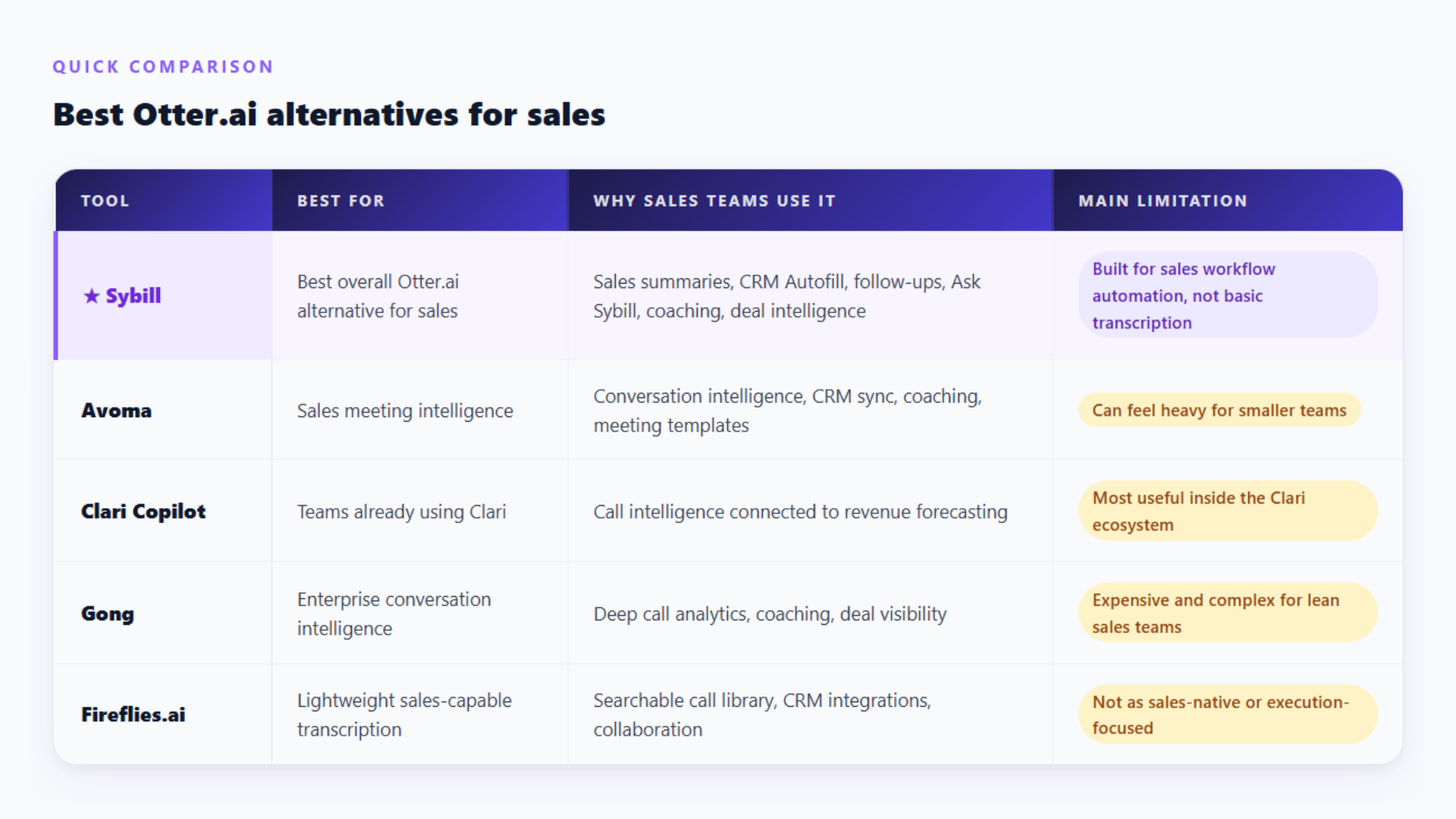
Avoma is a strong Otter.ai alternative for sales teams that want structured meeting notes, conversation intelligence, coaching, and CRM sync.
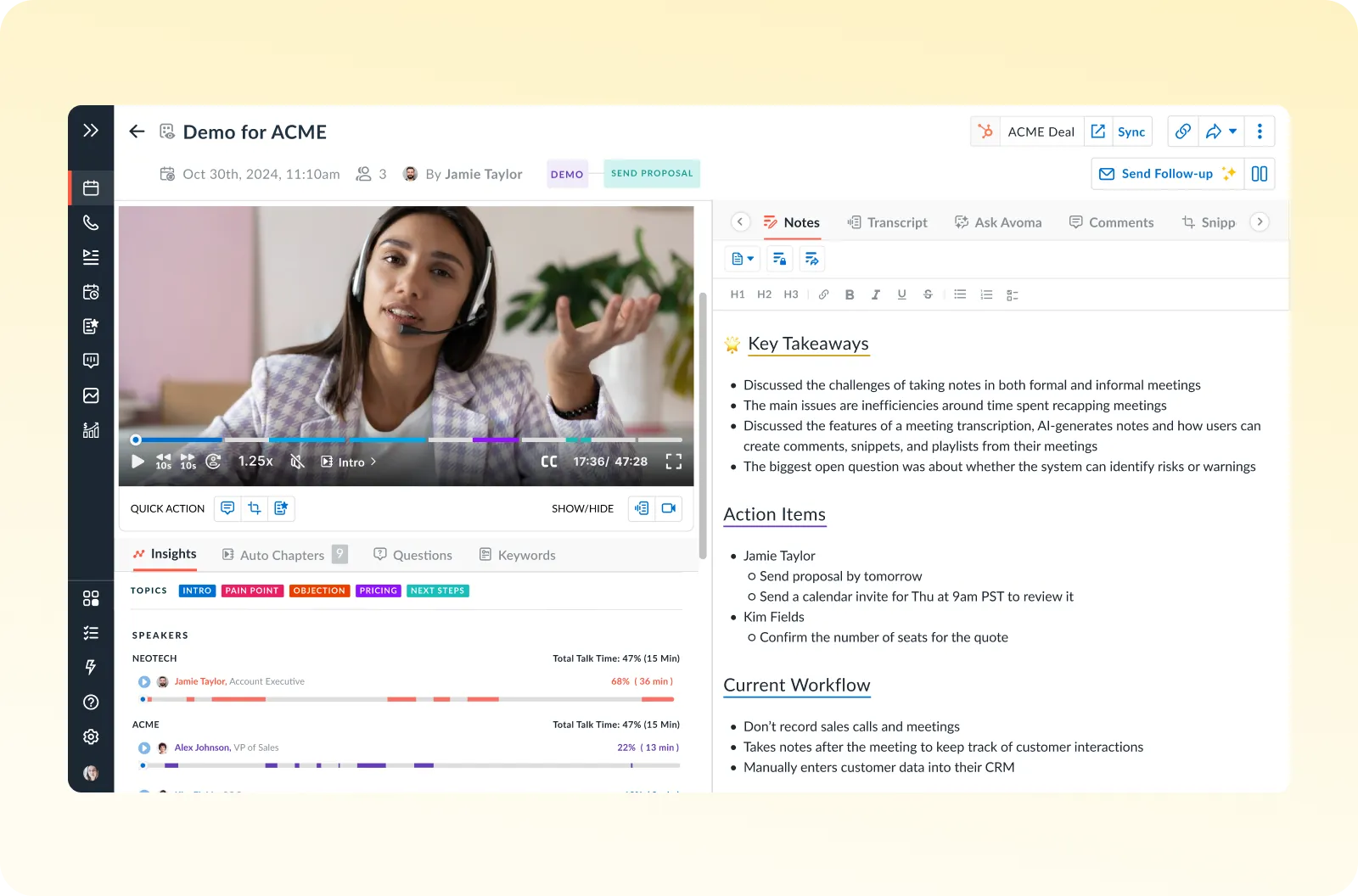
It is built for customer-facing teams, so it understands more of the sales workflow than a general transcription tool. Reps can use it to capture calls, generate notes, sync information to CRM, and review conversations. Managers can use it for coaching and performance insights.
Avoma is useful for teams that want:
It is a good fit for sales and customer success teams that want more structure than Otter provides.
Avoma can feel heavier for smaller teams that want fast execution without a lot of configuration. It is strong on meeting intelligence, but teams that want a more rep-first workflow around CRM Autofill, follow-up emails, AI Tasks, and plain-English deal querying may find Sybill more directly aligned with daily sales execution.
Bottom line: Choose Avoma if you want a sales meeting intelligence platform. Choose Sybill if you want sales intelligence plus execution.
Clari Copilot is best for revenue teams already invested in the Clari ecosystem.
It brings conversation intelligence into the broader revenue platform, helping teams connect call insights with forecasting, pipeline inspection, and revenue workflows.
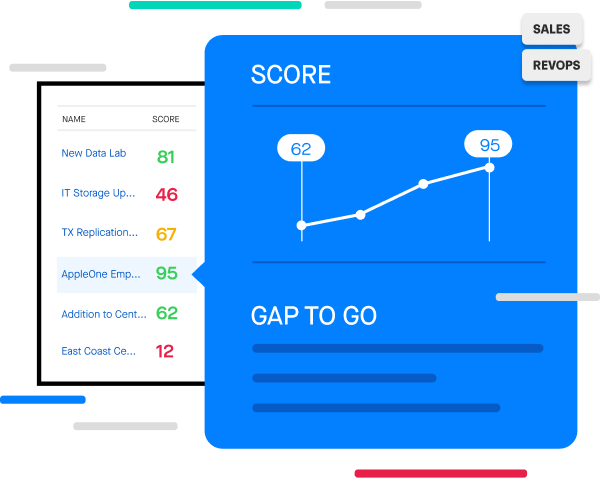
Clari Copilot is useful for:
For Clari customers, Copilot makes sense. It keeps conversation intelligence close to forecasting and pipeline management.
The biggest limitation is ecosystem dependency. If your team is not already using Clari, the value equation gets more complicated.
It can also feel less attractive for teams that mainly want quick adoption, faster follow-ups, clean CRM updates, and rep-level workflow automation.
Bottom line: Choose Clari Copilot if Clari is already your revenue operating system. Choose Sybill if you want an AI sales assistant reps can use every day across calls, CRM, emails, tasks, and deal inspection.
Gong is one of the best-known platforms in sales conversation intelligence. It is powerful, mature, and widely used by enterprise revenue teams.
It helps teams record and analyze sales conversations, inspect deals, coach reps, and identify revenue patterns.
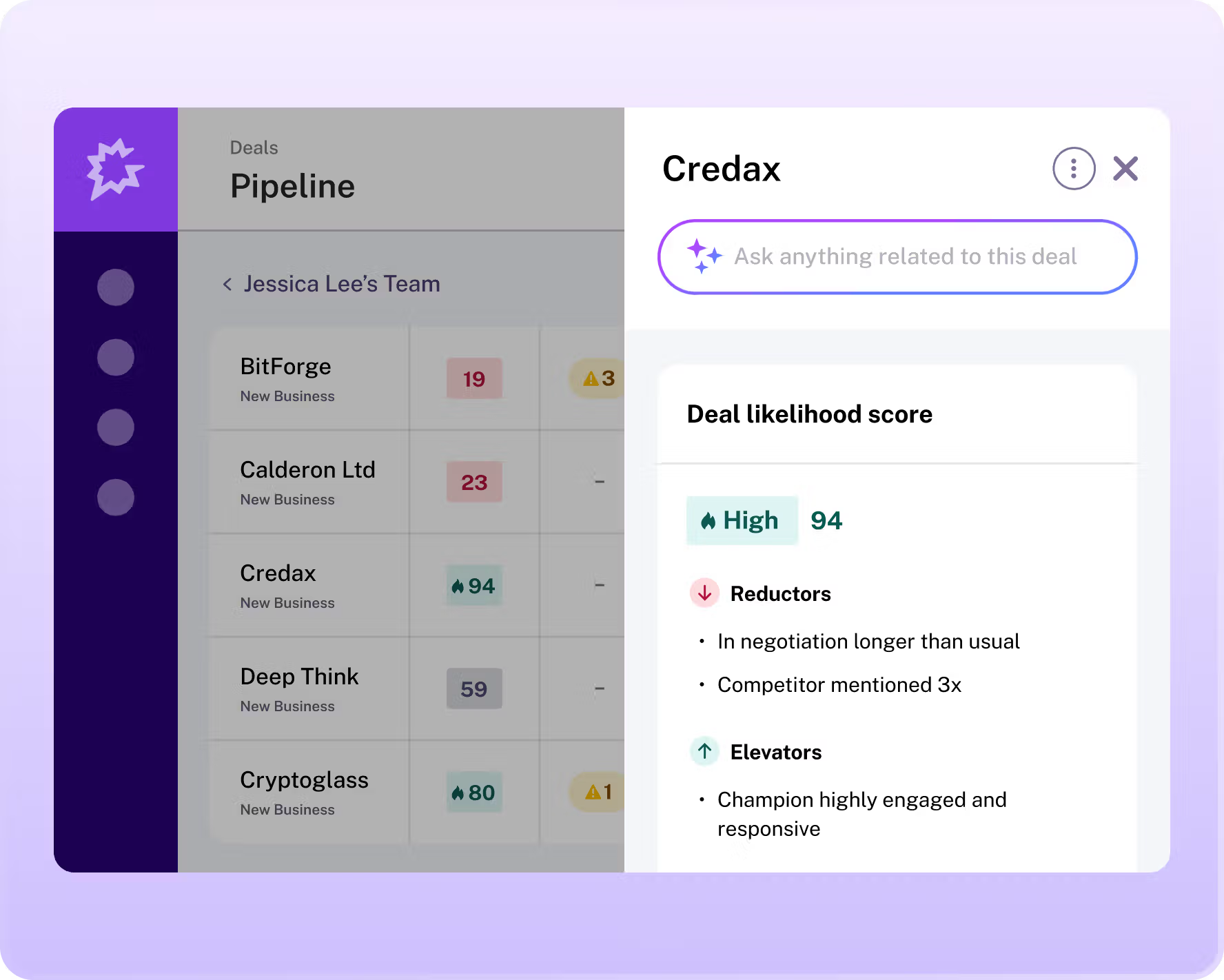
Gong is strong for:
Gong is not a simple note-taker. It is a revenue intelligence platform.
Gong can be expensive, complex, and more manager-centric than rep-centric. For many teams, it creates visibility without necessarily removing the daily admin reps hate most.
That is the key difference.
Gong helps leaders understand what is happening across the revenue org. Sybill helps reps get work done after every call.
For a more detailed comparison, read Sybill vs Gong Comparison or How They Compare for Conversation Intelligence in 2026.
Bottom line: Choose Gong if you need enterprise conversation intelligence and have the budget to support it. Choose Sybill if your priority is rep productivity, CRM automation, follow-up speed, and deal execution.
Fireflies.ai is a popular Otter.ai alternative because it is easy to use, works across major meeting platforms, and gives teams a searchable meeting library.
It is not purely a sales platform, but it has enough CRM and collaboration functionality to be useful for sales teams that need a lighter upgrade from Otter.
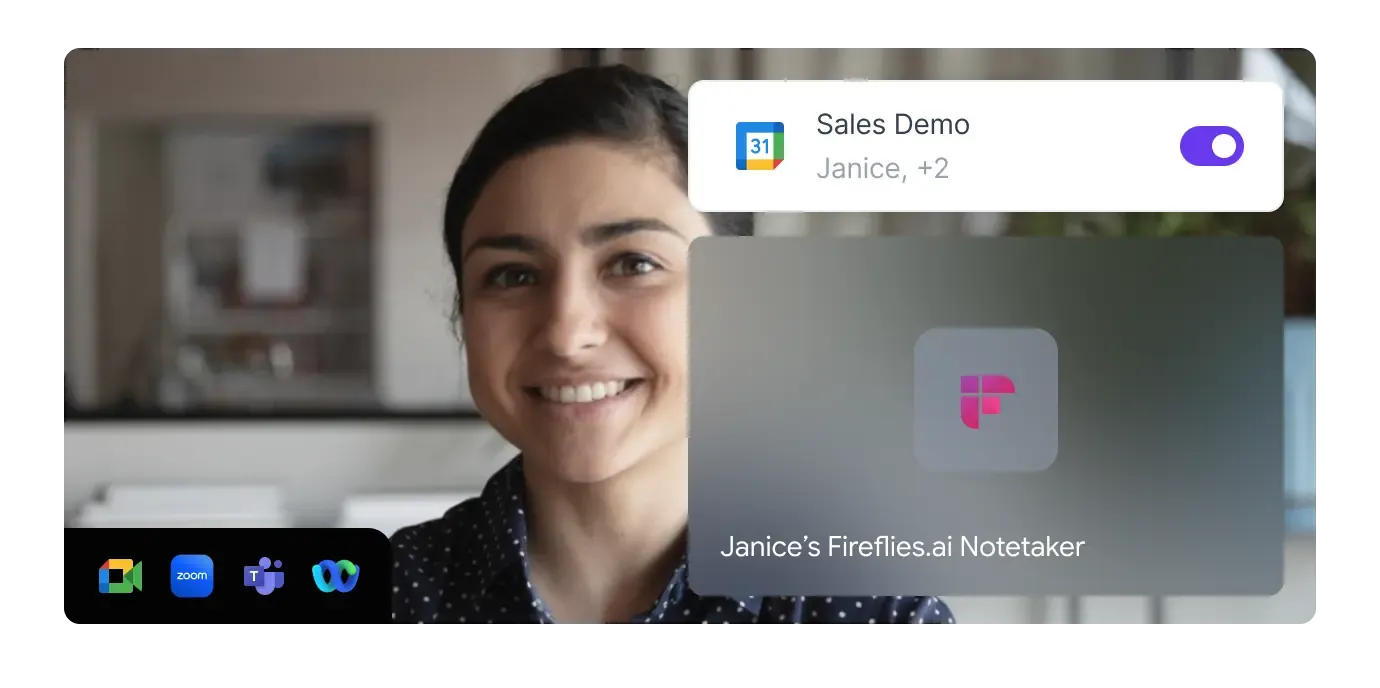
Fireflies.ai is useful for:
For small teams, Fireflies can be a practical step up from Otter.
Fireflies is sales-capable, not sales-native.
That means it can help with transcription, search, and basic workflow capture. But it does not go as deep into sales execution as Sybill. Teams looking for CRM Autofill, personalized follow-up emails, deal intelligence, coaching visibility, and AI-powered pipeline context will likely outgrow it.
For a direct comparison, read Fireflies vs Otter.ai.
Bottom line: Choose Fireflies.ai if you want a lightweight meeting assistant with CRM integrations. Choose Sybill if you want a sales-first AI assistant that turns calls into revenue action.
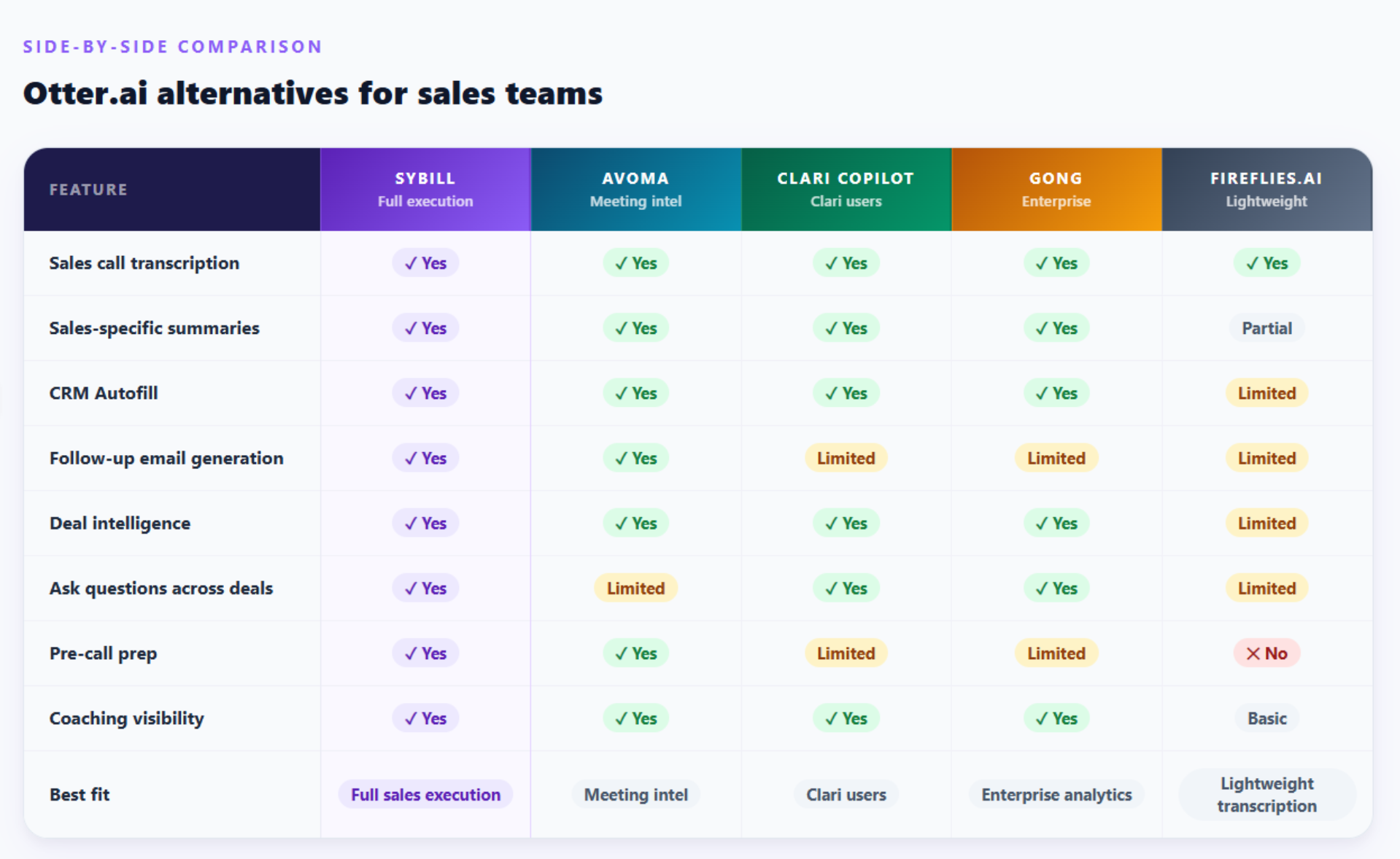
The pattern is clear.
Most Otter.ai alternatives help capture the meeting. A few help analyze the meeting. Sybill helps sales teams act on the meeting.
That is the commercial difference that matters.
There is no universal “best” tool for every team. There is only the best tool for the job your team actually needs done.
Choose Sybill if your reps are buried in post-call admin, your CRM is always half-updated, and your managers are tired of asking, “What actually happened on this deal?”
Sybill is the best choice if you want:
It is the strongest option for teams that want to move beyond transcription into actual sales execution.
Avoma is a good fit if your team wants structured notes, call recording, CRM sync, and coaching in a meeting-first platform.
It is especially useful for sales and customer success teams that want better meeting discipline and conversation visibility.
Clari Copilot makes the most sense when your team already runs forecasting and revenue operations through Clari.
If Clari is your system of record for revenue inspection, Copilot can extend that environment with conversation intelligence.
Gong is a strong fit for large sales organizations with mature RevOps, enablement, and leadership structures.
It is powerful, but it is not always the leanest option for teams that mainly need reps to follow up faster, update CRM automatically, and move deals forward.
For more on how Gong compares with other sales tools, read Gong Reviews: The Good, The Bad, The Ugly.
Fireflies.ai is a good fit if your team wants better meeting search, shared notes, and CRM-connected transcription without buying a heavier sales platform.
It is a practical middle step. But if sales execution is the goal, Sybill is the stronger long-term choice.
Sales teams do not lose deals because they forgot one sentence in a transcript.
They lose deals because the follow-up was late. The CRM was stale. The next step was vague. The manager missed the risk. The champion went quiet. The competitor came up twice and nobody noticed. The rep promised to send the security deck and then got swallowed by the calendar monster.
That is why transcription is only the first 10% of the problem.
The real value is turning buyer context into action.
A basic AI meeting assistant asks: “What happened on the call?”
A sales AI assistant like Sybill informs sales teams:
That is the future of AI tools for sales calls. Not cleaner transcripts. Cleaner execution.
If you only need transcription, Otter.ai is fine. But if you want the best overall Otter.ai alternative for sales teams, Sybill is the strongest choice.
Because Sybill solves the actual sales problem. It does not stop at “here is what was said.” It helps reps and managers act on what was said.
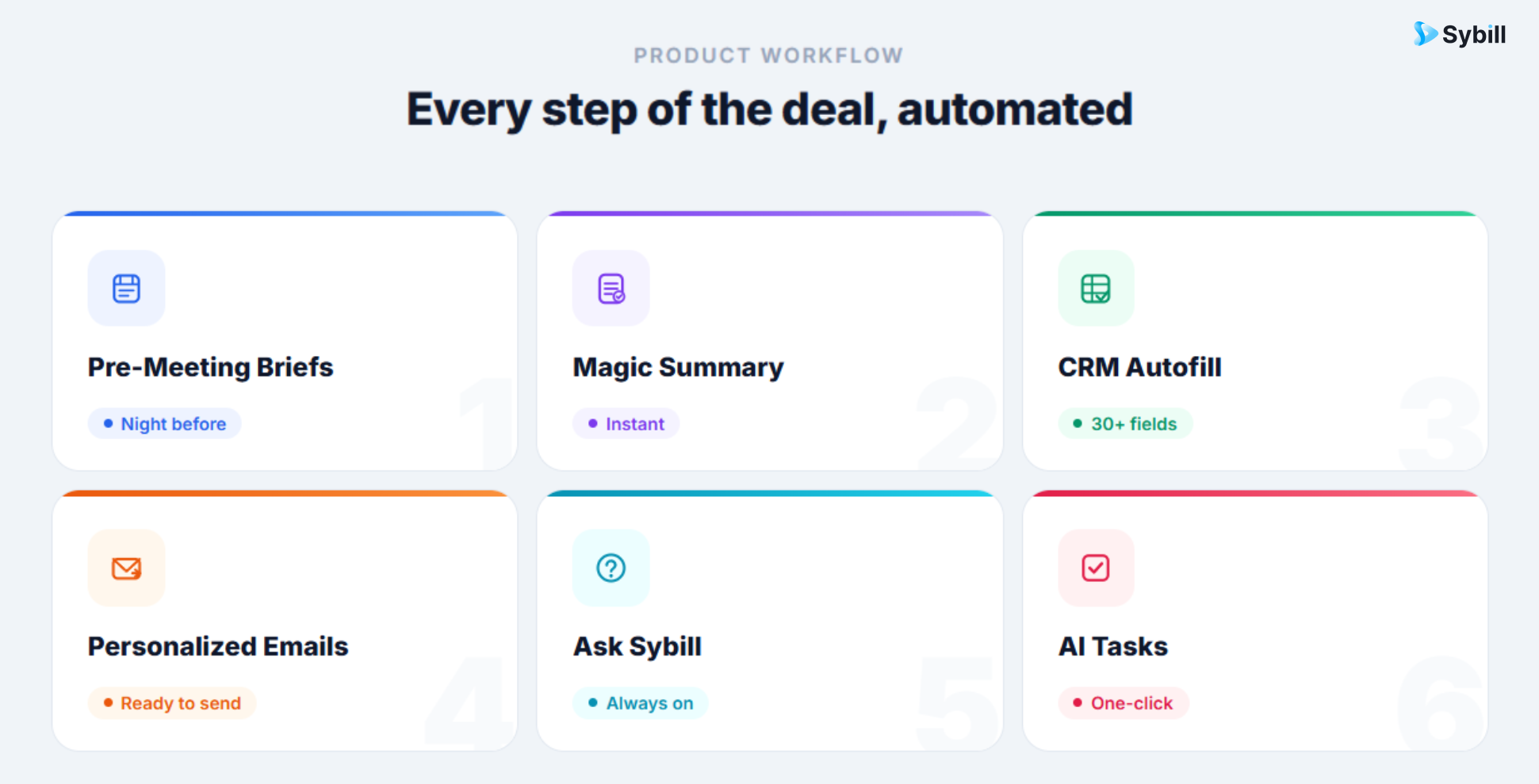
With Sybill, sales calls become Magic Summaries, CRM Autofill, Personalized Emails, AI Tasks, coaching signals, Pre-Meeting Briefs, and Ask Sybill answers that help teams inspect and move deals.
Otter gives you the record. Sybill gives you the next move.
Ready to move beyond transcripts? Get started with Sybill and turn every sales call into CRM updates, follow-ups, coaching insights, and pipeline momentum.
Sybill is the best Otter.ai alternative for sales teams because it is built around sales execution, not just transcription. It creates sales-specific summaries, autofills CRM fields, drafts follow-up emails, supports pre-call prep, and helps teams inspect deals using Ask Sybill.
Otter.ai can transcribe sales calls, but it is not ideal for revenue teams that need structured deal insights, CRM updates, follow-up emails, coaching visibility, and pipeline intelligence. It is better suited for general meeting transcription than sales execution.
For sales teams, Sybill, Avoma, Clari Copilot, Gong, and Fireflies.ai are better suited than Otter.ai because they offer more sales-focused workflows such as CRM integration, call summaries, coaching, and deal intelligence. Sybill is the strongest option for teams that want the full call-to-close workflow automated.
Sybill, Avoma, Clari Copilot, Gong, and Fireflies.ai all offer CRM-related capabilities. Sybill stands out because it focuses on CRM Autofill, turning call and email context into structured CRM updates instead of simply attaching notes.
Otter.ai is mainly a transcription and meeting notes tool. Sales conversation intelligence software analyzes calls for deal-relevant insights such as objections, next steps, buyer intent, stakeholders, and risks. The best tools also update CRM, support coaching, and help teams move deals forward.
Sybill is the best Otter.ai alternative for sales teams because it is built around sales execution, not just transcription. It creates sales-specific summaries, autofills CRM fields, drafts follow-up emails, supports pre-call prep, and helps teams inspect deals using Ask Sybill.
Otter.ai can transcribe sales calls, but it is not ideal for revenue teams that need structured deal insights, CRM updates, follow-up emails, coaching visibility, and pipeline intelligence. It is better suited for general meeting transcription than sales execution.
For sales teams, Sybill, Avoma, Clari Copilot, Gong, and Fireflies.ai are better suited than Otter.ai because they offer more sales-focused workflows such as CRM integration, call summaries, coaching, and deal intelligence. Sybill is the strongest option for teams that want the full call-to-close workflow automated.