Find us at booth #83, join us for a harbor side happy hour, or catch Gorish’s talk.

Sept, 16-18 > Learn more


Mamta Tainwala

January 30, 2026

Effective sales management training requires three critical components:
(1) transition training from IC to manager covering coaching techniques, pipeline management, and forecasting (typically 30-90 days),
(2) ongoing skill development in areas like deal coaching, performance management, hiring, and enablement design, and
(3) technology proficiency in conversation intelligence, CRM systems, and analytics platforms.
When developing a sales training program, sales managers must consider team skill gaps, business objectives, sales methodology alignment, rep learning styles, and measurement frameworks. The best training combines formal programs (Sandler, Challenger, Miller Heiman), practical application through role-plays and call reviews, and AI-powered coaching tools that surface insights at scale.
Remember your first week as a sales manager? You went from crushing quota to managing people who... aren't crushing quota. Nobody taught you how to run a forecast call. Nobody showed you how to give feedback that doesn't crush someone's soul. And that moment when your VP asked "How's the pipeline looking?" and you realized you had no idea?
Yeah, most companies promote their best reps and throw them into management with zero training. It's like asking a pet parent with a well-tempered, easy to train dog to train your nervous and anxious fur baby.
According to research from CSO Insights, 57% of sales managers receive no formal management training before taking on the role. None. They learn by making expensive mistakes with real deals and real people. Meanwhile, organizations with structured sales manager training programs see 91% higher quota attainment than those without.
Whether you're a newly promoted manager frantically Googling "how to run a one-on-one," a sales leader building a manager development program, or a veteran manager looking to level up, this guide breaks down exactly what sales management training should cover, how to structure it, and which programs actually drive results.
This isn't theory. It's the practical roadmap for turning good sellers into great leaders.
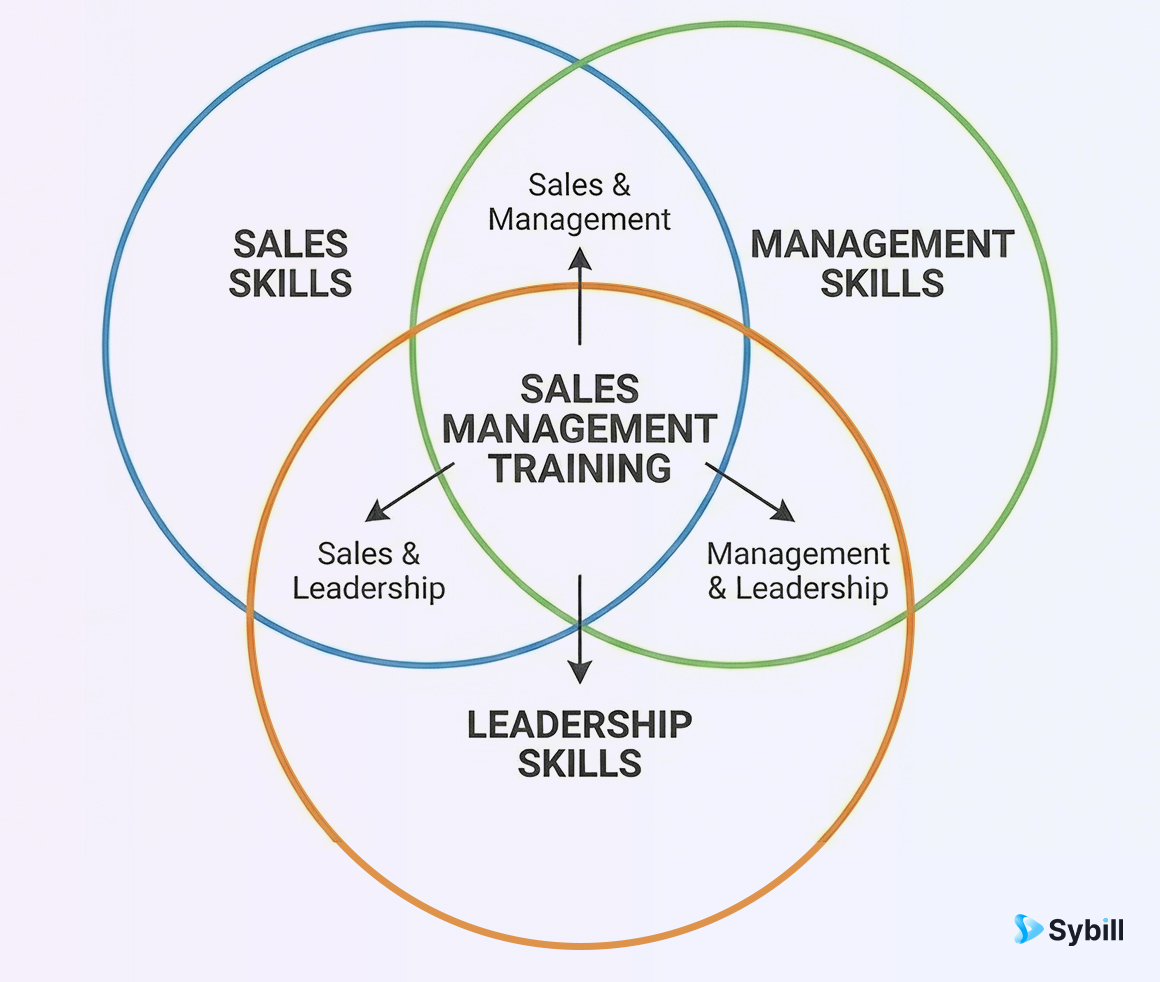
Sales management training is the structured development of skills, frameworks, and capabilities required to lead a sales team effectively. But here's where most programs go wrong: they either teach generic management principles (goal setting, feedback, performance reviews) without sales context, or they teach advanced sales techniques without the management layer.
Great sales management training lives at the intersection of three domains:
Managers can't coach what they don't understand. Effective management training for sales requires deep fluency in sales methodologies (SPIN, Challenger, MEDDPICC, Sandler), deal strategy, qualification frameworks, and the buyer journey. But it's not enough to know how to sell, managers must articulate why these approaches work and how to teach them to reps with different learning styles and skill levels.
The best training programs ensure managers can deconstruct a winning deal, identify the repeatable patterns, and coach those patterns across their team. They understand sales enablement frameworks and how to deploy content, tools, and training strategically.
This is where former top performers often struggle the most. Being a great seller doesn't automatically make you a great coach. Sales management training must cover:
These aren't sales skills - they're leadership skills applied to a sales context. Many managers never develop them because their companies assume "if you can sell, you can manage."
Modern sales managers are business operators, not just team cheerleaders. Training must include:
The best managers use data to diagnose problems, prioritize coaching, and make strategic decisions about where to invest time. This requires analytical capabilities many reps never developed as individual contributors.
When sales management training addresses all three domains: sales expertise, people management, and business strategy - you get managers who can actually multiply team performance. When it only covers one or two, you get struggling managers who either micromanage tactics, give generic motivational speeches, or focus solely on numbers without developing capability.
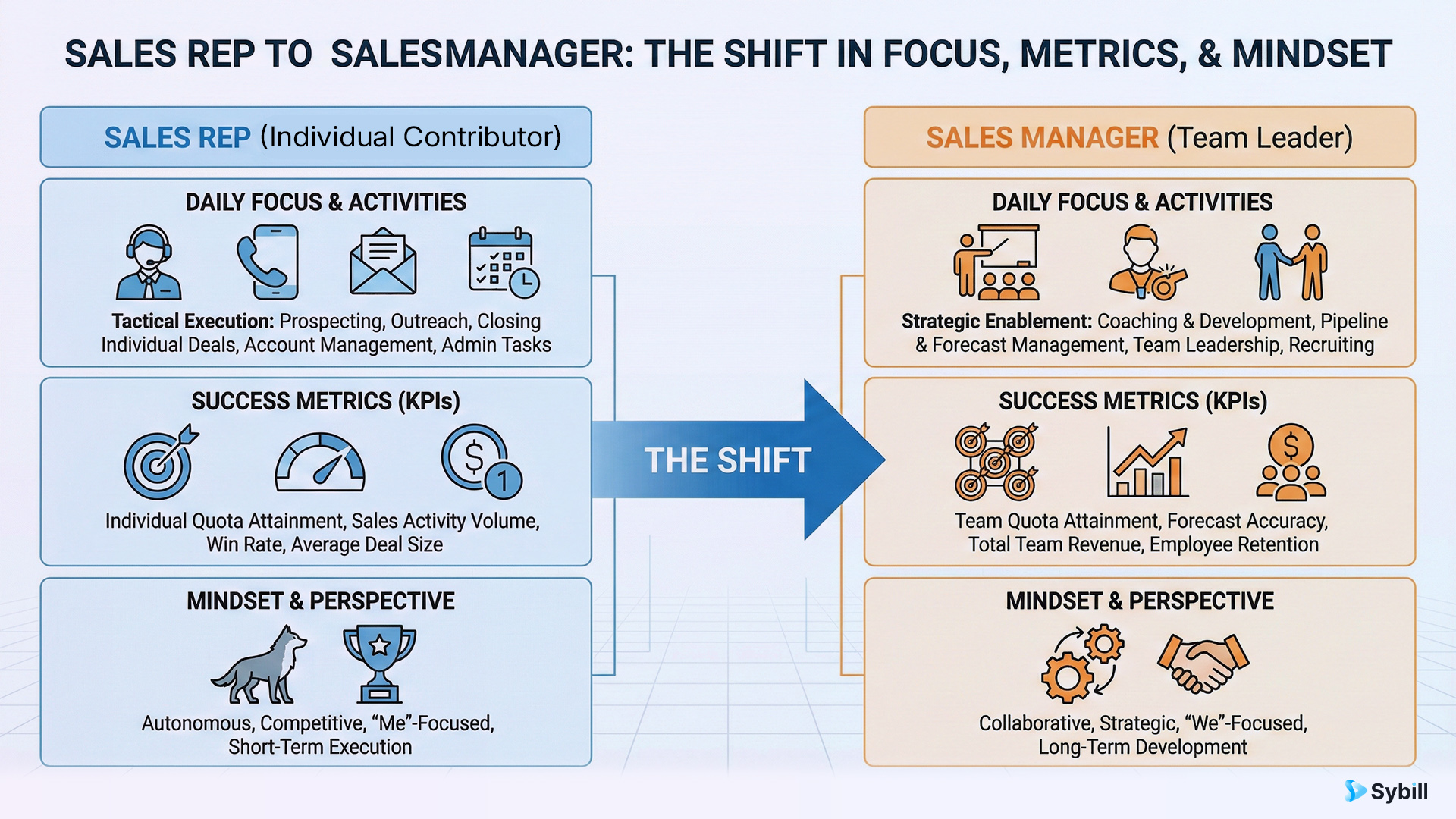
The leap from quota-carrying rep to sales manager is one of the hardest transitions in business. You go from being judged on your own deals to being evaluated on your team's collective performance. From controlling your own calendar to managing eight people's calendars. From personal achievement to team multiplication.
Here's what makes this transition so brutal:
As a rep: Did you hit your personal quota? What was your win rate? How big were your deals?
As a manager: Did your team hit their collective number? What's the team average win rate? Are you developing reps or just harvesting the good ones?
Suddenly, a rep crushing their quota doesn't help you if the other seven are struggling. Your job is to raise the floor and the ceiling across the entire team. That requires sales performance coaching at scale, not just individual heroics.
As a rep: 60-70% of your time in customer-facing activities, 20% on deal strategy and planning, 10% on admin and internal meetings.
As a manager: 40% coaching and development, 25% pipeline and forecast management, 20% hiring and internal collaboration, 15% strategic planning and reporting.
Most new managers try to maintain their rep schedule while layering management on top. This doesn't work. You can't do both jobs well. Sales management training must teach ruthless prioritization and delegation. If you're still the one chasing your biggest deal instead of coaching your reps on theirs, you're not managing, you're just a rep with reports.
Top reps often succeed through intense individual drive, competitive fire, and personal accountability. These traits don't automatically translate to management:
Competitive fire can become impatience with reps who aren't "getting it" as fast as you did.
Individual drive can become reluctance to delegate and develop others.
Personal accountability can become an inability to hold others accountable without feeling like you're being harsh.
The best sales manager training explicitly addresses these mindset shifts. It helps new managers understand that their role is to make their team successful, not to be the hero.
As a rep, you built your own book of business. As a manager, you inherit a team with varying skill levels, motivations, and coachability. Some reps will be hungry and coachable. Others will resist feedback. A few might be actively undermining you.
Training must prepare managers for the reality that not everyone can (or should) be saved. Effective management includes knowing when to invest in development and when to make a change. This is one of the hardest lessons for new managers, especially those who want to believe they can coach anyone to success.
The best organizations don't just promote someone and wish them luck. They provide:
30-60-90 day onboarding plans that gradually shift the new manager from doing to leading. Month one: learn the team, establish trust, observe patterns. Month two: implement your coaching cadence, start making incremental changes. Month three: drive measurable performance improvement.
Manager shadowing and mentorship where new managers observe experienced leaders running one-on-ones, forecast calls, pipeline reviews, and deal coaching sessions. Then they practice with feedback before running these on their own.
Formal training programs covering deal coaching, pipeline management, hiring, and performance management. Not generic management training but sales-specific, practical frameworks they can implement immediately.
Technology enablement on tools like conversation intelligence platforms, CRM analytics, and forecasting systems. New managers often inherit tech stacks they've never used from the management side.
The transition from IC to manager typically takes 6-12 months before someone feels truly competent in the role. Without structured training and support, that timeline extends or the manager flames out entirely.
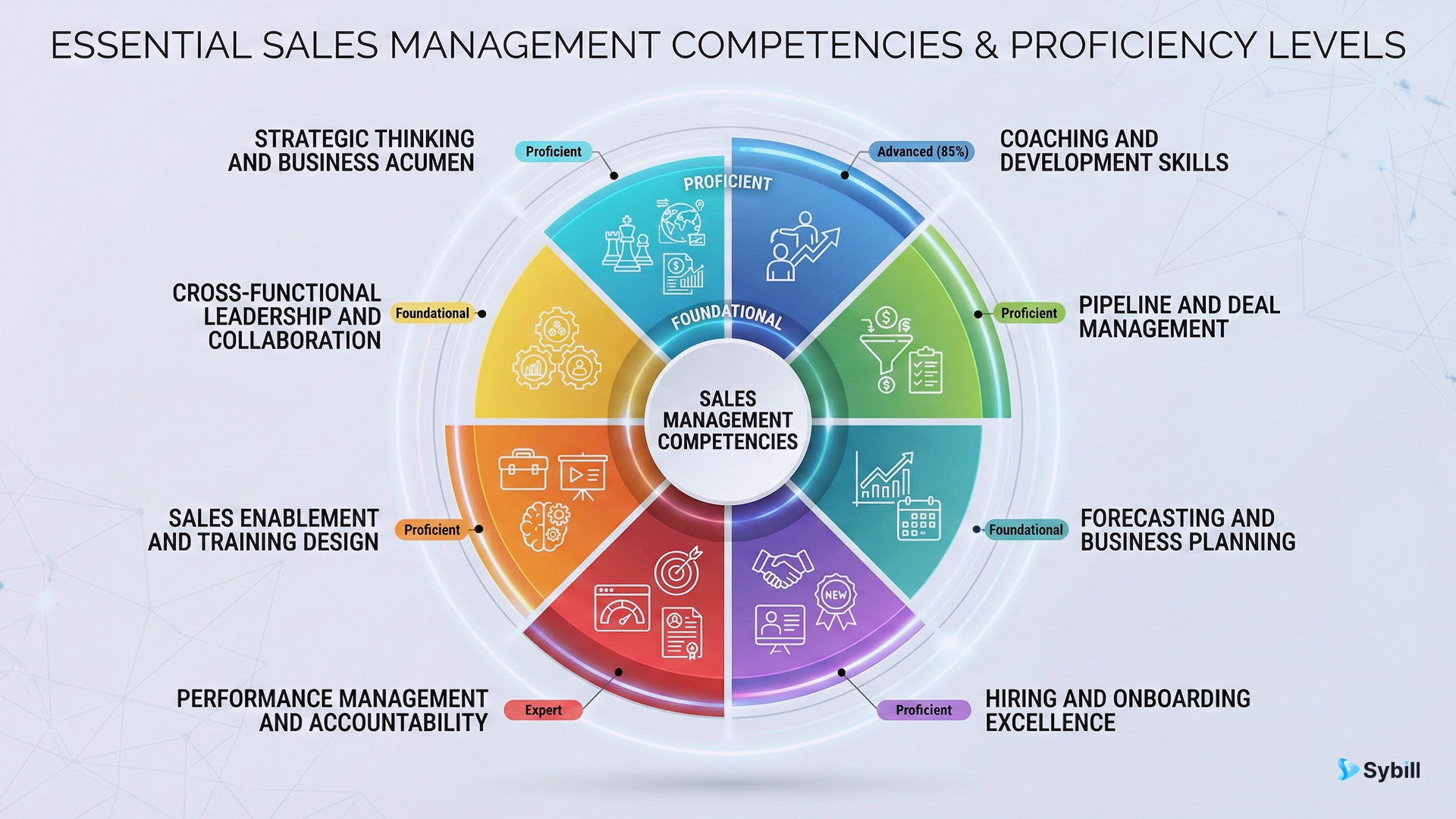
Great sales management training is built around competency development in specific domains. Here are the non-negotiables:
This is the highest-leverage activity for any sales manager. How sales managers ensure targeted training comes down to effective coaching practice.
What this includes:
How to develop it: Formal coaching certification programs (ICF, Sandler Coaching), shadowing great coaches, recording and reviewing your own coaching sessions, using platforms like Sybill to identify coaching opportunities from every call.
The best managers spend 30-40% of their time coaching. If you're spending less than 20%, you're not developing your team, you're just managing scorecards.
Managers must understand every deal in their team's pipeline, assess health accurately, and coach reps on strategy.
What this includes:
How to develop it: Study enterprise deal frameworks, practice weekly pipeline reviews with a mentor, analyze won vs. lost deals for patterns, use CRM analytics and revenue intelligence platforms to surface insights.
Accurate forecasting is both art and science. Great managers blend data, judgment, and understanding of their reps' tendencies.
What this includes:
How to develop it: Partner with experienced managers during forecast cycles, track your forecast vs. actual over time, analyze slippage patterns, use conversation intelligence to validate deal health beyond CRM stage.
Building a high-performing team starts with bringing in the right people and ramping them effectively.
What this includes:
How to develop it: Study proven hiring frameworks, conduct post-hire reviews to assess interview prediction accuracy, build repeatable onboarding playbooks, track new hire ramp metrics (time to first deal, time to quota).
Many managers struggle here because they've never hired before. Training should include role-playing interviews, learning how to spot red flags, and understanding what good looks like beyond just "they seem hungry."
Holding people accountable while maintaining psychological safety is a delicate balance and a critical management skill.
What this includes:
How to develop it: Learn from HR partners, study employment law basics, practice difficult conversation frameworks, get mentorship from experienced managers on navigating performance issues.
Managers don't just deliver training, they design it based on team needs.
What this includes:
How to develop it: Study instructional design principles, learn adult learning theory, practice facilitating workshops, get certified in sales methodologies your company uses.
When developing a sales training program, sales managers must consider not just what to teach but how people learn, when to intervene, and how to measure whether training translates to improved performance.
Great managers don't operate in silos. They collaborate across marketing, product, customer success, and operations.
What this includes:
How to develop it: Attend cross-functional meetings, build relationships proactively, learn how other functions measure success, practice influencing without authority.
Managers must think beyond this quarter. They're building sustainable performance engines.
What this includes:
How to develop it: Take business strategy courses, study your company's financials, read industry analysis, participate in annual planning, get exposure to executive-level strategic discussions.
Building elite sales managers requires the right tools. Sybill gives managers instant visibility into every rep's performance through conversation intelligence, automated CRM updates, and AI-powered coaching insights. Stop managing from gut feel and start leading with data. Get started for free and transform your management capability.
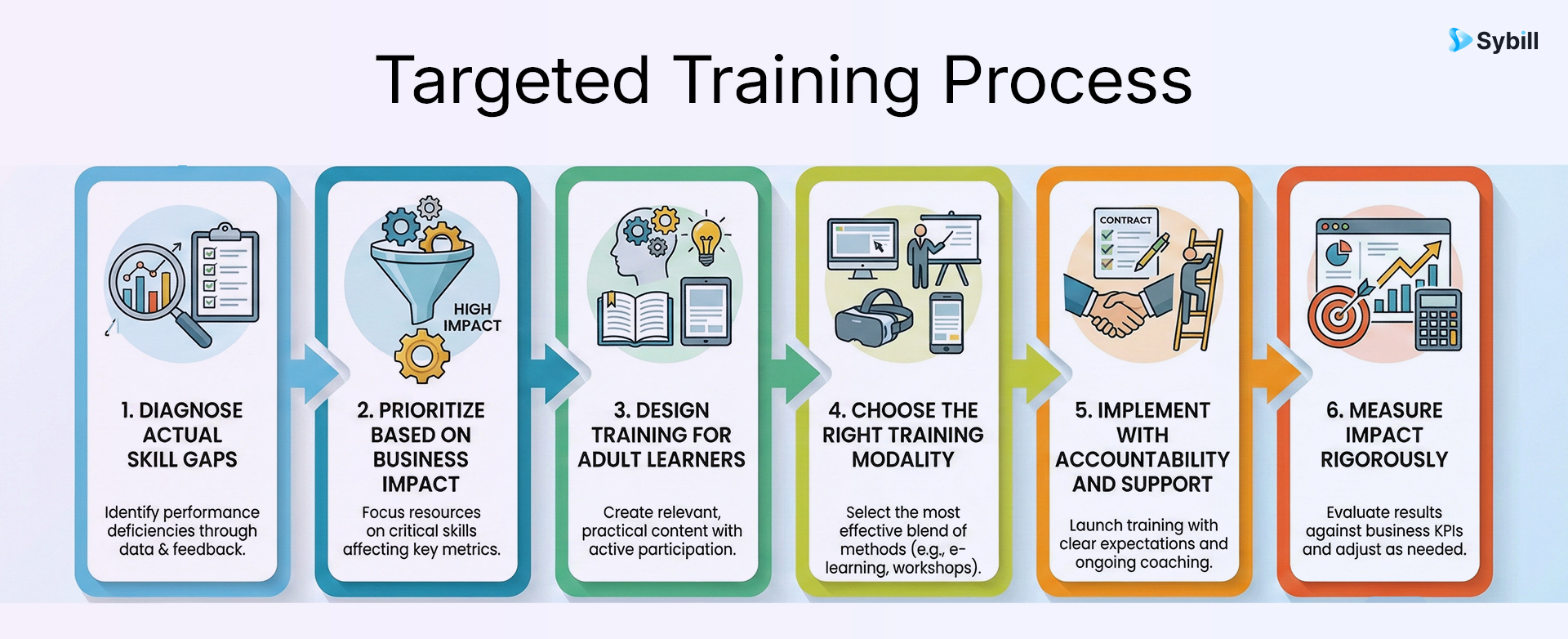
One of the most critical questions in sales leadership: how do sales managers ensure targeted training that actually moves the needle? Here's the systematic approach:
Most managers guess at what their team needs. Elite managers use data:
Analyze conversation patterns using tools like Sybill. Which reps struggle with discovery? Who dominates talk time? Where are objections being fumbled? AI-powered coaching tools surface these patterns automatically across hundreds of calls.
Review pipeline and deal data. Are deals stalling at a specific stage? Is qualification weak? Are we losing to competitors on price because reps can't articulate value?
Conduct skill assessments. Use competency frameworks to rate each rep's proficiency in key areas: discovery, qualification, demo delivery, objection handling, negotiation, closing.
Survey your team. Ask reps directly: "Where do you feel least confident? What skills would help you close more deals?"
Study won/loss patterns. What differentiates wins from losses? Are there specific behaviors or approaches that correlate with success?
This diagnostic phase should take 2-4 weeks and result in a clear picture of both team-wide patterns and individual development needs.
You can't fix everything at once. Prioritize training that will move revenue metrics:
High impact, high frequency: Skills used in every deal that directly affect outcomes (e.g., discovery, qualification). Train here first.
High impact, low frequency: Critical skills used in specific scenarios (e.g., executive selling, navigating procurement). Train for reps who encounter these situations.
Low impact, high frequency: Nice-to-have improvements that don't materially affect results. Deprioritize.
Low impact, low frequency: Ignore entirely until you've addressed higher priorities.
Also consider: What's the cost of not training? If weak qualification is causing pipeline bloat and forecast inaccuracy, that's expensive. If demo skills are mediocre but reps still convert, maybe that's not the priority.
Adults don't learn like kids. Effective sales training and coaching must account for adult learning principles:
Make it immediately applicable. Reps need to use new skills this week, not in theory someday. Training that sits in a playbook gathering dust is wasted effort.
Connect to real situations. Use actual deals, real call recordings, and scenarios your team encounters. Generic role-plays feel artificial and don't stick.
Respect existing expertise. Your reps aren't beginners. Build on what they know rather than starting from zero. Let them contribute insights and examples.
Provide practice and feedback. You can't learn to ride a bike by reading about it. Training must include deliberate practice with coaching and correction.
Make it social. Group training where reps learn from each other, share approaches, and role-play together creates accountability and peer learning.
Different skills require different training approaches:
One-on-one coaching for individualized development, difficult performance issues, and personalized skill building. Best for high-touch, high-stakes situations.
Group workshops for teaching new frameworks, methodologies, or processes to the entire team. Good for building shared language and approach.
Peer learning sessions where reps share best practices, review calls together, and learn from each other. High engagement, low prep time.
Microlearning and just-in-time training via short videos, email tips, or Slack nudges that reinforce key concepts without dedicated training time.
Formal certification programs like Sandler, Challenger, or Miller Heiman for comprehensive methodology training.
AI-powered practice using tools that let reps practice objection handling or pitch delivery and get instant feedback.
The best programs blend multiple modalities. For example: workshop to introduce a concept, one-on-one coaching to apply it to real deals, peer sessions to share learnings, microlearning to reinforce over time.
Training fails when there's no follow-through. Build accountability:
Pre-work: Before training, have reps review materials, assess their current skill level, or identify a specific deal where they'll apply the learning.
During training: Use live deals as examples, role-play realistic scenarios, get reps to commit to specific actions.
Post-training: Within 48 hours, have reps apply the new skill and report back. Schedule a follow-up session to review what worked and what didn't.
Ongoing reinforcement: Reference the training in one-on-ones. Review calls to see if behaviors changed. Celebrate wins when reps successfully apply new skills.
Manager modeling: You can't teach what you don't do. If you're training on better discovery questions, demonstrate them yourself. Lead by example.
What gets measured gets improved. Track both leading and lagging indicators:
Leading indicators (behavior change):
Lagging indicators (business results):
Compare trained vs. untrained cohorts where possible. Track the same metrics before and after training. Be honest about what's working and what isn't, then iterate.
When you follow this framework: diagnose, prioritize, design, deliver, implement, measure, you ensure training is targeted, relevant, and impactful. This is how sales managers ensure targeted training that drives results, not just checks a box.
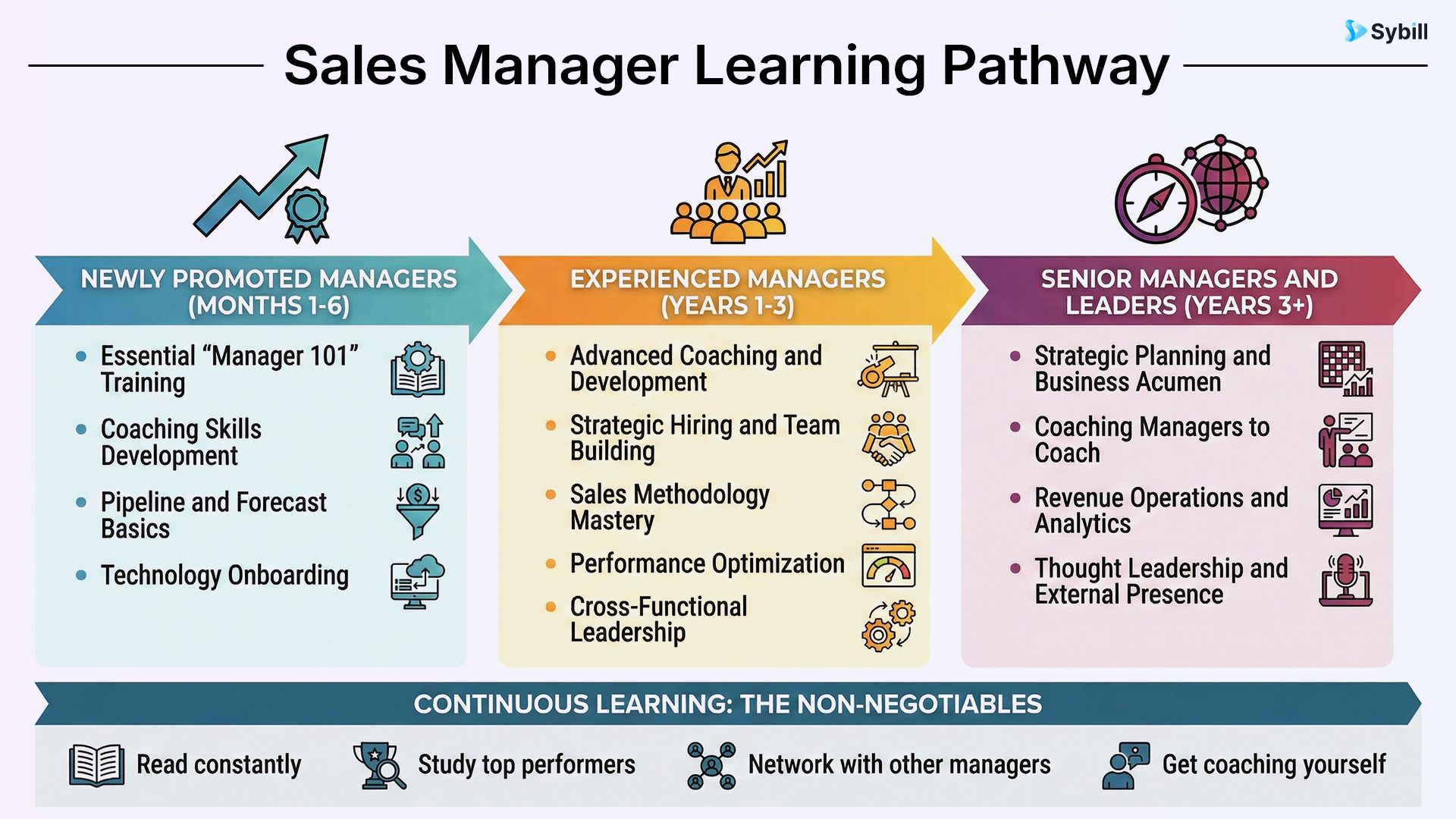
Sales manager training isn't one-size-fits-all. What you need depends on where you are in your management journey. Here's the curriculum:
Essential "Manager 101" Training:
Management fundamentals adapted for sales context. This isn't generic HR training, it's how to manage salespeople specifically, who are motivated differently, respond to different feedback styles, and have unique development needs.
Topics include: setting expectations, running effective one-on-ones, giving feedback that lands, basic performance management, time management for managers, delegation basics.
Recommended programs: Manager training from sales-specific companies like Richardson, Sandler Manager training, or internal company programs customized for sales.
Coaching Skills Development:
Learn the difference between coaching and managing. How to use powerful questions, observation frameworks, and practice techniques to develop capability rather than creating dependency.
Programs: ICF coaching fundamentals, Sandler Coaching certification, or internal coaching workshops. Pair this with shadowing experienced coaches and recording your own coaching sessions for review.
Pipeline and Forecast Basics:
Understanding pipeline health indicators, learning your company's forecasting process, building credibility with your forecast submissions, conducting pipeline reviews that surface real risks.
Training: Shadow your manager during forecast calls, partner with sales ops on pipeline analytics, use CRM reports and revenue intelligence tools to understand deal progression.
Technology Onboarding:
Get proficient with your management tech stack: CRM analytics, conversation intelligence platforms like Sybill, sales enablement tools, forecasting systems.
Training: Vendor training sessions, hands-on practice, internal power user mentorship.
Advanced Coaching and Development:
Move beyond basic coaching to specialized techniques: deal coaching frameworks, skill-specific coaching (discovery, demos, negotiation), coaching managers to coach (if you're building a team of managers).
Programs: Advanced sales coaching certifications, methodology-specific coaching training (Challenger Coach, MEDDPICC Practitioner).
Strategic Hiring and Team Building:
Get sophisticated about hiring, building diverse teams, assessing for culture add not just culture fit, creating effective interview panels, reducing bias in hiring decisions.
Training: Behavioral interview training, diversity and inclusion workshops, structured interviewing certifications.
Sales Methodology Mastery:
Deep expertise in one or more sales methodologies. Not just knowing them but being able to teach them, customize them for your sales motion, and coach reps through implementation.
Programs: Become certified in Sandler, Challenger, Miller Heiman, SPIN Selling, or whichever methodology your company uses. Many require 3-5 day workshops plus ongoing reinforcement.
Performance Optimization:
Get better at identifying high-potential reps, creating development plans, managing performance issues effectively, having difficult termination conversations, retention strategies for top performers.
Training: Partner with HR on performance management frameworks, study employment law basics, role-play difficult conversations with mentors.
Cross-Functional Leadership:
Learn to influence without authority, collaborate with marketing/product/CS effectively, represent your team in leadership forums, advocate for resources and support.
Training: Cross-functional project leadership, executive presence workshops, communication and influence programs.
Strategic Planning and Business Acumen:
Territory design, quota setting, comp plan design, market analysis, competitive positioning, long-term capacity planning, building sales playbooks that scale.
Programs: MBA-level strategy courses, industry-specific leadership programs, executive education at places like Harvard Business School or Kellogg.
Coaching Managers to Coach:
If you're managing managers, your job is to develop their coaching capability. This requires meta-skills: observing coaching, giving feedback on coaching, modeling excellent coaching.
Training: Manager of managers programs, leadership coaching certifications, internal manager development workshops.
Revenue Operations and Analytics:
Understanding the full revenue engine, optimizing handoffs between SDR/AE/CS, building data-driven processes, implementing and scaling technology, working with revenue operations teams.
Programs: RevOps certifications, sales operations courses, analytics and BI training, change management workshops.
Thought Leadership and External Presence:
Building your personal brand, speaking at conferences, contributing to industry conversations, attracting top talent through reputation.
Training: Public speaking courses, media training, content creation workshops, LinkedIn personal branding.
Regardless of tenure, every sales manager should:
Read constantly: One sales management book per quarter minimum. Stay current on sales trends, management best practices, and leadership development.
Study top performers: Regularly review calls from your best reps. What are they doing differently? How can you coach those patterns across the team?
Network with other managers: Join sales leadership communities, attend conferences, participate in peer groups. Learn from managers at other companies.
Get coaching yourself: The best managers have coaches or mentors. You can't pour from an empty cup so invest in your own development.
Leverage AI for continuous improvement: Use conversation intelligence to identify your own coaching patterns, blind spots, and opportunities for improvement.
What type of training is required for a sales manager? All of it. Management isn't a destination; it's a continuous learning journey.
The sales training market is crowded and confusing. Here's who actually delivers results, organized by what you need:
Sandler Training
Challenger (CEB/Gartner)
Miller Heiman (Korn Ferry)
Richardson Sales Performance
Corporate Visions
Sales training is evolving beyond traditional classroom-based models. The most forward-thinking companies are combining methodology training with technology:
AI-powered platforms that analyze real sales conversations and provide personalized coaching are becoming table stakes. Tools like Sybill don't replace traditional training, instead multiply its impact by giving managers instant visibility into whether training is translating to changed behavior on actual calls.
When developing a sales training program, sales managers must consider integrating conversation intelligence, practice platforms, and reinforcement tools alongside formal methodology training. The companies that win are those that blend human coaching with AI-powered insights.
Programs that work share these characteristics:
Executive sponsorship and accountability. Senior leaders participate, hold managers accountable for applying training, and tie development to performance reviews.
Manager time protected for development. Training isn't "in addition to your day job", it IS part of the job. Build it into calendars and respect that time.
Integration with existing tools and processes. Don't introduce new frameworks that conflict with how the company already sells. Build on what works.
Mix of formal and informal learning. Blend structured training with peer learning, on-the-job coaching, and self-directed development.
Technology enablement. Give managers tools like Sybill that make it easier to coach well, analyze performance, and identify training needs.
Great managers multiply team capability. They turn B-players into A-players, reduce the variance between top and bottom performers, and build cultures where people want to stay and grow. Poor managers do the opposite.
The companies that win don't leave management development to chance. They invest in structured training, provide ongoing support, hold managers accountable for development, and give them the tools (like conversation intelligence platforms) to coach at scale.
If you're a newly promoted manager: seek out training aggressively. Don't wait for your company to provide it. Read books, find mentors, join peer groups, take courses, and leverage AI tools to accelerate your learning. Your success depends on your willingness to develop yourself.
Sales management training isn't about checking a box or satisfying HR requirements. It's about building the leadership capability that drives sustainable revenue growth. Treat it accordingly.
Initial competency typically requires 6-12 months of structured development. Most newly promoted managers need 30-90 days of intensive onboarding covering coaching fundamentals. The best programs include: Month 1 shadowing and observation, Month 2-3 gradual assumption of responsibilities with heavy mentorship, Month 4-6 independent execution with regular check-ins and coaching, Month 7-12 refinement and advanced skill development. Even experienced managers require continuous learning like top performers dedicate 5-10 hours monthly to professional development through reading, courses, peer groups, and coaching.
Well-executed programs deliver 3-5x ROI within 12-18 months. Companies with structured manager training see 20-30% higher team quota attainment, 40% faster new hire ramp time, 25% lower rep turnover, and 15-20% improved forecast accuracy. For a 10-person team, a 20% improvement in quota attainment might mean $500K+ in additional annual revenue, against a $50K-$100K training investment. However, ROI depends heavily on execution: programs with no reinforcement or accountability typically fail regardless of content quality. The companies that see exceptional returns combine formal training with on-the-job application, coaching, and measurement.
The answer is both. External vendors excel at comprehensive methodology training (Sandler, Challenger, Miller Heiman) and bring proven frameworks, experienced facilitators, and industry best practices. They're worth the investment for foundational training. However, internal training is essential for company-specific processes, tools, cultural expectations, and role-playing with actual deals. Use conversation intelligence tools like Sybill to bridge both: they capture real conversations that become training content and coaching moments without requiring expensive external facilitation.