Find us at booth #83, join us for a harbor side happy hour, or catch Gorish’s talk.

Sept, 16-18 > Learn more

%20(1).avif)
Mamta Tainwala

March 17, 2026
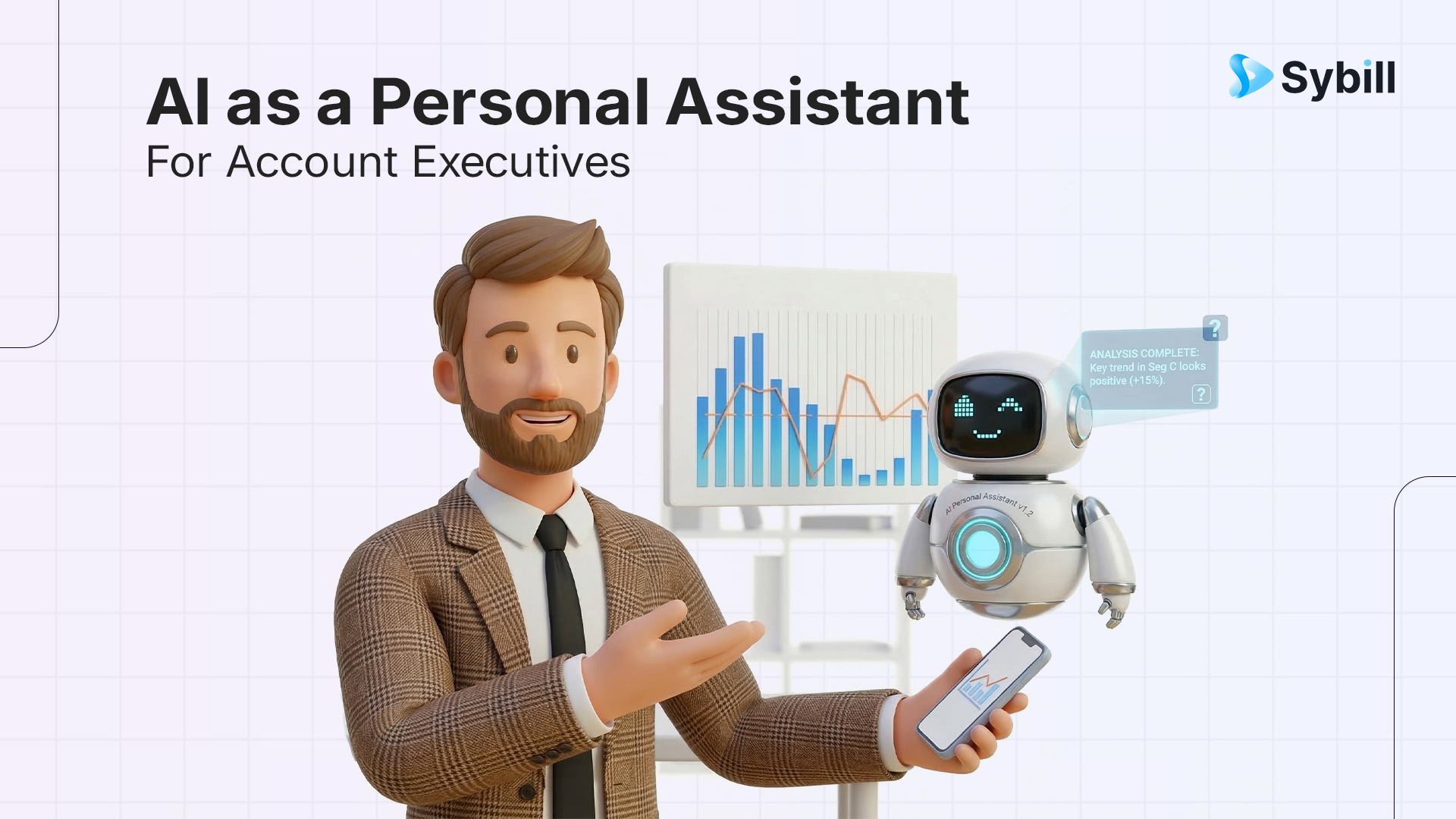
By now everyone in the world knows, aales reps spend less than 30% of their time actually selling. The rest goes to CRM updates, follow-up drafting, pre-call research, meeting prep, pipeline admin, and the bottomless inbox. For an Account Executive carrying a $1.2M quota, that math is genuinely painful.
AI does not fix the part of the job that requires a human. It cannot build trust with a skeptical economic buyer or navigate the political dynamics of a 12-person buying committee. But it can handle most of the administrative infrastructure that surrounds every deal, so the human parts get more of your attention.
This guide covers 12 specific ways AEs can use AI as a personal assistant, drawn from how high-performing account executives actually structure their workflows in 2026. Not theory. Daily practice.
An AI personal assistant for account executives is software that integrates with your deal environment, including your CRM, email, calendar, and call recordings, to handle the non-selling work that consumes your week.
The best versions are not general chatbots you have to prompt from scratch every time. They are systems that watch what is happening in your deals, surface what matters, execute defined tasks automatically, and answer questions across your entire pipeline on demand.
A well-configured AI assistant means you walk into every call prepared, walk out with your admin handled, and spend your selling hours actually selling instead of reconstructing what happened on the call you took three hours ago.
Here is where it makes the biggest difference.
The tab soup problem is real. Before a significant meeting, the average AE has their CRM open, LinkedIn for every attendee, a notes document, last quarter's call transcript, and a Slack thread with their manager all running simultaneously. They skim, they piece together fragments, and they join the call at 70% readiness hoping the buyer does not ask anything that exposes the gaps.
What AI does instead:
Sybill's pre-meeting briefs do this automatically before every call, without the rep asking. The brief is ready before the meeting starts. Pre-call prep goes from thirty minutes of tab surfing to two minutes of review.
A strong discovery call is not about having a list of questions. It is about having the right hypotheses going in, so you know what you are trying to confirm, challenge, or uncover. AI helps AEs arrive with sharper framing rather than a generic script.
What AI does:
This moves discovery from reactive listening to structured hypothesis-testing, which is how the best AEs run it regardless of deal stage.
The cognitive split during a sales call is one of the most underrated AE problems. Half your brain is in the conversation. The other half is silently panicking: "Did I get that objection? Is this the real decision-maker? What did they just say about timeline?" The result is calls where you are technically present but not fully there.
What AI does:
The rep's only job on the call is the human one: listen, probe, build rapport, read the room. The Magic Summaries are waiting when the call ends. Nothing gets lost because you were too focused on capturing to actually hear it.
The quality of a call summary determines what happens next. Generic summaries ("call went well, discussed pricing, follow up next week") are noise. Structured summaries that extract buyer pain points, objections raised, next steps confirmed, and deal risks surfaced are fuel.
What AI delivers after every call:
This is where sales workflow automation changes the post-call experience. Instead of spending forty minutes reconstructing the call, the rep reviews what the AI captured, makes any edits, and moves on to the next meeting.
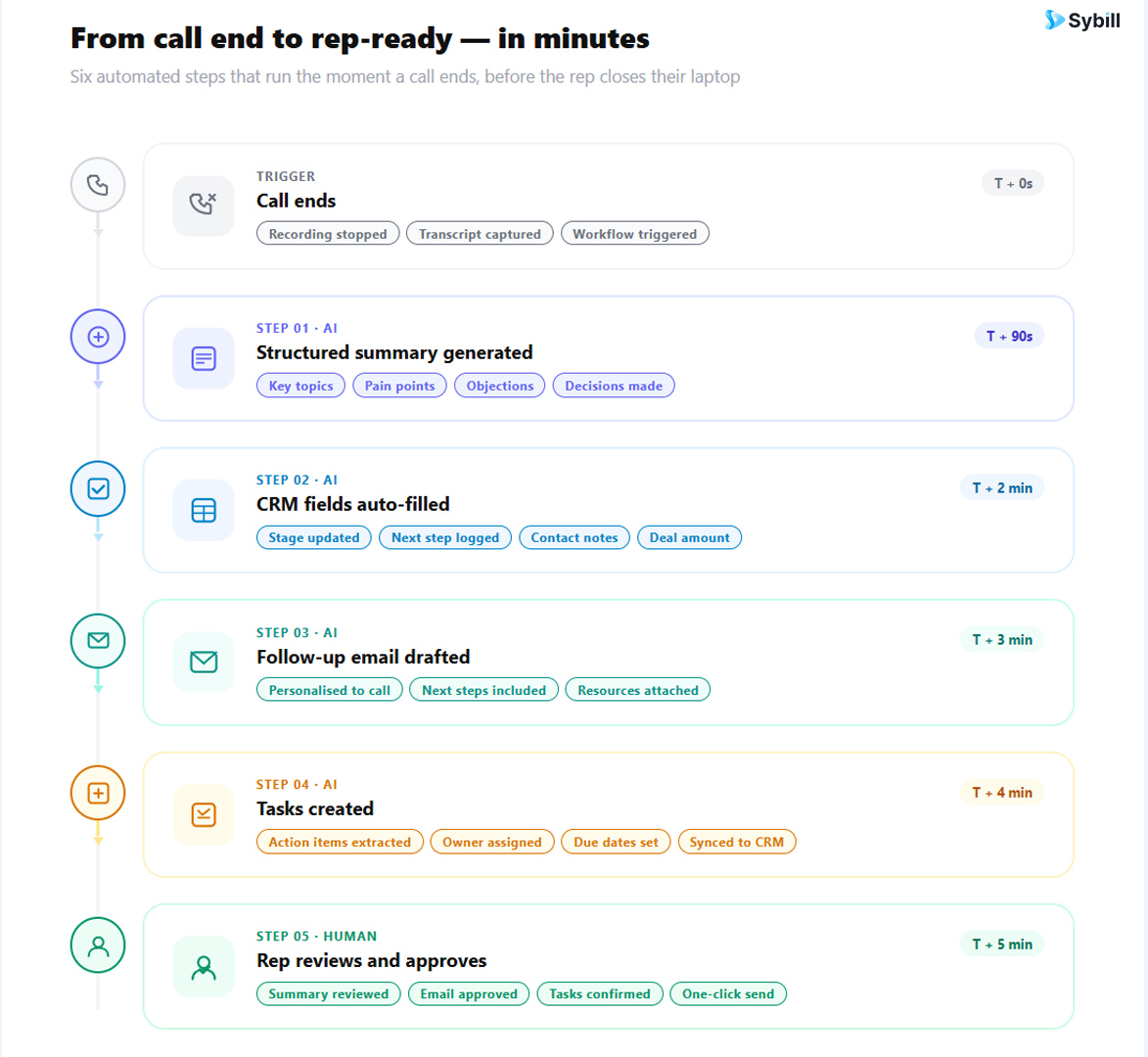
Follow-up emails are where deals quietly die or quietly accelerate. A generic "great to connect, as discussed" email signals that you were not listening. A follow-up that references the specific pain the buyer articulated, acknowledges the objection they raised, and proposes a concrete next step signals that you were. Most AEs know the difference. Most AEs do not have time to write the second kind for every call.
What AI drafts for you:
Sybill users send follow-ups 80% faster after calls. The quality is consistently higher because the draft is grounded in what was actually said, not reconstructed from memory an hour later. The rep edits, personalizes, and hits send. The average time from call end to follow-up sent drops from forty-five minutes to under five.
The CRM is the most important and most neglected tool in an AE's stack. It is neglected because updating it properly after every call takes time that feels like it is stealing from actual selling. The result is CRM data that reflects what the rep thought to log, not what actually happened in the deal.
What AI handles:
Sybill's CRM autofill does this across Salesforce, HubSpot, and Pipedrive with a 100% fill rate. The rep never re-types notes they already said out loud. The CRM reflects reality, which means forecast calls reflect reality, which means the number your VP commits to actually has a foundation.
An AE with twelve open opportunities cannot give equal attention to all of them. But identifying which ones need attention right now, without waiting for a manager to ask, is the difference between proactive pipeline management and reactive firefighting.
What AI surfaces:
The AE AI Agent built on Sybill answers questions like "which of my deals are most at risk this week?" and "where am I missing a champion?" directly, across your entire pipeline, without pulling a report or asking your manager.
A mutual action plan is one of the most effective closing tools an AE has. It aligns both sides on what needs to happen, by when, to reach a decision. It also surfaces procurement requirements, legal review timelines, and internal approval processes before they become surprise blockers in week ten.
What AI builds for you:
Building a MAP from scratch takes thirty minutes of careful work. Starting from an AI draft that Ask Sybill can build for you, already reflects the deal's context takes five. The difference compounds across ten active opportunities.
The quarterly forecast call is where an AE needs to defend every deal in commit with evidence, not vibes. AI makes that preparation fast and credible.
What AI prepares:
Ask Sybill handles this conversationally: "Give me a forecast review summary for my top five deals" returns a structured briefing grounded in real activity, not CRM stage labels. This connects directly to how AI agents for sales managers review the same pipeline from the other side.
Every AE faces the same dozen objections repeatedly. The difference between reps who handle them consistently well and those who stumble is preparation: knowing what the objection usually means, what responses have worked in similar deals, and where the trap is in each.
What AI surfaces:
Sybill's objection handling guide and sales coaching features let reps access this intelligence on demand, not just in quarterly training sessions. The feedback arrives after the call while the context is still fresh, not three weeks later when the deal has already moved or died.
Most AEs do not systematically study their lost deals. They process the loss emotionally, move on, and repeat the same patterns. AI makes self-coaching accessible because it removes the effort of reconstruction.
What AI analyzes:
Machine learning for sales finds patterns across hundreds of deals that are invisible at a human cognitive level. For an AE trying to improve win rate by even 5%, that intelligence is worth more than most sales training programs.
Even for AEs who are not running heavy outbound, there is always a version of this problem: a stalled deal that needs a re-engagement message, an expansion account that deserves a thoughtful touch, a previously lost opportunity where circumstances may have changed.
What AI creates:
Generative AI for personalization in sales produces outreach that converts at materially higher rates than mass-personalized templates, because it is built from actual deal and account context rather than company name plus industry vertical.
Get started for free with Sybill and let AI handle the prep, admin, and follow-through so you can spend your selling hours on the conversations that actually close deals.
Not every AI tool marketed at sales teams is built for how AEs actually work. These are the capabilities that separate a genuine AE assistant from a note-taker with marketing copy.
It should observe your deals, not wait to be asked. The best AI assistants surface what you need before you think to look for it: the deal going quiet, the missing qualification criteria, the follow-up that was not sent. Proactive intelligence is more valuable than a tool you have to prompt every time.
It should work across your full deal context. A tool that only sees your calls cannot tell you that the email sentiment has been cooling for three weeks. One that only sees your CRM cannot tell you that the champion said something contradictory in the last two calls. The most useful AI sales tools connect calls, emails, CRM, and calendar into a single view.
It should write in your voice. AI-drafted follow-ups that sound robotic get edited into oblivion, which defeats the purpose. A system that learns your writing style from past emails produces drafts that actually sound like you and require minimal editing.
It should fit your existing stack. The last thing an AE needs is another tool that requires a new login and a new habit. The right assistant integrates with your CRM, your email client, and your call platform so it works inside the workflow you already have.
The 28% figure is not going to fix itself. The administrative infrastructure of an AE role is real, and it does not shrink because you work harder. It shrinks when you stop doing it manually.
Get started for free with Sybill and build the kind of personal AI assistant that actually understands what stage your deals are at, what needs to happen next, and what you do not have time to get wrong.
AI helps AEs by eliminating the administrative work that surrounds every deal: pre-call research, note-taking, CRM updates, follow-up drafting, pipeline reviews, and self-coaching. The result is more time on actual selling, higher quality interactions from better preparation, and fewer deals lost to execution failures like missed follow-ups or stale CRM data.
The best AI assistant for AEs is one built specifically for deal workflows, not a general-purpose AI applied to sales. Sybill handles the full AE workflow from pre-call prep through post-call execution: automatic briefs before meetings, structured summaries after calls, CRM autofill against frameworks like MEDDPICC and BANT, follow-up email drafting in the rep's voice, and deal health monitoring across the pipeline. For a full comparison of options, the best AI sales assistants guide covers the landscape.
AEs using Sybill save an average of 10 to 14 hours per week on post-call admin alone. Across pre-call prep, CRM hygiene, follow-up drafting, and pipeline review preparation, the time savings compound. More importantly, the quality of those tasks improves: briefs are more complete, follow-ups are more relevant, and CRM data reflects what actually happened rather than what the rep remembered to log.
No. AI handles the information management layer of the AE role. It cannot replace the judgment required to navigate complex negotiations, read a room, build trust with a skeptical economic buyer, or adapt a pitch in real time. The best sales techniques are still fundamentally human ones. AI frees up the cognitive bandwidth and clock time to use those techniques better.
Yes, and this is one of the highest-impact applications. AI analyzes call recordings and email threads to automatically extract MEDDPICC-relevant signals and update the corresponding CRM fields. It flags which criteria are confirmed and which have gaps, giving the AE a clear picture of deal health without manually reviewing every interaction. The MEDDPICC guide covers how to implement the framework, and Sybill handles the documentation burden so the framework actually gets used in live deals.
Start with the two use cases that return the most time: post-call CRM updates and follow-up email drafting. Connect your call platform, CRM, and email to a tool like Sybill, run it on your next ten calls, and measure how much time you recover and whether your follow-up quality improves. Once the post-call workflow is running, layer in pre-call briefs, deal health monitoring, and pipeline analysis. The AE AI Agent guide walks through exactly how to set this up, including which templates to start with.
AI helps AEs by eliminating the administrative work that surrounds every deal: pre-call research, note-taking, CRM updates, follow-up drafting, pipeline reviews, and self-coaching. The result is more time on actual selling, higher quality interactions from better preparation, and fewer deals lost to execution failures like missed follow-ups or stale CRM data.
The best AI assistant for AEs is one built specifically for deal workflows, not a general-purpose AI applied to sales. Sybill handles the full AE workflow from pre-call prep through post-call execution: automatic briefs before meetings, structured summaries after calls, CRM autofill against frameworks like MEDDPICC and BANT, follow-up email drafting in the rep's voice, and deal health monitoring across the pipeline. For a full comparison of options, the best AI sales assistants guide covers the landscape.
AEs using Sybill save an average of 10 to 14 hours per week on post-call admin alone. Across pre-call prep, CRM hygiene, follow-up drafting, and pipeline review preparation, the time savings compound. More importantly, the quality of those tasks improves: briefs are more complete, follow-ups are more relevant, and CRM data reflects what actually happened rather than what the rep remembered to log.