
Find us at booth #83, join us for a harbor side happy hour, or catch Gorish’s talk.

Sept, 16-18 > Learn more

%20(1).avif)
Mamta Tainwala

April 16, 2026
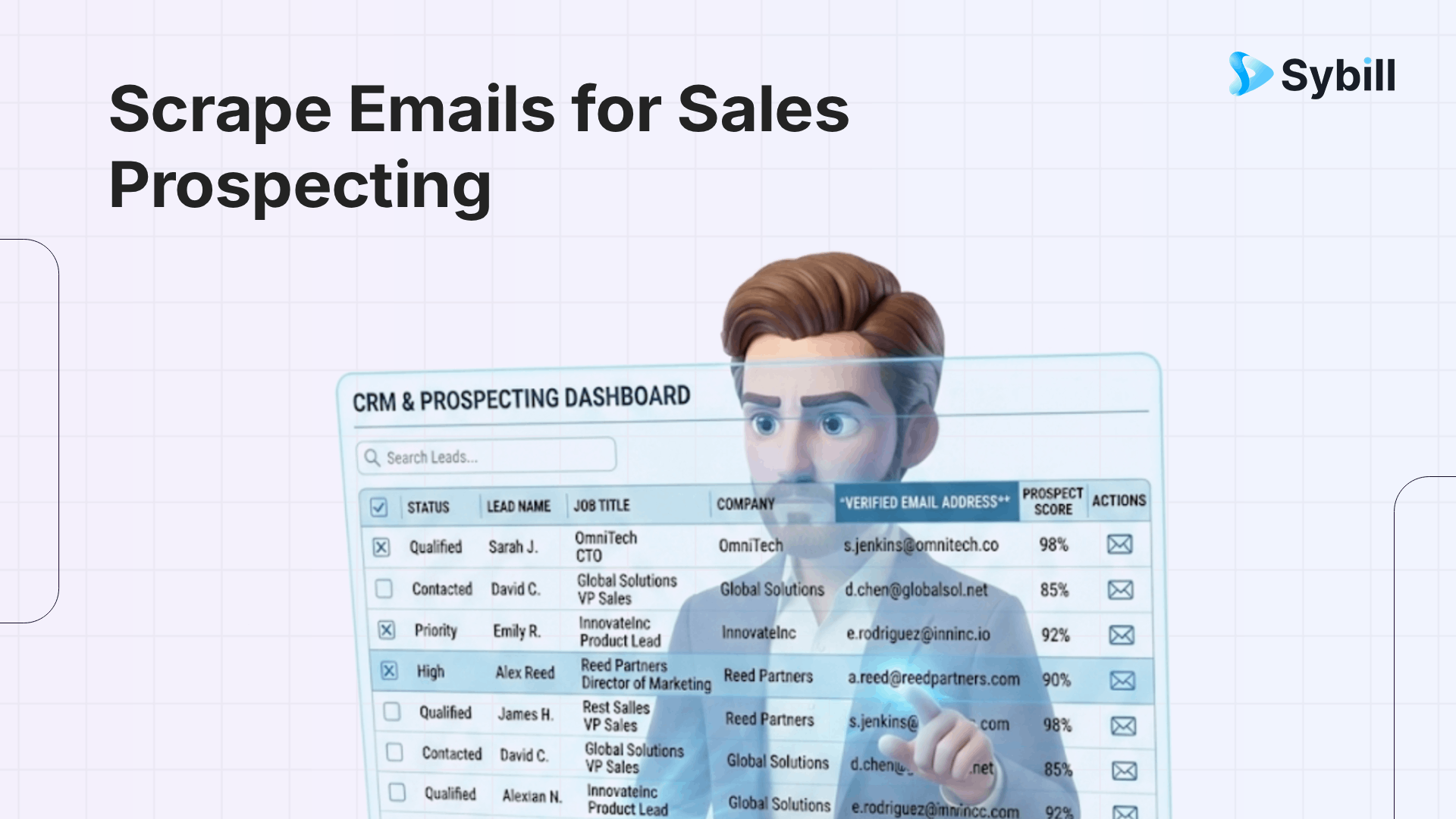
TL;DR: Email scraping is the process of extracting email addresses from publicly accessible online sources like websites, LinkedIn, and business directories. For B2B sales teams, the value is building targeted prospect lists faster than manual research allows. But scraping is only the first step. The list you build is only as useful as what you do with it: validate, enrich, personalize, and follow up. The teams that turn scraped emails into pipeline are the ones who invest as much in outreach quality as they do in data collection.
Email scraping is the automated extraction of email addresses from online sources. A scraping tool crawls web pages, identifies patterns that match email address formats (like [email protected]), and collects them into a structured list you can use for outreach.
The sources vary. Sales teams typically scrape from company websites (especially team or about pages), LinkedIn profiles, industry directories, conference speaker lists, guest post bylines, and public business databases. The goal is to find the verified professional email address of a specific person at a specific company, not to collect random addresses in bulk.
Modern email scraping tools have moved well beyond simple pattern matching. The best ones in 2026 use AI to understand page structure, detect job titles and roles, filter by seniority or department, and enrich contacts with company data, all without requiring the user to write code.
That said, email scraping is not a free-for-all. There are legal, ethical, and technical boundaries that determine whether your scraping workflow is sustainable or a liability. Understanding these boundaries before you build your first list is essential.
The short answer is that scraping publicly available email addresses is generally permissible, but what you do with those addresses is where the legal risk lives. The distinction between collecting data and using it for outreach matters significantly under data protection laws.
GDPR (European Union): If you are scraping email addresses of people based in the EU, GDPR applies. Personal data, including professional email addresses, cannot be collected or processed without a lawful basis. For B2B outreach, "legitimate interest" is often cited as the basis, but you must be able to demonstrate that the outreach is relevant to the recipient and that you are providing a way to opt out. You also need a clear data processing rationale and cannot retain the data indefinitely without a reason.
CAN-SPAM (United States): US law is more permissive on collection. You can send commercial emails without prior consent, but every message must include a functioning unsubscribe mechanism, your physical mailing address, and an accurate subject line. Violations carry penalties of over $50,000 per email, so sloppy compliance is expensive.
CASL (Canada): Canadian anti-spam law requires express consent before sending commercial emails, even in B2B contexts. There are narrow exceptions for existing business relationships, but cold outreach to scraped Canadian addresses without consent is risky.
Beyond legal compliance, there are practical boundaries. Most websites include Terms of Service that prohibit scraping. While enforcement is rare, scraping behind login walls, bypassing CAPTCHAs, or violating robots.txt directives can lead to IP blocks and, in extreme cases, legal action.
The safest approach for sales teams: scrape only from publicly accessible sources, validate every address before sending, include clear opt-out links in all outreach, and store the data securely with access controls.
The goal is not to collect the most email addresses. It is to build a targeted, verified list of contacts that match your ideal customer profile. Here is how to approach it systematically.
Before opening any scraping tool, get specific about who you are trying to reach. Which companies fit your ICP? What titles or roles are you targeting? What industry, company size, and geography matter?
The clearer your targeting criteria, the fewer junk contacts you will scrape and the less time you will spend cleaning the list afterward. If you sell to VP-level buyers at mid-market SaaS companies in North America, that specificity should drive every decision in the scraping workflow.
.png)
There are three broad approaches to email scraping, and the right one depends on your team's technical comfort and scale requirements.
B2B contact databases like Apollo, ZoomInfo, and Snov.io maintain large pre-built databases of professional contacts. You search by filters (title, company size, industry, location), and the platform returns verified email addresses. This is not traditional web scraping, but it solves the same problem and is the most accessible option for sales teams without technical resources.
Browser extensions like Kaspr, Lusha, and Hunter attach to LinkedIn or company websites and extract email addresses as you browse. These are useful for one-at-a-time prospecting or small batch scraping directly from Sales Navigator searches.
Custom scrapers and automation tools like PhantomBuster and Clay let you build multi-step workflows that scrape data from websites, enrich it with additional sources, and output cleaned lists. These require more setup but offer significantly more flexibility for teams with complex targeting needs.
This step is non-negotiable. Sending emails to invalid addresses does not just waste your time. It damages your sender reputation, increases bounce rates, and can get your domain blacklisted by email providers.
Run every scraped address through an email verification tool before adding it to any outreach sequence. Services like NeverBounce, ZeroBounce, and the built-in verification features of tools like Snov.io check whether the address exists, is active, and is not a spam trap or catch-all.
A good benchmark: your bounce rate should stay below 3%. Anything higher signals a data quality problem that needs to be fixed before you scale.
Raw email addresses are a starting point. To write personalized outreach that actually gets replies, you need context: the person's full name, title, company, company size, industry, recent news, and ideally a trigger event that makes your email timely.
Enrichment tools like Clay, Clearbit, and Apollo can append this data automatically. The more context you have, the more personal your sales emails can be. And personalization is the single biggest factor in whether a cold email gets a reply or gets archived.
Not every contact on your list deserves the same level of effort. Segment your list by factors that correlate with conversion likelihood: company size, role seniority, industry fit, and any intent signals you have access to.
High-priority segments (decision-makers at companies showing buying signals) should get personalized, one-to-one outreach. Lower-priority segments can go into automated sequences with lighter personalization. This tiered approach ensures your best prospects get your best effort while still covering a broader pipeline.
With a validated, enriched, and segmented list, you are ready to start sending. But the scraping phase ends here, and the email automation phase begins.
Most sales teams use dedicated outreach platforms like Outreach, Salesloft, Apollo, or Instantly to build multi-step sequences that combine email touches with call tasks and LinkedIn messages. The key is to match the outreach intensity to the segment quality: your best leads warrant multi-channel, multi-touch sequences, not a single spray-and-pray email.
The email scraping landscape has consolidated around a few categories. Here are the tools that matter most for sales and revenue teams.
Apollo.io is the most accessible all-in-one option. It combines a 275M+ contact database with email sequencing, phone dialing, and CRM integration. The free tier provides 10,000 credits, which is enough to test the workflow before committing. Paid plans start at $49 per user per month. Best for teams that want prospecting and outreach in one platform.
Snov.io offers a strong email finder with a 7-tier verification system, domain search, LinkedIn extension, and cold email sequencing. Plans start at $30 per month. It is well-suited for teams that need reliable data at a moderate price point.
Hunter.io is the simplest option for domain-based email search. Enter a company domain and Hunter returns all associated email addresses with confidence scores. Plans start at $34 per month. Best for quick, one-off lookups rather than large-scale scraping.
Kaspr works as a Chrome extension attached to LinkedIn. It extracts verified emails and phone numbers from profiles in real-time. Plans start at approximately $59 per month per user with unlimited B2B email credits. Best for reps who prospect directly inside LinkedIn and Sales Navigator.
Clay is the power-user option. It aggregates data from 75+ sources, supports waterfall enrichment (trying multiple providers sequentially until an email is found), and lets you build complex multi-step workflows with an AI research agent. Plans start at $149 per month. Best for growth teams and agencies running sophisticated, high-volume prospecting.
ZoomInfo is the enterprise option with the largest B2B database and the deepest intent data. Pricing is custom and generally starts in the thousands per month. Best for large revenue organizations that need comprehensive company and contact intelligence at scale.
Most content about email scraping focuses almost entirely on the extraction phase: which tool to use, how to scrape at scale, how to get around anti-bot measures. What they gloss over is that the scraping itself is the easy part. The hard part is what happens after.
A scraped list of 5,000 emails means nothing if your outreach is generic, your follow-ups are nonexistent, and your CRM has no record of any of it. The teams that turn scraped contacts into actual revenue are the ones who invest in what happens next.
That means writing personalized cold emails that reference something specific about the prospect. It means following up three to five times, not once. It means logging every interaction in your CRM so your sales manager can see what is working and what is not. It means using AI tools to draft those emails faster without losing personalization quality.
And once a cold email converts into a meeting, the email scraping workflow is completely irrelevant. What matters now is how well the rep runs the discovery call, how quickly they send a personalized follow-up, and how accurately the deal is documented in the CRM.
This is the transition point where prospecting tools hand off to deal execution tools. And it is where a tool like Sybill becomes valuable. Once that scraped lead turns into a call, Sybill captures the full conversation, generates a structured summary, drafts a personalized follow-up email based on what was discussed, and updates your CRM automatically. The scraping tool got the prospect on the phone. Sybill makes sure the deal does not stall after that first conversation.
Email scraping carries two categories of risk: legal and technical. Both are manageable with the right practices.
Legal risk comes primarily from how you use the data, not from the scraping itself. Sending unsolicited emails to scraped addresses without opt-out mechanisms, accurate sender information, or a legitimate business reason exposes you to regulatory penalties. The mitigation is straightforward: follow GDPR, CAN-SPAM, and CASL requirements. Include unsubscribe links. Use your real business identity. And if a recipient asks to be removed, do it immediately.
Technical risk comes from aggressive scraping practices that damage your IP reputation or get your domain blacklisted. Sending to unverified addresses, hitting high bounce rates, or getting flagged as spam all degrade deliverability. The mitigation: validate every email, warm up new sending domains gradually, use dedicated sending domains separate from your primary business domain, and monitor your sender reputation actively.
A less obvious risk is data decay. B2B contact data goes stale fast. People change jobs, companies merge, and email addresses stop working. A scraped list that was 95% accurate three months ago might be 80% accurate today. Build regular re-verification into your workflow, or use tools with built-in data refresh cycles.
The most common mistake in email scraping is treating it as an isolated activity. You scrape, you send, you hope. But the teams with the best conversion rates treat scraping as the first link in a chain that includes enrichment, personalization, outreach, meeting execution, and CRM documentation.
Here is what the full workflow looks like for a well-run sales team:
Scrape and enrich contacts using a database or extraction tool. Validate the list and segment by priority. Build email sequences with personalized messaging for each segment. Send outreach and track engagement (opens, clicks, replies). When a prospect responds, book the meeting. Run the discovery call and capture everything using call intelligence. Send a personalized follow-up email within an hour, referencing what was actually discussed. Update the CRM with structured deal data, automatically if possible. Tools that auto-fill CRM fields from call context eliminate the manual logging that most reps skip. Progress the deal through your pipeline with full context at every stage.
The scraping tool handles step one. A good sales email automation tool handles steps two through four. And a deal intelligence platform like Sybill handles steps six through nine, making sure that the hard-won prospect does not slip through the cracks because a rep forgot to send the follow-up or update the CRM.
Beyond legal compliance, there are practical habits that keep your scraping sustainable and your domain healthy.
Only scrape from publicly accessible sources. If you need to log in, bypass a CAPTCHA, or impersonate a user, you are crossing a line that creates both legal and reputational risk.
Skip generic addresses. Addresses like info@, sales@, careers@, and support@ almost never convert in B2B outreach. They route to shared inboxes where cold emails go to die. Focus on finding the specific person you want to reach.
Respect opt-outs immediately. When a recipient unsubscribes or asks you to stop emailing, remove them from your list and every future campaign. This is both legally required and practically smart, since continuing to email after an opt-out request is the fastest way to get reported as spam.
Store data securely. Scraped email addresses are personal data. Keep them in encrypted systems with role-based access controls. Delete addresses you no longer have a legitimate reason to retain.
Clean your lists regularly. Re-verify your scraped lists every 30 to 60 days. People change jobs, and email addresses expire. A stale list with a high bounce rate will damage your sender reputation faster than most teams realize.
Scraping publicly available email addresses is generally legal in most jurisdictions. The legal risk primarily comes from how you use the data afterward. Sending commercial emails without opt-out mechanisms violates CAN-SPAM. Using EU residents' data without a lawful basis violates GDPR. Always include unsubscribe links, use your real business identity, and comply with the data protection laws relevant to your recipients.
For most sales teams, Apollo.io offers the best balance of database size, verification, and built-in outreach tools. For teams that need deeper enrichment and custom workflows, Clay provides more flexibility. For LinkedIn-focused prospecting, Kaspr and Lusha are strong options. The best tool depends on your volume, budget, and how much of the workflow you want automated.
Accuracy varies by tool and source. Top-tier platforms like Apollo and Snov.io report verification rates between 85% and 95%. However, B2B contact data degrades over time as people change roles and companies. Always run scraped addresses through a verification service before sending, and re-verify lists regularly.
Use a dedicated sending domain separate from your primary business domain. Warm up the domain gradually before scaling volume. Keep bounce rates below 3% by verifying every address before sending. Monitor your sender reputation using tools like Google Postmaster Tools. And always include a clear unsubscribe option in every email.
Validate every address, enrich the data with names, titles, and company information, segment the list by priority, and build personalized outreach sequences. The scraping is just data collection. The real work, and the real results, come from what you do with the list.
LinkedIn's Terms of Service prohibit scraping. However, many B2B contact tools operate by matching LinkedIn profile data against their own verified databases rather than directly scraping LinkedIn pages. Tools like Apollo, Kaspr, and Snov.io offer LinkedIn extensions that find email addresses through database lookups triggered by profile views, which is a legally distinct approach from page scraping.
Scraping publicly available email addresses is generally legal in most jurisdictions. The legal risk primarily comes from how you use the data afterward. Sending commercial emails without opt-out mechanisms violates CAN-SPAM. Using EU residents' data without a lawful basis violates GDPR. Always include unsubscribe links, use your real business identity, and comply with the data protection laws relevant to your recipients.
For most sales teams, Apollo.io offers the best balance of database size, verification, and built-in outreach tools. For teams that need deeper enrichment and custom workflows, Clay provides more flexibility. For LinkedIn-focused prospecting, Kaspr and Lusha are strong options. The best tool depends on your volume, budget, and how much of the workflow you want automated.
Accuracy varies by tool and source. Top-tier platforms like Apollo and Snov.io report verification rates between 85% and 95%. However, B2B contact data degrades over time as people change roles and companies. Always run scraped addresses through a verification service before sending, and re-verify lists regularly.








