Find us at booth #83, join us for a harbor side happy hour, or catch Gorish’s talk.

Sept, 16-18 > Learn more

%20(1).avif)
Mamta Tainwala

August 13, 2026
%20(68).png)
Enterprise AI adoption in 2026 has moved from experimentation to operations: McKinsey's State of AI research puts the share of companies using AI in at least one business function above 70%. But deployment is not results, and MIT researchers reported in 2025 that roughly 95% of enterprise generative AI pilots were producing no measurable P&L return. The sales teams beating that failure rate share one playbook: start with a high-impact, low-disruption workflow (post-meeting admin and CRM capture), prove ROI in recovered selling hours and data quality, then expand into deal intelligence and coaching.
The gap between those teams and everyone else is no longer measured in percentage points. It shows up in deal cycles, rep retention, and whether the forecast is a number or a negotiation. Here is what is actually separating them.
Adoption has split into two very different realities: near-universal deployment (most enterprises now run AI in at least one function) and rare, concentrated returns (the minority who wired AI into daily workflows are compounding gains while the majority accumulate pilots). In sales specifically, the highest-ROI deployments cluster around one theme: removing the admin layer between conversations and outcomes.
The structural shift behind this is worth naming, because it explains the urgency. For years, revenue growth strategy defaulted to headcount: more pipeline needed meant more reps hired. That math broke. Hiring is slow and expensive, ramping takes quarters, and adding bodies to a broken process just scales the breakage. The strategy that replaced it is productivity: making the existing team meaningfully more effective, and AI is the first technology in a generation that credibly delivers that in sales.
The reason sales is where enterprise AI pays back fastest is embarrassingly simple: no function carries a larger gap between what people are paid to do and what they actually spend time doing. Salesforce's State of Sales research has consistently found reps spending well under a third of their time actually selling, with the rest consumed by CRM updates, note-taking, internal coordination, and hunting for context. That gap is the target, and every deployment that hits it pays back in weeks; every deployment that ignores it becomes a demo nobody opens twice.
Five failure patterns account for most of MIT's 95%: tool sprawl (many AI purchases, no workflow ownership), no fit with how reps actually work (tools that add steps instead of removing them), missing change management (rollout by Slack announcement), dirty data underneath (AI reasoning confidently on CRM fiction), and buying features instead of outcomes (impressive demos aimed at no named problem).
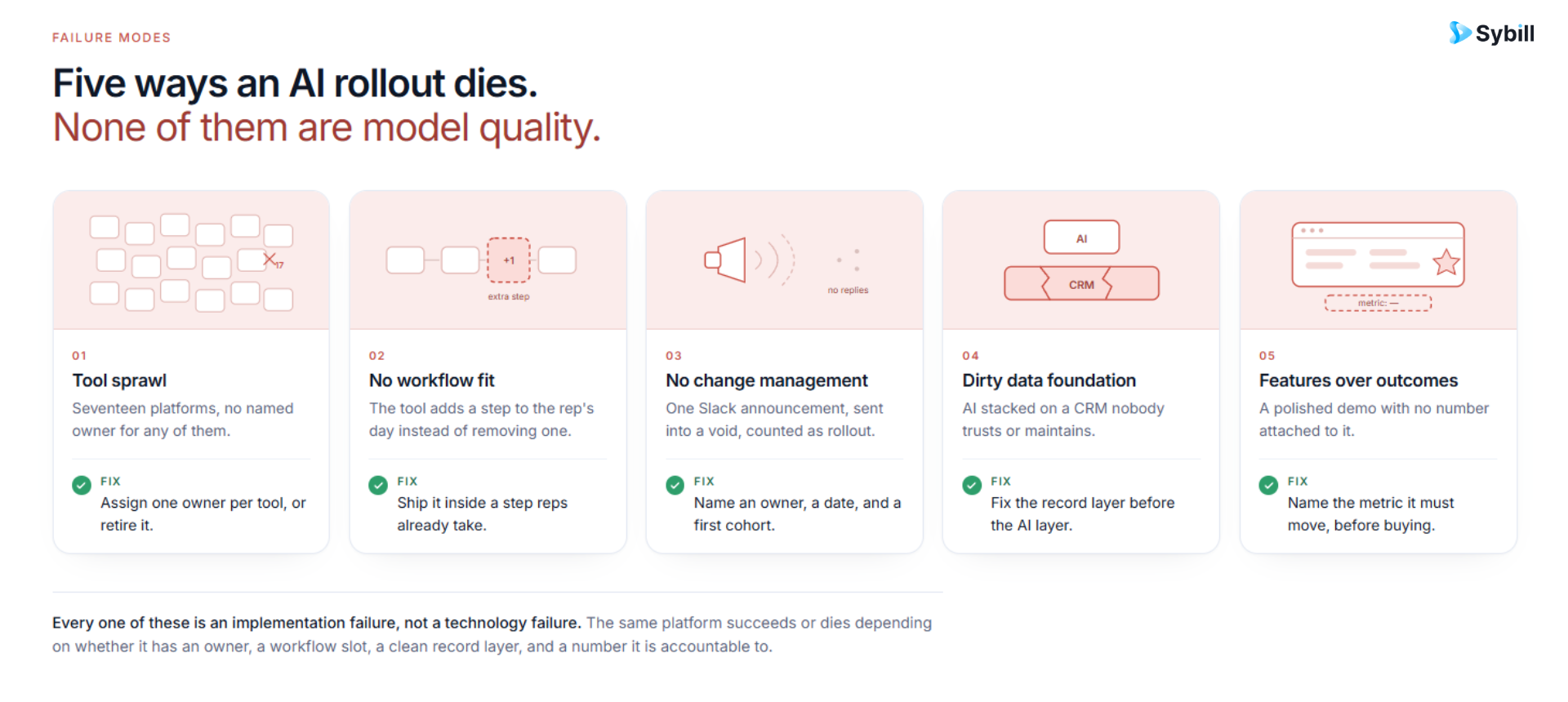
Each one deserves its fix, because they are all avoidable before the contract is signed:
Tool sprawl. Seventeen AI tools, enthusiasm through the roof, adoption near zero, because nothing connects to the actual workflow and nobody owns any of it. The fix: one tool, one problem, one team, full adoption, documented wins, then expand. Consolidation beats collection every time attention is the scarce resource.
No workflow fit. Tools that require reps to change how they work die in week three, however good the output. The tell in evaluation: does this remove steps from a rep's day, or add a destination they must remember to visit? The tools that survive are the ones that produce value from work already happening, meetings that were already booked, calls that were already taken.
No change management. A rollout announcement is not a rollout. The pattern that works: top performers first (they become the evangelists), the hated tasks first (when CRM entry and note-taking visibly vanish, adoption becomes pull rather than push), and time savings made public early.
Dirty data underneath. AI layered on a CRM full of stale stages and empty fields produces confident nonsense, and the failure gets blamed on the AI. The sequencing fix: deploy the AI that fixes data quality at the source first, so every later layer reasons on truth.
Features over outcomes. The purchase conversation that predicts failure starts with "look what it can do." The one that predicts success starts with "our reps lose two hours a day to admin, and this removes it." Name the metric before the shortlist, a discipline our AI platform selection guide turns into a full framework.
One mental model: they use AI for focus, not speed. The winning deployments do not help reps do admin faster; they remove the admin entirely and return the hours to selling. The practical test of any sales AI investment is what happens in the fifteen minutes after a call ends, because that window decides whether the deal record, the follow-up, and the next step exist.
The before-and-after that decides everything, in concrete terms:
Before: the rep finishes a discovery call, spends half an hour on notes, twenty minutes updating Salesforce, fifteen reconstructing what the prospect said about their current vendor, sends a generic follow-up, and walks into the next call having lost half the insight from the first.
After: the call ends and the work product already exists: the summary with pain points and next steps, the CRM fields filled, the follow-up drafted in the rep's own tone referencing what the buyer actually said, the commitments captured as tasks. The rep reviews, personalizes, sends, and preps the next call with an AI brief instead of an inbox excavation.
Multiply that across a team's weekly call volume and the second-order effect appears, the one ROI calculators miss: the end of the second shift. Sales admin was never just a time cost; it was the evening tax that burned out good reps and made the job worse than it needed to be. Teams that remove it report the same thing in different words: the work ends when the calls end. That shows up in retention numbers long before it shows up in a dashboard.
Enterprise AI pays back fastest in the hour after the call. Sybill turns every conversation into summaries, CRM updates, follow-ups, and deal intelligence, automatically, with no workflow change required. Get started for free with Sybill.
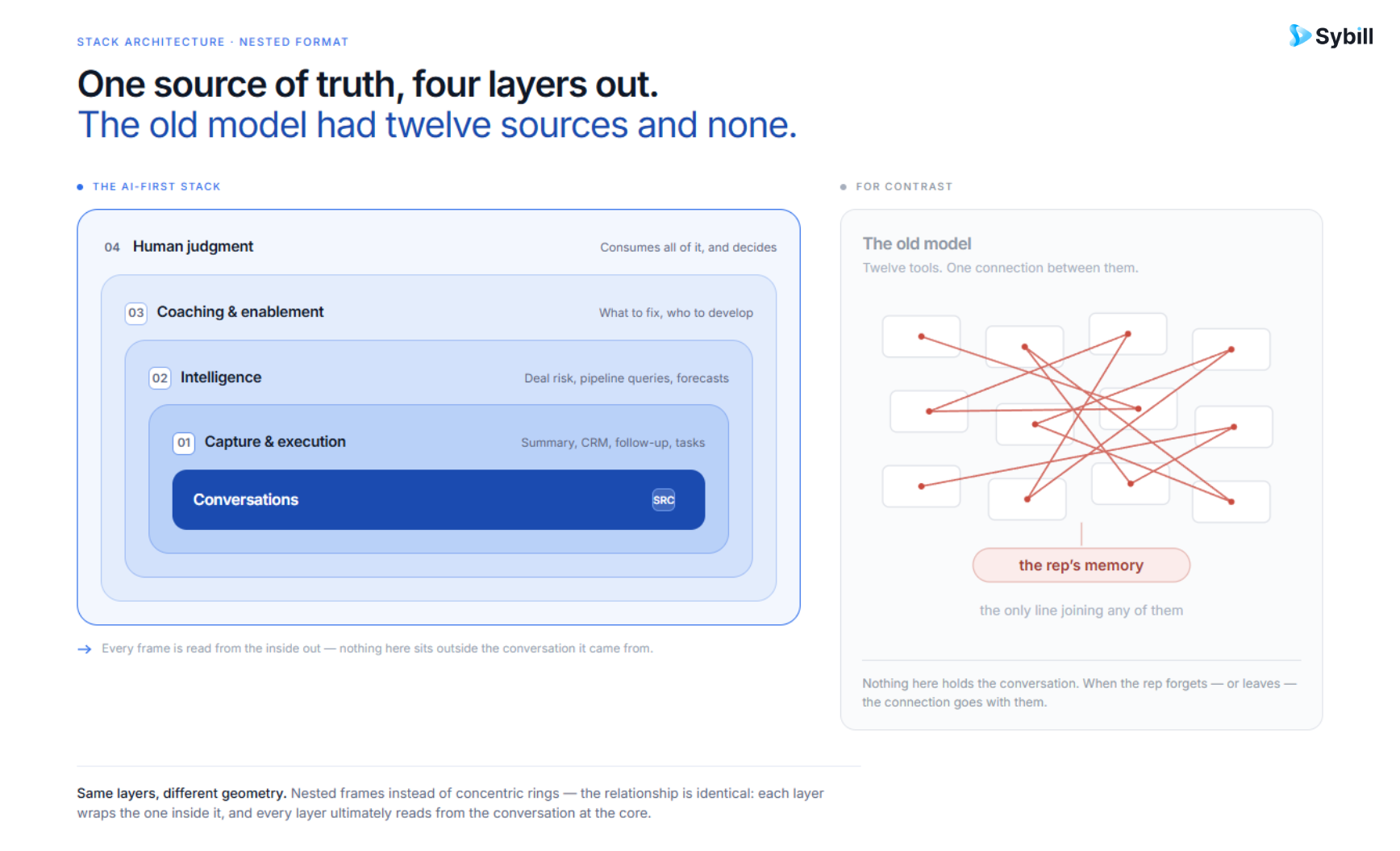
An AI-first stack puts the conversation layer at the center and lets everything else consume its output: calls and emails become the source of truth, the CRM becomes a self-maintaining record instead of a data-entry chore, and deal intelligence, coaching, and forecasting all run on evidence from what buyers actually said. The old model (a dozen disconnected tools plus rep memory as the integration layer) inverts.
The working layers, and what each one does:
Capture and execution. Every conversation becomes structured work product automatically: the summary, the record, the follow-up, the task list. This is the foundation layer because every other layer inherits its quality, and it is where conversation intelligence earns its budget. Sybill has analyzed around 33 million sales conversations, and the consistent pattern is that the details deals die over (the timeline the buyer mentioned once, the objection that never got resolved, the stakeholder who quietly stopped attending) are all in the record; the difference between teams is whether anything captures them.
Deal intelligence. With the record trustworthy, inspection becomes evidence-based: deal inspection flags risk from what actually happened (no confirmed next step, economic buyer absent, engagement dropping) rather than from a rep's stage-field optimism, and Ask Sybill makes the whole pipeline queryable in plain English. Pipeline reviews change character: from status recitation to intervention planning, which is the difference our pipeline management guide is built around.
Coaching at scale. No manager can review every call; the AI layer can, against the patterns that actually close deals. Coaching from recordings turns feedback specific and evidence-based, coaching analytics show which rep needs which conversation, and new hires ramp against a library of what good sounds like instead of trial and error.
The judgment layer stays human. Strategy, prioritization, relationship reading, the decision to walk away: none of it automates, and the honest pitch for the whole stack is that it hands humans complete, current evidence to exercise judgment on. For the wider tooling map beyond the conversation layer, our AI sales tools overview and AI agents for sales teams guide cover the terrain.
Build it on your own numbers, not vendor percentages:
(reps) × (calls per week) × (admin minutes per call) gives the recoverable hours;
hours × loaded cost gives the floor value;
then layer the harder-to-price returns (follow-up speed, data completeness, forecast trust, retention) as documented observations from the pilot. A case built this way survives finance review because every input is checkable.
The worked structure, with the assumptions explicit:
Take a 20-rep team averaging 8 customer calls a week, at a conservative 15 minutes of post-call admin each (notes, CRM, follow-up drafting). That is 40 recoverable hours per week, a full-time seller's worth of capacity, before counting meeting prep time or the weekly CRM cleanup ritual. Price those hours at your loaded rep cost, compare against tooling cost, and you have the floor of the case using no vendor's claims at all. For reference against ours: Sybill's own marketed figure is up to 14 hours per week returned per AE, and the right response to any vendor figure, including that one, is to run the pilot and measure your own.
Then the compounding lines, which the pilot should document rather than promise: median time from call to follow-up sent (same-day follow-up is a win-rate lever), field completeness on active deals, forecast variance once forecast calls run on evidence, ramp time for the next hire, and the retention effect of ending the admin second shift. None of these fit neatly in a spreadsheet cell in month one; all of them outweigh the hours math by year two.
Four phases, sequenced by risk and proof: months one to two, deploy conversation capture and CRM automation with one team and document the hours recovered; months three to four, layer deal intelligence and pipeline scoring; months five to six, turn on coaching at scale; months six to twelve, integrate the full workflow from meeting prep to forecast. Each phase funds the next with evidence.
Phase 1: Foundation. Conversation intelligence plus automatic CRM capture, one team or region, full adoption before any expansion. This phase is deliberately the least disruptive and most measurable: hours recovered and fields completed are countable within weeks, and the data-quality fix here is what makes every later phase trustworthy. Security review belongs here too, not later: SOC 2 and GDPR posture is the procurement gate that stalls enterprise rollouts when discovered late.
Phase 2: Deal intelligence. With months of clean conversation data accumulated, scoring and risk flags mean something. This is where sales leaders see strategic value beyond efficiency: forecast variance shrinking, stalls surfacing weeks earlier, pipeline reviews running on evidence.
Phase 3: Coaching at scale. The AI coaching layer analyzes every call against what wins, top performers' patterns become teachable, and ramp time drops measurably. Sequenced third on purpose: coaching recommendations built on thin data get ignored, and by now the data is thick.
Phase 4: Full integration. AI touches the whole motion, from pre-meeting briefs through follow-up automation to RevOps workflows, and the tools stop being a topic. The tell that phase four has landed: nobody talks about "the AI rollout" anymore, the same way nobody discusses the email rollout. It is just how the team works.
Strip the vendor noise away and enterprise AI adoption in 2026 reduces to one uncomfortable fact and one genuine opportunity. The fact: most companies deploying AI are getting nothing measurable from it, because they bought technology instead of fixing a workflow. The opportunity: the playbook that works is public, boring, and proven, start where the admin pain is worst, prove it in hours and data quality, expand on evidence, and the majority of your competitors are demonstrably not running it.
That combination does not last. By the time AI-first sales operations are table stakes, the compounding advantages (cleaner data, faster ramps, retained reps, trusted forecasts) will already belong to the teams that moved while everyone else was piloting.
The first phase costs a login and pays back in weeks. The admin work your reps did today was already optional.
Get started for free with Sybill or book a demo and run phase one on your own numbers.
Weeks, not quarters, if you start with the right phase. Conversation capture and automatic CRM updates produce measurable results in the first month: recovered admin hours per rep and field completeness are both countable immediately. Strategic returns like forecast accuracy and faster ramps follow over one to two quarters as the data accumulates.
MIT research in 2025 found roughly 95% of enterprise generative AI pilots producing no measurable P&L return, and the causes are organizational rather than technical: tools bought without a named problem, no fit with real workflows, rollout without change management, and AI layered on dirty data. Each failure mode is avoidable before purchase.
Post-meeting workflow automation: call capture, CRM autofill, and follow-up drafting. It requires no change to how reps sell, produces countable time savings immediately, fixes data quality at the source for every later AI layer, and targets the tasks reps most want to lose, which makes adoption pull rather than push.
Arguably more, because small teams cannot solve capacity problems with headcount. Making eight reps meaningfully more productive is the difference between hitting and missing the number, and modern sales AI prices per seat with free tiers available, so the enterprise label describes the buyer's ambition more than a minimum team size.
No, and deployments framed that way fail. AI in sales automates the record-keeping, monitoring, and drafting around conversations; the conversations themselves, the judgment about which deals to press, and the relationships remain human. The measurable effect on teams that adopt well is reps spending more time selling, not fewer reps.
Weeks, not quarters, if you start with the right phase. Conversation capture and automatic CRM updates produce measurable results in the first month: recovered admin hours per rep and field completeness are both countable immediately. Strategic returns like forecast accuracy and faster ramps follow over one to two quarters as the data accumulates.
MIT research in 2025 found roughly 95% of enterprise generative AI pilots producing no measurable P&L return, and the causes are organizational rather than technical: tools bought without a named problem, no fit with real workflows, rollout without change management, and AI layered on dirty data. Each failure mode is avoidable before purchase.
Post-meeting workflow automation: call capture, CRM autofill, and follow-up drafting. It requires no change to how reps sell, produces countable time savings immediately, fixes data quality at the source for every later AI layer, and targets the tasks reps most want to lose, which makes adoption pull rather than push.