Find us at booth #83, join us for a harbor side happy hour, or catch Gorish’s talk.

Sept, 16-18 > Learn more

%20(1).avif)
Mamta Tainwala

September 21, 2026
.png)
HubSpot Breeze is HubSpot's native AI layer, built into the customer platform rather than bolted on. It has three components: Breeze Assistant, the conversational copilot included with every edition; Breeze Agents, autonomous AI workers now organized under Agent Hub; and Breeze Intelligence, data enrichment and buyer intent. It is CRM-native AI, not conversation intelligence.
That last distinction is the one this entire review hangs on, so hold onto it. Breeze works on the data already sitting inside HubSpot, which means the quality of your call and meeting data sets the ceiling on everything Breeze produces. We will get to why that matters for sales teams specifically. First, the honest tour.
If you have been around HubSpot a while, you have watched this product change names more often than a witness in protection: ChatSpot became Copilot, Copilot became Breeze Copilot, Breeze Copilot became Breeze Assistant, and in July 2026 Breeze Agents were reorganized as Agent Hub with a new Agent Builder in public beta. Strip away the rebrands and the architecture is simple: an assistant that helps individuals, agents that run jobs in the background, and an intelligence layer that cleans the data both depend on, plus 80+ embedded AI features scattered across the platform. If you are new to the category, our explainer on what an AI agent actually is covers the fundamentals.
Breeze Assistant is the conversational AI sidebar inside HubSpot. It summarizes records, drafts emails, preps you for meetings, and can now take CRM actions like creating tasks and updating properties. It is included with every HubSpot edition, including free, and it consumes no credits. This is the piece every team should turn on today.
Credit where it is due: Assistant is genuinely good at CRM-native work. Ask it to summarize a contact, company, or deal record and it condenses months of activity into a readable brief. It knows what page you are on and adapts to your role, so a rep asking about a deal gets a different answer than an admin asking about a workflow. That sounds small until you have used AI tools that treat every user like a stranger at a bus stop.
The honest limit: Assistant is only as smart as the record it reads. If your deal record says "had a call, went well" because your rep was driving to the next meeting, Assistant will confidently summarize that nothing much happened. Garbage in, breezy garbage out. That is a data problem, not a Breeze problem, and we cover how to fix it in our guide to CRM data hygiene.
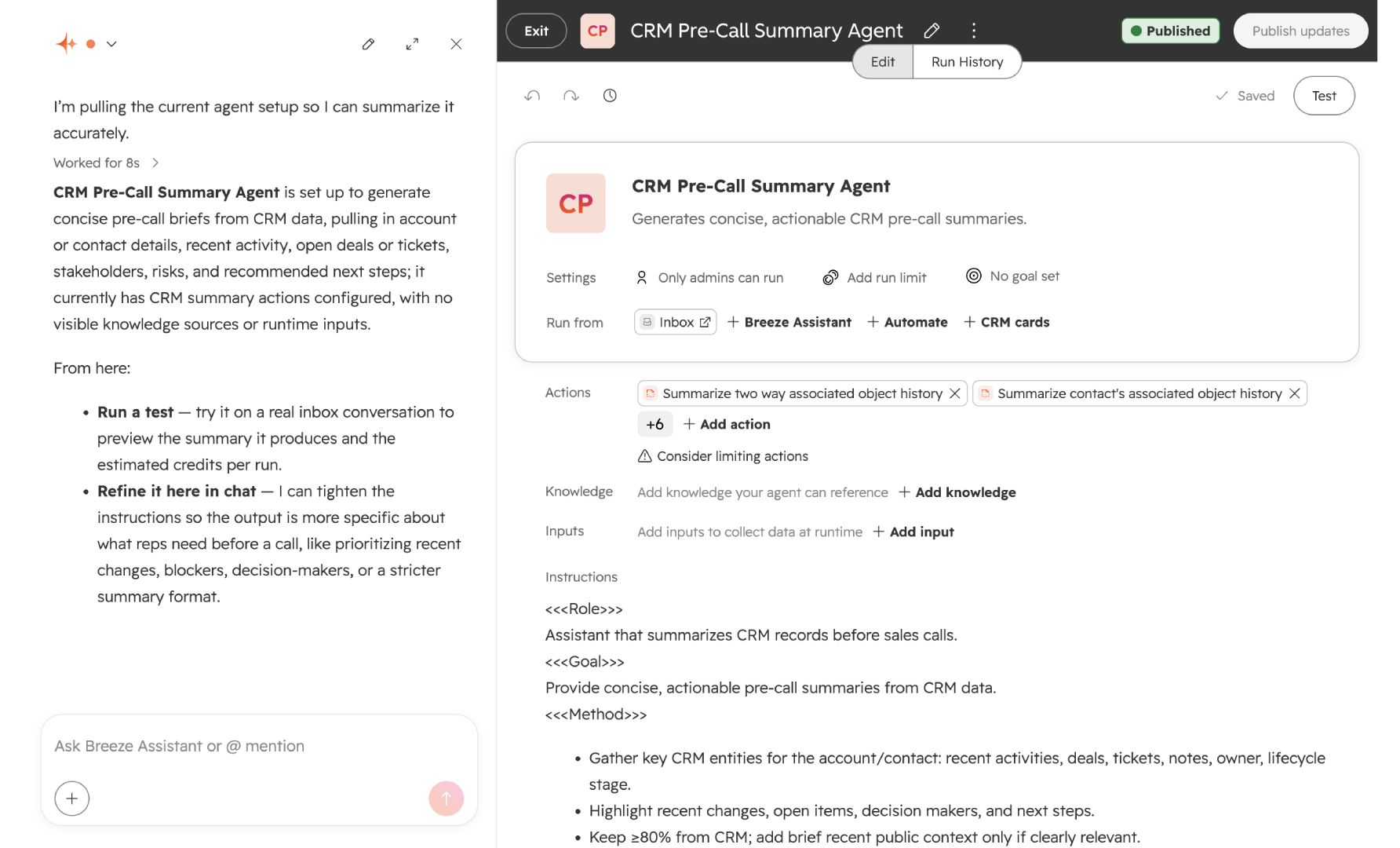
Breeze Agents are AI workers designed to complete jobs end to end: a Customer Agent for support deflection, a Prospecting Agent for outreach, a Content Agent for marketing assets, and data agents for enrichment. The Customer Agent is the standout. The Prospecting and Content Agents still need human review on most output, so "autonomous" currently comes with an asterisk.
The Customer Agent deserves its reputation. Knowledge-base-driven ticket deflection is a mature use case, the output is checkable, and the failure mode is "escalate to a human," which is exactly what you want a failure mode to be.
The Prospecting Agent is more complicated. It researches accounts, watches buying signals, and recommends leads with drafted outreach. Useful, but reviews from agencies running Breeze across client portals consistently land in the same place: autonomous outreach still needs a human eye on nearly every draft. That does not make it useless. It makes it a drafter with initiative, which is still valuable as long as you staff the review step instead of pretending you will not need it. Your team has targets, not vibes, and an unreviewed AI sequence hitting your best accounts is a target-missing machine.
Since agents write to your CRM and act on your behalf, permissioning matters too. We broke down the governance questions in AI agent security and permissions, and the broader landscape in AI agents for sales teams. For the record-keeping side specifically, see how AI agents improve HubSpot data hygiene.
Breeze Intelligence is HubSpot's data layer: enrichment drawn from a database of over 200 million company and contact profiles, buyer intent signals showing which target accounts are researching you, and form shortening that pre-fills known fields. Standard enrichment is now credit-free with paid seats, while intent features are metered.
Nobody puts data enrichment in a keynote sizzle reel, but this is quietly the highest-ROI piece of Breeze. Enriched firmographics make routing, scoring, and segmentation work. Form shortening lifts conversion because every field you remove from a form is a small mercy. Intent signals give SDRs a reason to call this account today instead of that one, which feeds directly into the workflows we covered in HubSpot sales workflow examples and the broader HubSpot automation stack.
Breeze Assistant and standard enrichment are free with HubSpot seats. Agents require a Professional or Enterprise subscription and bill in HubSpot Credits at $10 per 1,000 credits ($9 on annual terms). Since April 14, 2026, pricing is outcome-based: the Customer Agent costs 50 credits (about $0.50) per resolved conversation, and the Prospecting Agent costs 100 credits ($1) per recommended lead.
Those figures were verified against HubSpot's published rates on September 20, 2026, and they represent a genuine improvement: before April 2026, the Customer Agent billed $1.00 per conversation whether or not it resolved anything. Now a conversation the agent escalates to a human costs you nothing. Paid tiers also include monthly credit allowances, 500 on Starter, 3,000 on Professional, and 5,000 on Enterprise, so low-volume teams may pay little in overage. Credits reset monthly and do not roll over.
The strategic takeaway is not the exact rate; it is the model. Metered AI means costs scale with usage, so only turn on agents whose output you can measure. Pilot the Customer Agent and watch deflection. Cap the Prospecting Agent and watch pipeline per credit. Do not flip every toggle because it exists. For a wider look at what agent pricing models mean for budgets, see how much AI agents cost. And because HubSpot has repackaged its AI multiple times in two years, sanity-check the pricing page on the day you budget.
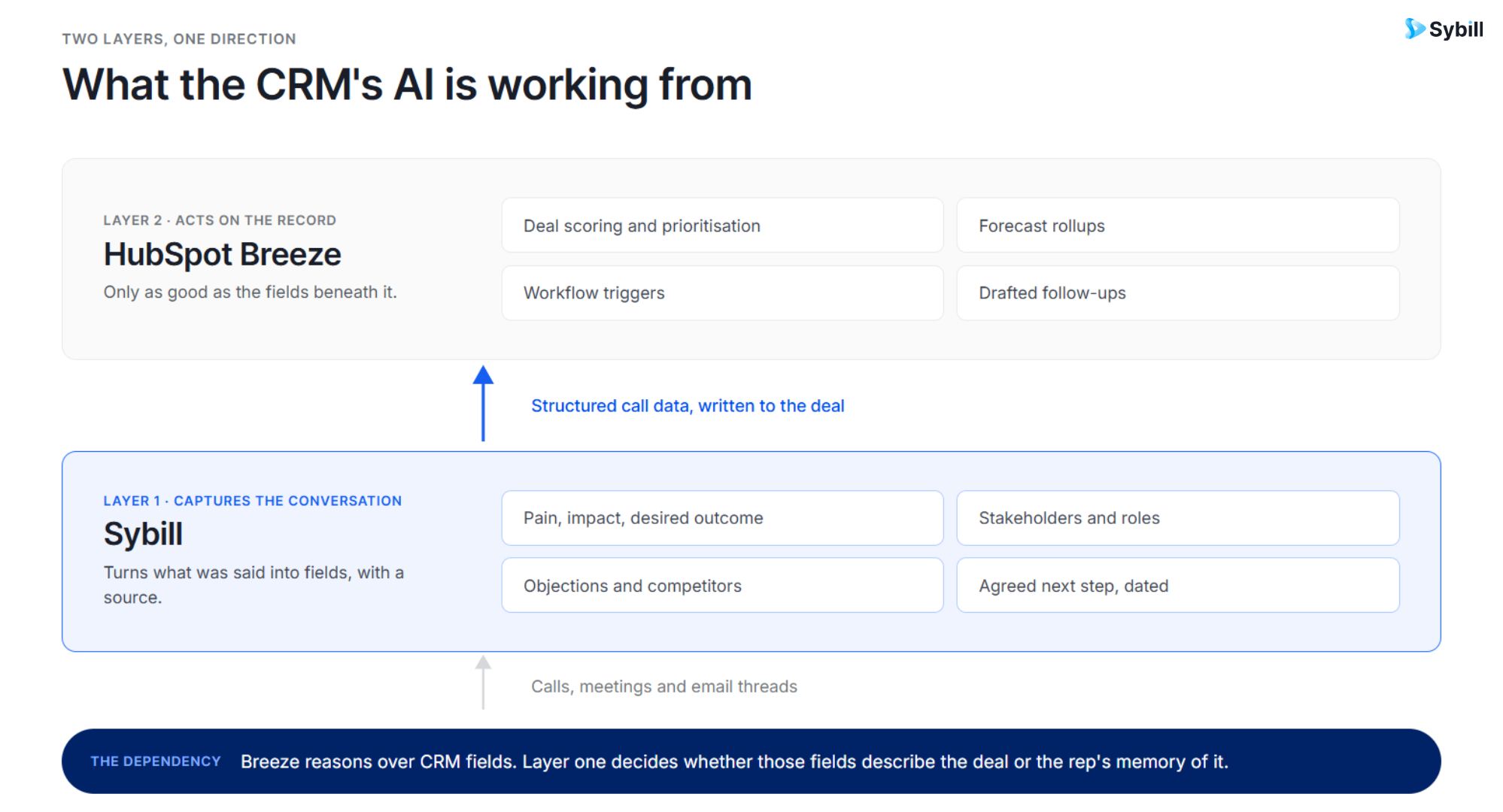
Breeze operates on the data inside HubSpot, and that is both its superpower and its boundary. The richest revenue data your company generates, the actual sales conversations, usually arrives in the CRM as thin residue: a logged activity, a two-line note, a stage someone dragged on Friday. Breeze cannot analyze what never got captured.
Think about what happens on a real discovery call. The prospect names their evaluation criteria. They mention a competitor twice, casually, the second time with an edge in their voice. The economic buyer joins late and asks exactly one question, about implementation timelines. Their energy visibly drops when pricing comes up. None of that lands in a CRM property on its own, so none of it is available to Breeze Assistant's summaries, Breeze's predictive scoring, or the forecasting features built on top.
Let us be adults for a second: this is not a flaw in Breeze, it is a category boundary. HubSpot offers native call recording and basic AI call summaries, and for light capture they are fine. But summarizing a transcript is not the same as understanding a deal, and conversation intelligence is its own discipline. Breeze was built to be the AI of your CRM. It was never built to be the intelligence layer of your conversations, and no amount of credits changes that.
Sybill is the post-conversation execution and intelligence layer that feeds Breeze better raw material. Sybill joins your sales calls, captures what buyers said and how it landed, then automatically pushes structured updates into HubSpot: summaries, custom properties, and qualification fields. Breeze then summarizes, scores, and automates on records that reflect reality instead of rep memory.
This is not guesswork. Sybill's understanding of sales conversations is built on around 33 million sales calls analyzed, per Sybill's own data, and it shows up in HubSpot as work already done: emotion-aware call summaries on the record, MEDDPICC and BANT fields filled from the actual conversation, CRM properties autofilled after every discovery call, and follow-up emails drafted in the rep's voice from what was actually discussed. The full setup takes minutes through the native Sybill HubSpot integration.
Here is why the pairing compounds: when Sybill autofills HubSpot after every call, Breeze Assistant summarizes records that contain the deal's reality. Predictive scoring scores contacts whose properties reflect what buyers said. Your deal stages move on evidence. The workflows in your email automation and inbox automation fire on fields that are populated instead of blank. CRM-native AI plus conversation-native AI is not a rivalry; it is a stack. You CAN have both, and the teams winning right now generally do.
Get started for free with Sybill and watch your next call show up in HubSpot as structured data before your rep finishes their coffee.
Yes, selectively. Turn on Breeze Assistant for everyone today: it is free and record summarization alone justifies the rollout email. Pilot the Customer Agent if you have a real knowledge base. Treat the Prospecting Agent as a supervised drafter with a credit cap. And fix your conversation-data pipeline first, because every Breeze feature runs on what your CRM contains.
By team:
Breeze is real, it is useful, and if you run revenue on HubSpot you should have the Assistant and probably the Customer Agent live by end of quarter. The boring features win, the autonomous ones need supervision, and the credits need a budget line. That is the field-tested verdict, not the keynote version.
But remember what Breeze is: a brilliant reader of your CRM. It cannot read the room on your sales calls, because it was never in the room.
Breeze makes your CRM smarter. Sybill makes your CRM true. Get started for free with Sybill, and give your smartest AI something worth reading.
Is HubSpot Breeze free? Partially. Breeze Assistant is included with every HubSpot edition, including free, and standard data enrichment is credit-free with paid seats. The agents require a Professional or Enterprise subscription and bill in HubSpot Credits per outcome, verified September 2026 at $10 per 1,000 credits.
What is the difference between Breeze Assistant and Breeze Agents? Breeze Assistant is a conversational copilot: you prompt it, it responds, and it can take CRM actions you direct. Breeze Agents (now Agent Hub) run multi-step jobs autonomously in the background, like resolving support conversations or recommending prospects, without waiting for a prompt.
Did HubSpot replace Breeze Copilot? Renamed, not replaced. ChatSpot became Copilot, then Breeze Copilot, and it is now Breeze Assistant, with added role awareness, page context, and the ability to update records. In July 2026, Breeze Agents were reorganized under Agent Hub, with Agent Builder in public beta.
How much does the Breeze Customer Agent cost? As of April 14, 2026, it is outcome-based: 50 HubSpot Credits, roughly $0.50, per resolved conversation. Conversations it escalates to a human cost nothing. Credits sell at $10 per 1,000 monthly, or $9 per 1,000 on annual terms, verified September 20, 2026.
Is Breeze a conversation intelligence tool? No. Breeze includes basic call summaries, but it is CRM-native AI that works on data inside HubSpot. Conversation intelligence platforms like Sybill analyze the full call, including buyer engagement and sentiment, and push structured insights into HubSpot where Breeze can then use them.
Does Sybill work with HubSpot Breeze? Yes, by design. Sybill's native HubSpot integration autofills properties, deal fields, and frameworks like MEDDPICC from every call. Breeze then operates on that enriched data. They occupy different layers of the stack: Breeze is the AI of your CRM, Sybill is the intelligence of your conversations.
Partially. Breeze Assistant is included with every HubSpot edition, including free, and standard data enrichment is credit-free with paid seats. The agents require a Professional or Enterprise subscription and bill in HubSpot Credits per outcome, verified September 2026 at $10 per 1,000 credits.
Breeze Assistant is a conversational copilot: you prompt it, it responds, and it can take CRM actions you direct. Breeze Agents (now Agent Hub) run multi-step jobs autonomously in the background, like resolving support conversations or recommending prospects, without waiting for a prompt.
Renamed, not replaced. ChatSpot became Copilot, then Breeze Copilot, and it is now Breeze Assistant, with added role awareness, page context, and the ability to update records. In July 2026, Breeze Agents were reorganized under Agent Hub, with Agent Builder in public beta.





.avif)